Free account: track your progress — Sign up free

NABTEB Commerce 2022 Theory Past Questions

All 8 questions from the National Business and Technical Examinations Board (NABTEB) Commerce 2022 Theory paper, with the correct answer and a full explanation for each. Free, no signup needed.

Advertisement

Commerce 2022 Theory — Question 1

In a carpentry workshop of three employees, one is responsible for cutting the wood, another for fixing and a third for polishing and spraying the furniture. (a) Identify the term that describes the production process the workshop uses. (b)(i) State five advantages of the production process identified in 1(a) to the workshop. (ii) State four disadvantages of the production process identified in 1(a) to the workshop.

Model answer

(a) The workshop uses the DIVISION OF LABOUR (specialization) production process. (b)(i) Advantages of division of labour to the workshop: - It leads to specialization, which improves the skills of the labour force. - It leads to production of a larger quantity of furniture. - It is a means of creating more jobs. - Wastage of resources/materials is minimized. - The production process becomes more speedy, as movement of labour from one function to another is minimized. (b)(ii) Disadvantages of division of labour to the workshop: - Monotonous nature of the job for the labour, as a result of repeating the same task every time. - Limited skills on the part of each labourer - a worker becomes skillful only in the line in which he specializes. - High cost of production, as more specialized labour may need to be paid more; this is worse if production is not carried out in large volume. - Total breakdown of production may occur if one section of the labour force (e.g. the person fixing) is unavailable.
Commerce 2022 Theory — Question 2

ABC Limited, a textile company, and XYZ Limited, a cotton processing company, agreed to merge. (a) Identify and explain the type of merger to be formed by the companies. (3 marks) (b) State four reasons that would have necessitated the formation of the merger. (8 marks) (c) List and explain three sources of finance available to the company formed. (12 marks)

Model answer

(a) This would form a VERTICAL INTEGRATION/MERGER. Vertical integration is a type of merger or combination of two or more firms, where a firm merges with another firm that supplies its input (i.e. companies that operate along the same chain of supply/production merge). Here, XYZ (which processes cotton, the raw material) merges with ABC (which uses cotton to produce textiles). (b) Reasons that would have necessitated the merger: - Diversification of the activities of a company. - Financial crisis on the part of one of the companies. - Improvement in the value and worth of the companies. - Tax incentives. (c) Sources of finance available to the company formed: 1. Retained earnings: this is the easiest source of finance to any business. It is part of the profit made previously that is yet to be spent; it can be used to finance the company whenever it is needed. 2. Issuance of shares: a limited liability company can issue shares to its members (for a private company) or to the general public (for a public company) to raise funds. 3. Loan: the company can apply for a loan from a financial institution to finance its activities.

Commerce 2022 Theory — Question 3

3(a). Differentiate between a trade association and a chamber of commerce. (b) State four functions of a chamber of commerce. (c) State four functions of an employers' association.

Model answer

(a) A trade association is an association of sellers of the SAME product (same line of trade), while a chamber of commerce is an association of sellers/businesses from DIFFERENT lines of products/trades within an area. (b) Functions of a chamber of commerce: - Organization of local and international trade fairs. - Promotion of trade and businesses in the country. - Removing unfair competition among businesses. - Creation and maintenance of a favourable business environment. (c) Functions of an employers' association: - Training and developing staff and members. - Obtaining data on wages to know the prevailing wage in the market. - Representation of members in front of government. - Promoting the welfare of its members.

Commerce 2022 Theory — Question 4

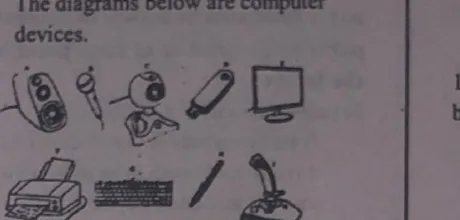
The diagrams below are computer devices. (a) Name any eight of the computer devices labeled A - I. (8 marks) (b) State one use of any six input devices named in 4(a). (12 marks)

Diagram for question 4

Model answer

(a) A - speaker; B - microphone; C - webcam; D - flash drive; E - monitor; F - printer; G - keyboard; H - joystick. (b) Uses: - Speaker - it produces sound output processed in the computer. - Microphone - it avails voice input into the computer. - Webcam - it avails image input into the computer. - Flash drive - it enables data to be saved from the computer and viewed at a later time. - Monitor - it provides image output, also known as softcopy output, from the computer. - Printer - it provides printed (hardcopy) output from the computer system. - Keyboard - it is used to input text and commands into the computer. - Joystick - it is used as an input/control device, especially for games and simulations.

Commerce 2022 Theory — Question 5

5(a). List four sources of credit available to a sole trader. (4 marks) (b) Explain the following credit instruments: (i) acceptance credit; (ii) luncheon voucher; (iii) bill of exchange. (6 marks) (c) State two advantages and three disadvantages of hire purchase to the seller. (10 marks)

Model answer

(a) Sources of credit available to a sole trader: 1. Family and friends 2. Credit purchases (trade credit) 3. Bank loan 4. Overdraft (b)(i) Acceptance credit: An acceptance credit is a type of letter of credit paid by a time draft authorizing payment on or after a specific date, once the terms of the letter of credit have been complied with. (ii) Luncheon voucher: A luncheon voucher (LV) is a paper ticket (voucher) used by some employees to pay for meals in private restaurants; it is usually issued by the employer. (iii) Bill of exchange: a bill of exchange is a written order binding one party to pay a fixed sum of money to another party on demand or at some point in the future. (c) Advantages of hire purchase (to the seller): - It enables a person who does not have ready cash to be able to use an asset and make payment by instalments. - It increases the sales of the seller. Disadvantages of hire purchase (to the seller): - It is usually more expensive than cash sales, which may discourage some buyers. - A seller can lose a huge amount if the buyer is unable to make payments when due. - If a buyer absconds with the asset, it can be a great loss for the seller.

Commerce 2022 Theory — Question 6

6(a). Explain three means of payment in international trade and two means of payment in home trade. (b) Explain five reasons countries engage in international trade.

Model answer

(a) Means of payment in international trade: - Cash in advance: the safest method for exporters, because they are securely paid before goods are shipped and ownership is transferred. - Letter of credit: a letter of credit, or documentary credit, is basically a promise by a bank to pay an exporter once all terms of the contract are executed properly. - Open account terms: a sale in which the goods are shipped and delivered before payment is due, usually in 30, 60 or 90 days. Means of payment in home trade: - Cash payment: transferring cash to the seller of the goods when or before goods are delivered. - Issuance of a cheque: writing a cheque in favour of the seller for the amount of the goods, which he will transfer to the buyer. (b) Reasons countries engage in international trade: - Comparative advantage: some countries can produce certain products at a relatively cheap price compared with others. - Difference in natural resource endowment: countries are blessed with different natural resources; international trade enables a country to get what it does not have. - Political alignment: political alignment can make countries engage in international trade. - Differences in technical know-how: differences in technological advancement encourage countries to trade to access what they lack. - Government policy: government policy can encourage or discourage international trade. - To make exchanges that save cost.

Commerce 2022 Theory — Question 7

The marketing manager of a shoe factory was in a senior management meeting to convince the board to accept his proposal of using television to advertise the company's products. (a) State four benefits the company would derive from using television to advertise its products. (8 marks) (b) List and explain four other promotional means the company could adopt. (12 marks)

Model answer

(a) Benefits of using television to advertise products: - It provides visual information about the product; a person wanting to sell shoes must display them so buyers can see what is being offered. - Television also provides voice information to prospective buyers. - Television can reach a large audience. - It can serve as a means of educating customers on how to use a product. (b) Other promotional means the company could adopt: 1. Sampling: the company can give consumers samples to taste/try and feel the improvement in the product. 2. Direct marketing: the company can approach prospective buyers directly to educate them about the product. 3. Salesperson: using sales persons to meet a wide range of buyers is another means of promoting a product. 4. Public relations: by creating good public relations and interacting with the general public, a company can easily promote its product.

Commerce 2022 Theory — Question 8

The data below relate to J.K. Limited as at December 31, 2021: Inventory - 1st January 2021; Inventory - 31st December 2021; Purchases; Operating expenses; Discount received; Other current assets; Current liabilities. Calculate: (i) Gross profit; (ii) Net profit; (iii) Gross profit margin; (iv) Net profit margin; (v) Working capital; (vi) Rate of inventory turnover. (20 marks) [Related] Question 8: The following information was extracted from the books of Lompat Ventures as at December 31, 2022: Trading Profit and Loss Account (Opening stock N37,500; Purchases N30,000; Cost of goods sold N67,500; Closing stock N15,000; Sales N70,000; Wages and salaries N2,500; Rent and rates N3,500; Transportation N2,600; Net profit N8,900). Also given: Stock N15,000; Debtors N100,000; Cash at bank N25,000; Creditors N50,000; Bank overdraft N60,000. Calculate: (i) Net profit; (ii) Working capital; (iii) Rate of stock turnover.

Model answer

[Note: the source material indicates some of the J.K. Limited figures were not fully legible/complete in the scanned original, so a general method is set out below and applied fully to the companion Lompat Ventures data, which was complete.] General formulas: (i) Gross profit = Sales - Cost of sales, where Cost of sales = Opening stock + Purchases - Closing stock (ii) Net profit = Gross profit - Operating expenses (+ other income such as discount received) (iii) Gross profit margin (%) = (Gross profit / Sales) x 100 (iv) Net profit margin (%) = (Net profit / Sales) x 100 (v) Working capital = Current assets - Current liabilities (vi) Rate of inventory/stock turnover = Cost of goods sold / Average stock, where Average stock = (Opening stock + Closing stock)/2 Worked example (Lompat Ventures, year ended 31 December 2022): Trading Account: Opening stock 37,500 + Purchases 30,000 = 67,500 available; less Closing stock 15,000 = Cost of goods sold 52,500; Sales 70,000; Gross profit = 70,000 - 52,500 = 17,500. Less expenses: Wages and salaries 2,500; Rent and rates 3,500; Transportation 2,600 = Total expenses 8,600. (i) Net profit = Gross profit 17,500 - Expenses 8,600 = N8,900. (ii) Working capital = Current assets - Current liabilities. Current assets: Stock 15,000 + Debtors 100,000 + Cash at bank... (per the data provided). Current liabilities: Creditors + Bank overdraft (per the data provided). Working capital = Current assets total - Current liabilities total (compute using the specific figures supplied in the question). (iii) Rate of stock turnover = Cost of goods sold / Average stock = 67,500 / ((37,500+15,000)/2) = 67,500/26,250 = 2.5714 times (approximately 2 to 3 times).

Advertisement

Sign up free to unlock

  • Score tracking
  • Practice history
  • Saved questions
  • Progress dashboard
  • Personalized sessions
  • Weak-topic breakdown

…and/or go further with premium services and No Ads.