All 18 questions from the National Examinations Council (NECO) Economics 2013 Theory paper, with the correct answer and a full explanation for each. Free, no signup needed.
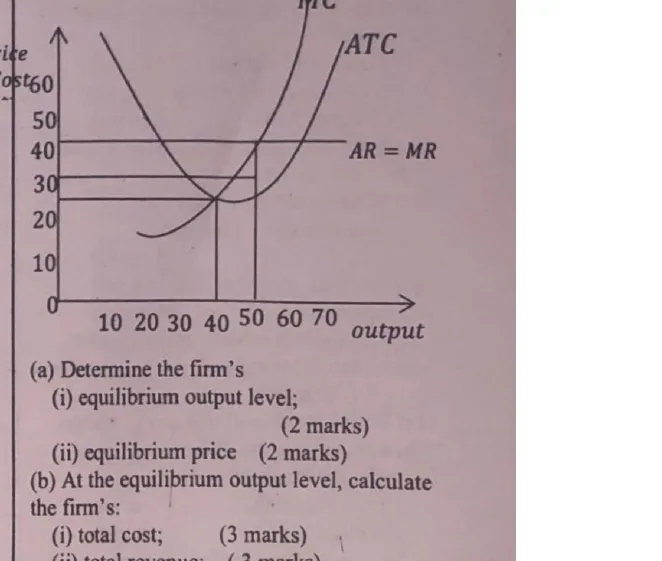
Essay Question 1. The equilibrium position of a firm is illustrated in the diagram (MC, ATC and AR=MR curves). Study the diagram and answer:
(a) Determine the firm's (i) equilibrium output level; (ii) equilibrium price.
(b) At the equilibrium output level, calculate the firm's (i) total cost; (ii) total revenue; (iii) total profit.
(c) Is the firm operating in the long-run or short-run? Explain your answer.
(d) (i) What type of market is the firm operating in? (ii) List three features of the market type identified.
Model answer
(a)(i) Equilibrium output level is where MC = MR (touches the AR=MR line): 50 units.
(ii) Equilibrium price is the same as Average Revenue (AR): $40.
(b)(i) Total cost = AC x output = $30 x 50 = $150.
(ii) Total revenue = AR (Price) x output = $40 x 50 = $200.
(iii) Total profit = TR - TC = $200 - $150 = $50.
(c) The firm is operating in the short-run because it is making abnormal profit, which is only possible in the short-run; in the long-run, perfect competitors make only normal profit as new firms enter the industry and compete away abnormal profit.
(d)(i) The firm is a perfect competitor operating in a perfectly competitive market, since its AR = MR (a horizontal demand curve).
(ii) Features of a perfect market: there are many buyers and sellers; homogeneous/identical goods are sold; goods are portable; there is no cost of transportation; there is adequate market information; there is no preferential treatment; the market is regulated by the forces of demand and supply.
Essay Question 2. Table I shows the output levels of a firm producing hand sanitizer: Output (units): 0, 10, 18, 28, 36, 45/48. The cost function of the firm is given as C = 30 + 4q, where C is the total cost and q is the units produced.
(a) Calculate the total cost in dollars of producing (i) 18 units (ii) 36 units.
(b) Calculate the average cost in dollars of producing (i) 28 units (ii) 45 units.
(c) What is the marginal cost in dollars of producing 28 units?
(d) Determine the profit made from producing 45 units when the market price is fixed at $5.00 per unit.
(e) Determine the fixed cost of the firm. Explain your answer.
Model answer
(a)(i) TC at 18 units = 30 + 4(18) = 30 + 72 = $102.
(ii) TC at 36 units = 30 + 4(36) = 30 + 144 = $174.
(b)(i) Average cost (ATC) at 28 units: TC = 30 + 4(28) = 30 + 112 = $142; ATC = TC/Q = 142/28 = $5.07.
(ii) At 45 units: TC = 30 + 4(45) = 30 + 180 = $210; ATC = 210/45 = $4.67.
(c) Marginal Cost (MC) = change in total cost / change in output. TC of 28 units = $142; TC of 18 units = $102. MC = (142-102)/(28-18) = 40/10 = $4.
(d) Profit = TR - TC. At 45 units, TR = Price x Quantity = $5 x 45 = $225. TC at 45 units = $210. Profit = 225 - 210 = $15.
(e) Fixed Cost (FC) is the cost of production that does not change with output, even at zero output. From C = 30 + 4q, at q = 0, C = 30 + 4(0) = $30. Therefore the fixed cost of the firm is $30 (the variable cost, 4q, varies directly with output, while FC of $30 remains constant across all levels).
Essay Question 3(a). Distinguish between (i) money cost and opportunity cost (ii) normal good and inferior good.
Model answer
(i) Money Cost is the amount of money incurred or spent in the purchase of a commodity; this is what an accountant knows as cost. Opportunity Cost is the sacrificed or foregone alternative - the value of the next best alternative given up; it is what an economist knows as cost.
(ii) A Normal good is a type of good whose demand rises as the income of the consumer increases, and vice versa. An Inferior good is a type of good whose demand rises as the income of the consumer falls, and vice versa (higher income leads to lower quantity demanded).
Essay Question 3(b). Explain how the scale of preference assists the following economic groups in making efficient allocation of their resources: (i) individuals (ii) firms (iii) governments.
Model answer
(i) Individuals: the scale of preference assists individuals or consumers by allowing them to rank their wants in order of importance and allocate their limited (scarce) resources to the best alternative uses, enabling them to satisfy their most important wants first.
(ii) Firms: the scale of preference helps firms determine which goods and services to produce first, based on consumer demand, ensuring they produce goods that are mostly demanded and maximise their profit.
(iii) Governments: the scale of preference enables government to allocate resources to the most important needs or areas, such as healthcare, education and infrastructure, in order to maximise or promote the welfare of members of society.
Essay Question 3(c). State three features of land as a factor of production.
Model answer
(i) Land is a fixed factor of production.
(ii) Land is immobile.
(iii) Land is fixed and limited in supply.
(iv) Its reward is rent.
(v) It is subject to the law of diminishing returns.
An economic system is a set of institutions, laws and customs that determine how economic decisions are made, how goods and services are produced and distributed, and how resources are allocated in a society. It is a system by which economic problems or goals are solved or attained.
Essay Question 4(b). Distinguish between a capitalist economy and a socialist economy under the following: (i) aim of production (ii) consumer sovereignty (iii) competition
Model answer
(i) Aim of production: a capitalist economy is primarily aimed at maximising profit, while a socialist economy is primarily aimed at promoting the welfare of members of the public through equitable allocation of resources or wealth/income.
(ii) Consumer sovereignty: under capitalism, consumers are regarded as "Kings", i.e. they determine what producers will produce. Under socialism this is absent, as government determines what goods and services are produced based on the needs of society.
(iii) Competition: capitalism encourages a high level of competition, promoting innovation, efficiency and consumer choice. Socialism does not encourage competition, promoting instead cooperation and collective ownership of the means of production.
Essay Question 5(a). What is a sole proprietorship? Distinguish it from a partnership.
Model answer
A sole proprietorship is a type of business organization owned, financed and managed by one individual for the purpose of making profit. It is also known as one-man business, individual proprietorship, or sole trading. It is the simplest form of business structure and requires no formal legal process to set up.
A partnership, however, is a business organization where two or more individuals come together to carry on a business with the intention of sharing profits and losses. In a partnership, more capital is available through the admission of new partners, giving greater possibility of expansion, unlike a sole proprietorship, which is limited to one owner's capital and skills.
Essay Question 5(b). List four features of a sole proprietorship.
Model answer
(i) It is owned, financed and managed by one individual.
(ii) There is unlimited liability.
(iii) It is not a legal entity separate from the owner.
(iv) There is no continuity or perpetual existence.
(v) There is an absence of conflict in management.
(vi) It requires small capital and is easy to set up.
Essay Question 5(c). Outline four advantages of a public limited liability company.
Model answer
(i) Limited Liability: shareholders do not suffer more loss than the amount of their capital contribution in the business.
(ii) Perpetual existence (continuity): the company continues to exist even if a shareholder changes or sells their shares.
(iii) Access to large capital: the company can raise large capital by selling shares to the public through the stock exchange, making it easier to obtain funds for expansion or investment.
(iv) Shares are easily transferred: a shareholder can transfer their capital at will if dissatisfied with the company; this also leads to invention/innovation, application of division of labour and specialization, and separation between business and management, allowing efficient management.
Essay Question 6(a). What is meant by location of industry?
Model answer
Location of industry is the siting or establishment of an industry in a particular area or place. An industry is a group or collection of different firms producing similar products or providing similar services. An industry may be established either by individuals or government for economic, political, social or geographical reasons.
Essay Question 6(b). Explain how the following factors influence where a firm is sited: (i) raw materials (ii) market (iii) government policy
Model answer
(i) Raw materials: a firm may choose to locate near sources of raw materials to reduce transportation costs and gain a competitive advantage in terms of cost of production, since it is economical to locate close to the raw material source.
(ii) Market: a firm may choose to locate its site near its target market (buyers) to reduce transportation costs of taking goods to market and gain a competitive advantage in delivery time; locating close to consumers reduces cost and ensures faster delivery.
(iii) Government Policy: government policies such as subsidies, tax incentives and regulations can influence the location decisions of firms, to achieve even development across regions; areas favoured by government policies attract more investors.
Essay Question 6(c). Outline three advantages of localization of industry.
Model answer
(i) Creation of Employment Opportunities: concentrating many industries in a particular area creates employment opportunities in that area.
(ii) Provision of Social amenities: an area with many concentrated industries will attract social amenities from government or organizations.
(iii) Attraction of more people to the area, as a result of job availability, increasing the number of consumers of the products of firms in that area (also leads to invention and innovation, healthy competition and research, and inter-dependence of firms deriving mutual benefits from concentration in the area).
Gross Domestic Product (GDP) is the total monetary value of all goods and services produced within the territory or border of a country, irrespective of the origins of the producers, in a particular year. It is also known as Aggregate Expenditure (AE): GDP = C + I + G, where C = Consumption, I = Investment, G = Government expenditure.
Essay Question 7(b). Describe the output approach as a method of computing national income.
Model answer
The output approach takes into consideration the total monetary value of all final goods and services produced in a country in a particular year. It is based on the value-added approach: value-added is the value of output less the cost of inputs. Using this approach, intermediate goods are excluded to avoid the problem of double counting - only finished/final goods are taken into consideration.
Essay Question 7(c). Identify any three problems associated with the expenditure approach of calculating national income.
Model answer
(i) Problem of double counting: intermediate expenditures are most often included, leading to double-counting and overestimation of the national income figure.
(ii) Inadequate statistical data: due to a large informal sector, e.g. self-employed people and subsistence production, accurate data is hard to obtain.
(iii) Difficulty in measuring value of imports and exports: many payments do not pass through official channels and are therefore difficult to estimate. (Other acceptable problems: difficulty measuring capital depreciation, and price fluctuations, which make valuation of goods and services difficult.)
An embargo is a government-imposed restriction or ban on the importation or exportation of certain goods or services to or from a particular country. It is a trade barrier typically implemented for political or economic reasons; it is also known as a ban or prohibition.
Essay Question 8(b). Outline any three reasons for imposing tariffs on imports.
Model answer
(i) Protection of Infant industries: tariffs can support the growth of emerging ("infant") industries by shielding them from foreign competition during their early stages, giving them a chance to develop and gain competitiveness.
(ii) Revenue Generation: tariffs are a major source of revenue; import duties on imported goods generate income that can fund public services and infrastructure projects, or reduce budget deficits.
(iii) Correction of Trade Imbalance: countries may impose tariffs to control unfavourable conditions in the balance of trade and payment, discouraging imports and encouraging exports, correcting trade imbalance. (Other acceptable reasons: promotion of national security, and promotion of domestic industries by making imported goods more expensive.)
Advertisement
Sign up free to unlock
Score tracking
Practice history
Saved questions
Progress dashboard
Personalized sessions
Weak-topic breakdown
…and/or go further with premium services and No Ads.