NECO Economics 2022 Theory — Question 2
Question 2 of 8 from the National Examinations Council (NECO) Economics 2022 Theory paper, with the correct answer and a full explanation.
Advertisement
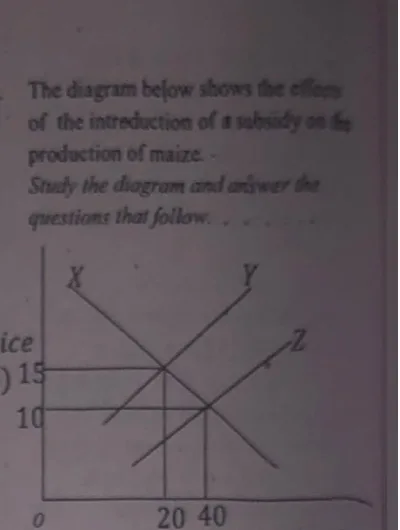
The diagram below shows the effects of the introduction of a subsidy on the production of maize. Study the diagram and answer the questions that follow. (Curves X, Y and Z shown; Price axis shows $15 and $10; Quantity axis shows 20 and 40 bags.) (a)(i) Identify the curves labeled X, Y and Z. (3 marks) (ii) State the direction of change in price and quantity with the introduction of subsidy. (2 marks) (b) Calculate the total revenue of the producers: (i) before the introduction of subsidy; (ii) after the introduction of subsidy. (2+2 marks) (c) Calculate the percentage increase or decrease in the total revenue of the producers with the introduction of subsidy. (2 marks) (d) If the quantity demanded of maize increases from 20 to 40 bags as a result of a fall in price from $15 to $10, calculate the price elasticity of demand. (7 marks) (e) State the type of elasticity of demand in 2(d). (2 marks)
Model answer
(a)(i) Curve X is the Demand Curve; Curve Y is the (original) Supply Curve; Curve Z is the new Supply Curve (after the subsidy). (a)(ii) A subsidy is a payment made to producers of some essential goods by the government to encourage production and improve the standard of living of consumers. A subsidy shifts the supply curve to the right, causing a reduction (fall) in price and an increase in the quantity demanded/supplied. (b)(i) Total revenue before subsidy = Price x Quantity = $15 x 20 = $300.00 (b)(ii) Total revenue after subsidy = Price x Quantity = $10 x 40 = $400.00 (c) Percentage change in total revenue = (New - Old)/Old x 100 = (400-300)/300 x 100 = 100/300 x 100 = 33.3% increase. (d) Price Elasticity of Demand (PED) = (%change in Qd) / (%change in Price) %change in Qd = (New Q - Old Q)/Old Q x 100 = (40-20)/20 x 100 = 100% %change in Price = (New P - Old P)/Old P x 100 = (10-15)/15 x 100 = -33.3% (we ignore the negative sign for PED) PED = 100% / 33.3% = 3.0 (e) Since PED (3.0) is greater than one (unity), demand in 2(d) is PRICE ELASTIC.
Advertisement
Sign up free to unlock
- Score tracking
- Practice history
- Saved questions
- Progress dashboard
- Personalized sessions
- Weak-topic breakdown
…and/or go further with premium services and No Ads.