Free account: track your progress — Sign up free

NECO Economics 2023 Objective Past Questions

All 50 questions from the National Examinations Council (NECO) Economics 2023 Objective paper, with the correct answer and a full explanation for each. Free, no signup needed.

Advertisement

Economics 2023 Objective — Question 1

The study of economics is mainly concerned with how to A. rank individuals' wants given the abundant resources B. make choice when resources are inadequate C. satisfy over member of all societies D. produce all the goods needed by everyone

  • A. rank individuals' wants given the abundant resources
  • B. make choice when resources are inadequateCorrect
  • C. satisfy over member of all societies
  • D. produce all the goods needed by everyone

Explanation

Economics is primarily concerned with how to allocate limited available resources to satisfy people's unlimited wants, i.e. making a choice when resources are inadequate/scarce.

Economics 2023 Objective — Question 2

Warehousing is an economic activity that falls under A. tertiary production B. intermediate production C. secondary production D. primary production

  • A. tertiary productionCorrect
  • B. intermediate production
  • C. secondary production
  • D. primary production

Explanation

Warehousing is a tertiary production (service) activity, along with other services such as banking, communication, advertising, transportation, insurance and tourism.

Economics 2023 Objective — Question 3

Which of the following items is not classified as working capital? A. Equipment B. Fuel C. Money to pay wages D. Semi-finished goods

  • A. EquipmentCorrect
  • B. Fuel
  • C. Money to pay wages
  • D. Semi-finished goods

Explanation

Working capital (circulating capital) is used for day-to-day productive activities, e.g. fuel, wages, raw materials. Equipment is fixed capital, not working capital.

Economics 2023 Objective — Question 4

An economic system is mainly concerned with A. handling situations of abundant resource B. studying the relationship between ends and means C. the establishment of economic laws D. the allocation of scarce resources between alternative ends

  • A. handling situations of abundant resource
  • B. studying the relationship between ends and means
  • C. the establishment of economic laws
  • D. the allocation of scarce resources between alternative endsCorrect

Explanation

An economic system is the mechanism by which limited (scarce) available resources are allocated among alternative ends in the course of production, distribution and consumption.

Economics 2023 Objective — Question 5

The marks obtained by 9 students in a class test are recorded below: 9, 8, 7, 5, 7, 6, 8, 9 and 7. What is the median mark? A. 7 B. 7.5 C. 8 D. 8.5

Diagram for question 5
  • A. 7Correct
  • B. 7.5
  • C. 8
  • D. 8.5

Explanation

Rearranged in ascending order: 5, 6, 7, 7, 7, 8, 8, 9, 9. With 9 values, the median is the 5th value, which is 7.

Economics 2023 Objective — Question 6

The demand for a factor input as a result of the demand for its output is known as A. complementary demand B. competitive demand C. derived demand D. market demand

Diagram for question 6
  • A. complementary demand
  • B. competitive demand
  • C. derived demandCorrect
  • D. market demand

Explanation

The demand for factor inputs (land, labour, capital) is a derived demand - it exists only because of the demand for the output/commodity the input helps to produce.

Economics 2023 Objective — Question 7

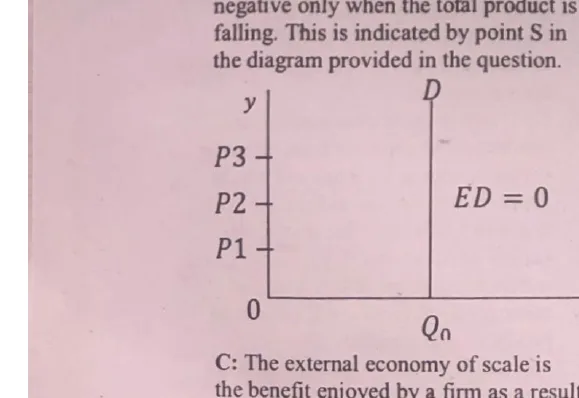
If the demand for a commodity remains constant as price increases, the commodity is said to be A. price elastic B. unit price elastic C. price inelastic D. perfectly price inelastic

  • A. price elastic
  • B. unit price elastic
  • C. price inelastic
  • D. perfectly price inelasticCorrect

Explanation

Demand is perfectly (completely) inelastic when quantity demanded stays constant regardless of price changes; elasticity equals zero, shown as a vertical demand curve (as in the diagram, ED = 0).

Economics 2023 Objective — Question 8

When more of the tax on a product is borne by the buyer than the seller, the commodity involved has A. elastic demand B. fairly inelastic demand C. perfectly elastic demand D. perfectly inelastic demand

  • A. elastic demand
  • B. fairly inelastic demandCorrect
  • C. perfectly elastic demand
  • D. perfectly inelastic demand

Explanation

When demand is fairly inelastic, buyers bear more of a tax than sellers, because quantity demanded falls only slightly as price rises, so the price increase is largely passed on to consumers.

Economics 2023 Objective — Question 9

A fall in the price of a normal commodity which has elastic demand will result in A. a fall in quantity demanded B. an increase in revenue C. a fall in demand D. a decrease in revenue

Diagram for question 9
  • A. a fall in quantity demanded
  • B. an increase in revenueCorrect
  • C. a fall in demand
  • D. a decrease in revenue

Explanation

For a commodity with elastic demand, a fall in price causes a proportionately larger rise in quantity demanded, so total revenue increases.

Economics 2023 Objective — Question 10

The supply of light could be met using a candle, lantern and gas lamp. This is an example of A. complementary supply B. joint supply C. composite supply D. abnormal supply

  • A. complementary supply
  • B. joint supply
  • C. composite supplyCorrect
  • D. abnormal supply

Explanation

Composite supply exists when a need (light) can be competitively met from two or more different sources (candle, lantern, gas lamp) for a similar use. Note: the official WAEC key marked this item as having no correct answer among the options given.

Economics 2023 Objective — Question 11

Petrol and kerosene are jointly obtained from crude oil. If the supply of petrol increases, the A. supply of kerosene will fall B. cost of crude oil production has increased C. supply of kerosene will rise D. supply of kerosene will remain unchanged

Diagram for question 11
  • A. supply of kerosene will fall
  • B. cost of crude oil production has increased
  • C. supply of kerosene will riseCorrect
  • D. supply of kerosene will remain unchanged

Explanation

Petrol and kerosene are in joint supply from crude oil, so refining more crude oil to increase petrol supply also increases the supply of kerosene.

Economics 2023 Objective — Question 12

If the government stops subsidy on cocoa production, the supply curve of cocoa will A. shift to the right B. become vertical C. shift to the left D. remain unchanged

  • A. shift to the right
  • B. become vertical
  • C. shift to the leftCorrect
  • D. remain unchanged

Explanation

Removing a subsidy raises production costs, reducing supply at every price level, which shifts the supply curve to the left.

Economics 2023 Objective — Question 13

When the marginal utility from the consumption of commodity X (MUx) is greater than the price of commodity X (Px), a rational consumer should A. Consume more of commodity X B. reduce consumption of commodity X C. consume the same quantity of commodity X D. strive to remain in disequilibrium

Diagram for question 13
  • A. Consume more of commodity XCorrect
  • B. reduce consumption of commodity X
  • C. consume the same quantity of commodity X
  • D. strive to remain in disequilibrium

Explanation

A rational consumer keeps consuming more of a good as long as marginal utility exceeds price, continuing until MU = P (utility maximisation).

Economics 2023 Objective — Question 14

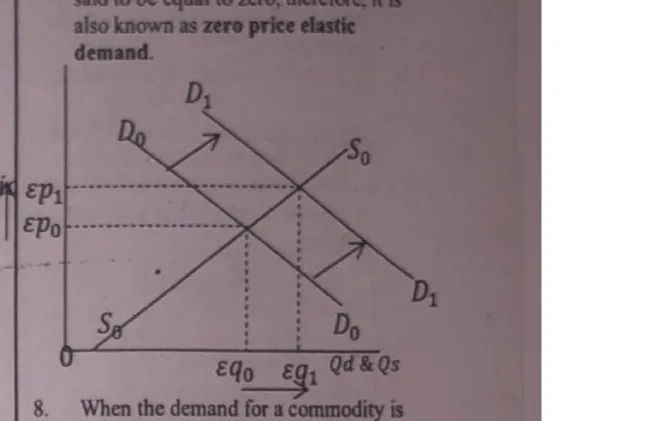
When the demand for a commodity increases while supply remains unchanged, the equilibrium price and quantity will A. remain constant B. decrease C. increase D. turn negative

  • A. remain constant
  • B. decrease
  • C. increaseCorrect
  • D. turn negative

Explanation

An increase in demand with supply unchanged creates excess demand at the old price, pushing equilibrium price and quantity upward.

Economics 2023 Objective — Question 15

The fixing of maximum prices by government is mainly on A. inferior goods B. luxury goods C. imported capital goods D. selected essential goods

  • A. inferior goods
  • B. luxury goods
  • C. imported capital goods
  • D. selected essential goodsCorrect

Explanation

Maximum price (price ceiling) legislation is used by governments to protect consumers, and is typically applied to selected essential commodities to keep them affordable.

Economics 2023 Objective — Question 16

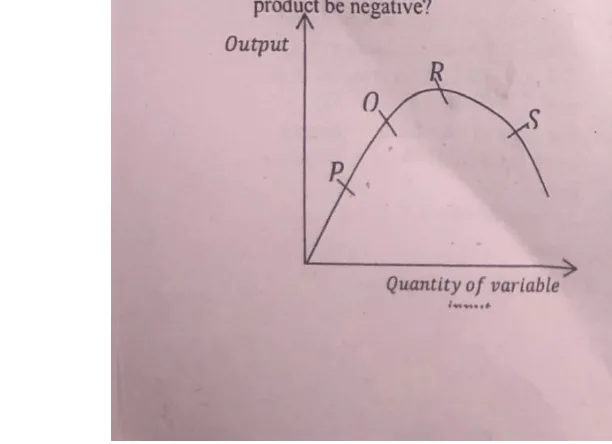
At what point on the total product curve shown below will marginal product be negative?

Diagram for question 16
  • A. P
  • B. Q
  • C. R
  • D. SCorrect

Explanation

Marginal product becomes negative only once total product starts falling after its maximum, which is indicated by point S on the curve.

Economics 2023 Objective — Question 17

A small scale firm located within an industrial estate will enjoy A. government protection and funding B. technological economics of scale C. external economics of scale D. Financial economics of scale

  • A. government protection and funding
  • B. technological economics of scale
  • C. external economics of scaleCorrect
  • D. Financial economics of scale

Explanation

External economies of scale are benefits a firm enjoys from being located near other firms in the same industry/locality, such as in an industrial estate.

Economics 2023 Objective — Question 18

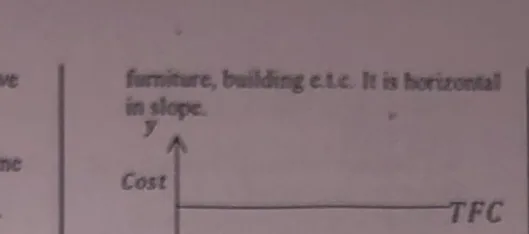
The total fixed cost curve is A. vertical B. Horizontal C. downward sloping D. upward sloping

  • A. vertical
  • B. HorizontalCorrect
  • C. downward sloping
  • D. upward sloping

Explanation

Total Fixed Cost does not change with the level of output, so it is represented by a horizontal line on a cost-output graph.

Economics 2023 Objective — Question 19

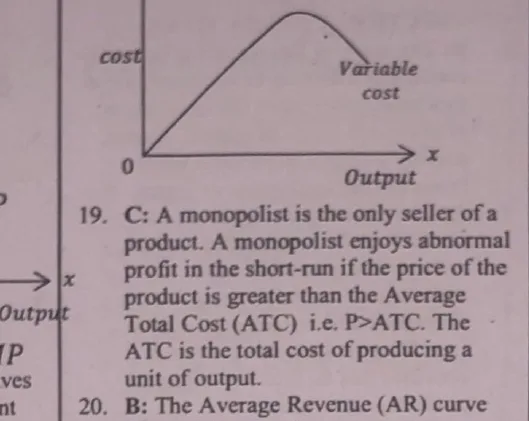
If a firm retrenches some of its factory workers, its A. fixed cost is likely to increase B. Marginal cost may increase C. average fixed cost may increase D. Variable cost will decline

  • A. fixed cost is likely to increase
  • B. Marginal cost may increase
  • C. average fixed cost may increase
  • D. Variable cost will declineCorrect

Explanation

Wages paid to workers are a variable cost; retrenching workers (reducing labour used) will reduce this variable cost, which changes with the level of output/employment.

Economics 2023 Objective — Question 20

A monopolist may enjoy abnormal profit only if its A. marginal cost exceeds marginal revenue B. demand curve is perfect elastic C. price exceeds average total cost D. expenditure on advertisement increases

  • A. marginal cost exceeds marginal revenue
  • B. demand curve is perfect elastic
  • C. price exceeds average total costCorrect
  • D. expenditure on advertisement increases

Explanation

A monopolist earns abnormal (supernormal) profit in the short run when price exceeds average total cost (P > ATC).

Economics 2023 Objective — Question 21

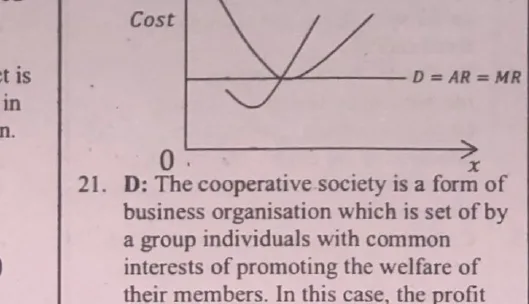
The average revenue curve of a firm in a perfect market is the same as the A. supply curve of the firm B. demand curve of the firm C. total revenue curve of the firm D. average cost curve of the firm

Diagram for question 21
  • A. supply curve of the firm
  • B. demand curve of the firmCorrect
  • C. total revenue curve of the firm
  • D. average cost curve of the firm

Explanation

In a perfectly competitive market, a firm is a price taker with a perfectly elastic demand curve, which coincides with its average revenue (and marginal revenue) curve, i.e. D = AR = MR.

Economics 2023 Objective — Question 22

Resources are pooled for the mutual benefit of its members mainly in a A. joint stock company B. partnership C. private company D. cooperative Society

  • A. joint stock company
  • B. partnership
  • C. private company
  • D. cooperative SocietyCorrect

Explanation

A cooperative society is a business organisation set up by a group of individuals with common interests who pool resources for their mutual benefit, sharing profit based on patronage.

Economics 2023 Objective — Question 23

A joint stock company enjoys perpetual existence because A. it is formed by a minimum of seven Members B. its shares are easily transferable C. it's a corporate entity D. there is a higher degree of specialization

  • A. it is formed by a minimum of seven Members
  • B. its shares are easily transferable
  • C. it's a corporate entityCorrect
  • D. there is a higher degree of specialization

Explanation

A joint stock company is a corporate (legal) entity separate from its owners, so it enjoys continuity/perpetual existence even when shareholders or management change.

Economics 2023 Objective — Question 24

Consumers have access to a variety of the activities of the A. advertising agencies B. wholesalers C. retail D. mass media

  • A. advertising agencies
  • B. wholesalers
  • C. retailCorrect
  • D. mass media

Explanation

Retailers are closest to consumers in the distribution chain, making a variety of goods available to them conveniently in small quantities purchased from wholesalers.

Economics 2023 Objective — Question 25

The rate of growth of population is A. the difference between birth rate and death rate B. birth rate less death rate plus net migration C. initial population plus net number of births D. number of immigrants plus number of births

  • A. the difference between birth rate and death rate
  • B. birth rate less death rate plus net migrationCorrect
  • C. initial population plus net number of births
  • D. number of immigrants plus number of births

Explanation

Population growth rate is the natural growth rate (birth rate minus death rate) plus net migration (immigrants minus emigrants).

Economics 2023 Objective — Question 26

The Malthusian theory of population is best illustrated when A. both population and food supply increase at the same rate B. population increases much faster than food supply C. the size of the population and available resources are equal D. food supply increases much faster than population growth

  • A. both population and food supply increase at the same rate
  • B. population increases much faster than food supplyCorrect
  • C. the size of the population and available resources are equal
  • D. food supply increases much faster than population growth

Explanation

The Malthusian theory holds that population grows in geometric progression while food production grows in arithmetic progression, so population increases much faster than food supply.

Economics 2023 Objective — Question 27

The dependency ratio of a country is the A. total active population who depend on government for survival B. number of children who depend on their parents for survival C. children and aged who rely on the active population for support D. people who are cared for by their extended families

  • A. total active population who depend on government for survival
  • B. number of children who depend on their parents for survival
  • C. children and aged who rely on the active population for supportCorrect
  • D. people who are cared for by their extended families

Explanation

The dependency ratio is the ratio of the dependent population (children, students and the elderly) to the independent (active working) population that supports them.

Economics 2023 Objective — Question 28

When job vacancies are publicized, the government is mainly trying to solve the problem of A. residual unemployment B. frictional unemployment C. technological unemployment D. cyclical unemployment

  • A. residual unemployment
  • B. frictional unemploymentCorrect
  • C. technological unemployment
  • D. cyclical unemployment

Explanation

Frictional unemployment occurs due to a lack of information about available jobs; publicising vacancies helps reduce this by informing job seekers of opportunities.

Economics 2023 Objective — Question 29

Many workers are employed in the agricultural sector of developing countries because A. they practice mechanized system of farm B. labour intensive method is mostly adopted C. wages in the sector is high D. abnormal profits are made

  • A. they practice mechanized system of farm
  • B. labour intensive method is mostly adoptedCorrect
  • C. wages in the sector is high
  • D. abnormal profits are made

Explanation

Developing countries mostly adopt labour-intensive farming methods (using more labour than machinery) due to their large population and underdeveloped economies.

Economics 2023 Objective — Question 30

Industries are sometimes located in areas which are not profitable so as to A. encourage rural-urban migration B. enjoy internal economies of scale C. reap internal economies of scale D. bring about even development

  • A. encourage rural-urban migration
  • B. enjoy internal economies of scale
  • C. reap internal economies of scale
  • D. bring about even developmentCorrect

Explanation

Industries are sometimes deliberately sited in less profitable areas to promote even (balanced) development across regions of a country.

Economics 2023 Objective — Question 31

One factor that may not promote industrial development is A. granting old firms tax exemptions B. local firms entering into partnership with foreign firms C. setting up industrial estates with modern amenities D. granting capital to firms at reasonable interest rates

  • A. granting old firms tax exemptionsCorrect
  • B. local firms entering into partnership with foreign firms
  • C. setting up industrial estates with modern amenities
  • D. granting capital to firms at reasonable interest rates

Explanation

Options B, C and D actively support industrialisation; granting old, already established firms tax exemptions does not particularly promote new industrial development.

Economics 2023 Objective — Question 32

National income is calculated mainly to A. determine how income is to be shared B. help firms generate more funds C. determine the level of sectoral performance D. determine aid to be received from other nations

  • A. determine how income is to be shared
  • B. help firms generate more funds
  • C. determine the level of sectoral performanceCorrect
  • D. determine aid to be received from other nations

Explanation

National income is calculated to determine the contribution or level of sectoral performance to the economy of a country, among other reasons.

Economics 2023 Objective — Question 33

To overcome the problem of double counting under the expenditure approach, A. value added method is used B. only spending on final goods are considered C. proper accounting standards must be used D. spending on intermediate goods and inputs are considered

  • A. value added method is used
  • B. only spending on final goods are consideredCorrect
  • C. proper accounting standards must be used
  • D. spending on intermediate goods and inputs are considered

Explanation

The expenditure approach avoids double counting by considering only the total monetary value of final goods and services, excluding spending on intermediate goods and inputs.

Economics 2023 Objective — Question 34

The Net National Product (NNP) of a country is $50m while the depreciation allowance is $10m. The Gross National Product (GNP) is A. $30m B. $40m C. $60m D. $500m

  • A. $30m
  • B. $40m
  • C. $60mCorrect
  • D. $500m

Explanation

NNP = GNP - Depreciation, so GNP = NNP + Depreciation = $50m + $10m = $60m.

Economics 2023 Objective — Question 35

The price level and the value of money are A. inversely related B. directly related C. not related D. positively related

  • A. inversely relatedCorrect
  • B. directly related
  • C. not related
  • D. positively related

Explanation

The value of money is the purchasing power of money; the higher the price level, the lower the value of money, so they are inversely related.

Economics 2023 Objective — Question 36

Money is able to function more as a medium of exchange when A. more people engage in subsistence production B. there is a fall in production C. there is specialization of labour D. individuals and nations are self-sufficient

  • A. more people engage in subsistence production
  • B. there is a fall in production
  • C. there is specialization of labourCorrect
  • D. individuals and nations are self-sufficient

Explanation

Money enhances and is enhanced by specialisation and division of labour in production, since specialised producers need a medium of exchange to trade their surplus output.

Economics 2023 Objective — Question 37

An indication that there is inflation in a country is that A. the demand for goods and services increases B. there are too many goods in circulation C. the same amount of money buys a lower quantity of goods D. people prefer to lend than to borrow

  • A. the demand for goods and services increases
  • B. there are too many goods in circulation
  • C. the same amount of money buys a lower quantity of goodsCorrect
  • D. people prefer to lend than to borrow

Explanation

Inflation is a persistent increase in the general price level, which reduces the value/worth of money, so the same amount of money buys fewer goods than before.

Economics 2023 Objective — Question 38

The most liquid asset among the following is A. shares B. bonds C. cash D. cheque

  • A. shares
  • B. bonds
  • C. cashCorrect
  • D. cheque

Explanation

Cash is already in liquid form and can be used immediately, unlike shares, bonds or cheques which must first be converted to cash or cleared.

Economics 2023 Objective — Question 39

Commercial banks help in economic development mainly by A. acting as intermediaries between lenders and borrowers B. giving financial advice to the government C. acting as trustees and executors of wills D. serving as custodians of valuables

  • A. acting as intermediaries between lenders and borrowersCorrect
  • B. giving financial advice to the government
  • C. acting as trustees and executors of wills
  • D. serving as custodians of valuables

Explanation

Commercial banks mainly promote economic development by acting as an intermediary between lenders (savers) and borrowers, channelling funds into productive use.

Economics 2023 Objective — Question 40

Taxes levied on goods and services by governments are called A. direct taxes B. corporate taxes C. indirect taxes D. poll taxes

  • A. direct taxes
  • B. corporate taxes
  • C. indirect taxesCorrect
  • D. poll taxes

Explanation

Indirect taxes (e.g. sales tax, purchase tax, excise duty, VAT) are levied on goods and services, unlike direct taxes which are levied on income, profit or property.

Economics 2023 Objective — Question 41

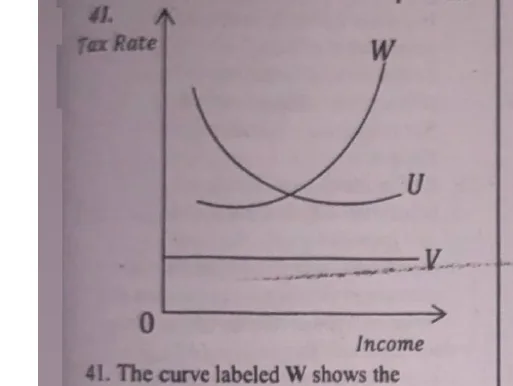
Use the diagram below to answer this question. The curve labeled W shows the A. proportional tax B. progressive tax C. specific tax D. regressive tax

  • A. proportional tax
  • B. progressive taxCorrect
  • C. specific tax
  • D. regressive tax

Explanation

A progressive tax system is one where the tax rate rises as income rises, matching curve W which slopes upward as income increases.

Economics 2023 Objective — Question 42

An example of government's recurrent expenditure is A. the cost of building a school B. paying salaries of workers C. purchase of new vehicles D. electrification projects in rural areas

  • A. the cost of building a school
  • B. paying salaries of workersCorrect
  • C. purchase of new vehicles
  • D. electrification projects in rural areas

Explanation

Recurrent expenditure is government spending incurred every year, such as wages and salaries; the other options are capital/development expenditure.

Economics 2023 Objective — Question 43

A country is described as developing if A. the population is decreasing B. there is low labour supply C. the contribution of tertiary sector to national income is high D. the income per head is low

  • A. the population is decreasing
  • B. there is low labour supply
  • C. the contribution of tertiary sector to national income is high
  • D. the income per head is lowCorrect

Explanation

Developing countries typically have low per capita income, among other characteristics such as high unemployment, low standard of living and high population growth.

Economics 2023 Objective — Question 44

Tariffs, quotas and embargoes are examples of A. Foreign exchange policies B. trade restriction policies C. fiscal policies D. monetary policies

  • A. Foreign exchange policies
  • B. trade restriction policiesCorrect
  • C. fiscal policies
  • D. monetary policies

Explanation

Tariffs, quotas and embargoes are examples of protectionist/trade restriction policies used to control the movement of goods and passengers between countries.

Economics 2023 Objective — Question 45

Trade protection will assist economic growth in developing countries if it can A. eliminate importation of all commodities B. generate enough revenue through export duties C. effectively safeguard newly established firms D. allow the importation of cheaper goods people want

  • A. eliminate importation of all commodities
  • B. generate enough revenue through export duties
  • C. effectively safeguard newly established firmsCorrect
  • D. allow the importation of cheaper goods people want

Explanation

Protectionist measures such as tariffs can help developing economies by safeguarding newly established (infant) firms from foreign competition while they grow.

Economics 2023 Objective — Question 46

A government may cause a favourable change in her invisible trade account by A. increasing the export of her primary products B. imposing high tariff on exports C. developing tourism and other services D. encouraging people to go for medical treatment abroad

  • A. increasing the export of her primary products
  • B. imposing high tariff on exports
  • C. developing tourism and other servicesCorrect
  • D. encouraging people to go for medical treatment abroad

Explanation

Invisible trade covers services such as tourism, aviation, shipping and insurance. Developing tourism and other services improves a country's invisible trade account.

Economics 2023 Objective — Question 47

Country M enjoys absolute advantage over country N in the production of commodities X and Y, if country M A. can produce only commodity Y cheaper than country N B. is more efficient than country N in producing both commodities X and Y C. is inefficient in the production of both commodities X and Y D. and country N are efficient in the production of both goods

  • A. can produce only commodity Y cheaper than country N
  • B. is more efficient than country N in producing both commodities X and YCorrect
  • C. is inefficient in the production of both commodities X and Y
  • D. and country N are efficient in the production of both goods

Explanation

Absolute advantage means a country can produce a good using fewer resources (more efficiently) than another country; here, country M is more efficient than N in producing both X and Y.

Economics 2023 Objective — Question 48

Which of the following is not a problem facing the Economic Community of West African States (ECOWAS)? A. Language barriers B. Production of the same commodities C. Poor transportation and communication D. Inadequate supply of labour

  • A. Language barriers
  • B. Production of the same commodities
  • C. Poor transportation and communication
  • D. Inadequate supply of labourCorrect

Explanation

Language barriers, production of similar commodities, and poor transportation/communication are recognised problems facing ECOWAS; inadequate labour supply is not.

Economics 2023 Objective — Question 49

Assisting members to solve temporary balance of payments problems is the reason for the establishment of the A. World Bank B. International Monetary Fund C. African Development Bank D. Economic Commission for Africa

  • A. World Bank
  • B. International Monetary FundCorrect
  • C. African Development Bank
  • D. Economic Commission for Africa

Explanation

The International Monetary Fund (IMF) was established in 1944 primarily to assist member countries in resolving temporary balance of payments difficulties.
Economics 2023 Objective — Question 50

Which of the following is a non-renewable natural resource? A. Cocoa B. Oil palm C. Coal D. Rubber

  • A. Cocoa
  • B. Oil palm
  • C. CoalCorrect
  • D. Rubber

Explanation

Coal is a non-renewable resource, unlike cocoa, oil palm and rubber, which are agricultural products that can be replenished/renewed.

Advertisement

Sign up free to unlock

  • Score tracking
  • Practice history
  • Saved questions
  • Progress dashboard
  • Personalized sessions
  • Weak-topic breakdown

…and/or go further with premium services and No Ads.