Mathematics 2023 Objective — Question 1
What is the square of 30?
- A. 60
- B. 90
- C. 270
- D. 810
- E. 900Correct
Explanation
30 × 30 = 900.
All 120 questions from the Basic Education Certificate Examination (Junior WAEC) (BECE) Mathematics 2023 Objective paper, with the correct answer and a full explanation for each. Free, no signup needed.
Advertisement
What is the square of 30?
30 × 30 = 900.
Find the square root of 75/300.
75/300 = 1/4. √(1/4) = 1/2.
Express 61782 in standard form.
Move the decimal point 4 places left: 61782 = 6.1782 × 10⁴.
Express 0.0030752 to three significant figures.
First three significant figures are 3, 0, 7; the next digit 5 rounds up, so 0.00308.
Simplify 7/13 ÷ 3/4.
7/13 × 4/3 = 28/39.
Simplify 2/3 + 1/5.
LCM = 15: 10/15 + 3/15 = 13/15.
Express 108 as a product of its prime factors.
108 = 4 × 27 = 2² × 3³.
Convert 9 1/7 to improper fraction.
(9 × 7 + 1)/7 = 64/7.
Divide 100 by the positive difference between 65 and 75.
Difference = 75 − 65 = 10. 100 ÷ 10 = 10.
Express 46₈ as denary.
4 × 8 + 6 = 38.
If 30% of a number is 900, find the number.
Number = 900 ÷ 0.30 = 3,000.
Simplify 2 2/5 × 1 1/4.
12/5 × 5/4 = 3.
Express 0.24 in the form p/q in its lowest terms.
0.24 = 24/100 = 6/25.
Find the H.C.F of 224 and 168.
224 = 2⁵ × 7 and 168 = 2³ × 3 × 7. HCF = 2³ × 7 = 56.
Determine the L.C.M of 12, 24 and 36.
12 = 2² × 3, 24 = 2³ × 3, 36 = 2² × 3². LCM = 2³ × 3² = 72.
Subtract 1101₂ from 11011₂.
11011₂ = 27 and 1101₂ = 13. 27 − 13 = 14 = 1110₂.
Find the product of 10₂ and 11₂.
10₂ = 2 and 11₂ = 3. 2 × 3 = 6 = 110₂.
Find the reciprocal of 0.65, correct to three significant figures.
1 ÷ 0.65 = 1.5385 = 1.54 (3 s.f.).
If 6 men can do a job in 4 days, how many days will it take 8 men to do the same job if they work at the same rate?
6 × 4 = 24 man-days. 24 ÷ 8 = 3 days.
The ratio of boys to girls in a mixed school is 4:5. If there are 375 girls in the school, how many are boys?
Boys = 4/5 × 375 = 300.
At what rate per annum will ₦1,600 give ₦400.00 as simple interest in 2 years?
R = (100 × I)/(P × T) = (100 × 400)/(1600 × 2) = 12.5%.
A trader borrows ₦200,000 at a compound interest of 3% per annum. How much does he pay back after 2 years?
A = 200,000 × (1.03)² = 200,000 × 1.0609 = ₦212,180.
If 6 packets of cream cost ₦450.00, find the cost of 3 packets.
3 packets = half of 6 packets = 450 ÷ 2 = ₦225.
Find the amount of energy in units used by a customer, if his present and previous meter readings are 85,402 units and 74,012 units respectively.
85,402 − 74,012 = 11,390 units.
Find the value of y in the figure below.
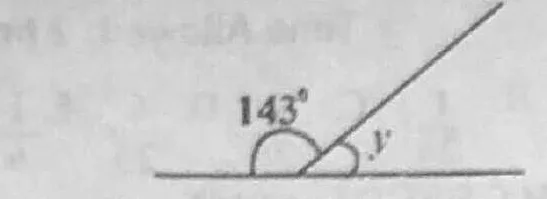
y and 143° lie on a straight line, so y = 180° − 143° = 37°.
The area of a rhombus is 48cm². If one of its diagonals is 8cm, find the length of the other.
Area = ½ × d₁ × d₂. 48 = ½ × 8 × d₂, so d₂ = 12cm.
How many edges does a cube have?
A cube has 12 edges.
How many vertices does a rectangular pyramid have?
4 base vertices + 1 apex = 5.
Which of the following gives the volume of a cylinder of height h and base radius r?
Volume of a cylinder = base area × height = πr²h.
If the bearing of A from B is 240°, find the bearing of B and A.
Bearing of B from A = 240° − 180° = 060°.
What is the three-figure bearing of S45°W?
S45°W = 180° + 45° = 225°.
Which of the following angles can be bisected to get angle 22.5°?
22.5° × 2 = 45°.
If one side of a square is 0.5m, find the perimeter of the square.
Perimeter = 4 × 0.5 = 2m.
Find the volume of a cuboid whose length, breadth and height are 4cm, 5cm and 6cm respectively.
V = 4 × 5 × 6 = 120cm³.
Find the value of z in the figure below.
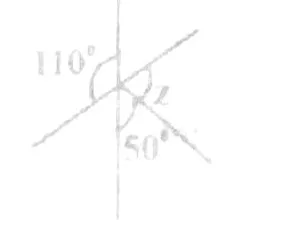
The angle opposite 110° equals 110°, which is 50° + z. So z = 110° − 50° = 60°.
Calculate the value of y in the figure below.
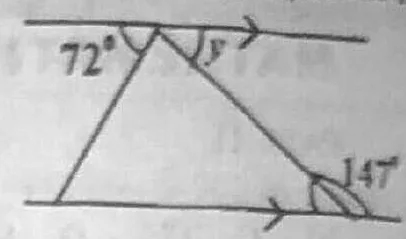
Angle on the lower parallel line next to 147° is 180° − 147° = 33°. y is alternate to it, so y = 33°.
The sum of the interior angles of a polygon of n-side is 180°. Find the value of n.
(n − 2) × 180° = 180°, so n − 2 = 1 and n = 3.
Determine the number of sides of a regular polygon whose interior angles are 90° each.
Exterior angle = 180° − 90° = 90°. Sides = 360° ÷ 90° = 4.
A goat is tied to a peg on the ground with a rope 7m long. Find the maximum area of the ground the goat can graze on. (Take π = 22/7)
Area = πr² = 22/7 × 7 × 7 = 154m².
The figure below is a sport field with a rectangular centre and a semi-circular area at each end. Find the area of the field, correct to one decimal place. (Take π = 22/7)
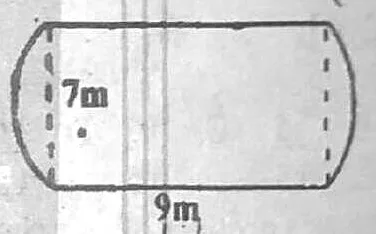
Rectangle = 9 × 7 = 63m². Two semicircles = one circle of radius 3.5m = 22/7 × 3.5 × 3.5 = 38.5m². Total = 101.5m².
Use the similar triangles below to answer questions 41 and 42. Calculate ∣ST∣.
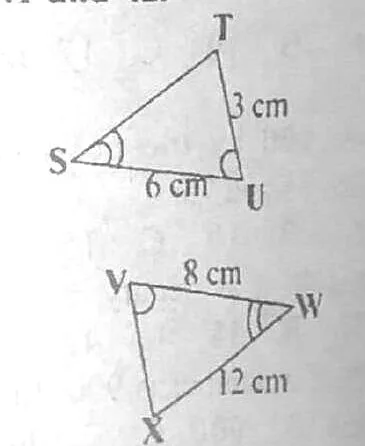
S matches W, U matches V and T matches X. Scale factor = VW/SU = 8/6 = 4/3. WX = ST × 4/3, so ST = 12 × 3/4 = 9cm.
Calculate ∣XV∣.
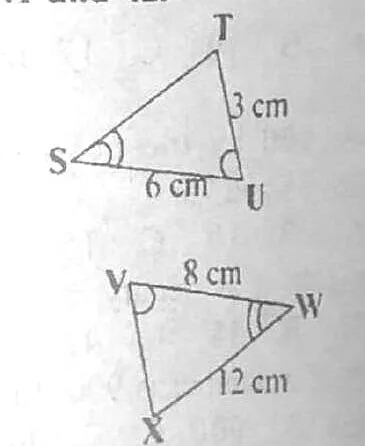
XV = TU × 4/3 = 3 × 4/3 = 4cm.
The construction below represents angle.
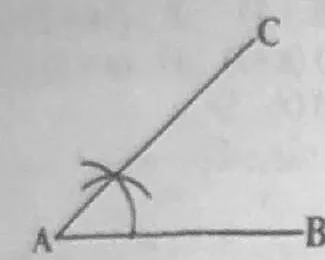
Two arcs of the same radius, one centred at A and one centred where the first arc cuts AB, meet at a point. That construction gives 60°.
Calculate the area of the shaded region in the figure below. (Take π = 22/7)
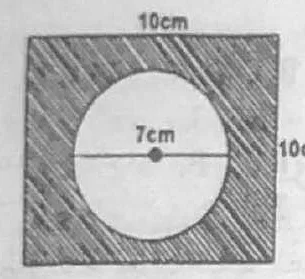
Square = 10 × 10 = 100cm². Circle (r = 3.5cm) = 22/7 × 3.5 × 3.5 = 38.5cm². Shaded = 100 − 38.5 = 61.5cm².
Two similar cylindrical tins are 6cm and 9cm high. If the smaller tin has diameter 8cm, find diameter of the bigger one.
Ratio of corresponding lengths = 9/6 = 3/2. Diameter = 8 × 3/2 = 12cm.
Use the figure below to answer questions 46 and 48. Find ∣AB∣.
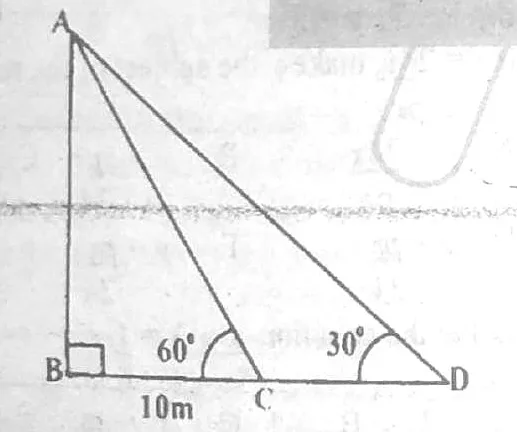
In right-angled triangle ABC, tan 60° = AB/BC. AB = 10 × √3 = 10√3 m.
Calculate ∣AD∣.
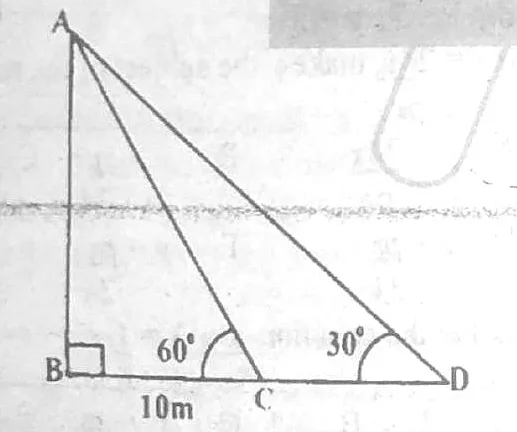
In triangle ABD, sin 30° = AB/AD. AD = 10√3 ÷ ½ = 20√3 m.
Calculate ∣CD∣.
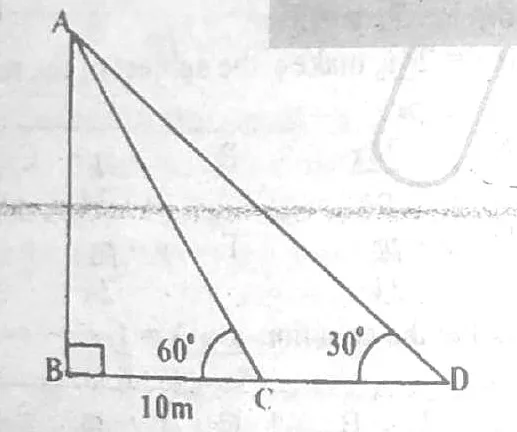
BD = AB ÷ tan 30° = 10√3 × √3 = 30m. CD = BD − BC = 30 − 10 = 20m.
Which of the following angles cannot be constructed using a ruler and a pair of compasses only?
30°, 45°, 90° and 120° can be built from 60° and 90° by bisecting or adding. 70° cannot.
Find the area of the figure below.
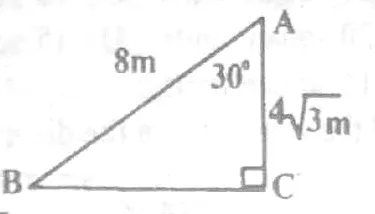
Right angle at C, AB = 8m and AC = 4√3m. BC = 8 sin 30° = 4m. Area = ½ × 4 × 4√3 = 8√3 m².
Find the radius of a circle whose circumstance is 22cm. (Take π = 22/7)
2πr = 22, so r = 22 ÷ (2 × 22/7) = 3.5cm.
Calculate the area of a triangle whose base is 5cm and height 2cm.
Area = ½ × 5 × 2 = 5cm².
The angle of elevation of the top X of a vertical pole from a point P on the level ground is 45°. If the distance from P to the foot of the pole is 7m, find the height of the pole.
tan 45° = height/7, so height = 7 × 1 = 7m.
Use the diagram below to answer questions 54 and 55. Find the size of ∠ROQ.
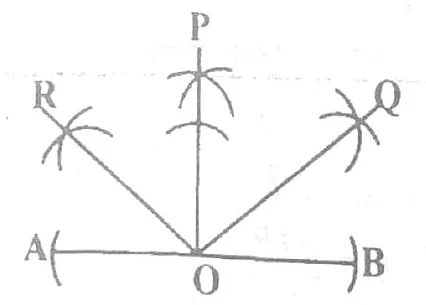
OP is perpendicular to AB. OR and OQ bisect ∠AOP and ∠POB, so ∠ROQ = 45° + 45° = 90°.
Calculate the sum of ∠AOP and ∠QOB.
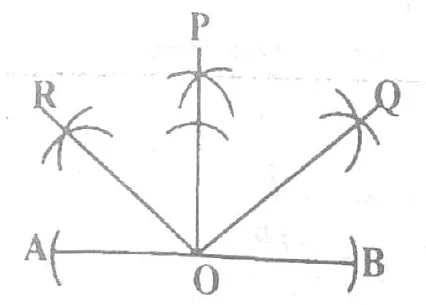
∠AOP = 90° and ∠QOB = 45°. Sum = 135°.
Find the area of the figure below.
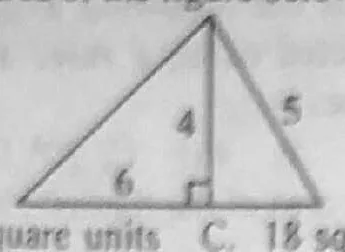
The altitude is 4 and the right-hand side is 5, so the right part of the base is 3 (3-4-5 triangle). Base = 6 + 3 = 9. Area = ½ × 9 × 4 = 18 square units.
Find the value of θ in the diagram below.
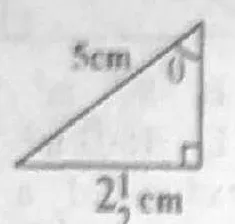
sin θ = opposite/hypotenuse = 2.5/5 = 0.5, so θ = 30°.
In the figure below, find the side marked x.
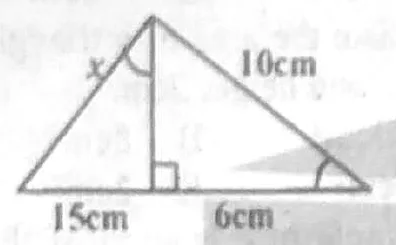
Height² = 10² − 6² = 64, so height = 8cm. x² = 15² + 8² = 289, so x = 17cm.
The perimeter of a rectangular lawn is 32cm. If the difference between its length and breadth is 2cm, find the area of the lawn.
l + b = 16 and l − b = 2, so l = 9 and b = 7. Area = 9 × 7 = 63cm².
In the figure below, lines AB and CD are parallel. Which of the following is not true?
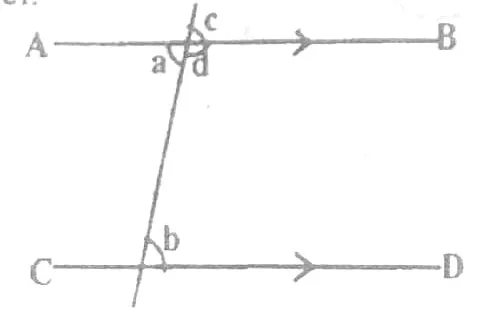
a and c are vertically opposite (equal). b and c are corresponding angles (equal). b and d are alternate angles (equal). d + a = 180° (angles on a straight line). a and b are co-interior angles, so a + b = 180°; a = b is not true.
Factorize mx − my − nx + ny.
m(x − y) − n(x − y) = (m − n)(x − y).
Factorize 3a² + 7a − 6.
3a² + 9a − 2a − 6 = 3a(a + 3) − 2(a + 3) = (3a − 2)(a + 3).
Simplify 3/5x − (2x − 1)/x.
LCD = 5x: [3 − 5(2x − 1)]/5x = (3 − 10x + 5)/5x = (8 − 10x)/5x.
Solve 3 − k/3 = 1.
k/3 = 2, so k = 6.
Solve 2(x − 1) > 3.
2x − 2 > 3, so 2x > 5 and x > 2 1/2.
When 15 is added to 1/4 of a number, the result is 4 times the number. Find the number.
n/4 + 15 = 4n, so 15 = 15n/4 and n = 4.
Find the value of p if 2p = 15 − p.
3p = 15, so p = 5.
Solve the equations 2x + y = 4 and x + y = 2 simultaneously.
Subtract: (2x + y) − (x + y) = 4 − 2, so x = 2. Then y = 2 − 2 = 0.
If x = 24y/pr, make y the subject of the relation.
Multiply both sides by pr: xpr = 24y, so y = xpr/24.
Solve the equation (x + 1)/(5x − 1) = 1/6.
6(x + 1) = 5x − 1, so 6x + 6 = 5x − 1 and x = −7.
Expand (x + 2)(2x − 1).
2x² − x + 4x − 2 = 2x² + 3x − 2.
Use the table below to answer questions 72 and 73 for the relation y = 2x + 5. x: −4, −3, −2, −1, 0, 1, 2, 3, 4 y: −3, A, 1, B, 5, C, 9, D, 13 Find the value of A.
A = 2(−3) + 5 = −1.
Find the value of B × C + D.
B = 2(−1) + 5 = 3, C = 2(1) + 5 = 7, D = 2(3) + 5 = 11. B × C + D = 3 × 7 + 11 = 32.
The figure below represents which of the following inequalities?
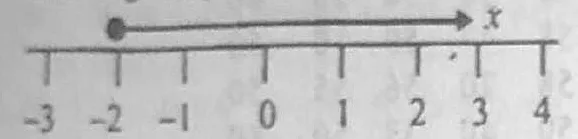
The solid dot at −2 means −2 is included, and the arrow points to the right, so x ≥ −2.
Two-thirds of a certain number is greater than 6. Find the range of value of the number.
2x/3 > 6, so x > 9.
The sum of two numbers is 9 and their difference is 3. Find the numbers.
6 + 3 = 9 and 6 − 3 = 3.
Solve the simultaneous equations; 3x + 2y = 6, 2x + y = 4.
From the second equation y = 4 − 2x. Then 3x + 8 − 4x = 6, so x = 2 and y = 0.
Simplify (x² − 1) − (x + 2)².
x² − 1 − (x² + 4x + 4) = −4x − 5 = −(4x + 5).
Simplify 72pqr ÷ (−9q).
72 ÷ (−9) = −8, and q cancels, leaving −8pr.
If 3 is divided by the sum of x and 1, the result equals to 3 divided by 5. Find the value of x.
3/(x + 1) = 3/5, so x + 1 = 5 and x = 4.
Solve the equation (x + 2)/3 + 2x − 5 = 5.
x + 2 + 6x − 15 = 15, so 7x = 28 and x = 4.
Ade's age is 56 years more than his son. If the son's age is w years, find the value of w when the sum of their ages is 76 years.
w + (w + 56) = 76, so 2w = 20 and w = 10.
If x = 2, y = 6 and z = 4, evaluate (4y + 2z)/(x + y).
(24 + 8)/(2 + 6) = 32/8 = 4.
Expand (2a − 3)(1 + a).
2a + 2a² − 3 − 3a = 2a² − a − 3.
Solve the equation 1/(p + 2) = 8/(3p + 1).
Cross-multiply: 3p + 1 = 8p + 16, so −5p = 15 and p = −3.
Find the value of x if 3x + 5 = 4x − 7.
5 + 7 = 4x − 3x, so x = 12.
Factorize 16a² − 9b².
Difference of two squares: (4a)² − (3b)² = (4a + 3b)(4a − 3b).
Find the coefficient of xy in the expansion of (3x + 2y)(5x − 3y).
xy terms: 3x(−3y) + 2y(5x) = −9xy + 10xy = xy. Coefficient = 1.
Express 3/y − 5/y + 2 as a single fraction.
(3 − 5 + 2y)/y = (2y − 2)/y = 2(y − 1)/y.
Simplify (x + 3)/3 + (x − 3)/4.
LCD = 12: [4(x + 3) + 3(x − 3)]/12 = (4x + 12 + 3x − 9)/12 = (7x + 3)/12.
If 3/8 of Olu's monthly savings is ₦24,000.00, find his monthly savings.
Savings = 24,000 ÷ 3 × 8 = ₦64,000.
Find the coefficient of x in the expansion of (2x + 1)(1 − 2x).
(2x + 1)(1 − 2x) = 2x − 4x² + 1 − 2x = 1 − 4x². There is no x term, so the coefficient is 0.
Evaluate (2x − 2)/2 + (2x + 2)/3 when x = 2.
(4 − 2)/2 + (4 + 2)/3 = 1 + 2 = 3.
Solve for x if 2x − 5 > 7.
2x > 12, so x > 6.
Two-fifths of a certain number is greater than 8. Find the range of values of the number.
2x/5 > 8, so 2x > 40 and x > 20.
If a certain number y is tripled, the result is less than 18. Find the range of values of the number.
3y < 18, so y < 6.
Solve the equation 1/(z − 1) = 5/(4z + 1).
Cross-multiply: 4z + 1 = 5z − 5, so z = 6.
A certain number of boys were to share 160 oranges. 5 boys left and the rest shared the oranges, each of them got 8 oranges. How many boys were present originally?
160 ÷ 8 = 20 boys shared the oranges. Original number = 20 + 5 = 25.
If x varies directly as y and x = 2 when y = 3, find the formular connecting x and y.
x = ky. 2 = 3k, so k = 2/3. Therefore x = 2y/3.
Three pens and five rulers cost ₦65.00 while three pens and a ruler cost ₦25.00. Find the cost of a pen and a ruler respectively.
Subtract: 4 rulers = 65 − 25 = ₦40, so a ruler = ₦10. Then 3 pens = 25 − 10 = ₦15, so a pen = ₦5.
Factorize 5a(a − b) − 2a(a − b).
(5a − 2a)(a − b) = 3a(a − b).
Find the value of 3c/b − a if a = 8, b = 3 and c = 9.
3(9)/3 − 8 = 9 − 8 = 1.
The branch of Mathematics that deals with collection of data is known as ______.
Collection, organisation and interpretation of data is statistics.
In a class, the youngest student is 12 years while oldest is x years. If the age range is 7 years, find the value of x.
Range = oldest − youngest. 7 = x − 12, so x = 19.
Find the mean of the following scores; 24, 18, 40, 22, 31.
Sum = 24 + 18 + 40 + 22 + 31 = 135. Mean = 135 ÷ 5 = 27.
Find the median of the following set of numbers; 48, 58, 65, 43, 60, 53, 68, 57, 62, 47, 45.
Arranged: 43, 45, 47, 48, 53, 57, 58, 60, 62, 65, 68. The middle (6th) value is 57.
The data below shows the weight in kg of 20 students: 70 50 70 50 40 58 47 59 50 50 58 70 56 55 50 50 40 37 50 80 Find the modal weight.
50 appears 7 times, more than any other weight. The mode is 50.
If 9 is the mean of the following set of numbers 1, 2, x, 11, 13, 14, find the value of x.
Sum = 9 × 6 = 54. 1 + 2 + 11 + 13 + 14 = 41, so x = 54 − 41 = 13.
The scores of students in a given test are as follows; 2, 3, 4, 5, 6, 3, 4, 5. Find the median.
Arranged: 2, 3, 3, 4, 4, 5, 5, 6. Median = (4 + 4)/2 = 4.
The pie-chart below shows the distribution of 600 students into different houses in a school sport competition. Use the chart to answer questions 110 to 112. Calculate the angle of the sector for blue house.
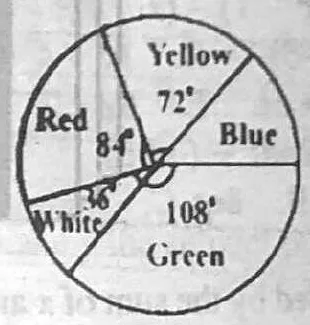
Angles: yellow 72° + red 84° + white 36° + green 108° = 300°. Blue = 360° − 300° = 60°.
Find the number of students in yellow house.
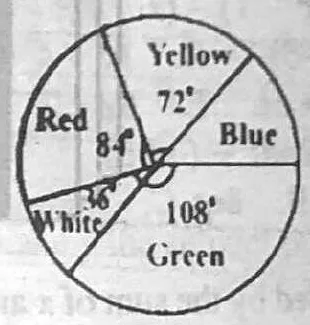
72/360 × 600 = 120 students.
What fraction of the students are there in white house?
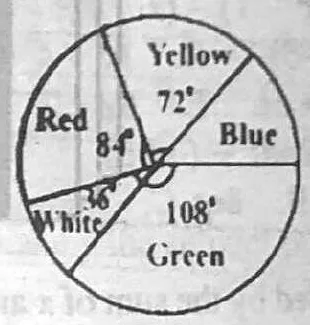
White = 36°. 36/360 = 1/10.
Use the frequency table below to answer questions 113 and 114. Score (x): 0, 1, 2, 3, 4, 5 frequency (f): 2, 4, 3, 3, 6, 2 Calculate the mode.
The highest frequency is 6, which belongs to the score 4. Mode = 4.
Find the median.
Total frequency = 20. Cumulative frequencies: 2, 6, 9, 12, 18, 20. The 10th and 11th scores are both 3, so the median = 3.
The probability that it will rain in Minna today is 1/5. What is the probability that it will not rain?
P(not rain) = 1 − 1/5 = 4/5.
What is the probability of getting a 2 when a dice is thrown once?
One face shows 2 out of 6 equally likely faces, so P = 1/6.
A fair dice is thrown once. Find the probability of getting an even number.
Even numbers are 2, 4 and 6, so P = 3/6 = 1/2.
Use the information below to answer questions 118 and 119. A bag contains 20 red balls. A child picks out one of the balls at random. Determine the probability of picking a red ball?
All 20 balls are red, so the picked ball is certainly red. P = 20/20 = 1.
Find the probability of picking a black ball.
There are no black balls in the bag, so P = 0.
In a pie chart, four fruits are represented namely; orange, mango, apple and banana. If the sectorial angles of orange, mango and apple are 120°, 90° and 100° respectively, find the sectorial angle of banana.
Banana = 360° − (120° + 90° + 100°) = 360° − 310° = 50°.
Advertisement
…and/or go further with premium services and No Ads.