GCE Economics 2013 Theory — Question 1
Question 1 of 18 from the General Certificate of Education (GCE) Economics 2013 Theory paper, with the correct answer and a full explanation.
Advertisement
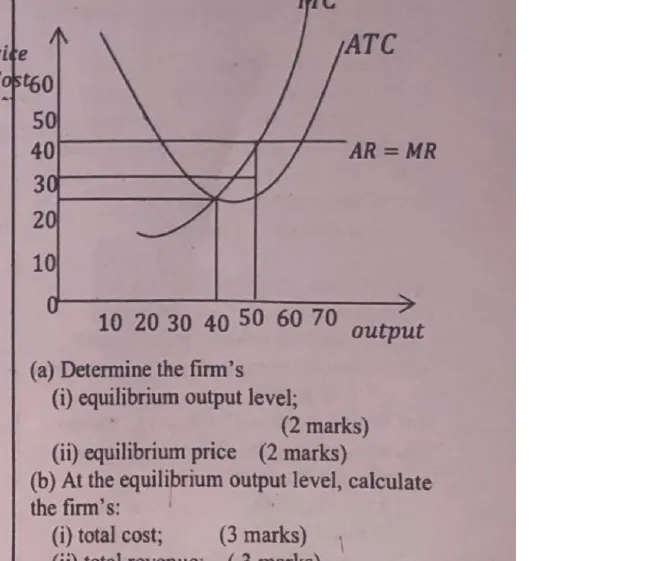
Essay Question 1. The equilibrium position of a firm is illustrated in the diagram (MC, ATC and AR=MR curves). Study the diagram and answer: (a) Determine the firm's (i) equilibrium output level; (ii) equilibrium price. (b) At the equilibrium output level, calculate the firm's (i) total cost; (ii) total revenue; (iii) total profit. (c) Is the firm operating in the long-run or short-run? Explain your answer. (d) (i) What type of market is the firm operating in? (ii) List three features of the market type identified.
Model answer
(a)(i) Equilibrium output level is where MC = MR (touches the AR=MR line): 50 units. (ii) Equilibrium price is the same as Average Revenue (AR): $40. (b)(i) Total cost = AC x output = $30 x 50 = $150. (ii) Total revenue = AR (Price) x output = $40 x 50 = $200. (iii) Total profit = TR - TC = $200 - $150 = $50. (c) The firm is operating in the short-run because it is making abnormal profit, which is only possible in the short-run; in the long-run, perfect competitors make only normal profit as new firms enter the industry and compete away abnormal profit. (d)(i) The firm is a perfect competitor operating in a perfectly competitive market, since its AR = MR (a horizontal demand curve). (ii) Features of a perfect market: there are many buyers and sellers; homogeneous/identical goods are sold; goods are portable; there is no cost of transportation; there is adequate market information; there is no preferential treatment; the market is regulated by the forces of demand and supply.
Advertisement
Sign up free to unlock
- Score tracking
- Practice history
- Saved questions
- Progress dashboard
- Personalized sessions
- Weak-topic breakdown
…and/or go further with premium services and No Ads.