Free account: track your progress — Sign up free

GCE Economics 2022 Theory Past Questions

All 8 questions from the General Certificate of Education (GCE) Economics 2022 Theory paper, with the correct answer and a full explanation for each. Free, no signup needed.

Advertisement

Economics 2022 Theory — Question 1

SECTION A (answer one question only) A hypothetical national income data for a country in a particular year is given: Wages and Salaries $250 million; Income paid abroad $75 million; Income from self employment $120 million; Stock appreciation $5 million; Interest $10 million; Income received from abroad $50 million; Rent $25 million; Depreciation allowance $3 million; Royalties $2 million; Profits and dividends $35 million. (a) Calculate the Gross Domestic Product (GDP). (11 marks) (b) Calculate the Gross National Product (GNP). (5 marks) (c) Calculate the Net National Product (NNP). (4 marks)

Model answer

(a) GDP = C + I + G (Aggregate Expenditure); using the income approach, GDP is the sum of all factor incomes earned within the country: Wages and Salaries 250 + Income from self employment 120 + Stock appreciation 5 + Interest 10 + Rent 25 + Depreciation allowance 3 + Royalties 2 + Profits and dividends 35 = $450 million. GDP = $450 million. (b) GNP = GDP + Net income from abroad. Net export/Net income from abroad = Income received from abroad - Income paid abroad = $50million - $75million = -$25million. GNP = $450million + (-$25million) = $425 million. (c) NNP = GNP - Depreciation (capital consumption allowance). NNP = $425million - $3million = $422 million.
Economics 2022 Theory — Question 2

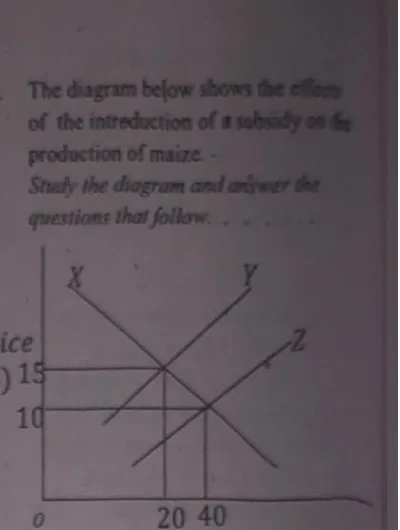
The diagram below shows the effects of the introduction of a subsidy on the production of maize. Study the diagram and answer the questions that follow. (Curves X, Y and Z shown; Price axis shows $15 and $10; Quantity axis shows 20 and 40 bags.) (a)(i) Identify the curves labeled X, Y and Z. (3 marks) (ii) State the direction of change in price and quantity with the introduction of subsidy. (2 marks) (b) Calculate the total revenue of the producers: (i) before the introduction of subsidy; (ii) after the introduction of subsidy. (2+2 marks) (c) Calculate the percentage increase or decrease in the total revenue of the producers with the introduction of subsidy. (2 marks) (d) If the quantity demanded of maize increases from 20 to 40 bags as a result of a fall in price from $15 to $10, calculate the price elasticity of demand. (7 marks) (e) State the type of elasticity of demand in 2(d). (2 marks)

Diagram for question 2

Model answer

(a)(i) Curve X is the Demand Curve; Curve Y is the (original) Supply Curve; Curve Z is the new Supply Curve (after the subsidy). (a)(ii) A subsidy is a payment made to producers of some essential goods by the government to encourage production and improve the standard of living of consumers. A subsidy shifts the supply curve to the right, causing a reduction (fall) in price and an increase in the quantity demanded/supplied. (b)(i) Total revenue before subsidy = Price x Quantity = $15 x 20 = $300.00 (b)(ii) Total revenue after subsidy = Price x Quantity = $10 x 40 = $400.00 (c) Percentage change in total revenue = (New - Old)/Old x 100 = (400-300)/300 x 100 = 100/300 x 100 = 33.3% increase. (d) Price Elasticity of Demand (PED) = (%change in Qd) / (%change in Price) %change in Qd = (New Q - Old Q)/Old Q x 100 = (40-20)/20 x 100 = 100% %change in Price = (New P - Old P)/Old P x 100 = (10-15)/15 x 100 = -33.3% (we ignore the negative sign for PED) PED = 100% / 33.3% = 3.0 (e) Since PED (3.0) is greater than one (unity), demand in 2(d) is PRICE ELASTIC.

Economics 2022 Theory — Question 3

SECTION B (answer three questions only) (a) Define the term limited liability. (2 marks) (b) Describe four differences between a public joint-stock company and a private joint-stock company. (12 marks) (c) Outline three sources of finance available to a sole proprietorship. (6 marks)

Model answer

(a) Limited Liability is a situation in which the debt or liability of an individual or a business is limited; it implies that a person or business cannot lose more than the amount they have invested in the business, in the event of liquidation or business failure. (b) Differences between a public joint-stock company and a private joint-stock company: 1. The public joint-stock company has a minimum of 7 members and no maximum number of membership, whereas the private joint-stock company has a minimum of 2 members (owners) and a maximum of 50 owners. 2. The public joint-stock company sells its shares to members of the public, whereas the private joint-stock company does not sell shares to members of the public. 3. The public joint-stock company can issue debentures to raise long-term loans from members of the public; the private joint-stock company does not issue debentures. 4. The public joint-stock company cannot commence business fully until it obtains its Certificate of Trading (in addition to the Certificate of Incorporation); the private joint-stock company can start business fully upon obtaining its Certificate of Incorporation and does not need a Certificate of Trading. (c) Sources of finance available to a sole proprietorship: 1. Personal savings 2. Loan from banks 3. Retained profit

Economics 2022 Theory — Question 4

(a) Distinguish between labour force and efficiency of labour. (5 marks) (b) Describe five factors which determine the size of labour force in a country. (15 marks)

Model answer

(a) Labour force can be defined as the total number of individuals or people who are capable and qualified to work in an economy; it is the total number of people of working age in a country who are able and willing by law to work. It is also known as the working/active population. Efficiency of labour, on the other hand, can be defined as the ability of labour to increase the level of output or productivity without a corresponding increase in the quantity of labour used. It is measured in terms of the increase in the level of output within a specified period of time, without a fall in the quality of goods and services produced. (b) Factors that determine the size of the labour force in a country: 1. Age structure of the population: the age structure of a country's population is a significant determinant of the size of the labour force. The lower the dependent population, the higher the labour force, and vice versa. In other words, the labour force of a country will increase as more people fall within the working ages (e.g. 18 to 65 years), although this varies from country to country. 2. Number of working hours and working days: the number of working hours per day and the number of working days in a week or a year is also a determinant of the size of the labour force. If working hours per week are too many, people will be discouraged from joining the labour force. 3. The number of disabled persons: since disabled individuals are not included in the labour force even if their ages fall within the working population, the higher the population of the disabled, the lower the size of the labour force, and vice versa. 4. Emigration: emigrants are people who move out of a country to settle down in other countries. The higher the level of emigration, the lower the size of the labour force of the native (home) country, and vice versa. 5. The activities of trade unions: this also affects the size of the labour force in a country. For example, if a trade union attaches strict conditions to entry into a particular job/profession, this may discourage people from going into such an occupation.

Economics 2022 Theory — Question 5

(a) What is a Demand schedule? (2 marks) (b) Explain the following terms: (i) effective demand; (ii) composite demand; (iii) derived demand. (2+2+2 marks) (c) Using appropriate diagrams, explain how a change in the price of a commodity would influence the demand for its: (i) substitute (6 marks); (ii) complement (6 marks).

Model answer

(a) A demand schedule can be defined as a table which shows the relationship between the price of a commodity and the quantity of that commodity demanded. It shows the quantity of a commodity that can be purchased as the price changes. There are two types of demand schedule: (i) an Individual Demand Schedule, which shows the units of a particular commodity purchased at different prices by an individual; and (ii) a Market (or Aggregate/Composite) Demand Schedule, which shows the units of a particular commodity purchased by different buyers at different prices. (b)(i) Effective demand: demand is said to be effective where there is willingness and ability to pay. In this case, someone has both the desire and the monetary means to pay for a good/service; if the reverse is the case, then it is ineffective demand. (ii) Composite demand: demand is said to be composite when a commodity is wanted for several purposes or uses. For example, palm oil can be demanded/wanted for several purposes such as cooking, frying, production of soap, cream, and other products. (iii) Derived demand: demand is said to be derived when a commodity is not wanted for its own sake but for the sake of another commodity it can be used to produce; that is, when a commodity is wanted as a result of the demand for another commodity. Derived demand is applicable to the factors of production, e.g. demand for labour, capital, land and entrepreneurship. Demand for money is also a derived demand. Derived demand is also known as Circuitous Demand. (c)(i) Substitute goods are those goods that are used in place of one another (e.g. close-up and Oral B toothpaste, Milo and Bournvita, meat and fish). For this type of demand, an increase in the price of a commodity will result in an increase in the quantity demanded of its substitute, and vice versa. DIAGRAM: for Commodity A (whose price rises from p1 to p2), its own demand curve (D0-D1) shows quantity demanded falling from q2 to q1; for the substitute, Commodity B, its demand curve shifts rightward (D0 to D1), so the quantity demanded of B increases from q1 to q2 at the same price, because buyers switch to the substitute as A becomes more expensive. (ii) Complementary goods are goods that are used together for the purpose of satisfying a want (e.g. car and petrol, stove and kerosene, shirt and trouser); such a product cannot be used in isolation. DIAGRAM: for Commodity A (whose price falls from p1 to p2), quantity demanded increases; for its complement, Commodity B, the demand curve shifts rightward (D0 to D1), so the quantity demanded of B also increases (from q1 to q2), because a fall in the price of A increases demand for both A and its complement B. Conversely, a rise in the price of commodity A results in a decrease in the demand for its complement, B.

Economics 2022 Theory — Question 6

(a) Explain the following types of taxes: (i) specific taxes (3 marks); (ii) value-added tax (3 marks). (b) With the aid of diagrams, describe the effects of an indirect tax on a commodity when demand is: (i) perfectly inelastic (7 marks); (ii) perfectly elastic (7 marks).

Model answer

(a)(i) Specific tax: this is a type of indirect tax that is imposed or levied according to the volume or units of goods imported, exported or manufactured locally. It is a type of tax levied at a fixed rate per unit of output. (ii) Value-added tax (VAT): this is a type of indirect tax that is levied/imposed by the government at different stages of production of a good or service. (b) Indirect taxes are taxes imposed or levied on goods and services; they have significant effects on demand and supply. Generally, the higher the indirect tax on a commodity, the higher the price of the commodity, and the lower the quantity demanded, and vice versa. (i) Perfectly Inelastic Demand: demand is said to be perfectly inelastic when the quantity demanded does not react to changes in the price of the commodity (i.e. the quantity demanded remains the same regardless of whether the price rises or falls). However, an indirect tax charged/imposed on a commodity with this type of elasticity of demand will increase the price of the commodity by the entire amount of the tax, because buyers do not react to any change in the price of the commodity. This means the entire burden of the indirect tax is shifted onto the buyers alone, i.e. new price P2 = old price P1 + tax. DIAGRAM: the supply curve shifts upward/leftward from S1 to S2 by the amount of the tax; the demand curve is vertical; the shaded area between P1 and P2 (up to the vertical demand curve) represents the tax, entirely borne by the buyer, with quantity demanded unchanged at Q1. (ii) Perfectly Elastic Demand: demand is said to be perfectly elastic when the quantity demanded is highly sensitive/reacting to any change in the price of the commodity. However, an indirect tax charged on a commodity with this elasticity of demand will have NO effect on the price of the commodity, because buyers react sharply to any slight change in price. Therefore, the sellers alone bear the burden of the tax imposed, and this will reduce the quantity supplied (from Oq1 to Oq2), while the price of the commodity remains unchanged at OP1. DIAGRAM: the demand curve is horizontal at price P1; the supply curve shifts upward from S1 to S2 by the amount of the tax; the shaded region represents the indirect tax, entirely borne by the sellers, since the price remains at OP1 while quantity supplied falls from Oq1 to Oq2.

Economics 2022 Theory — Question 7

(a) Distinguish between: (i) a mortgage bank and a merchant bank; (ii) a commercial bank and a development bank. (4+4 marks) (b) Explain any four functions of commercial banks. (12 marks)

Model answer

(a)(i) A mortgage bank is a financial institution established for the acceptance of fixed deposits from members of the public, with the aim of encouraging them to build their own houses by offering them long-term loans; mortgage banks are also known as building societies. A merchant bank, in contrast, is a financial institution that provides medium- and long-term loans, accepts large deposits, bills and deals in stocks. Merchant banks deal with companies, government and other financial institutions, and offer wholesale banking services, with the primary objective of making profit. (a)(ii) A commercial bank is a financial institution which carries out retail banking services, set up for keeping and lending money to people, with the primary objective of making profit. Commercial banks deal with companies, government and individuals, and can be owned by any of them (examples in Nigeria include GTB, UBA, First Bank Plc, etc). A development bank, on the other hand, is a financial institution set up primarily to offer long-term loans meant for the implementation of development projects that will facilitate the economic growth and development of a country, such as roads, schools, electricity, airports, seaports etc (examples of development banks in Nigeria include the Nigerian Bank for Commerce and Industry (N.B.C.I) and the Nigerian Industrial Development Bank (N.I.D.B)). (b) Functions of Commercial Banks: (i) Credit Creation: commercial banks are the only financial institutions that have this unique function, which they perform through their lending and borrowing activities, i.e. the use of loans and overdrafts. (ii) Lending of money: commercial banks lend money to industrialists, businessmen and other members of the public, in the form of loans and overdrafts. (iii) Transfer of funds: commercial banks assist their customers in transferring funds from one place to another. This is done in several ways, such as drafts, standing orders, cheques and electronic banking, etc. (iv) Acceptance of deposits: commercial banks accept deposits from members of the public for safe custody, by the operation of three methods, which include savings, current and fixed deposit accounts.

Economics 2022 Theory — Question 8

(a) What is economic integration? (2 marks) (b) Outline any three short-comings/limitations of the Economic Community of West African States (ECOWAS). (9 marks) (c) Highlight any three achievements of the Economic Community of West African States (ECOWAS). (9 marks)

Model answer

(a) Economic Integration can be defined as the merging of the economies and economic policies of two or more countries within a particular region, for the purpose of facilitating their economic development; this can be achieved by eliminating trade barriers as well as coordinating their monetary and fiscal policies, among other measures. Examples of economic integrations include the Free Trade Area, Customs Union, Common Market, and Economic Union, etc. (b) Short-comings/Limitations of ECOWAS: (i) Political Instability in member states: as a result of political instability, many leaders that show great interest in ECOWAS do not stay in office for a long enough time to help achieve the aims and objectives of the community. (ii) Colonial Linkage: this is another factor affecting the community. Francophone (French-speaking) countries that are yet to fully cut the economic chains binding them to France display more allegiance to their former colonial master than they do to ECOWAS. (iii) Increase in social vices: the presence of the community in some member states, Nigeria for example, has escalated the wave of armed robbery, banditry, murder, prostitution, arson, etc. (c) Achievements of ECOWAS: (i) Fostering of Unity: the community has united all the member countries and enhanced a more friendly atmosphere among them. (ii) Increase in Bargaining Power: by coming together under the banner of ECOWAS, the bargaining power of member-nations in the world market has improved, hence the improvement in their terms of trade. (iii) Availability of More Labour: the community has made more labour available from member countries where they are in abundance, to areas or countries where they are scarce.

Advertisement

Sign up free to unlock

  • Score tracking
  • Practice history
  • Saved questions
  • Progress dashboard
  • Personalized sessions
  • Weak-topic breakdown

…and/or go further with premium services and No Ads.