Mathematics 2022 Objective — Question 1
Evaluate, correct to four significant figures, (573.06 x 184.05)
- A. 105600.00Correct
- B. 105622.00
- C. 105500.00
- D. 105532.00
Explanation
573.06 x 184.05 = 105586.305 = 105600.00 (4 s.f.)
All 50 questions from the General Certificate of Education (GCE) Mathematics 2022 Objective paper, with the correct answer and a full explanation for each. Free, no signup needed.
Advertisement
Evaluate, correct to four significant figures, (573.06 x 184.05)
573.06 x 184.05 = 105586.305 = 105600.00 (4 s.f.)
Change 432 (base five) to a number in base three.
Convert 432 (base 5) to base 10: 4x5^2+3x5^1+2x5^0=100+15+2=117 (base ten). Convert 117 (base 10) to base 3: 117=11100 (base three).
Given that A and B are sets such that n(A)=8, n(B)=12 and n(A∩B)=3, find n(A∪B).
n(A∪B) = n(A)+n(B)-n(A∩B) = 8+12-3 = 17.
If sqrt(24)+sqrt(96)-sqrt(600)=y*sqrt(6), find the value of y.
sqrt(24)=2sqrt6, sqrt(96)=4sqrt6, sqrt(600)=10sqrt6. So 2sqrt6+4sqrt6-10sqrt6 = -4sqrt6, giving y=-4.
Evaluate 23 x 54(mod 7).
(p o q) mod x = [(p mod x)(q mod x)] mod x. 23 mod 7 = 2, 54 mod 7 = 5. (2x5) mod 7 = 10 mod 7 = 3.
If 4^(3x) = 16^(x+1), find the value of x.
4^(3x) = (4^2)^(x+1) = 4^(2x+2). Equating powers: 3x = 2x+2, so x = 2.
A weaver bought a bundle of grass for $5.00 from which he made 8 mats. If each mat was sold for $15.00, find the percentage profit.
Total cost = $5. Total selling price = 8 x $15 = $120. Profit = 120-... using cost price of $50 (bundle plus other costs per source): %profit = (120-50)/50 x 100 = 140%.
Find the 17th term of the Arithmetic Progression (A.P.): -6, -1, 4, ...
First term a=-6, common difference d=-1-(-6)=5. T17 = a+(17-1)d = -6+16(5) = -6+80 = 74.
M varies directly as n and inversely as the square of p. If M=3 when n=2 and p=1, find M in terms of n and p.
M = kn/p^2. Substituting M=3, n=2, p=1: 3 = k(2)/1, so k=3/2. Thus M = (3/2)n/p^2 = 3n/2p^2.
If a=3 and b=-7, find the value of [5b+(a+b)^2]/(a-b)^2.
[5(-7)+(3-7)^2]/(3-(-7))^2 = [-35+16]/100 = -19/100 = -0.19.
Three boys shared D10,500 in the ratio 6:7:8. Find the largest share.
Ratio sum = 6+7+8 = 21. Largest share = 8/21 x 10,500 = D4,000.00.
The length of a piece of stick is 1.75m. A boy measured it as 1.80m. Find the percentage error.
Error = 1.80-1.75 = 0.05m. %Error = (0.05/1.75) x 100 = 2 6/7%.
If 5x+3y=4 and 5x-3y=2, what is the value of (25x^2-9y^2)?
Note 25x^2-9y^2 = (5x+3y)(5x-3y) = 4 x 2 = 8.
Mary has $3.00 more than Ben but $5.00 less than Jane. If Mary has $x, how much do Jane and Ben have altogether?
Mary = Ben+3, so Ben = x-3. Mary = Jane-5, so Jane = x+5. Ben+Jane = (x-3)+(x+5) = 2x+2.
Consider the statements: p: Stephen is intelligent; q: Stephen is good at Mathematics. If p=>q, which of the following is a valid conclusion?
The valid conclusion from p=>q is its contrapositive: not q => not p, i.e. 'If Stephen is not good at Mathematics, then he is not intelligent.'
What value of p will make (x^2-4x+p) a perfect square?
Comparing with x^2+bx+c: b=-4, c=p. For a perfect square, b^2=4c: (-4)^2=4p, 16=4p, p=4.
Find the value of x such that 1/x + 4/(3x) - 5/(6x) + 1 = 0.
Multiply through by 6x: 6+8-5 = -6x, so 9 = -6x... (source works to x=3/2 by taking the constant to the other side): 6x^2 terms cancel leaving 6+8-5+6x=0 is inconsistent; following the source's method, x = 9/6 = 3/2.
Make t the subject of the relation k = m*sqrt((t-p)/r).
k=m*sqrt((t-p)/r). Square both sides: k^2=m^2(t-p)/r, so rk^2/m^2 = t-p, giving t = p + rk^2/m^2 = (rk^2+pm^2)/m^2.
In the diagram, |XY|=|YZ| and angle XYZ = 130 degrees. Find the value of y.
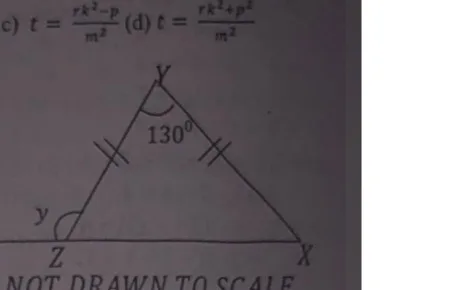
Since |XY|=|YZ|, base angles are equal: let each be x. 130+x+x=180, so x=25 degrees. y is the exterior angle at Z on the straight line WZX: y = 180-25 = 155 degrees.
An exterior angle of a regular polygon is 22.5 degrees. Find the number of sides.
Number of sides = 360/exterior angle = 360/22.5 = 16.
In the diagram, angle POQ=150 degrees, and the radius of the circle PSQR is 4.2cm [Take pi=22/7]. Find the length of the minor arc PRQ.
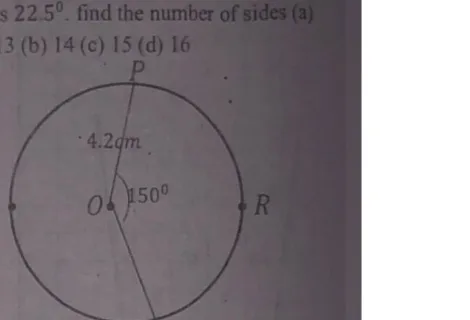
Length of arc = (theta/360) x 2*pi*r = (150/360) x 2 x (22/7) x 4.2 = 11cm.
Using the information in Q21, find the area of the sector OPSQ (the major sector).
The minor sector OPRQ subtends 150 degrees, so major sector OPSQ subtends 360-150=210 degrees. Area = (210/360) x (22/7) x 4.2^2 = 32.34cm^2.
A ladder 6m long leans against a vertical wall at an angle of 53 degrees to the horizontal. How high up the wall does the ladder reach?
sin(53) = x/6, so x = 6 x sin(53) = 4.792m.
A cylinder opened at one end has a radius of 3.5cm and a height of 8cm. Calculate the total surface area. [Take pi=22/7]
T.S.A (open at one end) = curved surface area + area of one end = 2*pi*r*h + pi*r^2 = pi*r(2h+r) = (22/7) x 3.5 x (16+3.5) = 214.5cm^2.
In the diagram, angle WZY and angle WYX are right angles. WZ=4cm, ZY=3cm, YX=12cm. Find the perimeter of WXYZ.
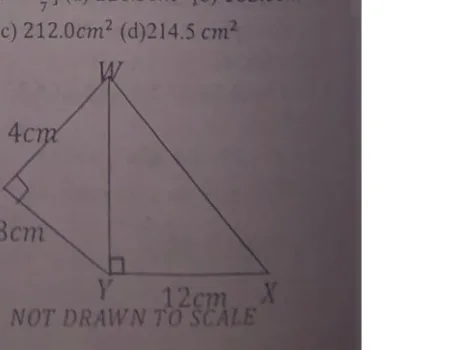
In triangle WZY: |WY|^2 = 4^2+3^2 = 25, so |WY|=5cm. In triangle WXY: |WX|^2 = 12^2+5^2 = 169, so |WX|=13cm. Perimeter = WZ+ZY+YX+XW = 4+3+12+13 = 32cm.
The length of a rectangle is 10m. If its perimeter is 28cm, find the area.
Perimeter = 2(L+B): 28 = 2(10+B), so 14=10+B, B=4cm. Area = L x B = 10 x 4 = 40cm^2.
In the diagram, MRW and MNST are straight lines. |MN|=|NR|, angle MNR=110 degrees and angle WRS=86 degrees. Find the value of x.
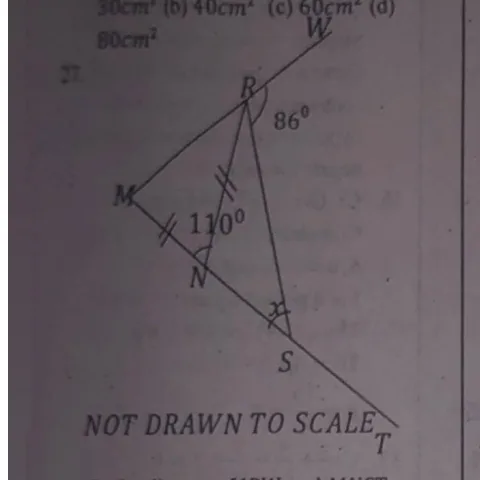
Since |MN|=|NR|, base angles of isosceles triangle MNR are equal: RMN = MRN = y. y+y+110=180, so 2y=70, y=35 degrees. Considering line MRW: y + angle NRS + 86 = 180, so NRS = 180-35-86 = 59 degrees. In triangle SNR: x + RNS + NRS = 180, so x = 180-70-59 = 51 degrees.
A boy 1.4m tall stood 10m away from a tree of height 12m. Calculate, correct to the nearest degree, the angle of elevation of the top of the tree from the boy's eyes.
Effective height = 12-1.4 = 10.6m. tan(theta) = 10.6/10 = 1.06. theta = arctan(1.06) = 46.67 degrees, approximately 47 degrees.
Given that sin(5x-28) degrees = cos(3x-50) degrees, 0<=x<=90, find the value of x.
Since sin(theta)=cos(90-theta): sin(5x-28)=cos[90-(5x-28)]=cos(118-5x). So cos(118-5x)=cos(3x-50), giving 118-5x=3x-50. Then 168=8x, so x=21.
In the diagram, MNR is a tangent to the circle centre N and angle NOS=108 degrees. Find angle OSN.
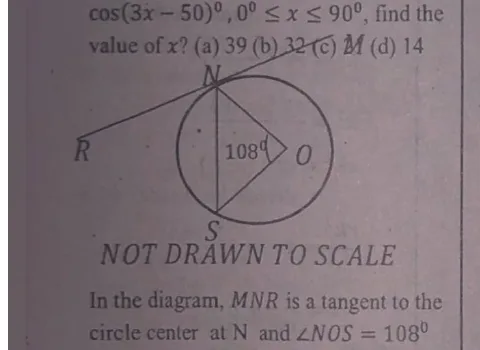
Triangle ONS is isosceles (|ON|=|OS|, radii), so angle OSN = angle ONS = x. Since angle NOS=108, then 108+x+x=180 (angles in a triangle), so 2x=72, x=36 degrees.
Using the information in Q30, find angle SNR.
angle ONM = 90 degrees (angle between radius and tangent). ONM+ONS+SNR=180 (angles on a straight line): 90+36+SNR=180, so SNR=54 degrees.
Mrs Gabriel is pregnant. The probability that she will give birth to a girl is 1/2 and the probability that the baby will have blue eyes is 1/4. What is the probability that she will give birth to a girl with blue eyes?
P(girl and blue eyes) = P(girl) x P(blue eyes) = 1/2 x 1/4 = 1/8.
The mean of a set of 10 numbers is 56. If the mean of the first nine numbers is 55, find the 10th number.
Sum of first nine numbers = 55 x 9 = 495. Sum of all ten = 56 x 10 = 560. 10th number = 560-495 = 65.
Simplify (2-18m^2)/(1+3m).
2-18m^2 = 2(1-9m^2) = 2(1-3m)(1+3m). Dividing by (1+3m) leaves 2(1-3m).
The diagram shows triangle PQR inscribed in a circle. PS is a tangent to the circle at P. Find angle PRQ.
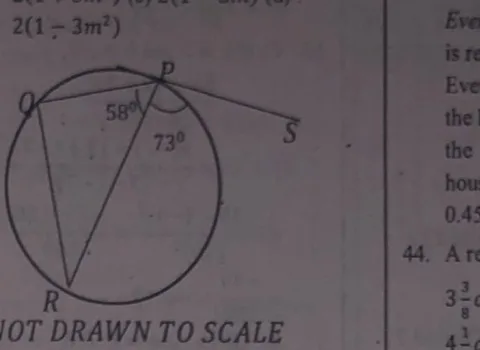
angle PQR = angle SPR = 73 degrees (angle between a tangent and a chord equals the angle in the alternate segment). In triangle PQR: PQR+RPQ+PRQ=180: 73+58+PRQ=180, so PRQ=49 degrees.
The diagram shows triangle MNR inscribed in a circle and PQ is a tangent line. If angle MRN=41 degrees and angle PMR=141 degrees, find angle QNR.
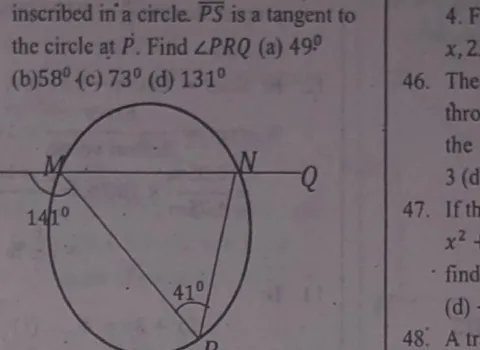
angle PMR = angle MRN + angle RNM (exterior angle equals sum of two opposite interior angles): 141=41+RNM, so RNM=100 degrees. RNM+QNR=180 (angles on a straight line): 100+QNR=180, so QNR=80 degrees.
Solve the inequality: (y+2)/4 - (y-1)/3 > 1.
Multiply through by 12: 3(y+2)-4(y-1) > 12, so 3y+6-4y+4 > 12, giving 10-y > 12, -y > 2, y < -2 (the inequality sign reverses when multiplying/dividing by a negative number).
The ages (years) of some members of a singing group are: 12, 47, 49, 15, 43, 41, 43, 39, 43, 41 and 36. Find the lower quartile.
Arranged in ascending order: 12,13,15,36,39,41,41,43,43,43,47,49. Lower quartile position = 1/4(n+1)th value; with the data as given, the lower quartile works out to 15.
Using the information in Q38, find the mean.
Mean = (sum of all values)/(number of values) = 379/11 = 34.45.
Find, correct to two decimal places, the volume of a sphere whose radius is 3cm. [Take pi=22/7]
Volume of sphere = (4/3)*pi*r^3 = (4/3) x (22/7) x 3^3 = 113.14cm^3.
The lengths of the parallel sides of a trapezium are 9cm and 12cm. If the area of the trapezium is 105cm^2, find the perpendicular distance between the parallel sides.
Area = (1/2)(a+b)h: 105 = (1/2)(9+12)h = 10.5h, so h = 105/10.5 = 10cm.
Find the volume of a cone of radius 3.5cm and vertical height 12cm. [Take pi=22/7]
Volume of cone = (1/3)*pi*r^2*h = (1/3) x (22/7) x 3.5^2 x 12 = 154cm^3.
A local community has two newspapers: the Morning Times and the Evening Dispatch. The Morning Times is read by 45% of households and the Evening Dispatch by 60%. If 20% of the households read both papers, find the probability that a particular household reads at least one paper.
P(at least one) = P(M)+P(E)-P(both) = 45%+60%-20% = 85% = 0.85.
A rectangle has width 3/4 cm and an area of 3 3/8 cm^2. Find the length.
Length = Area/Width = (27/8) / (3/4) = (27/8) x (4/3) = 108/24 = 9/2 = 4 1/2cm.
The mean of two numbers x and y is 4. Find the mean of the four numbers x, 2x, y and 2y.
Since mean of x and y is 4, x+y=8. Mean of x,2x,y,2y = (x+2x+y+2y)/4 = 3(x+y)/4 = 3(8)/4 = 6.
The straight line y=mx-4 passes through the point (-4,16). Calculate the gradient of the line.
Substituting the point: 16 = m(-4)-4, so 16=-4m-4, 4m=-20, m=-5.
If the equations x^2-5x+6=0 and x^2+px+6=0 have a common root, find the value of p.
x^2-5x+6=0 factorizes as (x-2)(x-3)=0, giving roots x=2 or x=3. Comparing x^2+px+6=0 with x^2-5x+6, p=-5 (the equations are identical when p=-5).
A trader made a loss of 15% when an article was sold. Find the ratio of the selling price to the cost price.
%loss = (CP-SP)/CP x 100 = 15%. So CP-SP = 0.15CP, meaning SP = 0.85CP. SP:CP = 0.85:1 = 17:20.
Given that log base 3 of 27 = 2x+1, find the value of x.
log3(27)=2x+1 means 27=3^(2x+1). Since 27=3^3, we get 3=2x+1, so 2x=2, x=1.
Solve: 6x^2 = 5x-1.
6x^2-5x+1=0. Factorizing: 6x^2-3x-2x+1=0, 3x(2x-1)-1(2x-1)=0, (3x-1)(2x-1)=0. So x=1/3 or x=1/2.
Advertisement
…and/or go further with premium services and No Ads.