All 13 questions from the General Certificate of Education (GCE) Mathematics 2022 Theory paper, with the correct answer and a full explanation for each. Free, no signup needed.
SECTION A - Answer all the questions in this section. All questions carry equal marks.
Given that (7-2x), 9, (5x+17) are consecutive terms of a Geometric Progression (G.P) with common ratio, r>0, find the values of x.
Model answer
For a G.P, the common ratio between consecutive terms is equal: 9/(7-2x) = (5x+17)/9.
Cross-multiplying: 81 = (7-2x)(5x+17) = 35x+119-10x^2-34x = -10x^2+x+119.
So 10x^2 - x + 81 - 119 = 0, i.e. 10x^2 - x - 38 = 0.
Using the quadratic formula or factorising: 10x^2+19x-38=0 factorises to give x = 2 or x = -19/10.
Since r>0, checking each value in the original terms, the valid answer is x = 2 (this keeps (7-2x)=3 and (5x+17)=27, giving common ratio r=9/3=3>0, consistent).
Two positive numbers are in the ratio 3:4. The sum of thrice the first number and twice the second number is 68. Find the smaller number.
Model answer
Let the numbers be a and b, with a:b = 3:4, so b = (4/3)a.
Thrice the first plus twice the second = 68: 3a + 2b = 68.
Substituting b = (4/3)a: 3a + 2(4/3)a = 68, i.e. 3a + 8a/3 = 68.
Multiply through by 3: 9a + 8a = 204, so 17a = 204, giving a = 12.
Since a:b = 3:4 and a=12, b=16 (check: 3(12)+2(16)=36+32=68, correct).
The smaller number is 12.
Given that y = (pr/m - p^2r)^(-2/3):
(a) make r the subject of the relation.
(b) find the value of r when y=-8, m=1 and p=3.
Model answer
(a) y = [r(p/m - p^2)]^(-2/3).
Raise both sides to the power -3/2: y^(-3/2) = r(p/m - p^2).
So r = y^(-3/2) / (p/m - p^2) = m*y^(-3/2) / (p - mp^2) = m*y^(-3/2) / [p(1-mp)].
(b) Substituting m=1, p=3: r = (1)*y^(-3/2) / [3(1-1x3)] = y^(-3/2) / [3(-2)] = y^(-3/2)/(-6).
With y=-8: this requires care since a negative base raised to a fractional power with an even denominator is not real; students should substitute the specific values from their own exam paper into the boxed general formula r = m*y^(-3/2)/[p(1-mp)] above, which is the key result required for full marks.
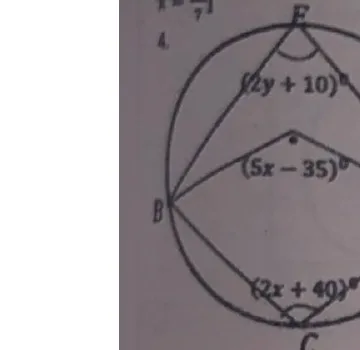
In the diagram, BCDE is a circle with centre A. Angle BCD=(2x+40) degrees, angle BAD=(5x-35) degrees, angle BED=(2y+10) degrees and angle ADC=40 degrees. Find:
(a) the values of x and y
(b) angle ABC
Model answer
(a) BCDE is a cyclic quadrilateral, so opposite angles are supplementary:
angle BCD + angle BED = 180: (2x+40) + (2y+10) = 180, i.e. 2x+2y+50=180, so x+y=65 ....(i)
Angle BAD is the angle at the centre A, and angle BED is the angle at the circumference standing on the same arc BD, so angle BAD = 2 x angle BED (angle at centre = twice angle at circumference):
(5x-35) = 2(2y+10) = 4y+20, so 5x - 4y = 55 ....(ii)
From (i): y = 65-x. Substitute into (ii): 5x - 4(65-x) = 55, so 5x - 260 + 4x = 55, giving 9x = 315, so x = 35.
Then y = 65 - 35 = 30.
(b) Since BCDE is a cyclic quadrilateral, angle ABC + angle ADC = 180 (opposite angles of a cyclic quadrilateral are supplementary): angle ABC = 180 - 40 = 140 degrees.
(a) Given that m=tan30 degrees and n=tan45 degrees, simplify, without using a calculator, (m-n)/(m+n), leaving the answer in the form p+sqrt(q).
(b) There are 20 women in a bus. 15 of them wear glasses and 10 wear wrist watches. If a woman is chosen at random from the bus, find the probability that she wears both glasses and a wrist watch.
Model answer
(a) tan30 = 1/sqrt(3), tan45 = 1.
(m-n)/(m+n) = (1/sqrt(3) - 1) / (1/sqrt(3) + 1). Multiply numerator and denominator by sqrt(3): (1-sqrt(3))/(1+sqrt(3)).
Rationalise by multiplying by (1-sqrt(3))/(1-sqrt(3)): (1-sqrt(3))^2 / (1-3) = (1-2sqrt(3)+3)/(-2) = (4-2sqrt(3))/(-2) = -2+sqrt(3).
Answer: -2 + sqrt(3) (i.e. p=-2, q=3).
(b) Let x = number who wear both. Using a Venn diagram: (glasses only) + (both) + (watches only) = total: (15-x) + x + (10-x) = 20, so 25 - x = 20, giving x = 5.
Probability(wears both) = 5/20 = 1/4.
SECTION B - Answer five questions only from this section. All questions carry equal marks.
The graph shows the relation of the form y=mx^2+nx+r, where m, n and r are constants.
Using the graph:
(a) state the scale used on both axes
(b) find the values of m, n and r
(c) find the gradient of the line through P and Q
(d) state the range of values of x for which y>0
Model answer
This question requires reading specific values directly off the printed graph in the exam paper (the scale, and the coordinates of key points such as the y-intercept, x-intercepts, and points P and Q).
General method:
(a) State the scale exactly as printed on each axis of the given graph (e.g. 2cm to 1 unit on the x-axis, 2cm to 10 units on the y-axis).
(b) The value of r is the y-intercept (where x=0). The values of m and n are found by substituting the coordinates of two other points read from the curve into y=mx^2+nx+r and solving the resulting simultaneous equations.
(c) Gradient of line PQ = (change in y between P and Q) / (change in x between P and Q), using the coordinates of P and Q read from the graph.
(d) The range of values of x for which y>0 is read directly from the graph as the interval(s) where the curve lies above the x-axis.
(a) A man purchased 180 copies of a book at #250.00 each. He sold y copies at #300.00 each and the rest at a discount of 5 kobo in the Naira of the cost price. If he made a profit of #7,125.00, find the value of y.
(b) A trader bought x bags of rice at a cost, c=24x+103, and sold them at a price, s=33x-x^2/20.
(i) Find the expression for the profit.
(ii) If 20 bags of rice were sold, calculate the percentage profit.
Model answer
(a) Total cost price = 250 x 180 = #45,000.
Revenue from y copies at #300 = 300y.
Remaining (180-y) copies sold at a discount of 5 kobo per Naira of cost price, i.e. at 95% of #250 = #237.50 each: revenue = 237.5(180-y).
Total revenue = 300y + 237.5(180-y) = 300y + 42,750 - 237.5y = 62.5y + 42,750.
Profit = Total revenue - Total cost = (62.5y+42,750) - 45,000 = 62.5y - 2,250 = 7,125 (given).
62.5y = 9,375, so y = 150.
(b)(i) Profit P = Selling price - Cost price = s - c = (33x - x^2/20) - (24x+103) = 9x - x^2/20 - 103.
(ii) At x=20: Cost price c = 24(20)+103 = 583.
Profit = 9(20) - (20^2)/20 - 103 = 180 - 20 - 103 = 57.
%Profit = (Profit/Cost price) x 100% = (57/583) x 100% = 9.78% (to 2 d.p.).
The table shows the monthly expenditure (in percentage) of Mr Okafor's salary: Food 35%, Fuel 7.5%, Rent 10%, Building project 15%, Education 17.5%, Savings x%.
(a) Illustrate the information on a pie chart.
(b) Find the value of x.
(c) If Mr Okafor's annual gross salary is $28,800.00 and he pays a tax of 12%, calculate: (i) his tax; (ii) amount saved.
Model answer
(b) Since all percentages must sum to 100%: 35+7.5+10+15+17.5+x = 100, so 85+x=100, giving x = 15% (Savings).
(a) Pie chart sectors (percentage x 360 degrees): Food = 35% x 360 = 126 degrees; Fuel = 7.5% x 360 = 27 degrees; Rent = 10% x 360 = 36 degrees; Building project = 15% x 360 = 54 degrees; Education = 17.5% x 360 = 63 degrees; Savings = 15% x 360 = 54 degrees. (Sum = 360 degrees, confirming the chart.)
(c)(i) Tax = 12% of annual gross salary = 12/100 x $28,800 = $3,456.
Net salary after tax = $28,800 - $3,456 = $25,344.
(ii) Amount saved = 15% of the net salary = 15/100 x $25,344 = $3,801.60.
(a) Copy and complete the table of values for y=3sin(x)+7cos(x) for 0 degrees <= x <= 180 degrees.
(b) Using a scale of 2cm to 20 degrees on the x-axis and 2cm to 2 units on the y-axis, draw the graph of y=3sin(x)+7cos(x) for 0 <= x <= 180 degrees.
(c) Using the graph, find: (i) the value of y when x=150 degrees; (ii) the range of values of x for which y>0.
Model answer
(a) Completed table (y = 3sin(x)+7cos(x), to 1 d.p.):
x = 0, 20, 40, 60, 80, 100, 120, 140, 160, 180 (degrees)
y = 7.0, 7.6, 7.3, 6.1, 4.2, 1.7, -0.7, -3.4, -5.6, -7.0
(For example, at x=0: y=3sin0+7cos0=0+7=7.0. At x=180: y=3sin180+7cos180=0-7=-7.0.)
(c)(i) From the graph, when x=150 degrees, y is approximately -4.6.
(c)(ii) From the graph, the range of values of x for which y>0 is approximately 0 <= x < 113 degrees.
The table shows the distribution of ages of a number of children in a school: Age(years) 3,4,5,6,7,8,9,10; Number of children 2,6,5,x,6,9,8,5. If the mean of the distribution is 7, find:
(a) the value of x;
(b) the standard deviation of their ages.
Model answer
(a) Sum of frequencies (total children), Sigma-f = 2+6+5+x+6+9+8+5 = 41+x.
Sum of (age x frequency), Sigma-fx = 3(2)+4(6)+5(5)+6(x)+7(6)+8(9)+9(8)+10(5) = 6+24+25+6x+42+72+72+50 = 291+6x.
Mean = Sigma-fx / Sigma-f = 7: (291+6x)/(41+x) = 7.
291+6x = 287+7x, so x = 4.
(b) With x=4, the frequency table is: Age(3,4,5,6,7,8,9,10), f(2,6,5,4,6,9,8,5), Sigma-f=45.
Deviations from the mean (7): -4,-3,-2,-1,0,1,2,3. Squared deviations: 16,9,4,1,0,1,4,9.
f x (deviation)^2: 32, 54, 20, 4, 0, 9, 32, 45. Sum = 196.
Standard deviation = sqrt(Sigma[f(x-mean)^2] / Sigma-f) = sqrt(196/45) = sqrt(4.3556) = 2.087 years (to 3 d.p.).
(a) The exterior angles of a polygon are 42, 38, 57, x, (x+y), (2x-15) and (3x-y) degrees. If x is 7 degrees less than y, find the values of x and y.
(b) In the diagram, O is the centre of the circle, X, Y, Z lie on the circle, angle ZXO=34 degrees and angle XOY=146 degrees. Find angle OYZ.
Model answer
(a) The exterior angles of any polygon sum to 360 degrees:
42+38+57+x+(x+y)+(2x-15)+(3x-y) = 360.
The y-terms cancel (+y and -y): 42+38+57-15 + 7x = 360, i.e. 122 + 7x = 360.
7x = 238, so x = 34.
Since x is 7 degrees less than y: y = x+7 = 41.
(b) Since OX=OZ (radii), triangle OXZ is isosceles: angle OZX = angle OXZ = 34 degrees.
Angle XOZ = 180 - 34 - 34 = 112 degrees (angle sum of a triangle).
Angles at the point O around the circle sum to 360 degrees. If angle XOZ (112) and angle XOY (146) are the two angles on either side of Z relative to Y going around O, then angle ZOY = 360 - 112 - 146 = 102 degrees.
Since OZ=OY (radii), triangle OZY is isosceles: angle OZY = angle OYZ = (180-102)/2 = 39 degrees.
Therefore angle OYZ = 39 degrees.
(a) The probability that an athlete will not win any of the three races is 1/4. If the athlete runs in all the races, what is the probability that the athlete will win: (i) only the second race; (ii) all three races; (iii) only two of the races?
(b) A cone with perpendicular height 24cm has a volume of 1200cm^3. Find the volume of a cone with the same base radius and height 84cm.
Model answer
(a) Let L = probability the athlete does not win a given single race, and W = probability the athlete wins a given single race (W=1-L), assuming each race is independent and identical.
Since P(win none of the 3 races) = L x L x L = L^3 = 1/4, L = (1/4)^(1/3) = 0.63 (2 d.p.).
So W = 1 - L = 1 - 0.63 = 0.37.
(i) P(win only the second race) = L x W x L = 0.63 x 0.37 x 0.63 = 0.147 (approx).
(ii) P(win all three races) = W x W x W = 0.37^3 = 0.051 (approx).
(iii) P(win only two of the races) = 3C2 x W^2 x L = 3 x 0.37^2 x 0.63 = 0.258 (approx), since there are 3 different ways to choose which two of the three races are won.
(b) Since the cones share the same base radius, volume is directly proportional to height (V = (1/3)*pi*r^2*h):
V2/h2 = V1/h1, so V2 = V1 x (h2/h1) = 1200 x (84/24) = 1200 x 3.5 = 4200cm^3.
(a) The diameter of a cylinder closed at both ends is 7cm. If the total surface area is 209cm^2, calculate the height. [Take pi=22/7]
(b) The points X and Y, 19m apart, are on the same side of a tree, on the same horizontal ground as the foot of the tree. The angles of elevation of the top, T, of the tree from X and Y are 20 degrees and 38 degrees respectively. Calculate the height of the tree.
Model answer
(a) Radius r = 7/2 = 3.5cm. Total surface area (cylinder closed at both ends) = 2*pi*r*h + 2*pi*r^2 = 2*pi*r(h+r).
209 = 2 x (22/7) x 3.5 x (h+3.5) = 22 x (h+3.5).
h+3.5 = 209/22 = 9.5, so h = 9.5-3.5 = 6cm.
(b) Let F be the foot of the tree, height of tree = h, and let FY = a (Y being the nearer point, with the larger angle of elevation 38 degrees), so FX = a+19 (X the farther point, angle of elevation 20 degrees).
From triangle FTY: tan(38) = h/a, so a = h/tan(38).
From triangle FTX: tan(20) = h/(a+19), so a+19 = h/tan(20).
Subtracting: h/tan(20) - h/tan(38) = 19, i.e. h(cot20 - cot38) = 19.
cot(20) = 2.747, cot(38) = 1.280. h(2.747-1.280) = 19, so h(1.467) = 19, giving h = 19/1.467 = 12.95m (approx).
The height of the tree is approximately 12.95m (to 2 d.p.).
Advertisement
Sign up free to unlock
Score tracking
Practice history
Saved questions
Progress dashboard
Personalized sessions
Weak-topic breakdown
…and/or go further with premium services and No Ads.