All 13 questions from the General Certificate of Education (GCE) Mathematics 2024 Theory paper, with the correct answer and a full explanation for each. Free, no signup needed.
SECTION A [40 marks] — Answer all questions in this section.
1. The time (t) taken to buy fuel at a station varies directly as the number of vehicles (V) in a queue and varies inversely as the number of pumps (P) available at the station. In a station with 5 pumps, it took 10 minutes to fuel 20 vehicles. Find:
(a) the relationship between t, P and V;
(b) the time it takes to fuel 50 vehicles at a station with 2 pumps;
(c) the number of pumps required to fuel 40 vehicles in 20 minutes.
Model answer
t ∝ V/P → t = kV/P.
Given P=5, V=20, t=10: 10 = k(20)/5 = 4k → k = 2.5.
(a) Relationship: t = 2.5V/P.
(b) At V=50, P=2: t = 2.5×50/2 = 62.5 minutes.
(c) At t=20 minutes, V=40, find P: 20 = 2.5×40/P = 100/P → P = 100/20 = 5 pumps.
A car travelled a distance of (2x+13)km at 67.5km/h and (5x−20)km at 72km/h. If the total time for the entire journey was 90 minutes, find the value of x.
Model answer
Time = Distance/Speed. Total time = 90 minutes = 1.5 hours.
(2x+13)/67.5 + (5x−20)/72 = 1.5
Multiplying through by 540 (LCM of 67.5 and 72, since 540/67.5=8 and 540/72=7.5):
8(2x+13) + 7.5(5x−20) = 1.5×540
16x + 104 + 37.5x − 150 = 810
53.5x − 46 = 810
53.5x = 856
x = 16.
A circular floor of a building is to be tiled with ceramic tiles each of side 40cm × 40cm. If the perimeter of the floor is 66m, calculate, correct to the nearest whole number, the number of tiles required to completely tile the floor. [Take π=22/7]
Model answer
Perimeter (circumference) = 66m = 2πr.
r = 66/(2×22/7) = 66×7/44 = 10.5m.
Area of floor = πr² = 22/7 × 10.5² = 22/7 × 110.25 = 346.5 m².
Area of one tile = 40cm×40cm = 0.4m×0.4m = 0.16m².
Number of tiles = 346.5/0.16 = 2165.625 ≈ 2166 tiles.
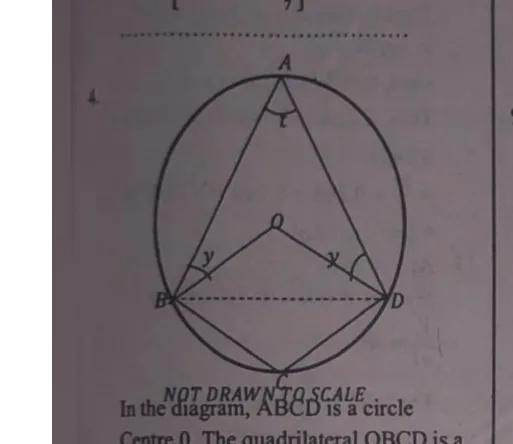
In the diagram, ABCD is a circle centre O. The quadrilateral OBCD is a rhombus such that ∠ADO=∠OBA=y and ∠BAD=t. Find:
(a) the value of t;
(b) the value of y;
(c) ∠ADC.
Model answer
Since OBCD is a rhombus and O is the centre of the circle passing through A, B, C, D, all sides OB, BC, CD, DO equal the radius r, and since C also lies on the circle, OC = r too. This means triangles OBC and OCD are each equilateral (all three sides = r), so ∠BOC = ∠COD = 60°, giving ∠BOD (measured through C) = 120°.
(a) The angle t = ∠BAD is the inscribed angle standing on arc BD (the arc containing C), and the angle at the centre standing on the same arc is 120°. By the inscribed angle theorem (angle at centre = twice angle at circumference): t = 120°/2 = 60°.
(b) Since OA=OB=r, triangle OAB is isosceles with ∠OAB=∠OBA=y. Similarly triangle OAD is isosceles with ∠OAD=∠ODA=y. Since OA bisects ∠BAD by symmetry: t = 2y → 60° = 2y → y = 30°.
(c) In the rhombus OBCD, opposite angles are equal: ∠O=∠C=120°, so ∠B+∠D=360°−120°−120°=120°, and since ∠B=∠D, each = 60°. So ∠ODC=60°.
∠ADC = ∠ADO + ∠ODC = y + 60° = 30° + 60° = 90°.
A basket contains 3 gold-plated marbles, 4 diamond marbles and some silver marbles, all of the same size and shape. Two marbles were drawn from the basket at random one after the other without replacement. If the probability that the two marbles were all silver is 1/15, find the number of silver marbles.
Model answer
Let the number of silver marbles = s. Total marbles = 3+4+s = 7+s.
P(both silver, no replacement) = [s/(7+s)] × [(s−1)/(6+s)] = 1/15.
15s(s−1) = (7+s)(6+s)
15s²−15s = s²+13s+42
14s²−28s−42 = 0
Dividing by 14: s²−2s−3 = 0
(s−3)(s+1) = 0 → s = 3 (rejecting the negative root).
Number of silver marbles = 3.
Given that (x+2), (4x+3) and (7x+24) are consecutive terms of a Geometric Progression (G.P), find:
(a) value of x;
(b) common ratio.
Model answer
For consecutive G.P terms, the middle term squared equals the product of the outer terms:
(4x+3)² = (x+2)(7x+24)
16x²+24x+9 = 7x²+38x+48
9x²−14x−39 = 0
Using the quadratic formula: x = [14±√(196+1404)]/18 = [14±√1600]/18 = [14±40]/18
x = 54/18 = 3 (taking the positive root).
(a) x = 3.
Check: (x+2)=5, (4x+3)=15, (7x+24)=45. 15/5=3, 45/15=3 ✓ confirms a valid G.P.
(b) Common ratio = 3.
Two observers Abu and Badu, 46m apart, observe a board on a vertical pole from the same side of the bird. The angles of elevation of the bird from Abu's and Badu's eye are 40° and 48° respectively. If at the foot of the pole, Abu and Badu are on the same horizontal:
(a) illustrate the information in a diagram;
(b) calculate, correct to one decimal place, the height of the pole.
Model answer
(a) Let the height of the pole (to the board) be h. Since Badu's angle of elevation (48°) is greater than Abu's (40°), Badu is closer to the pole. Let Badu's horizontal distance from the foot of the pole = d, so Abu's distance = d+46 (Abu being further away). A simple diagram would show: the pole standing vertically at one end, with Badu at distance d from its foot and Abu at distance (d+46) from its foot, both on the same horizontal line, with lines of sight rising at 48° (from Badu) and 40° (from Abu) to the top of the pole.
(b) tan48° = h/d → d = h/tan48°
tan40° = h/(d+46) → d+46 = h/tan40°
Subtracting: h/tan40° − h/tan48° = 46
h(1/tan40° − 1/tan48°) = 46
h(1.1918 − 0.9004) = 46
h(0.2914) = 46
h = 46/0.2914 ≈ 157.9m (correct to one decimal place).
The diameter of a circle centre O is 26cm. If a chord PQ is drawn such that it is 5cm from O to the centre of the chord, calculate, correct to the nearest whole number:
(a) ∠POQ;
(b) area of the minor segment formed by the chord PQ. [Take π=22/7]
Model answer
Radius r=13cm (half of diameter 26cm). Perpendicular distance from O to chord PQ = 5cm.
Half-chord length = √(r²−d²) = √(169−25) = √144 = 12cm, so PQ=24cm.
(a) In the right triangle formed by O, the midpoint of PQ, and P: cos(∠POQ/2) = 5/13 → ∠POQ/2 = cos⁻¹(5/13) = 67.38° → ∠POQ = 134.76° ≈ 135° (to the nearest whole number).
(b) Area of sector POQ = (θ/360)×πr² = (134.76/360)×(22/7)×169 ≈ 0.3743×531.14 ≈ 198.8cm².
Area of triangle POQ = (1/2)r²sinθ = 0.5×169×sin(134.76°) = 84.5×0.7106 ≈ 60.1cm².
Area of minor segment = Sector − Triangle = 198.8−60.1 ≈ 138.7 ≈ 139cm² (to the nearest whole number).
(a) In a man's will, he gave 2/5 of the total acres of his cocoa farm to the wife and 1/3 of what is left to be shared for family upkeep. The rest of the farm was to be shared amongst his three children in the ratio 3:5:2. Given that the child who had the least share received 8 acres, calculate: (i) total acres the man left; (ii) number of acres the wife received.
(b) The list price of a television set is $1,600.00. It can be purchased by a deposit of $400.00 and the rest of the amount paid by 12 monthly instalment at 25% per annum simple interest. If the television set is purchased by instalment, find the total cost.
Model answer
(a) Let total acres = T. Wife's share = 2/5T. Remainder = 3/5T. Of this remainder, 1/3 goes to family upkeep, leaving 2/3 × 3/5T = 2/5T for the three children, shared in ratio 3:5:2 (total 10 parts).
Least share (2 parts) = 8 acres → 1 part = 4 acres → children's total share (10 parts) = 40 acres = 2/5T.
(i) T = 40 × 5/2 = 100 acres.
(ii) Wife's share = 2/5 × 100 = 40 acres.
(b) Deposit = $400. Balance = $1600−$400 = $1200, paid over 12 months (1 year) at 25% p.a simple interest.
Interest = PRT/100 = (1200×25×1)/100 = $300.
Total instalment payments = $1200+$300 = $1500.
Total cost = Deposit + Instalment total = $400+$1500 = $1900.
(a) Find the equation of the line that passes through the origin and the point of intersection of the lines x+2y=7 and x−y=4.
(b) The ratio of an interior angle to an exterior angle of a regular polygon is 4:1. Find: (i) number of sides; (ii) value of the exterior angle; (iii) sum of the interior angles of the polygon.
Model answer
(a) Solve x+2y=7 and x−y=4 simultaneously: from the second equation, x=y+4. Substituting: (y+4)+2y=7 → 3y+4=7 → 3y=3 → y=1, x=5.
Intersection point = (5,1). Line through origin (0,0) and (5,1) has gradient = 1/5.
Equation: y = (1/5)x, i.e. x−5y=0.
(b) Interior:Exterior = 4:1. Since interior+exterior=180° (angles on a straight line): let exterior=e, interior=4e. 4e+e=180° → 5e=180° → e=36°.
(i) Number of sides = 360°/e = 360/36 = 10 sides.
(ii) Exterior angle = 36°.
(iii) Sum of interior angles = (n−2)×180° = (10−2)×180° = 8×180° = 1440°.
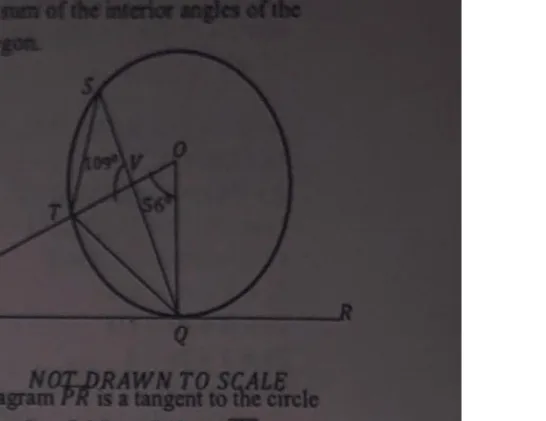
(a) In the diagram, PR is a tangent to the circle centre O at Q. ∠POQ=56° and PO intersects SQ at V such that ∠SVP=109°. Calculate: (i) ∠TQP; (ii) ∠QTS.
(b) Simplify: (2n²−3n−2)/(2n²+3n+1) × (n²−1)/(n²−4)
Model answer
(a) Since V lies on line OP, ∠VOQ = ∠POQ = 56°. Using the exterior angle theorem on triangle OVQ, the exterior angle ∠SVP (=109°) equals the sum of the two opposite interior angles: ∠SVP = ∠VOQ + ∠VQO. So 109° = 56° + ∠VQO → ∠VQO = 53°.
Since OQ is a radius and PR is a tangent to the circle at Q, OQ ⊥ PR, so ∠OQP = 90°.
(i) ∠TQP = ∠OQP − ∠VQO = 90° − 53° = 37°.
(ii) By the tangent-chord angle theorem, the angle between tangent QP and chord QT equals the angle in the alternate segment: ∠QTS = ∠TQP = 37°.
(b) Factorising: 2n²−3n−2 = (2n+1)(n−2); 2n²+3n+1 = (2n+1)(n+1); n²−1 = (n−1)(n+1); n²−4 = (n−2)(n+2).
Expression = [(2n+1)(n−2)/((2n+1)(n+1))] × [(n−1)(n+1)/((n−2)(n+2))]
= [(n−2)/(n+1)] × [(n−1)(n+1)/((n−2)(n+2))]
= (n−1)(n+1)/[(n+1)(n+2)] [the (n−2) terms cancel]
= (n−1)/(n+2) [the (n+1) terms cancel].
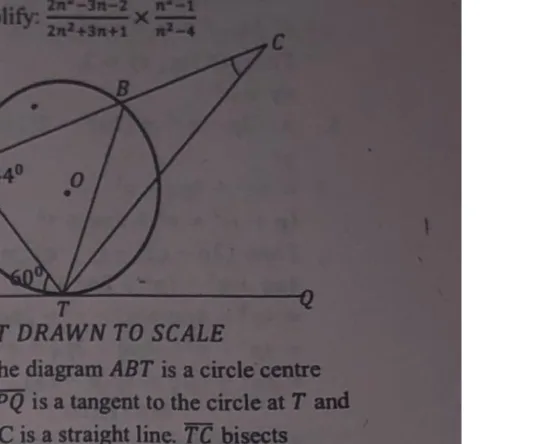
In the diagram, ABT is a circle centre O. PQ is a tangent to the circle at T and ABC is a straight line. TC bisects ∠BTQ. ∠BAT=44° and ∠PTA=60°. Find ∠ACT.
(b) The circumference of the base of a cylindrical tank is 11m. The height of the tank is 3m more than 6 times the base radius. Calculate: (i) radius; (ii) height; (iii) volume of the tank. [Take π=22/7]
Model answer
(a) By the tangent-chord angle theorem, ∠PTA (between tangent PT and chord TA) = angle in the alternate segment = ∠ABT = 60°.
Since ABC is a straight line, in triangle ABT: ∠BAT+∠ABT+∠ATB=180° → 44°+60°+∠ATB=180° → ∠ATB=76°.
Also by the tangent-chord angle theorem, ∠BTQ (between tangent TQ and chord TB) = angle in alternate segment = ∠BAT = 44°.
Since TC bisects ∠BTQ: ∠BTC = ∠CTQ = 22° each.
∠ATC = ∠ATB + ∠BTC = 76° + 22° = 98°.
Since ABC is a straight line, ∠TAC = ∠TAB = 44° (same ray).
In triangle ATC: ∠ACT = 180° − ∠TAC − ∠ATC = 180° − 44° − 98° = 38°.
(b) Circumference = 2πr = 11m → r = 11/(2×22/7) = 11×7/44 = 1.75m.
(i) Radius = 1.75m.
Height = 6r+3 = 6(1.75)+3 = 10.5+3 = 13.5m.
(ii) Height = 13.5m.
(iii) Volume = πr²h = 22/7×(1.75)²×13.5 = 22/7×3.0625×13.5 = 22/7×41.34375 ≈ 129.9m³.
Advertisement
Sign up free to unlock
Score tracking
Practice history
Saved questions
Progress dashboard
Personalized sessions
Weak-topic breakdown
…and/or go further with premium services and No Ads.