Free account: track your progress — Sign up free

JAMB Accounting 2020 Objective Past Questions

All 40 questions from the Joint Admissions and Matriculation Board (JAMB) Accounting 2020 Objective paper, with the correct answer and a full explanation for each. Free, no signup needed.

Advertisement

Accounting 2020 Objective — Question 1

1. Book-keeping deals with ......... and financial accounting deals with ......... .

  • A. A. Computation/documentation
  • B. B. Documentation/recording
  • C. C. Recording/documentation
  • D. D. Documentation/computationCorrect

Explanation

Book-keeping deals with documentation of financial records while financial accounting deals with computation and analysis of records.

Accounting 2020 Objective — Question 2

2. Sales day book is used to record

  • A. A. Total sales for the day
  • B. B. Cash sales for the day
  • C. C. Credit sales for the dayCorrect
  • D. D. None of the above

Explanation

The sales day book is used to record credit sales for the day; the total in the sales day book indicates the total debtors.

Accounting 2020 Objective — Question 3

3. Use the following information to answer question 3 and 4: Ibikunle ltd. has the following records: Stock 1/1/19 N500, Sales N15,000, Purchases N7,000, Stock 31/12/19 N900. Director withdrew goods that worth N600. Calculate mark-up for the business

  • A. A. 50%
  • B. B. 100%
  • C. C. 150%Correct
  • D. D. 20%

Explanation

Cost of goods sold = Opening stock + Purchases - Director's withdrawal - Closing stock = 500+7000-600-900 = 6000. Profit = Sales - COGS = 15000-6000 = 9000. Mark-up = Profit/Cost of sale = 9000/6000 = 150%.

Accounting 2020 Objective — Question 4

4. What is the cost of sales for the year? (using the Ibikunle ltd. data in Q3)

  • A. A. N6,600
  • B. B. N6,000Correct
  • C. C. N7,000
  • D. D. N9,000

Explanation

Cost of sales = Opening stock + Purchases - Director's withdrawal - Closing stock = 500+7000-600-900 = N6,000.

Accounting 2020 Objective — Question 5

5. In government accounting, CRF stands for?

  • A. A. Consolidated revenue fundCorrect
  • B. B. Combined revenue fund
  • C. C. Cost-revenue formula
  • D. D. Consolidated revised fund

Explanation

CRF means Consolidated Revenue Fund in government accounting; it is the account used to record all funds belonging to federal, state and local government.

Accounting 2020 Objective — Question 6

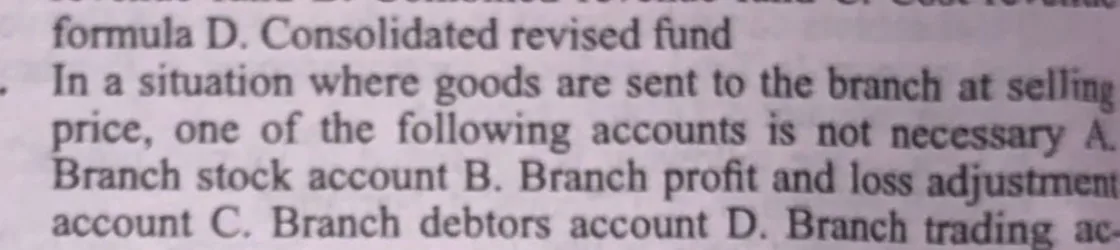
6. In a situation where goods are sent to the branch at selling price, one of the following accounts is not necessary

Diagram for question 6
  • A. A. Branch stock account
  • B. B. Branch profit and loss adjustment account
  • C. C. Branch debtors account
  • D. D. Branch trading accountCorrect

Explanation

If goods are sent to the branch at selling price, there is no need for a branch trading account, because the profit calculated by headquarters for the branch will be the same as the profit gotten by the branch.

Accounting 2020 Objective — Question 7

7. [See diagram] The correct title for the account above is

  • A. A. Debtors control accountCorrect
  • B. B. Creditors control account
  • C. C. Sales account
  • D. D. Purchases account

Explanation

The T-account shown, based on its typical entries (balance b/d, credit sales, cash received, discount allowed, returns), represents the Debtors Control Account, which summarises all transactions with debtors.

Accounting 2020 Objective — Question 8

8. The difference between a bank statement and bank reconciliation statement is?

  • A. A. No difference
  • B. B. Bank statement is not an account
  • C. C. Bank reconciliation statement is not an accountCorrect
  • D. D. Bank statement is an account

Explanation

A bank statement is a periodic document sent by banks to customers while a bank reconciliation statement is the account used to reconcile the discrepancy between a bank statement and the cash book.

Accounting 2020 Objective — Question 9

9. Imprest is used to record

  • A. A. All cash transactions
  • B. B. Petty cash transactionsCorrect
  • C. C. All credit transactions
  • D. D. Petty credit transactions

Explanation

The imprest system is used to record petty cash transactions in order not to overload the main cash book.

Accounting 2020 Objective — Question 10

10. If Mr. Yusuf starts a business with N20,000 in his bank account, this transaction will be recorded as a

  • A. A. Dr: cash account Cr: capital account
  • B. B. Dr: cash account Cr: bank account
  • C. C. Dr: capital account Cr: bank account
  • D. D. Dr: bank account and Cr: capital accountCorrect

Explanation

When a new business starts, the accounting record is always Dr: cash/bank account and Cr: capital account. Since the money is in the bank, the bank account will be debited.

Accounting 2020 Objective — Question 11

Use the following information to answer question 11 and 12: ABC ltd purchase a machine worth N6500 on 1st of January 19x0. If the netbook value of all machines is at same date is N40,000 with accumulated depreciation of N11,300. The expected life span of all machines is 5 years. 11. What is the accumulated depreciation as at year end?

  • A. A. N12,600
  • B. B. N11,560
  • C. C. N22,860Correct
  • D. D. N10,260

Explanation

Depreciation of the new machine = 6,500/5 = N1,300. Depreciation per year on old machines = 51,300/5 = N10,260 (NBV of old machines = 40,000+11,300 = 51,300). Total accumulated depreciation = 11,300+10,260+1,300 = N22,860.

Accounting 2020 Objective — Question 12

12. What is the netbook value of all machines as at year end? (using the Q11 data)

  • A. A. N34,940Correct
  • B. B. N46,500
  • C. C. N45,200
  • D. D. N33,900

Explanation

NBV of all machines = cost of all machines - accumulated depreciation on all machines = (51,300+6,500) - 22,860 = N34,940.

Accounting 2020 Objective — Question 13

13. Which of the following is odd?

  • A. A. Reducing balance
  • B. B. Sum of year digits
  • C. C. Straight line
  • D. D. Cost valueCorrect

Explanation

Reducing balance, sum-of-year-digits and straight line are all methods used for calculating depreciation; cost value is therefore the odd one out.

Accounting 2020 Objective — Question 14

14. Which of the following is not a source document?

  • A. A. Receipt
  • B. B. Debit not C.
  • C. C. cashbook
  • D. D. Sales accountCorrect

Explanation

Source documents are documents used in entering transactions to their proper accounts; they are books of original entry. The sales account is a ledger entry, not a source document.

Accounting 2020 Objective — Question 15

15. The cost of repairing motor van was recorded in motor van account, the error committed is

  • A. A. No error
  • B. B. Error of commission
  • C. C. Error of principleCorrect
  • D. D. Error of compensation

Explanation

When an account of a nominal nature, such as repairs, is recorded in an account of a real nature, an error of principle has been committed.

Accounting 2020 Objective — Question 16

16. The equivalent of statement of affairs of non-profit organization is a profit oriented organization is a

  • A. A. Profit and loss account
  • B. B. Cash book
  • C. C. Receipt and payment account
  • D. D. Balance sheetCorrect

Explanation

The statement of affairs in a not-for-profit making organisation is equivalent to the balance sheet of a profit-making organisation.

Accounting 2020 Objective — Question 17

17. Subscription in arrears is ......... to the organization The statement of account of Home Boys Social club shows the following: Arrears for current year N150, Advance pay since last year N100, Receipt for the year: Previous arrears N3000, Due for the year N4000, Advance pay N1000

  • A. A. AssetCorrect
  • B. B. Liability
  • C. C. Capital
  • D. D. Income

Explanation

Subscription in arrears is just like debt owing the organisation. Since debtors are assets to the organisation, so also is subscription in arrears.

Accounting 2020 Objective — Question 18

18. Subscription to be posted to the income and expenditure account is (using Q17 data)

  • A. A. N6,050
  • B. B. N8,000
  • C. C. N4,150Correct
  • D. D. N8,250

Explanation

The subscription charged into the income and expenditure account is the subscription due for the year. Cash received for subscription due for the year is N4000 and subscription due for the year not paid is N150. Total = 4000+150 = N4,150.

Accounting 2020 Objective — Question 19

19. LIFO doing inflation will

  • A. A. Over value stock
  • B. B. Under value stockCorrect
  • C. C. Value stock at par
  • D. D. Have no effect on stock

Explanation

LIFO means last-in-first-out. If goods that come into store last are the first to be issued, the old stock will lose value during a period of inflation, thereby undervaluing stock.

Accounting 2020 Objective — Question 20

20. The main difference between financial accounting and cost accounting is?

  • A. A. Financial accounting is useful internally only
  • B. B. Cost accounting is useful internally onlyCorrect
  • C. C. Financial accounting is useful externally only
  • D. D. Cost accounting is useful both internally and externally

Explanation

Cost accounting is prepared for management decision; thus it is mostly useful for internal consumption.

Accounting 2020 Objective — Question 21

21. Which of the following is correct?

  • A. A. Capital + current liabilities = Assets + long term liabilities
  • B. B. Assets - current assets = fixed asset + long term liability
  • C. C. Capital - current asset = fixed asset - long term liabilitiesCorrect
  • D. D. Long term liability - capital = Assets + current liabilities

Explanation

The accounting equation is Asset = Capital + Liability. Through mathematical manipulation: Capital - fixed assets + current liability = current asset - long term liabilities.

Accounting 2020 Objective — Question 22

22. The accuracy of ledgers is checked by

  • A. A. Trading account
  • B. B. Profit and loss account
  • C. C. Balance sheet
  • D. D. Trial balanceCorrect

Explanation

The Trial Balance is the list of balances in the ledger. It tests the accuracy of ledger balances.

Accounting 2020 Objective — Question 23

23. The total in the manufacturing account is

  • A. A. Prime cost
  • B. B. Overhead cost
  • C. C. Cost of sales
  • D. D. Cost of finished goodsCorrect

Explanation

The total amount in the manufacturing account indicates the cost of finished goods that will be transferred to the trading account.

Accounting 2020 Objective — Question 24

24. The principle of double entry is credited to

  • A. A. Lucas PacioloCorrect
  • B. B. Lucas Luca
  • C. C. Lucas Arthur
  • D. D. None of the above

Explanation

Lucas Paciolo introduced the principle of double entry.

Accounting 2020 Objective — Question 25

25. Acid test is used to

  • A. A. Test acidity of accounting records
  • B. B. Test viability of accounting records
  • C. C. Test correctness of accounting records
  • D. D. Test ability of the firm to meet its daily cash obligationCorrect

Explanation

The acid test is used to test the liquidity of the firm. The liquidity test shows the ability of the firm to meet its cash obligations within a short term.

Accounting 2020 Objective — Question 26

26. Reimbursement in imprest system is

  • A. A. Payment of debt
  • B. B. Amount spent from the imprestCorrect
  • C. C. Compensation pay for loss
  • D. D. Repayment

Explanation

Reimbursement is the amount returned to the petty cashier for the petty expenses incurred within a particular period of time.

Accounting 2020 Objective — Question 27

27. Rent paid in advance is a

  • A. A. Liability
  • B. B. AssetCorrect
  • C. C. Income
  • D. D. Loss

Explanation

When rent is paid in advance, it means the landlord is owing the firm; thus, it is treated like a debtor and therefore an asset.

Accounting 2020 Objective — Question 28

28. Discount allowed to debtors to encourage early payment is

  • A. A. Cash discountCorrect
  • B. B. Trade discount
  • C. C. Commission
  • D. D. Periodic discount

Explanation

Discount allowed to debtors to encourage early payment is cash discount.

Accounting 2020 Objective — Question 29

29. Debtors is N4000. The new net profit after making 5% provision for doubtful debt is

  • A. A. N360
  • B. B. N3,600Correct
  • C. C. N4,400
  • D. D. N3,000

Explanation

The cost of new provision for bad debt is 5% x N4000 = N800. New profit = N4,000 - N800 = N3,200.

Accounting 2020 Objective — Question 30

30. (i) Land and building account (ii) Salaries account (iii) Rent account (iv) Land repair account. Which of the above is/are nominal account(s)

  • A. A. i only
  • B. B. i and ii only
  • C. C. ii, iii and iv onlyCorrect
  • D. D. ii and iii only

Explanation

Nominal account is the account used to record transactions that occur regularly, such as rent and wages, etc. Salaries, rent and land repair are nominal accounts.

Accounting 2020 Objective — Question 31

31. The difference between a chain shop and departmental store is

  • A. A. departmental store operate under a single roofCorrect
  • B. B. chain store operate under a single roof
  • C. C. chain store has stores side by side
  • D. D. departmental store has many stores

Explanation

A departmental store operates under a single roof, which is the basis for apportioning joint expenses in a departmental store.

Accounting 2020 Objective — Question 32

32. When a partnership operation is converted to a public liability company, balances in the current accounts of partners will be transferred to

  • A. A. capital accountCorrect
  • B. B. profit and loss appropriation account
  • C. C. bank account
  • D. D. share capital account

Explanation

The balances in the current account of partners will be transferred to the capital account in the case of wind up or conversion, and the capital account will be closed.

Accounting 2020 Objective — Question 33

33. The accounting concept that states how expenses will be treated is a

  • A. A. consistency concept
  • B. B. reality concept
  • C. C. objectivity concept
  • D. D. materiality conceptCorrect

Explanation

Materiality concept is the accounting concept that states that transactions should be recognized based on their materiality, i.e. how much is involved and how such amount affects the cash of the business.

Accounting 2020 Objective — Question 34

34. The imprest account, at the end of the year, will be transferred to

  • A. A. cash accountCorrect
  • B. B. bank account
  • C. C. profit and loss account
  • D. D. ledger account

Explanation

The balance on the imprest at the end of the year will be transferred to the cash book for proper effect.

Accounting 2020 Objective — Question 35

35. One of the following is not the reason why the cash book and bank statement disagree

  • A. A. Dishonoured cheque
  • B. B. Unpresented cheque
  • C. C. Uncredited cheque
  • D. D. Honoured chequeCorrect

Explanation

An honoured cheque will not cause discrepancy between the cash book and the bank statement because both would have duly recorded it in corresponding effects.

Accounting 2020 Objective — Question 36

36. Goodwill is a

  • A. A. Fictitious assetCorrect
  • B. B. Fixed asset
  • C. C. Current asset
  • D. D. Investment

Explanation

Goodwill is a fictitious asset because it cannot be seen nor touched.

Accounting 2020 Objective — Question 37

37. Working capital is

  • A. A. Total assets - liabilities
  • B. B. Current liabilities - current assets
  • C. C. Capital - liabilities
  • D. D. Current assets - current liabilitiesCorrect

Explanation

Working capital = current asset - current liability.

Accounting 2020 Objective — Question 38

38. Entry in the subsidiary book which does not form part of the double entry system is

  • A. A. Contra entry
  • B. B. Journal entry
  • C. C. Memorandum entryCorrect
  • D. D. Single entry

Explanation

Memorandum entries are entries in pamphlets such as notification of meeting. Thus, it will not be transferred to the book of double entry.

Accounting 2020 Objective — Question 39

39. Partners' salary is effected in

  • A. A. Profit and loss account
  • B. B. Trading account
  • C. C. Profit and loss appropriation accountCorrect
  • D. D. Partners' bank account

Explanation

Partners' salaries will be effected in the profit and loss appropriation account as well as the current account/capital account of each partner or as the case may be.

Accounting 2020 Objective — Question 40

40. First accounting entry for shares forfeited is

  • A. A. Dr: forfeited share account Cr: cash account
  • B. B. Dr: application account Cr: forfeited share accountCorrect
  • C. C. Dr: cash account Cr: forfeited share account
  • D. D. Dr: forfeited share account Cr: cash account

Explanation

When shares are forfeited, the application for such number of shares will be cancelled. Thus, the proper accounting entry is to debit application account and credit forfeited share account.

Advertisement

Sign up free to unlock

  • Score tracking
  • Practice history
  • Saved questions
  • Progress dashboard
  • Personalized sessions
  • Weak-topic breakdown

…and/or go further with premium services and No Ads.