All 50 questions from the Joint Admissions and Matriculation Board (JAMB) Biology 2008 Objective paper, with the correct answer and a full explanation for each. Free, no signup needed.
In terms of the number of 61 individuals, which of the following tax is a most inclusive?
A. Order
B. Family
C. ClassCorrect
D. Species
Explanation
The most inclusive tax (in terms of the number of individuals) is the kingdom while the least inclusive is the species. Kingdom > Phyllum > Class > Order > Family > Genus > Species. From the list given, the most inclusive is the class.
A characteristic that can possibly be shared by both living and non-living organisms is
A. locomotion
B. irritability
C. increase in biomassCorrect
D. increase in size
Explanation
It is possible for a non-living thing to move. For example, a car can move if fuel is available; increase in biomass can also occur for non-living entities like fire.
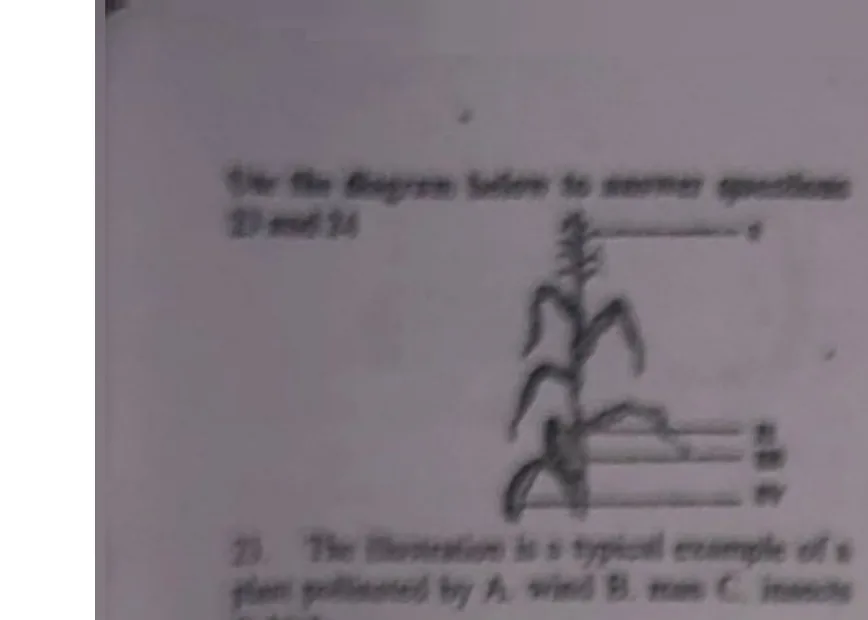
Use the diagram below to answer questions 4 and 5 (wind-pollinated plant, corn). Which of the organisms is characterized by the possession of a chitinous exoskeleton?
A. ICorrect
B. II
C. III
D. IV
Explanation
The possession of chitinous exoskeleton is a feature of insects. 'I' is an insect, 'II' is a fish, 'III' is a bird while 'IV' refers to hydra.
The most important characteristic that makes reptiles to conquer terrestrial habitats is
A. the possession of a long tail
B. scaly skinCorrect
C. sharp claw
D. amniotic egg
Explanation
The scaly skin is the most important characteristic that makes reptiles live successfully in terrestrial habitats. It prevents reptiles from getting desiccated.
The order of passage of food in the digestive system is
A. ileum caecum large intestine rectum
B. ileum colon caecum rectumCorrect
C. large intestine ileum caecum rectum
D. colon caecum ileum rectum
Explanation
The food moves from the ileum (one of the three main divisions of the small intestine) to the colon (a part of the large intestine). It then moves from the colon to the caecum, and finally to the rectum. Thus, the sequence is: Ileum -> colon -> caecum -> rectum.
Insectivorous plants trap and kill their prey to derive
A. phosphorous
B. calcium
C. nitrogenCorrect
D. zinc
Explanation
Insectivorous or carnivorous plants trap and kill their prey in order to derive nitrogen. This is because these plants normally grow in areas with little nitrogen supply.
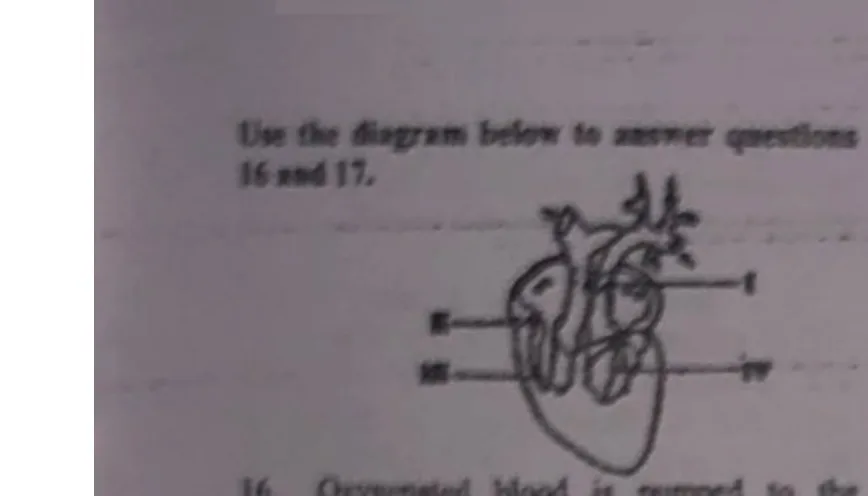
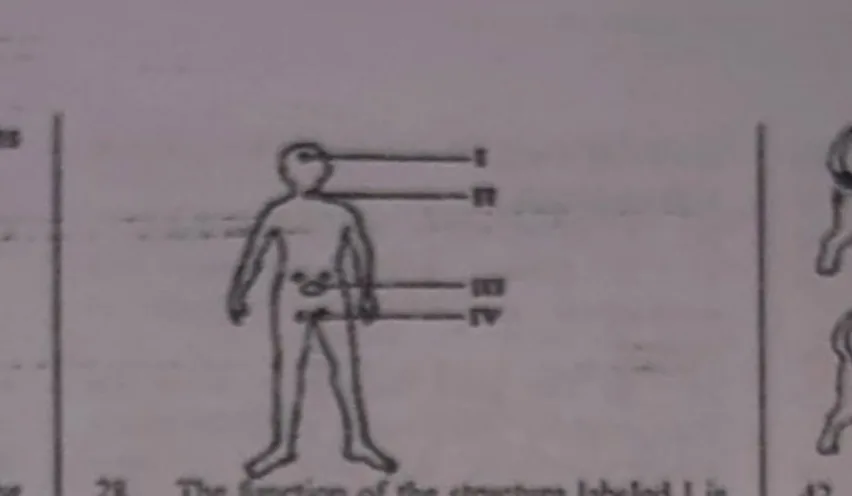
Use the diagram below to answer questions 16 and 17 (heart with 4 labeled parts). Which represents the heart while which represents the lungs?
A. I represents the heart, II represents the lungsCorrect
B. II represents the heart, I represents the lungs
C. III represents the heart, IV represents the lungs
D. IV represents the heart, III represents the lungs
Explanation
'I' represents the heart while 'II' represents the lungs. The blood vessel that carries blood from the heart to the lungs is known as the pulmonary artery while the one that returns blood from the lungs to the heart is known as the pulmonary vein.
A. isotonic to the content of the cytoplasm of the cells in pawpaw X
B. hypertonic to the content of the cytoplasm of the cells in pawpaw XCorrect
C. hypotonic to the content of the cytoplasm of the cells in pawpaw Y
D. equal to the content of the cytoplasm
Explanation
Concentrated salt solution is hypertonic to the content of the cytoplasm of the cells in pawpaw X. This causes the outflow of water from the pawpaw. Distilled water, on the other hand, is hypotonic to the content of the cytoplasm of the cells in pawpaw Y. This causes the in-flow of water into the pawpaw. Summarily, the two events cause X to become progressively flaccid while Y becomes turgid.
The exhaled air contains more CO2, H2O and heat than inhaled air. This is because these substances are produced as by-products of cellular respiration. C6H12O6 + 6O2 -> 6CO2 + 6H2O + Energy.
Use the diagram below to answer questions 23 and 24 (flower parts I-IV labeled). 'I' represents the
A. styles
B. leaf
C. male inflorescenceCorrect
D. stem
Explanation
'I' is the male inflorescence, 'II' represents the styles, 'III' is a leaf while 'IV' represents the female inflorescence. In wind pollinated flowers, the male inflorescence is positioned in such a way that they swing readily in air, causing them to release the pollen grains easily; such is the case with the diagram given. As indicated earlier, the structure labeled 'I' is the male inflorescence.
Which of the following is an example of parasitism?
A. Mistletoe growing on an orange treeCorrect
B. Fungi growing on a dead tree branch
C. Cattle egrets taking ticks from the body of cattle
D. A squirrel living in an abandoned nest of a bird
Explanation
Mistletoe growing on an orange tree is an example of parasitism. Fungi growing on a dead tree branch is saprophytism. Cattle egrets taking ticks from cattle is mutualism. A squirrel living in an abandoned bird's nest is commensalism.
One adaptation shown by hydrophytes in fresh water habitats is the
A. poor development of roots and xylem tissuesCorrect
B. well-developed roots and supporting system
C. leaves reduced to spines
D. waxy cuticle on shoot surface
Explanation
One adaptation shown by hydrophytes in fresh water habitats is the poor development of roots and xylem tissues; they well-developed roots and supporting system, leaves reduced to spines and waxy cuticle on shoot surface are features of xerophytes.
A crucible of 5 gm, weighed 10gm after filling with fresh soil. It is then heated in an oven at 100C for 1 hour. After cooling in a desiccator, the weight was 8 gm. Percentage of water in the soil is
A. 20%
B. 40%Correct
C. 60%
D. 80%
Explanation
Mass of crucible = 10g. Mass of crucible and soil before heating = 5+... water content is calculated using mass before and after heating, giving approximately 40%.
A. It involves the asexual multiplication of the tissues of the original organismsCorrect
B. The clone is dissimilar to but not exactly like the original organism
C. Only one cell of the original organism is needed to initiate the process
D. It is welcomed as an ethically and morally sound science
Explanation
Cloning involves the asexual multiplication of the tissues of the original organisms. The clone is similar to but not exactly like the original organism. Only one cell of the original organism is needed to initiate the process. It is not universally welcomed as ethically and morally sound science by all.
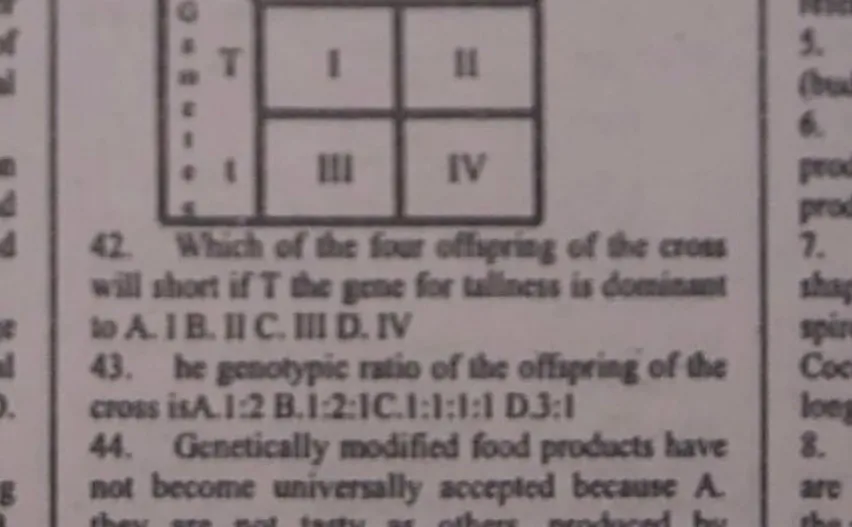
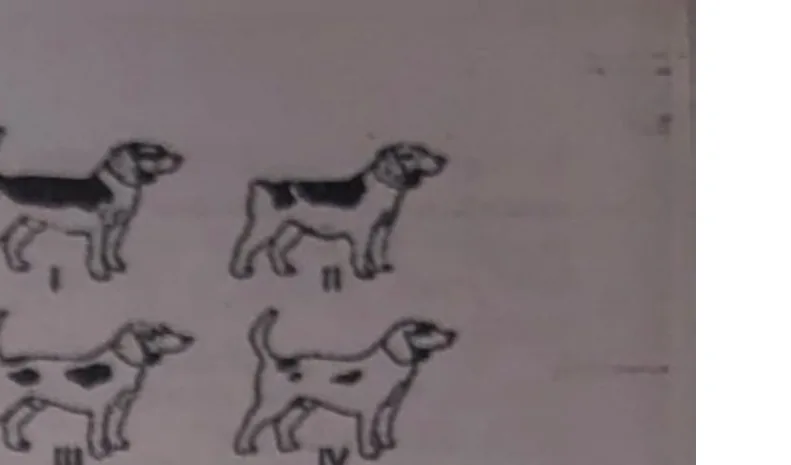
Use the diagram below to answer questions 42 and 43 (dogs I-IV). If the dogs are offspring of a monohybrid cross and the gene G for grey head is dominant over its allele e.g. the individual whose genotype is likely to be egg is
A. ICorrect
B. II
C. III
D. IV
Explanation
For a monohybrid cross where G (grey head) is dominant, the individual with the recessive phenotype (no grey head) most likely has the homozygous recessive genotype, corresponding to option A.
Which of the following will be true of dog II which lost its tail in an accident if it relates with dog III?
A. All its offspring will be born without tails
B. 1/4 of its offspring will be born without tails
C. None of its offspring will be born without a tailCorrect
D. 3/4 of its offspring will be born without tails
Explanation
Since losing a tail in an accident is not a heritable genetic change, none of dog II's offspring will be born without a tail as a result of this accident.