Biology 2010 Objective — Question 1
Which Biology Question Paper Type is given to you?
- A. Type A
- B. Type B
- C. Type CCorrect
- D. Type D
Explanation
This is a Type C Biology Question Paper, as indicated on the paper's header.
All 50 questions from the Joint Admissions and Matriculation Board (JAMB) Biology 2010 Objective paper, with the correct answer and a full explanation for each. Free, no signup needed.
Advertisement
Which Biology Question Paper Type is given to you?
This is a Type C Biology Question Paper, as indicated on the paper's header.
Which of the following characterizes a mature plant cell?
Unlike animal cells where the nucleus is central, a mature plant cell has its nucleus pushed to the edge as the vacuole enlarges. The cell wall of a plant is always made of cellulose.
Which of the following is NOT a function of the nucleus of a cell?
The nucleus controls cell processes, translates genetic information, and stores hereditary information. Energy reservoir/production is the role of the mitochondrion, not the nucleus.
The dominant phase in the life cycle of a fern is the
The gametophyte is the dominant phase in the life cycle of bryophytes (e.g. mosses), while the sporophyte is the dominant phase in pteridophytes (e.g. ferns).
Parental care is exhibited by
Parental care describes animals that show great care for their young. Birds and mammals exhibit the greatest parental care, though fish and amphibians can show some care to a lesser extent.
Use the diagram below to answer questions 6 and 7 With respect to their decreasing dependence on aquatic conditions for reproduction, which of the following is the correct arrangement of the animals represented?
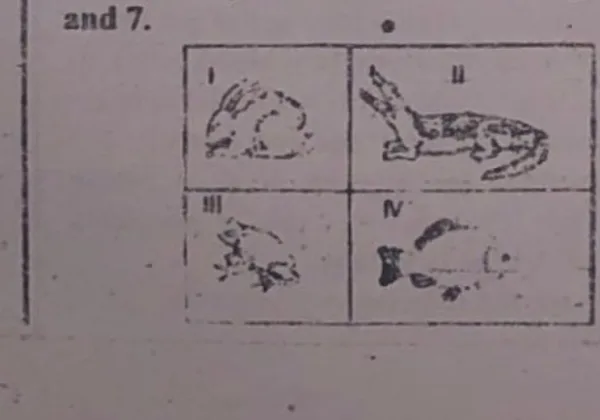
The correct sequence of decreasing dependence on water for reproduction is IV, III, II, I — fish are the most water-dependent, followed by amphibians, then reptiles, then birds/mammals being least dependent.
Which of the animals represents the oldest creatures in terms of evolutionary history?
The first vertebrates to evolve were the pisces (fish), followed by amphibians, then reptiles, then birds, and finally mammals; the animal labelled IV (fish) represents the oldest lineage.
Which of the following groups of cells is devoid of true nuclei?
Organisms in Kingdom Monera (prokaryotes such as bacteria) lack a true, membrane-bound nucleus — their nuclear material is scattered within the cytoplasm.
Use the diagram below to answer Questions 9 and 10 The main function of the feathers covering the part labeled I is to
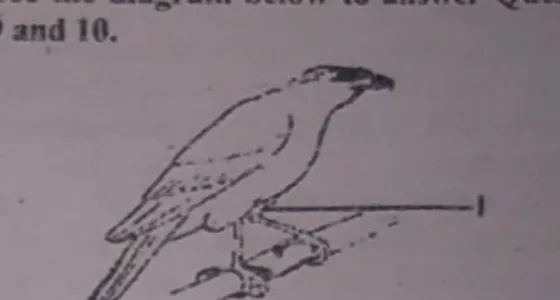
The feathers covering the labelled part (tail/wing area) primarily protect the bird from ectoparasites attacking the skin.
Based on the shape and structure of the beak and feet, the bird represented is likely to feed mainly on
The hooked beak and sharp talons shown are typical of a bird of prey (carnivorous), so it is clearly adapted for feeding on flesh.
Which of the following is true of the transverse section of a dicot stem?
In a dicot stem, the xylem transports water and mineral salts up from the soil and is located more interiorly (centrally) than the phloem, which transports manufactured food to other plant parts.
Use the diagram below to answer questions 12 and 13 The movement of material in the xylem and phloem tissues of the plant are represented by the arrows labeled
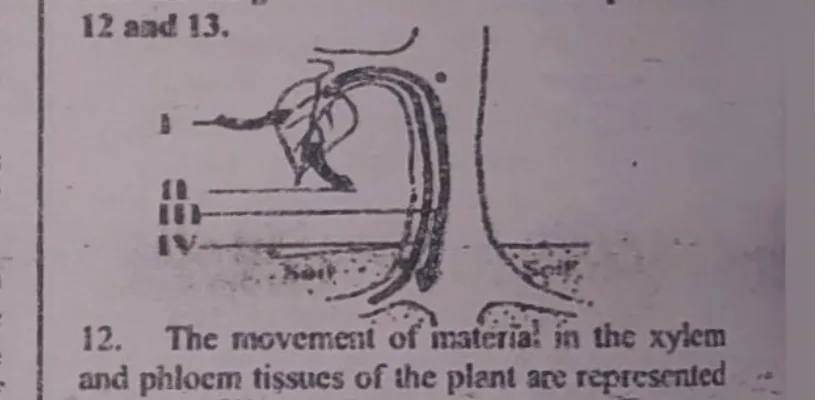
The xylem transports water and mineral salts up from the soil (represented by arrow IV) while the phloem transports manufactured food from the leaves to other parts of the plant (arrow III).
During photosynthesis, the arrow labeled II represents the
During photosynthesis, 6CO2 + 6H2O → C6H12O6 + 6O2; oxygen is released as a by-product, which is what the labelled arrow represents.
Which of the following is lacking in the diet of a person with kwashiorkor?
Kwashiorkor is a form of malnutrition caused specifically by a deficiency of protein in the diet.
The mode of nutrition of sundew and bladderwort can be described as
Sundew and bladderwort are carnivorous plants that trap and digest insects directly, which is a holozoic mode of nutrition, although they are also capable of photosynthesis.
When a mixture of a food substance and Benedict's solution was warmed, the solution changed from blue to brick-red. This indicates the presence of
A brick-red precipitate with Benedict's solution on warming confirms the presence of a reducing sugar (e.g. glucose).
The primary structure responsible for pumping blood for circulation through the mammalian circulatory systems is the
The blood is pumped from the left ventricle (through the largest artery, the aorta) into the circulatory system.
Circulation of blood to all parts of the body except the lungs is through
The circulation of blood to all parts of the body except the lungs is known as systemic circulation, while circulation of blood to the lungs is pulmonary circulation.
Yeast respires anaerobically to convert simple sugar to carbon(IV) oxide and
The anaerobic respiration of yeast (fermentation) converts simple sugar to carbon (IV) oxide and ethanol (alcohol): C6H12O6 → 2C2H5OH + 2CO2 + Energy.
The sheet of muscle that separates the thoracic and the abdominal cavities is the
The diaphragm is the sheet of muscle that separates the thoracic cavity from the abdominal cavity.
The oily substance that lubricates the mammalian hair to keep it flexible and water repellent is secreted by the
Sebum, the oily substance that lubricates skin and mammalian hair, is secreted by the sebaceous glands.
The outer layer of the kidney where the Bowman's capsules are found is the
The outer layer of the kidney, known as the cortex, contains the Bowman's capsules, while the inner layer is known as the medulla.
Which of the following stimuli is likely to elicit a nastic response in an organism?
Nastic movement is a non-directional response to stimuli such as light intensity or humidity, unlike tropisms which are directional responses.
In the male reproductive system of a mammal, sperm is stored in the
Sperm cells are produced in the seminiferous tubules but are temporarily stored in the epididymis.
Chemosynthetic organisms are capable of manufacturing their food from simple inorganic substances through the process of
Chemosynthesis is a form of nutrition in which organisms synthesize organic compounds from simple inorganic materials such as ammonia, water, and CO2, with the required energy obtained from the oxidation of inorganic substances.
The part of the human gut that has an acidic content in the
The human stomach glands secrete hydrochloric acid, giving the stomach contents an acidic environment; the acid neutralizes the alkalinity of saliva and provides the appropriate medium for pepsin to act.
I. Stomata → Spirogyra II. Alveoli → Earthworm III. Malpighian tubule → Mammal IV. Contractile vacuole → Protozoa. Which of the above structures is correctly matched with the organism in which it is found?
Of the listed pairs, only the contractile vacuole–Protozoa pairing (IV) is correctly matched; stomata occur in leaves (not Spirogyra), alveoli in mammalian lungs (not earthworms), and Malpighian tubules in insects (not mammals).
A food chain always begins with a
A food chain always begins with a producer (a green plant), followed by the consumers.
Mycorrhizae promote plant growth by
There is a mutualistic relationship between fungi and plants known as mycorrhiza; the fungi provide food for the plant while the hyphae of the fungi help the plant absorb water and minerals (inorganic ions) from the soil.
The barrier between maternal and foetal blood is the
The placenta is the barrier between maternal and foetal blood; it prevents the maternal blood from mixing with the foetal blood.
The blood component that has the greatest affinity for oxygen is the
The erythrocytes (red blood cells) transport oxygen round the body due to their haemoglobin content, which has a strong affinity for oxygen.
Which of the following organisms is mainly found in the marine habitat?
The dogfish is mainly found in marine habitats, while tilapia can be found in both marine and fresh water habitats.
The two halves of the pelvic girdle are joined together at the
The two halves of the pelvic girdle are joined together at the pubic symphysis.
Which of the following are the adaptive features of desert animals? (i) They can withstand a high degree of fluid loss (ii) Some of them have thick covering to prevent water loss e.g. some reptiles and insects (iii) During the day, they usually hide in burrows (iv) Most of them are nocturnal
Desert animals adapt to extreme heat by withstanding fluid loss, having thick water-preventing coverings, and hiding in burrows during the day.
Low annual rainfall, sparse vegetation, high diurnal temperatures and cold nights are characteristic features of the
Hot days and cold nights, low rainfall and sparse vegetation are the features of a desert.
The population density is the number of individuals per unit area. It is measured in
Population density is the number of individuals per unit area, measured as Total number of individuals / Total Area (e.g. per m²).
Which of the following characterizes a population which affects the survival of another organism in the same habitat constitutes a
Biotic factors affecting an organism are the living factors, while non-living factors are called abiotic factors.
The loss of soil through erosion can be reduced by
Crop rotation is one of the natural ways of reducing soil erosion.
The vector for yellow fever is the
The Aedes mosquito is the vector for yellow fever, while the tsetse fly, which carries trypanosome species, causes sleeping sickness.
The protozoan Plasmodium falciparum is transmitted by
Malaria's causative agent, Plasmodium falciparum, is transmitted by the female Anopheles mosquito.
A dilute solution of phenythiocarbamide tastes bitter to some people and is tasteless to others. This is an example of
Since people are either able to taste PTC or not (i.e. no intermediate), the variation is said to be discontinuous.
Use the diagram below to answer questions 42 and 43 In which plantation are all the trees between the height of 2-4m?
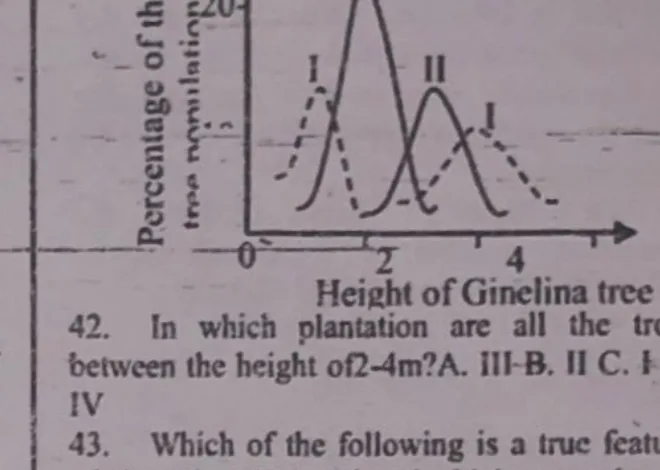
From the graph, 'III' falls between 2m and 4m, meaning that all the trees in plantation III are between the height of 2-4m.
Which of the following is a true feature of plantation II?
Plantation 'II' has the highest number of trees about 2m high (about 20%), but the range of all its tree heights spans between 2-6m.
Thyroxine and adrenalin are examples of hormones that control
Thyroxine and adrenalin are examples of hormones that control behavioural patterns; adrenalin (the fight and flight hormone) dictates how an individual acts in times of emergency.
A pair of genes that control a trait is referred to as
The gene that controls a trait is the allele. When there are two dissimilar genes for a particular trait, the one that is expressed is known as the dominant gene while the one that is suppressed is known as the recessive gene.
The chromosome number of a cell before and after the process of meiosis is conventionally represented as
Meiosis always halves the chromosome number, i.e. it produces haploid (n) daughter cells from diploid (2n) cells: 2n(diploid) → n(haploid).
If both parents are heterozygous for a trait, the probability that an offspring will be recessive for that trait is
Let each parent be Tt. Crossing Tt × Tt gives a ratio of 1 TT : 2 Tt : 1 tt, meaning the probability of a recessive phenotype (tt) offspring is 1/4.
At what stage in the life history of a mammal is the sex of an individual set?
The sex of an individual is determined at conception, since you should be able to tell what the correct option is based on which sex chromosome (X or Y) combines at fertilization.
The main distinguishing features between the soldier termite and other members of the caste are the
Since the role of the soldier termite is to defend the colony, the mandibles with which they do this must be strong; soldiers have a large head with strong mandibles and lack wings.
The flippers of a whale and the fins of a fish are examples of
Convergent evolution is said to have occurred when species that look similar are from different ancestral species; the flipper of a whale and fins of a fish make them look similar, however the whale is a mammal, not a fish.
Advertisement
…and/or go further with premium services and No Ads.