All 60 questions from the Joint Admissions and Matriculation Board (JAMB) Biology 2011 Objective paper, with the correct answer and a full explanation for each. Free, no signup needed.
The branch of Biology that deals with the principles of classification of organisms is known as
A. biological indexB. nomenclatureC. taxonomyCorrect D. ecologyExplanation The branch of biology that deals with the principles of classification of organisms is known as taxonomy.
Which of the following structures is a tissue?
A. Vessel elementB. BloodCorrect C. Sieve tube elementD. ErythrocyteExplanation Blood contains many cells such as red blood cells (erythrocytes), white blood cells (leucocytes) and blood platelets (thrombocytes), so it is classed as a tissue.
Which of the following cells are not regarded as specialized cells?
A. Sperm cellsB. Root tip cellsC. Muscle cellsD. Somatic cellsCorrect Explanation Sperm cells, root tip cells and muscle cells are all specialized cells. The term 'somatic cell' is too ambiguous to be considered specialized.
Which of the following pairs of cells carry out the same function?
A. Check cell and red blood cellB. Spermatozoon and ovumCorrect C. Palisade cell and epidermal cellD. Root tip cell and guard cellExplanation Spermatozoon and ovum perform the same function i.e. they are both used for reproduction.
If Amoeba is placed in a salt solution, the contractile vacuoles would
A. be bursting more frequentlyB. be more numerousC. be formed less frequentlyCorrect D. grow bigger before they burstExplanation The contractile vacuole removes excess water from the protozoan's body. In salt solution the organism loses water instead of gaining it, so the vacuole forms less frequently.
In which of the following habitats is Paramecium not found?
A. PondB. AquariumCorrect C. LakeD. PuddleExplanation Paramecium is found in pond, lake, puddle etc., not typically in an aquarium.
The following processes are involved in water movement in the endodermis except
A. osmosisB. vacuolar pathwayCorrect C. diffusionD. active transportExplanation Osmosis, diffusion and active transport all play a part in water movement in the endodermis; 'vacuolar pathway' is not a recognised term here.
Cells that utilize a lot of energy are characterized by the presence of a large number of
A. vacuolesB. mitochondriaCorrect C. endoplasmic reticulumD. ribosomesExplanation Mitochondria are the powerhouse of the cell, so cells needing lots of energy have many mitochondria.
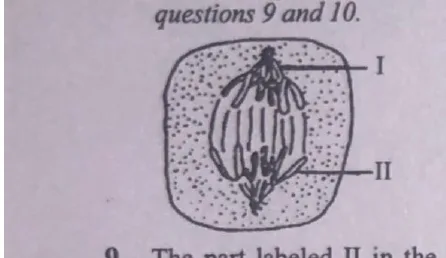
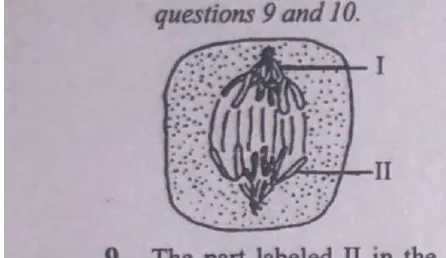
The part labeled II in the diagram is the
A. centrioleB. chloroplastC. chromatidCorrect D. tonoplastExplanation The part labeled 'II' is the chromatid; a chromosome comprises two chromatids.
The part labelled I is called the
A. nucleolusB. centromereC. centrioleD. spindleCorrect Explanation The part labeled 'I' is the spindle.
Secondary growth is brought about by the activities of the
A. phellogen and phellodermB. phellogen and procambiumC. vascular cambium and phellodermD. vascular cambium and phellogenCorrect Explanation In gymnosperms and most dicots, secondary growth (increase in diameter) results from activity of the vascular cambium and cork cambium (phellogen).
A monocot root is different from a dicot root by having
A. endodermisB. cambiumC. wide pithCorrect D. root hairExplanation A monocot root has a wide pith while a dicot root does not.
Which of the following statements best describes haemoglobin? It is
A. yellowish in colourB. a red blood cellC. an oxygen carrying pigmentCorrect D. needed for blood clottingExplanation Haemoglobin is the pigment in red blood cells responsible for transporting oxygen.
Inhaled air is made warm and moist in the
A. epiglottisB. nasal cavityCorrect C. tracheaD. mouthExplanation Inhaled air is warmed and moistened as it passes through the paranasal sinuses surrounding the nasal cavity.
Which of the following structures is not involved in respiration?
A. Lung booksB. MouthC. StomachCorrect D. TracheaExplanation The stomach is not adapted for respiration; lung books (arachnids), mouth (amphibian buccal respiration) and trachea (insects) are respiratory structures.
Filtrate in the Bowman's capsule contains vitamins because
A. only a little amount is required by the bodyB. they can be reabsorbed into the bloodC. they have low molecular massD. most of them are fat solubleCorrect Explanation Vitamins appear in the filtrate mainly because most of them are fat soluble.
More sweat is produced during muscular exercise because
A. the contracting muscles produce waterB. fermentation occurs in musclesC. the temperature of the body risesCorrect D. the muscle fatiguesExplanation Sweating is an adaptation to lower body temperature, which rises during exercise; sweat cools the body as it evaporates.
Which of the following neurons may not have myelin sheath?
A. Effector cellsB. Intermediate neuronsCorrect C. Motor neuronsD. Sensory neuronsExplanation The myelin sheath insulates axons and speeds impulse conduction. Intermediate (association) neurons are typically unmyelinated.
Which of the following is an effector organ?
A. TongueB. SkinCorrect C. Nose bridgeD. Ear glandsExplanation Skin is regarded as an effector organ since it can react to impulses from the brain.
During sexual reproduction in Paramecium, how many times does the zygote divide to produce eight nuclei?
Explanation Reproduction in Paramecium is by conjugation; the zygote in each conjugant divides three times to form eight nuclei.
The testes in male mammals descend into the scrotal sac because
A. there is congestion in the lower abdomenB. they run the risk of being destroyedC. they need special supportD. they require a relatively low temperatureCorrect Explanation The testes must be at a temperature slightly lower than body temperature for optimum sperm production.
Some animals return to water bodies to reproduce because
A. natural enemies destroy their eggs on landB. water nourishes their embryos and young onesC. they are close to their ancestors and imitate themD. the temperature on land is not suitable for the development of their embryosCorrect Explanation The land temperature may not be suitable for the development of their embryos, so they return to water to reproduce.
Which of the following methods is appropriate for the cultivation of cassava?
A. BuddingB. FragmentationC. Root cuttingD. Stem cuttingCorrect Explanation Cassava is propagated by stem cutting.
What will be the chromosome number of the hybrid of two varieties of a plant with 36 chromosomes in the endosperm cell?
A. 12B. 24Correct C. 36D. 48Explanation Endosperm cells are triploid (3n). If 3n = 36, then 2n = 36/3 x 2 = 24.
Kreb's cycle occurs in the
A. mitochondriaCorrect B. cytoplasmC. nucleusD. ribosomesExplanation Glycolysis occurs in the cytoplasm, while the Krebs (citric acid) cycle occurs in the mitochondria.
The process whereby electrons are emitted from chlorophyll and returned to it unchanged is known as
A. non-cyclic phosphorylationB. photochemical reactionC. phosphorylationD. cyclic photophosphorylationCorrect Explanation In cyclic photophosphorylation, electrons emitted from P700 cycle through the electron transport chain and return to the same photosystem; NADPH and oxygen are not produced.
Which of the following statements about photosynthesis is not true?
A. Plants can photosynthesize without an increase in dry weightCorrect B. Carbon dioxide is absorbed in bright lightC. Oxygen is produced during photosynthesis from the breakdown of waterD. Photosynthesis occurs in green plantsExplanation Photosynthesis always results in an increase in dry weight of the plant, so statement A is false.
The equation below represents the process of glycolysis: Glucose+ATP → X+ADP. X in the equation represents
A. glucose diphosphateB. glucose phosphateCorrect C. glucose triphosphateD. fructose phosphateExplanation Glucose is phosphorylated by addition of a phosphate group to form glucose phosphate.
The removal of all phloem tissues of the stem of a plant close to the root system for a long period of time is likely to
A. provide more energy to the rootsB. accumulate more starch in the rootsC. cause the underground roots to develop budsD. cause the plant to wither and dieCorrect Explanation Removing all phloem tissue for a long time will kill the plant because conduction of food to the roots is stopped (ring-barking).
The conversion of glucose to starch in the leaf during the day principally
A. enables photosynthesisB. prevents osmotic problemsC. enables the leaf to store the starch to be used upCorrect D. enables glucose to be used upExplanation Plants store carbohydrate as starch (animals and fungi store it as glycogen); converting glucose to starch allows storage for later use.
Which of the following groups of substances are not six-carbon compounds?
A. Glucose and LactoseB. Lactose and CelluloseC. Glucose, Lactose and PyruvateCorrect D. Pyruvate and CelluloseExplanation Pyruvate is not a carbohydrate; it is formed when a six-carbon glucose molecule is broken down into three-carbon molecules.
A purple colour was obtained when sodium hydroxide solution and a drop of copper sulphate solution was added to a food substance. The food substance is likely to be a
A. carbohydrateB. fatC. proteinCorrect D. sugarExplanation This is the Biuret test, which gives a purple/violet colour in the presence of protein.
Which of the following enzymes is active in the duodenum?
A. PepsinB. ReninC. TrypsinCorrect D. AmylaseExplanation Trypsin is produced in the pancreas but transported (with other enzymes in pancreatic juice) to the duodenum where it converts peptone to polypeptides.
The following organisms are producers except
A. HibiscusB. MushroomCorrect C. CactusD. SpirogyraExplanation Hibiscus, cactus and spirogyra all contain chlorophyll and are producers; mushrooms are achlorophyllous (fungi) and are not producers.
Which of the following structures produces the greatest variety of digestive enzymes?
A. Salivary glandsB. PancreasCorrect C. StomachD. ColonExplanation The pancreas produces the greatest variety of digestive enzymes: amylase (amylopsin), lipase, trypsin, chymotrypsin, carboxypeptidase, ribonuclease and deoxyribonuclease.
The following are abiotic components of an ecosystem except
A. oxygenB. bacteriaCorrect C. waterD. soilExplanation Abiotic components are non-living; bacteria are living organisms and so are biotic, not abiotic.
[Capture-recapture data: First capture = 200, second capture = 120; Number of organisms with mark in second capture = 40] The total number of organisms therefore is
A. 200B. 360C. 600Correct D. 800Explanation N = (first capture x second capture) / marked recaptures = (200 x 120) / 40 = 600.
Ecological investigation in a habitat includes the following procedures except
A. Choosing a habitatB. identification of specimensC. determining the genetic make-up of specimensCorrect D. measuring abiotic and biotic factorsExplanation Investigating the genetic make-up of specimens is not part of ecological investigation, which studies interactions of organisms with each other and their environment.
Which of the following substances when lost from the body of a mammal will not be returned to the ecosystem?
A. SweatB. UreaC. Heat energyCorrect D. Carbon dioxideExplanation Sweat, urea and carbon dioxide are returned to the ecosystem; heat energy dissipates and is not returned/recycled in the ecosystem.
The rate of decomposition of organisms is faster in the tropical rain forest than in other biomes because
A. of the relatively constant daylightB. there are more plants per square feetC. of abundance of waterCorrect D. of constant cool temperatureExplanation Tropical rainforests receive abundant rainfall (2000-4000mm annually) and have high temperatures/humidity, which speed up decomposition.
A Xerophyte conserves water by possession of the following features except
A. thick cuticleB. sunken stomataC. broad leavesCorrect D. fleshy stemExplanation Xerophytes have thick cuticle, sunken stomata and fleshy stems to conserve water; broad leaves increase water loss through transpiration, so this is the exception.
The falling off of leaves of deciduous trees is helpful to the plant because it
A. reduces the rate of transpirationCorrect B. enables the plant to conveniently eliminate its excretory productsC. enables the plant to bear more fruitsD. ensures that the limited mineral salts get to only growing regionsExplanation Shedding leaves reduces the surface area for transpiration, helping the plant conserve water.
A sample of wet garden soil of known weight was heated to constant weight. The loss of weight is due to loss of
A. waterB. organic matterC. water and organic matterCorrect D. water and inorganic matterExplanation Continual heating causes loss of water first; if heating persists to a constant weight, the organic matter (humus) is also burnt off.
Assuming that a period of stable population size is followed by a period when natality increases by ten (10) percent and immigration by twenty (20) percent of population size, the population size will
A. be at equilibriumB. increase by forty (40) percentC. begin to increaseCorrect D. begin to decreaseExplanation An increase in natality (birth rate) and immigration rate causes the population to begin to increase.
Which of the following methods does not make water fit for drinking?
A. Addition of chlorineB. BoilingC. DistillationD. Addition of alumCorrect Explanation Alum coagulates solid impurities in water (the water must still be boiled to kill bacteria); it does not by itself make water fit for drinking.
Vaccination results in
A. aiding red blood cells to carry more oxygenB. production of antibodies which destroy toxins of germsCorrect C. arresting excessive bleedingD. production of white blood cells which engulf and digest bacteriaExplanation Vaccination works by stimulating the body to produce antibodies against the antigen introduced.
Leguminous crops are incorporated into crop rotation in order to
A. improve aeration of soilB. promote nitrogen fixationCorrect C. increase the rate of soil formationD. improve upon the water holding capacity of the soilExplanation Leguminous crops host nitrogen-fixing bacteria (e.g. Rhizobium leguminosarium) in their root nodules, enriching the soil with nitrogen.
Which of the following practices improves crop yield in a clayey soil? Addition of
A. more water and humusB. lime and humusCorrect C. fertilizersD. weedicides and fertilizersExplanation Adding lime and humus improves crop yield in clayey soil.
Which of the following activities promotes forest conservation?
A. LumberingB. Use of firewood for cookingC. AfforestationCorrect D. Production of paperExplanation Afforestation (planting trees) promotes forest conservation, while the other options tend to encourage deforestation.
Which of the following statements is not true about continuous variation? It
A. is usually controlled by several genesB. can be influenced by environmental factorsC. follows a normal distribution curveD. is usually controlled by one or two pair(s) of genesCorrect Explanation Continuous variation is usually controlled by many genes (polygenic), not just one or two gene pairs.
Acquired characters are
A. received from parentsB. passed to offspringC. caused by the environmentCorrect D. caused by mutationExplanation Acquired characters are caused by the environment; they cannot be passed from one generation to the next.
Differences in the characteristics observed between individuals of the same species is known as
A. traitB. phenotypeC. mutationD. variationCorrect Explanation Variation refers to the difference in characteristics observed between individuals of the same species.
Which of the following statements best describes protein synthesis?
A. DNA is directly involved in translationB. Translocation of the ribosome exposes a new codon for base pairing with an amino acidCorrect C. Each tRNA with a particular anticodon always carries a different protein in the processD. One amino acid is always carried by more than one tRNAExplanation During translation, the ribosome moves (translocates) along the mRNA, exposing a new codon each time for base pairing.
If a person has two alleles of the sickle cell anaemia gene, the person is
A. a heterozygous carrier of the diseaseB. immune to the disease and cannot pass it on to an offspringC. a sufferer of the diseaseCorrect D. probably of Asian ancestryExplanation A person with two alleles of the sickle cell gene (homozygous) is a sufferer of the disease; a person with just one allele is a carrier.
What is the probability of a man of blood group AB married to a woman of blood group O producing a child of blood group O?
A. 0%Correct B. 25%C. 50%D. 75%Explanation It is not possible for a man of blood group AB married to a woman of blood group O to produce a child of blood group O; the child will be either A or B.
A man with blood group IA IA is married to a woman with blood group IA IO. The blood group of their son is likely to be
Explanation Since allele A is dominant over O, the child of this cross can only be blood group A.
Natural selection is a consequence of
A. distribution of organismsB. adverse conditionsCorrect C. variation in organismsD. inbreedingExplanation Natural selection is a consequence of adverse conditions, which cause organisms to strive and compete for survival.
Which of the following components of Lamarck's theory of evolution is considered faulty?
A. Individuals of the same species growing under different environmental conditions differ from each otherB. Use of certain organs results in development of those partsC. Unused organs degenerateD. Changes that result in individuals of the same species are transmitted to offspringCorrect Explanation The loophole in Lamarck's theory of use and disuse is the claim that acquired traits are transmittable to offspring, which is false.
A vestigial structure in humans is
A. earlobeB. toe boneC. tail boneCorrect D. spleenExplanation Vestigial organs have no popular function in humans; the tail bone (caudal vertebrae) is a classic example, alongside the appendix.
Adenine pairs with thymine because
A. the two occur in the same nucleic acidB. one is a strong base and the other a weak baseC. two purine bases easily pair upD. one is a purine and the other a pyrimidineCorrect Explanation Guanine and adenine are purines; cytosine and thymine are pyrimidines. A purine always pairs with a pyrimidine (adenine-thymine, guanine-cytosine).
Sign up free to unlock …and/or go further with premium services and No Ads .