Biology 2012 Objective — Question 1
Which Question Paper Type of Biology as indicated above is given to you?
- A. Type Green
- B. Type Purple
- C. Type Red
- D. Type YellowCorrect
Explanation
This is type yellow biology question.
All 50 questions from the Joint Admissions and Matriculation Board (JAMB) Biology 2012 Objective paper, with the correct answer and a full explanation for each. Free, no signup needed.
Advertisement
Which Question Paper Type of Biology as indicated above is given to you?
This is type yellow biology question.
Use the diagram below to answer questions 2 and 3. The organelle responsible for heredity is labeled
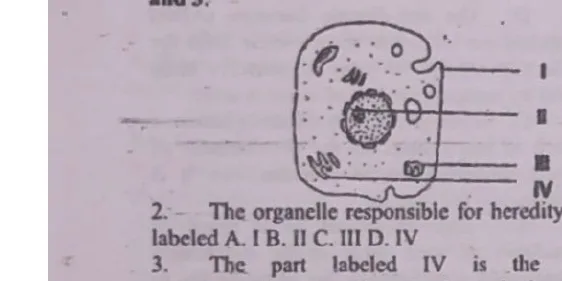
The structure labeled 'II' is the nucleus. The nucleus, which is the most important organelle, is responsible for heredity. It is also the chief coordinator of all the activities of a cell.
(Using the same diagram as Q2) The part labeled IV is the
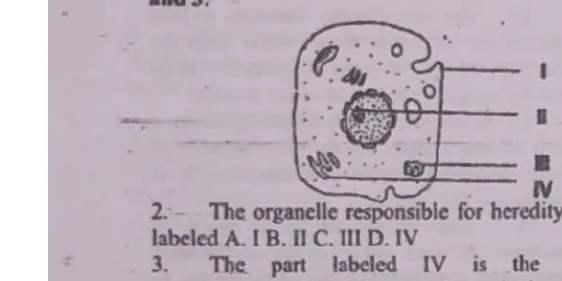
The part labeled 'IV' is endoplasmic reticulum. It is worthy of notice that the endoplasmic reticulum occurs in two forms — if it has ribosomes attached to its surface, it is a Rough Endoplasmic Reticulum, if it doesn't, it is a Smooth Endoplasmic Reticulum.
Which of the following is most advanced in the evolutionary trend of animals?
The evolutionary trend among invertebrates is: Protozoa→Coelenterata→Platyhelminthess→Nematode→Annelida→Mollusca→Arthropoda→Echinodermata. Liverfluke is a platyhelminthe, earthworm is an annelid, snail is a molluscan while cockroach is an arthropod. It is crystal clear that the cockroach is the most advanced.
Which of the following is the lowest category of classification?
The species is the lowest category of classification; the kingdom is the highest category. The hierarchy goes as: Kingdom→Phylum (or division for plant)→Class→Order→Family→Genus→Species.
Plants that show secondary growth are usually found among the
Secondary growth or secondary thickening is characteristic of dicotyledonous plants. A plant that shows secondary growth or thickening grows both in height and width.
The fungi are a distinct group of eukaryotes mainly because they have
It is not lack of chlorophyll that makes fungi unique (many organisms lack chlorophyll). Nor is it possession of spores, or common sexual/asexual reproduction (both widespread across organisms). The unique feature of fungi is the possession of many fruiting bodies.
An arthropod that is destructive at the early stage of its lifecycle is
The young forms of butterflies (known as the caterpillars) are plant pests.
An animal body that can be cut along its axis in any plane to give two identical parts is said to be a
A radially symmetrical body is one that can be cut along its axis in any plane to give two identical parts.
Which of the following possesses mammary gland?
The possession of mammary gland and hair distinguishes mammals from other groups of animals. Dogfish, Shark and Catfish are fishes while Whale, though aquatic, is a mammal.
The feature that links birds to reptiles in evolution is possession of
The possession of scales links birds to reptiles. Recall that birds are next to reptiles in the vertebrate evolutionary trend: Pisces→Amphibians→Reptiles→Aves (Birds)→Mammals.
Counter shading is an adaptive feature that enables animals to
Counter shading is an adaptation for protection. It enables an animal to remain undetected in its environment, with this it can escape predation.
Which of the following plant structures lacks a waterproof cuticle?
The root does not have a water-proof cuticle. If roots had water-proof cuticles, the absorption of water from the soil would be impossible.
In the mammalian male reproductive system, the part that serves as a passage for both urine and semen is the
The urethra is urinogenital in function — it serves as a passage for both urine and semen. The urethra should not be confused for the ureter, which is a structure that passes urine from the kidney to the bladder.
In plants, which of the following is required in minute quantities for growth?
Elements needed in large quantities are called major elements or macronutrients (e.g. Potassium, Sodium, Phosphorus) while those needed in small quantities are called minor elements or micronutrients, such as Copper, Molybdenum, Zinc, Manganese and Boron.
Which of the following organisms is both parasitic and autotrophic?
Insectivorous plants like Sundew can photosynthesize but they trap insects to obtain nitrogen, since they are typically found in nitrogen-poor soils. Loranthus is a parasitic plant that can also photosynthesize (autotrophic).
A function of the hydrochloric acid produced in the human stomach during digestion is to
The HCl produced in the stomach kills germs, provides an acidic environment for gastric enzymes, and neutralizes the alkalinity of saliva. Since the enzyme ptyalin present in saliva only works in an alkaline medium, once HCl neutralizes that alkalinity, the action of ptyalin is stopped.
Which of the following is a polysaccharide?
Glucose, galactose, fructose and mannose are monosaccharides. Sucrose, maltose and lactose are disaccharides. Starch and cellulose are polysaccharides.
Use the diagram below to answer questions 19 and 20. Transportation in the xylem is represented by
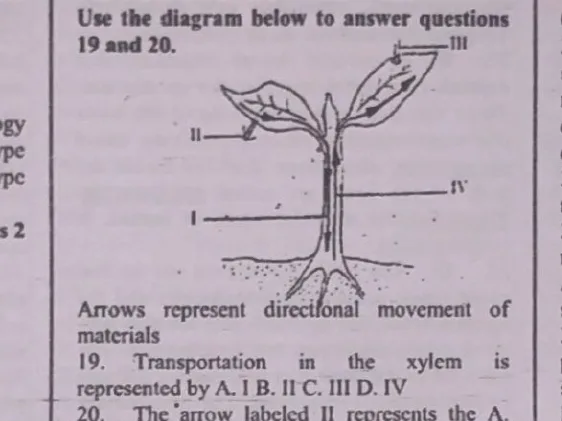
The xylem transports water and mineral salts from the soil upwards (as shown by 'IV'). The phloem transports food substances from the leaf to other parts of the plant (as shown by 'I').
(Using the same diagram as Q19) The arrow labeled II represents the
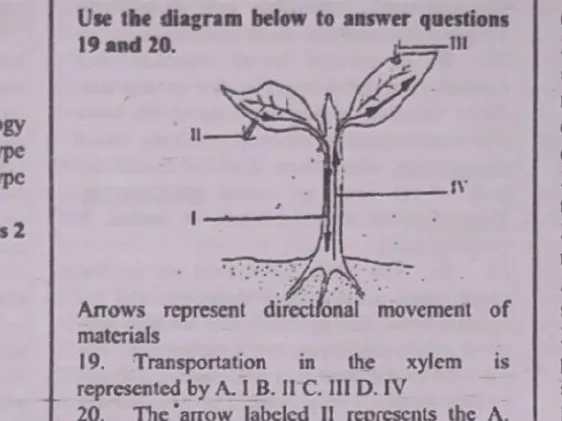
The arrow labeled 'II' depicts the release of oxygen into the environment. This happens during photosynthesis.
In the kidney of mammals, the site of ultrafiltration is the
Ultrafiltration occurs in the Bowman's capsule.
Which of the following is involved in secondary thickening in plants?
In gymnosperms and dicotyledons, growth does not only take place by the activities of apical root, apical stem and intercalary meristems but also by the activities of the vascular cambium and cork cambium to bring about increase in the diameter of the roots and stem. This is known as secondary growth.
An example of a fruit that develops from a single carpel is
A legume is a simple fruit that develops from a superior monocarpous pistil; bean is a legume.
Use the diagram to answer questions 24 and 25. The developing embryo is usually contained in the part labeled
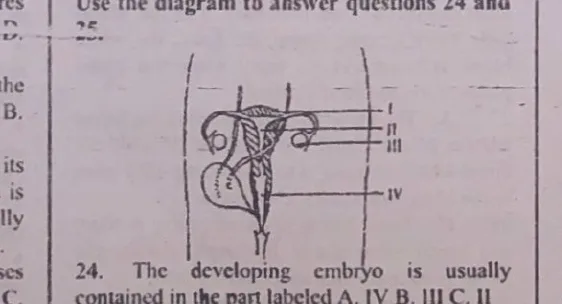
The developing embryo is usually contained in the part labeled 'II'. The part is known as the uterus or womb.
(Using the same diagram as Q24) The function of the part labeled III is to
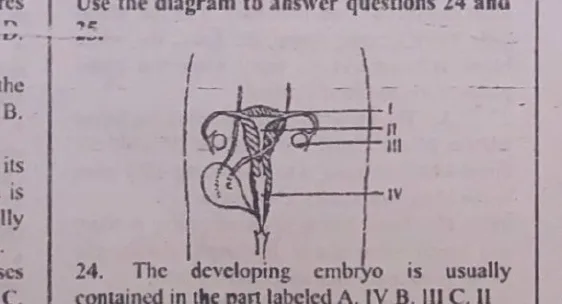
The part labeled 'III' is the ovary. The ovary produces egg cells.
Plant growth can be artificially stimulated by the addition of
Plant growth can be artificially stimulated by the addition of gibberellin, which stimulates the growth of root and stem.
The autonomic nervous system consists of neurons that control the
The autonomic nervous system is concerned with involuntary body activities e.g. breathing, heart beat etc.
Plants of temperate origin can be grown in tropical areas in the vegetation zones of the
Plants of temperate origin can do well in tropical areas in the vegetation zones of the montane forest, given the cooler high-altitude conditions there.
The water cycle is maintained mainly by
The water cycle is maintained mainly by evaporation and condensation of water in the environment.
Organisms living in an estuarine habitat are adapted to
Organisms living in an estuarine habitat are adapted to withstand wide fluctuations in salinity.
The presence of stilt roots, pneumatophores, sunken stomata and salt glands are adaptive features of plants found in the
The presence of stilt roots, pneumatophores, sunken stomata and salt glands are adaptive features of plants found in the mangrove swamps.
Which of the following animals can exist solely on the water they get from food and metabolic reactions?
Desert dwellers can exist solely on the water they get from food and metabolic reactions, due to their adaptation to arid conditions.
The most likely first colonizers of a bare rock are
The most likely first colonizers of a bare rock are lichen.
The carrying capacity of a habitat is reached when the population growth begins to
The carrying capacity of a habitat is reached when the population growth begins to remain steady.
The abiotic factors that control human population include
The abiotic factors that control human population include space and rainfall (per the printed key).
An indigenous method of renewing and maintaining soil fertility is by
An indigenous method of renewing and maintaining soil fertility is by crop rotation and shifting cultivation.
The diseases caused by water-borne pathogens include
Typhoid and cholera are caused by water-borne pathogens (unlike gonorrhoea, poliomyelitis, syphilis and tuberculosis).
Use the diagram below to answer questions 38 and 39. The graph illustrates
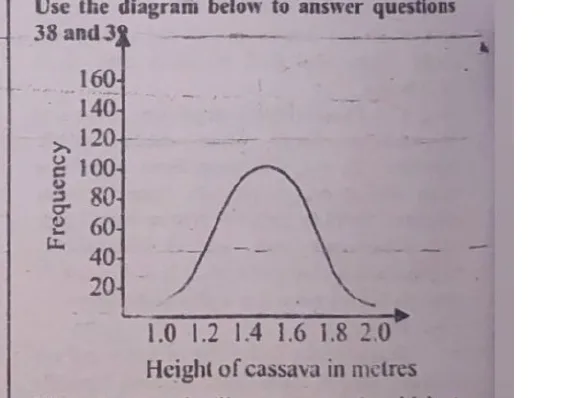
The graph illustrates a continuously varying character.
(Using the same diagram as Q38) The largest number of cassava plants has an approximate height of
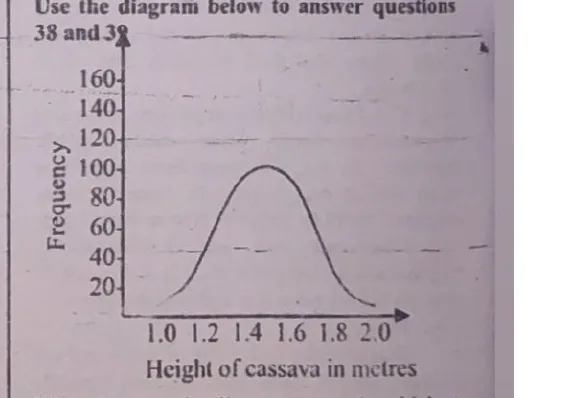
From the graph, the peak (largest number of cassava plants) corresponds to an approximate height of 1.6m.
Which of the following is true in blood transfusion?
Persons of blood groups A and B can donate or receive blood from each other, since a valid donor-recipient combination exists between certain groups.
A yellow maize is planted and all the fruits obtained are of yellow seeds. When they are cross-bred, yellow seeds and white seeds are obtained in a ratio 3:1. The yellow seed is said to be a
A 3:1 ratio when crossed indicates that the yellow seed colour is a dominant trait.
When a colour-blind man marries a carrier woman. What is the probability of their offspring being colour blind?
The probability of their offspring being colour blind is 50%.
The correct base pairing for DNA is
Guanine will always pair with cytosine while thymine always pairs with adenine.
Use the diagram below to answer questions 44 and 45. The type of interaction shown is referred to as
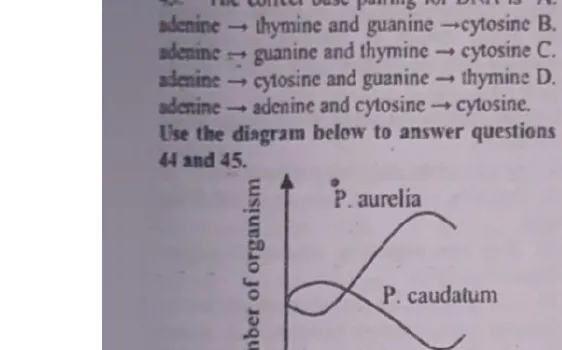
Interspecific competition involves organisms of different species while intraspecific competition involves those of the same species. P. Aurelia and P. caudatum are two different species of paramecium.
(Using the same diagram as Q44) Which of the following statement is correct about the interaction?
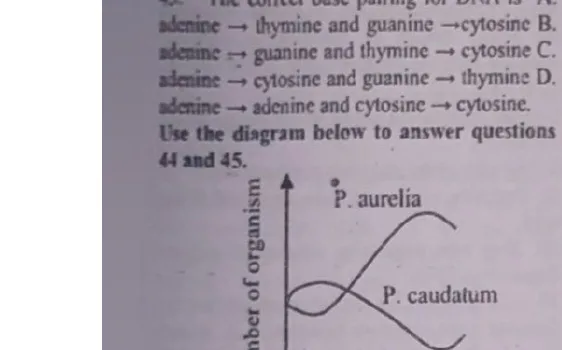
Since P. aurelia occurs in greater number than P. caudatum, the former is better adapted than the latter.
The short thick beak in birds is an adaptation for
Short thick beaks are adapted for crushing seeds. Long, narrow and tubular beaks are for sucking liquid food. Flattened and broad beaks with grooved sides are for sifting out food from water and mud.
The basking of Agama lizards in the sun is to
The basking of Agama lizards in the sun is to raise their body temperature to become active.
The significance of a very large number of termites involved in nuptial swarming is to
The significance of a very large number of termites involved in nuptial swarming is to ensure their perpetuation despite predatory pressure.
The use and disuse of body parts and the inheritance of acquired traits were used to explain
The use and disuse of body parts and the inheritance of acquired traits were used to explain Lamarck's theory.
From his study of Galapagos finches, Darwin derived his theory of evolution from
Darwin observed that the finches had dissimilar beaks. He therefore concluded that natural selection shaped the beaks differently. Since anatomy deals with body structures, it can be said that he derived his theory of evolution from comparative anatomy.
Advertisement
…and/or go further with premium services and No Ads.