All 49 questions from the Joint Admissions and Matriculation Board (JAMB) Biology 2014 Objective paper, with the correct answer and a full explanation for each. Free, no signup needed.
Which of the following has the most primitive respiratory system?
A. InsectB. FishC. SnailCorrect D. MouseExplanation Snails have a simple mantle cavity respiratory system, more primitive than gills, tracheae, or lungs.
One adaptation shown by hydrophytes in fresh water habitats is the
A. waxy cuticle on shoot surfaceB. poorly developed roots and xylem tissuesCorrect C. well-developed roots and supporting systemD. leaves reduced to spinesExplanation Since hydrophytes are aquatic plants, water is readily available, so they do not need sophisticated xylem tissues or extensive roots.
Which of the following uses diffusion as the principal method of gaseous exchange?
A. GrasshopperB. RatC. LizardD. EarthwormCorrect Explanation The earthworm has a large surface area to volume ratio, making diffusion an efficient means of gaseous exchange through its moist skin.
The theory which supports the view that the large muscles developed by an athlete will be passed on to the offspring was proposed by
A. MendelB. DarwinC. LamarckCorrect D. PasteurExplanation This is the theory of use and disuse (inheritance of acquired characteristics) proposed by Jean Baptiste Lamarck.
The chromosomes of members of the Kingdom Monera are within the
A. nucleoplasmB. nucleusC. nucleolusD. cytoplasmCorrect Explanation Prokaryotes (Monerans) do not have a defined nucleus, so their chromosomes lie free within the cytoplasm.
The mangrove swamp in Nigeria is restricted to the
A. Sahel SavannaB. Guinea SavannaC. Tropical RainforestCorrect D. Sudan SavannaExplanation Nigeria's extensive mangrove forests lie in the coastal region of the Niger Delta, part of the tropical rainforest belt.
The pancreas secretes enzymes for the digestion of
A. fats, proteins and carbohydratesCorrect B. fats, vitamins and celluloseC. fats, carbohydrates and vitaminsD. proteins, cellulose and mineralsExplanation Pancreatic juice contains amylase (carbohydrates), lipase (fats/oils) and trypsin (proteins).
The causative agent of bird flu is a
A. protozoanB. VirusCorrect C. bacteriumD. fungusExplanation Bird flu (avian influenza) is an infectious viral disease that can, in rare cases, affect humans.
A water medium is necessary for fertilization in
A. conifersB. angiospermsC. fernsCorrect D. fungiExplanation Pteridophytes (e.g. ferns) and bryophytes (e.g. mosses) require water for fertilization since their motile male gametes must swim to the egg.
An example of a sex-linked trait is the
A. colour of the skin in humansB. ability to roll the tongueC. possession of facial hair in adult humansCorrect D. ability to grow long hair in femalesExplanation The possession of facial hair in humans is almost restricted to males, a classic sex-linked/sex-influenced trait.
In which of the following Nigerian states can montane vegetation be found?
A. BauchiB. PlateauCorrect C. TarabaD. EnuguExplanation Montane vegetation in Nigeria is found mainly in Plateau State, due to its high elevation.
Which of the following is true of cloning?
A. It is welcomed as an ethically and morally sound scienceB. It involves the asexual multiplication of the tissues of the original organismC. The clone is similar to but not exactly like the original organismD. Only one cell of the original organism is needed to initiate the processCorrect Explanation To successfully clone an organism, a single cell is sufficient to initiate the process.
The process of shedding the exoskeleton of an arthropod is known as
A. ecdysisCorrect B. instar formationC. metamorphosisD. tagmosisExplanation The shedding of an arthropod's exoskeleton is known as ecdysis or moulting.
Which of the following is a major cause of constipation in humans?
A. Lack of roughageCorrect B. Vitamin BC. Vitamin ED. Lack of saltsExplanation A lack of roughage (dietary fibre) in food causes constipation in humans.
In mammals, the organ directly on top of the kidney is the
A. adrenal glandCorrect B. prostate glandC. pancreasD. thyroid glandExplanation The adrenal gland is situated directly above the kidney.
An accurate identification of a rapist can be carried out by conducting a
A. RNA analysisB. blood group testC. behavioural traits testD. DNA analysisCorrect Explanation The most accurate way to identify a rapist is by conducting DNA analysis.
An example of a fish that aestivates is
A. croakerB. lung fishCorrect C. sharkD. cat fishExplanation Aestivation is a state of dormancy in dry/hot conditions; the lungfish is a classic example of a fish that aestivates.
The opening and closing of the stoma are regulated by
A. respirationB. osmosisCorrect C. diffusionD. transpirationExplanation The opening and closing of the stoma is regulated by osmosis in the guard cells.
Which of the following is common to the mosquito, housefly and black fly?
A. They are parasites of manB. Their immature stages are aquaticC. They undergo complete metamorphosisCorrect D. Their adults have two pairs of wingsExplanation Mosquito, housefly and blackfly all undergo complete metamorphosis (egg, larva, pupa, adult).
The organs that will be most useful to giant African rats in finding their way in underground habitats are the
A. nostrilsB. eyesC. vibrissaeCorrect D. tailsExplanation Underground habitats are dark, so eyes are less useful; the rat relies on its vibrissae (whiskers) to find its way.
A crucible of 5gm weighed 10gm after filling with fresh soil. It is then heated in an oven at 100°C for 1 hour. After cooling in a desiccator the weight was 8gm. The percentage of water in the soil is
A. 0.8B. 0.4Correct C. 0.2D. 0.6Explanation Weight of fresh soil = 5g; weight of water lost = 10−8 = 2g. Percentage of water = 2/5 × 100% = 40% = 0.4.
The waste product of plants used in the conversion of hide to leather is
A. alkaloidB. resinC. tanninCorrect D. gumExplanation Tannin is the plant waste product used in the tanning (conversion) of hide to leather.
The correct sequence of the movement of urea during urine formation is
A. glomerulus → bowman's capsule → convoluted tubule → Henle's loop → collecting tubuleCorrect B. convoluted tubule → glomerulus → Henle's loop → bowman's capsule → collecting tubuleC. bowman's capsule → glomerulus → convoluted tubule → Henle's loop → collecting tubuleD. glomerulus → bowman's capsule → Henle's loop → convoluted tubule → collecting tubuleExplanation Urine formation follows: Glomerulus → Bowman's capsule → Convoluted tubule → Henle's loop → Collecting tubule.
In lizards, the lowering of the gular fold is used to
A. defend their territoryB. attract matesCorrect C. frighten enemiesD. catch insectsExplanation Male lizards attract female counterparts by lowering the gular fold, a granular fold on the ventral throat, in front of the forelegs.
The photosynthesis pigments include
A. chloroplast and cytochromesB. melanin and haemoglobinC. chlorophyll and carotenoidsCorrect D. carotenoids and haemoglobinExplanation The major photosynthetic pigment is chlorophyll; carotenoid is also a photosynthetic pigment (the chloroplast itself is an organelle, not a pigment).
The highest level of ecological organization is the
A. ecosystemCorrect B. nicheC. biosphereD. populationExplanation The ecosystem is the highest level of ecological organization (among the options given).
A biotic factor which affects the distribution and abundance of organisms in a terrestrial habitat is
A. pHB. competitionCorrect C. temperatureD. lightExplanation Competition can be a biotic factor since living organisms compete only with other living organisms.
The eye defect that arises because the cornea is not curved smoothly is
A. astigmatismCorrect B. short sightednessC. long sightednessD. presbyopiaExplanation Astigmatism is caused by uneven curvature of the cornea or lens, preventing light rays from focusing evenly on the retina.
Which of the following is an example of parasitism?
A. A squirrel living in an abandoned nest of a birdB. Mistletoe growing on an orange treeCorrect C. Fungi growing on a dead tree branchD. Cattle egrets taking ticks from the body of cattleExplanation The orange tree suffers as mistletoe penetrates its tissues to absorb nutrients — a parasitic relationship.
The increasing order of particle size in the following soil types is
A. silt → sand → clay → gravelB. clay → silt → sand → gravelCorrect C. silt → clay → sand → gravelD. clay → sand → silt → gravelExplanation By particle diameter, the correct increasing order is: Clay → Silt → Sand → Gravel.
Which of the following factors can bring about competition in a population?
A. EmigrationB. DroughtCorrect C. MortalityD. DispersionExplanation Drought brings scarcity of food and water, increasing competition within a population.
Stunted growth and poor root development are a result of a deficiency in
A. phosphorusCorrect B. calciumC. sulphurD. ironExplanation Stunted growth and poor root development are deficiency symptoms of phosphorus.
The cell organelle solely responsible for respiration is the
A. nucleusB. nucleolusC. endoplasmic reticulumD. mitochondrionCorrect Explanation The mitochondrion is the organelle responsible for cellular respiration.
The organelle responsible for heredity is
A. IVB. IC. IID. IIICorrect Explanation Genes, the units of heredity, are located on chromosomes found within the nucleus (labelled III in the diagram).
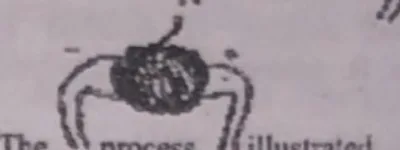
The process illustrated in the diagram (gametangia) is
A. gametogenesisB. sexual reproduction in RhizopusCorrect C. sexual reproduction in SpirogyraD. sporulationExplanation The diagram demonstrates conjugation in Rhizopus, a form of sexual reproduction.
The structure labeled I in the gametangia diagram is the
A. zygosporeCorrect B. conidiosporeC. sporangiumD. hyphaExplanation The structure labelled 'I' is the zygospore, the product of gametangial fusion.
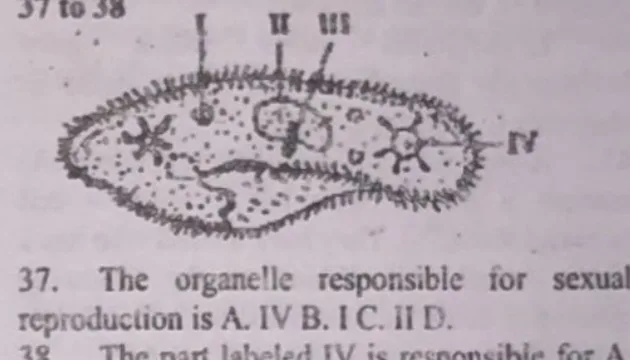
In the diagram, the organelle responsible for sexual reproduction is
A. IVB. IC. IICorrect D. IIIExplanation The structure labelled 'II' is the nucleus, which is responsible for sexual reproduction.
In the diagram, the part labeled IV is responsible for
A. respirationB. ingestionC. locomotionD. osmoregulationCorrect Explanation The part labelled 'IV' is the contractile vacuole, responsible for osmoregulation.
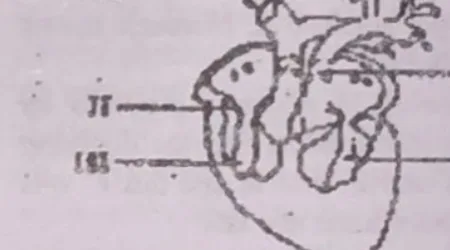
In the heart diagram, the part labeled I is the
A. pulmonary arteryB. bicuspid valveC. aortaCorrect D. vena cavaExplanation The aorta is the largest artery of the body; the other artery in the diagram is the pulmonary artery.
Oxygenated blood is pumped to the entire body from the part labeled
A. IVB. ICorrect C. IID. IIIExplanation Oxygenated blood is pumped from the left ventricle through the aorta to the entire body.
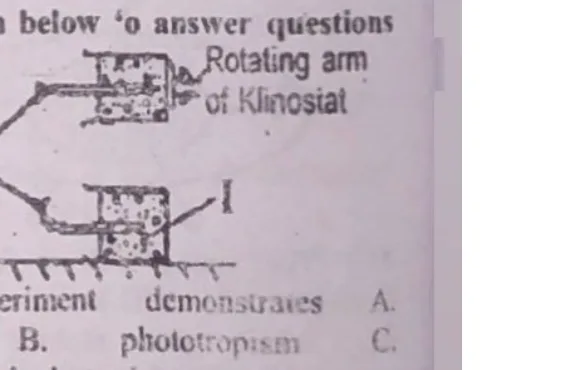
In the diagram, the germinating seedlings experiment demonstrates
A. hydrotropismB. phototropismC. thigmotropismCorrect D. geotropismExplanation The rotating klinostat apparatus with the seedlings demonstrates thigmotropism.
The part marked I will contain a high concentration of
A. ethyleneB. abscisic acidC. auxinCorrect D. ascorbic acidExplanation Auxins are produced from plant apices; the highest concentration of auxin is expected at the tip (part I).
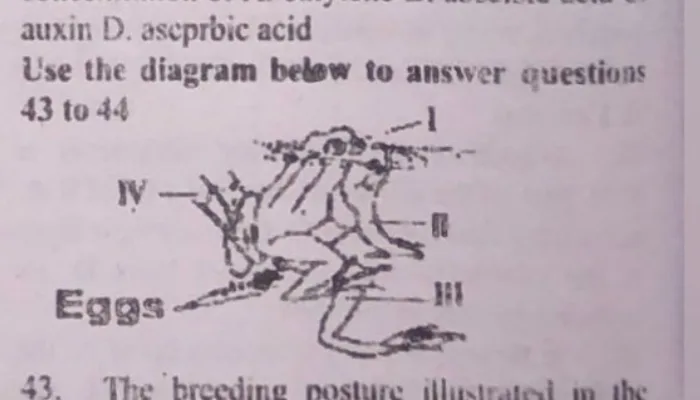
The breeding posture illustrated in the diagram is known as
A. reproductive swimmingB. amplexusCorrect C. matingD. courtshipExplanation The picture illustrates the mating posture in toads/frogs, known as amplexus.
The diagram shows that the organisms are
A. viviparousB. hermaphroditeC. ovoviviparousD. oviparousCorrect Explanation Since laying of eggs is involved, the organisms are oviparous.
Insulin is produced by the endocrine organ labeled
A. ICorrect B. IVC. IIID. IIExplanation Insulin is produced by the islets of Langerhans in the pancreas, labelled 'I' in the diagram.
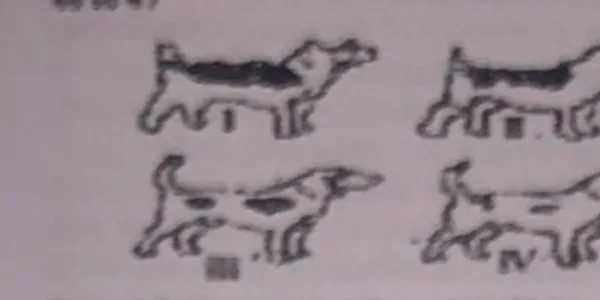
In the diagram, which of the following will be true of dog II, which lost its tail in an accident, if it mates with dog III?
A. All its offspring will be born without tailsB. ¾ of its offspring's will be born without tailsC. None of its offspring will be born without tailsCorrect D. ¼ of its offspring will be born without tailsExplanation Since acquired traits (like an accidentally lost tail) are not heritable, none of dog II's offspring will be born without a tail.
If the dogs are offspring of a monohybrid cross and the gene G for grey head is dominant over its allele g, the individual whose genotype is likely to be gg is
A. IB. IVCorrect C. IIID. IIExplanation If G (grey head) is dominant over g, then a dog without a grey head must have the genotype gg.
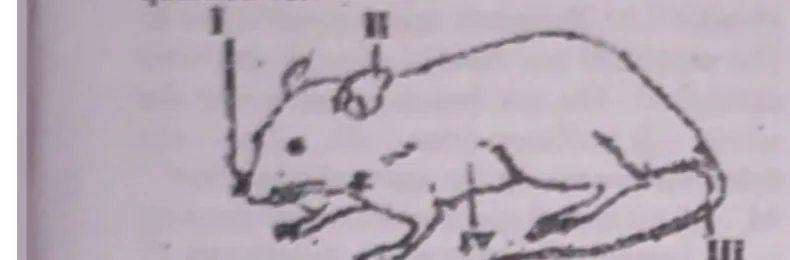
The type of protective adaptation exhibited by the animal (rat) in the diagram is
A. flash colourationB. counter shading colourationCorrect C. warning colourationD. disruptive colourationExplanation The rat shows counter-shading, a method of camouflage where the animal's colouration is darker on the upper side and lighter on the underside of the body.
The structure labeled I is
A. tactileCorrect B. radio sensitiveC. photosensitiveD. chemoreceptiveExplanation The structure labelled 'I' is the vibrissae, a tactile organ sensitive to touch.
Sign up free to unlock …and/or go further with premium services and No Ads .