Free account: track your progress — Sign up free

JAMB Biology 2021 Objective Past Questions

All 40 questions from the Joint Admissions and Matriculation Board (JAMB) Biology 2021 Objective paper, with the correct answer and a full explanation for each. Free, no signup needed.

Advertisement

Biology 2021 Objective — Question 1

1. The taxon containing the least similar set of organisms is the (a) species (b) genus (c) order (d) kingdom

  • A. species
  • B. genus
  • C. order
  • D. kingdomCorrect

Explanation

The kingdom is the taxon in which all other taxa are embedded, i.e. it is the largest taxon and contains the most dissimilar set of organisms. Species is the smallest taxon and comprises the most closely related organisms.

Biology 2021 Objective — Question 2

2. Which of the following is true about sex-linked characters? (a) they are dominant and linked to X-chromosome (b) They are recessive and linked to X-chromosome (c) They are dominant and linked to Y-chromosome (d) they are recessive and linked to Y-chromosome

  • A. they are dominant and linked to X-chromosome
  • B. They are recessive and linked to X-chromosomeCorrect
  • C. They are dominant and linked to Y-chromosome
  • D. they are recessive and linked to Y-chromosome

Explanation

Sex-linked characters are recessive and are linked to the X-chromosome.

Biology 2021 Objective — Question 3

3. The smallest bone in the human body is the (a) stapes (b) femur (c) malleus (d) incus

  • A. stapesCorrect
  • B. femur
  • C. malleus
  • D. incus

Explanation

The smallest bones in the human body are the ear ossicles - malleus (hammer), incus (anvil) and stapes (stirrup). Of these, the stapes is the smallest.

Biology 2021 Objective — Question 4

4. The instrument with which atmospheric pressure is measured is the (a) wind vane (b) hydrometer (c) barometer (d) hygrometer

  • A. wind vane
  • B. hydrometer
  • C. barometerCorrect
  • D. hygrometer

Explanation

The barometer measures atmospheric pressure. (Windvane measures wind direction, hydrometer measures relative density, and hygrometer measures relative humidity.)

Biology 2021 Objective — Question 5

5. Cutaneous respiration is peculiar (a) Pisces (b) amphibians (c) reptiles (d) Aves

  • A. Pisces
  • B. amphibiansCorrect
  • C. reptiles
  • D. Aves

Explanation

Amphibians exhibit pulmonary, buccal and cutaneous (skin) respiration; cutaneous respiration is peculiar to them.

Biology 2021 Objective — Question 6

6. The content of which of the following acidic? (a) mouth (b) stomach (c) Duodenum (d) stomach & duodenum

  • A. mouth
  • B. stomachCorrect
  • C. Duodenum
  • D. stomach & duodenum

Explanation

Saliva in the mouth is alkaline, but this alkalinity is neutralised in the stomach by HCl, making the stomach's content acidic. The duodenum's content is alkaline due to bile.

Biology 2021 Objective — Question 7

7. Height, skin color, weight and colour of the eyes are examples of (a) morphological variation (b) physiological variation (c) discontinuous characters (d) sex-linked characters

  • A. morphological variationCorrect
  • B. physiological variation
  • C. discontinuous characters
  • D. sex-linked characters

Explanation

Height, skin colour, weight and eye colour deal with physical appearance and therefore represent morphological (continuous) variation, since these features have many intermediates.

Biology 2021 Objective — Question 8

8. When an allele can express itself both in the homozygous pairing and the heterozygous pairing, it is said to be (a) recessive (b) dominant (c) an allelomorph (d) genetic

  • A. recessive
  • B. dominantCorrect
  • C. an allelomorph
  • D. genetic

Explanation

An allele that can express itself only in the homozygous pairing is recessive; one that expresses itself in both homozygous and heterozygous pairing is dominant.

Biology 2021 Objective — Question 9

9. Beriberi is a deficiency symptom of vitamin (a) A (b) K (c) B1 (d) C

  • A. A
  • B. K
  • C. B1Correct
  • D. C

Explanation

Vitamin A deficiency causes night blindness, Vitamin K deficiency causes haemophilia-like bleeding, Vitamin B1 deficiency causes beriberi, and Vitamin C deficiency causes scurvy.

Biology 2021 Objective — Question 10

10. Which of the following animals has diastema? (a) fish (b) Human (c) Dog (d) rabbit

  • A. fish
  • B. Human
  • C. Dog
  • D. rabbitCorrect

Explanation

Diastema is a feature seen in the jaw of a herbivore — a gap between the incisors and premolars, caused by the absence of canines. The rabbit, being a herbivore, has a diastema.

Biology 2021 Objective — Question 11

11. The plant hormone that is responsible for ripening of fruits is (a) auxin (b) gibberellin (c) acetylene (d) ethylene

  • A. auxin
  • B. gibberellin
  • C. acetylene
  • D. ethyleneCorrect

Explanation

Ethylene (ethene) is the plant hormone responsible for the ripening of fruits. It should not be confused with acetylene (ethyne).

Biology 2021 Objective — Question 12

12. Which of the following blood types has no antibody? (a) O (b) A (c) AB (d) B

  • A. O
  • B. A
  • C. ABCorrect
  • D. B

Explanation

Blood type A has antigen A and antibody B; type B has antigen B and antibody A; type AB has antigens A & B but no antibody; type O has no antigen but has antibodies A & B. So AB has no antibody.

Biology 2021 Objective — Question 13

13. The bacteria that cannot convert atmospheric nitrogen to soil nitrate are called (a) denitrifying bacteria (b) nitrogen-fixing bacteria (c) putrefying bacteria (d) aerobic bacteria

  • A. denitrifying bacteria
  • B. nitrogen-fixing bacteriaCorrect
  • C. putrefying bacteria
  • D. aerobic bacteria

Explanation

Nitrogen-fixing bacteria are the ones that aid nitrogen fixation, i.e. convert atmospheric nitrogen to soil nitrate; other bacteria types cannot perform this conversion. These bacteria live mutualistically in the root nodules of leguminous plants.

Biology 2021 Objective — Question 14

14. In which of the following organisms is diffusion efficient as a means of gaseous exchange? (a) rat (b) lizard (c) earthworm (d) cockroach

  • A. rat
  • B. lizard
  • C. earthwormCorrect
  • D. cockroach

Explanation

Diffusion is an effective means of gaseous exchange in earthworms (through their moist skin) but not in organisms like the lizard and rat, which have too large a body mass for diffusion alone to suffice.

Biology 2021 Objective — Question 15

15. The cell organelle that is responsible for respiration is the (a) mitochondrion (b) ribosome (c) lysosome (d) endoplasmic reticulum

  • A. mitochondrionCorrect
  • B. ribosome
  • C. lysosome
  • D. endoplasmic reticulum

Explanation

The mitochondrion is the organelle responsible for (cellular) respiration, which is why it is known as the powerhouse of the cell.

Biology 2021 Objective — Question 16

16. Taenia saginata is associated with (a) fish (b) pork (c) beef (d) dog

  • A. fish
  • B. pork
  • C. beefCorrect
  • D. dog

Explanation

Taenia solium is associated with pork, while Taenia saginata is associated with beef.

Biology 2021 Objective — Question 17

17. The genetic make-up of an organism is known as its (a) phenotype (b) blood type (c) genotype (d) allelomorph

  • A. phenotype
  • B. blood type
  • C. genotypeCorrect
  • D. allelomorph

Explanation

The genetic make-up of an organism is its genotype, while its physical appearance is its phenotype. The phenotype is determined by the genotype and the environment.

Biology 2021 Objective — Question 18

18. The seat of intelligence in the brain is the (a) Pons varolli (b) thalamus (c) cerebrum (d) cerebellum

  • A. Pons varolli
  • B. thalamus
  • C. cerebrumCorrect
  • D. cerebellum

Explanation

The cerebrum is the seat of intelligence, consciousness, memory, alertness and judgement. The cerebellum, by contrast, is associated with the maintenance of balance.

Biology 2021 Objective — Question 19

19. The study of how and why population size changes over time is known as (a) population estimation (b) population cycle (c) population ecology (d) population dynamics

  • A. population estimation
  • B. population cycle
  • C. population ecology
  • D. population dynamicsCorrect

Explanation

Population dynamics is the study of how and why population sizes change over time.

Biology 2021 Objective — Question 20

20. Which of the following sits comfortably at the borderline between living and non-living things? (a) virus (b) bacteria (c) protozoan (d) alga

  • A. virusCorrect
  • B. bacteria
  • C. protozoan
  • D. alga

Explanation

The virus sits at the borderline between living and non-living things — it behaves as a living thing inside a host cell but assumes a crystalline, non-living form outside a living system.

Biology 2021 Objective — Question 21

21. The pigment utilized by the chameleon for changing colour is (a) pneumatophore (b) carotene (c) melanin (d) chromatophore

  • A. pneumatophore
  • B. carotene
  • C. melanin
  • D. chromatophoreCorrect

Explanation

The chromatophore is the pigment cell utilised by the chameleon for changing colour. (A pneumatophore is a breathing root used by mangrove plants for gaseous exchange, not a pigment.)

Biology 2021 Objective — Question 22

22. Which of the following serves as a passage for both urine and semen is the (a) urinary bladder (b) urethra (c) ureter (d) seminal vesicle

  • A. urinary bladder
  • B. urethraCorrect
  • C. ureter
  • D. seminal vesicle

Explanation

The urethra plays a urinogenital role — it serves as a passage for both urine and semen (in males).

Biology 2021 Objective — Question 23

23. Which of the following is not a process in urine formation? (a) detoxification (b) ultrafiltration (c) hormonal secretion (d) selective re-absorption

  • A. detoxificationCorrect
  • B. ultrafiltration
  • C. hormonal secretion
  • D. selective re-absorption

Explanation

Ultrafiltration and selective re-absorption are processes involved in urine formation. Detoxification (the breaking down of harmful substances) occurs in the liver, not as part of urine formation.

Biology 2021 Objective — Question 24

24. The water cycle is maintained mainly by (a) evaporation (b) condensation (c) evaporation and condensation (d) transpiration and respiration

  • A. evaporation
  • B. condensation
  • C. evaporation and condensationCorrect
  • D. transpiration and respiration

Explanation

Evaporation removes water from the earth's surface into the atmosphere, while condensation returns it as precipitation — together these mainly maintain the water cycle.

Biology 2021 Objective — Question 25

25. Which of the following involves only one living organism? (a) predation (b) commensalism (c) saprophytism (d) mutualism

  • A. predation
  • B. commensalism
  • C. saprophytismCorrect
  • D. mutualism

Explanation

Predation, commensalism and mutualism each involve two living organisms, while saprophytism involves only one living organism (a living organism feeding on dead/decaying matter).

Biology 2021 Objective — Question 26

26. The competition between paramecium Aurelia and paramecium caudatum is (a) interspecific (b) intraspecific (c) intergeneric (d) intrageneric

  • A. interspecificCorrect
  • B. intraspecific
  • C. intergeneric
  • D. intrageneric

Explanation

Since P. aurelia and P. caudatum are two different species within the same genus, the competition between them is interspecific.

Biology 2021 Objective — Question 27

27. The theory of use and disuse was propounded by (a) Jean Lamark (b) Gregor Mendel (c) Charles Darwin

  • A. Jean LamarkCorrect
  • B. Gregor Mendel
  • C. Charles Darwin

Explanation

Jean Baptiste Lamarck propounded the theory of use and disuse, while Charles Darwin propounded the theory of natural selection. (Note: only three options were legible in the source scan; a fourth option may be missing.)

Biology 2021 Objective — Question 28

28. The number of chromosomes in the check [cheek] cell and the sperm cell of a human are respectively (a) 50 & 25 (b) 46 & 23 (c) 23 & 46 (d) 92 & 46

  • A. 50 & 25
  • B. 46 & 23Correct
  • C. 23 & 46
  • D. 92 & 46

Explanation

A somatic cell (such as the cheek cell) has 46 chromosomes, while a sex cell (such as the sperm cell) has 23 chromosomes — a somatic cell has twice the number of chromosomes of a sex cell.

Biology 2021 Objective — Question 29

29. The bright coloured eye spots on the hind wings of a moth are an example of (a) mimicry (b) cryptic colouration (c) disruptive colouration (d) warning colouration

  • A. mimicry
  • B. cryptic colouration
  • C. disruptive colouration
  • D. warning colourationCorrect

Explanation

The bright coloured eye spots on a moth's hind wings serve as warning colouration, intended to scare off potential predators.

Biology 2021 Objective — Question 30

30. Given that both parents are heterozygous for a particular trait the probability that an offspring will be recessive for that trait is (a) 1/2 (b) 3/4 (c) 1/4 (d) 1

  • A. 1/2
  • B. 3/4
  • C. 1/4Correct
  • D. 1

Explanation

Crossing two heterozygotes (Tt x Tt) gives offspring in the ratio 1 TT : 2 Tt : 1 tt, so the probability of a recessive (tt) offspring is 1/4.

Biology 2021 Objective — Question 31

31. Which of the following is not part of the axial skeleton? (a) Ulna (b) skull (c) sternum (d) rib

  • A. UlnaCorrect
  • B. skull
  • C. sternum
  • D. rib

Explanation

The axial skeleton comprises the skull, vertebral column, sternum and ribs. The ulna is a bone of the forearm and is part of the appendicular skeleton.

Biology 2021 Objective — Question 32

32. The feature that makes locomotion in water easy for fish is the (a) lateral line (b) streamlined body (c) slimy body (d) scaly body

  • A. lateral line
  • B. streamlined bodyCorrect
  • C. slimy body
  • D. scaly body

Explanation

Locomotion in water is made easy for fish by its streamlined body. (The lateral line, by contrast, is used to detect vibrations in water.)

Biology 2021 Objective — Question 33

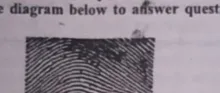
33. [See diagram] The fingerprint shown above is (a) loop (b) whorl (c) arch (d) compound

Diagram for question 33
  • A. loop
  • B. whorl
  • C. archCorrect
  • D. compound

Explanation

The diagram shows an arch fingerprint. Arch fingerprints have ridges that form a hill-like pattern.

Biology 2021 Objective — Question 34

34. The diagram shows what type of variation? (a) morphological (b) physiological (c) both (d) neither

  • A. morphologicalCorrect
  • B. physiological
  • C. both
  • D. neither

Explanation

Fingerprints show morphological variation (variation in physical form/structure).

Biology 2021 Objective — Question 35

35. The structure is effective for (a) resolving paternity dispute (b) detection (c) ancestral tracing (d) B and C

  • A. resolving paternity dispute
  • B. detectionCorrect
  • C. ancestral tracing
  • D. B and C

Explanation

Since no two people share exactly the same fingerprint, fingerprints are effective for detection (crime detection/identification).

Biology 2021 Objective — Question 36

36. The only blood vessel that begins and end in capillaries is (a) aorta (b) hepatic artery (c) hepatic portal vein (d) renal vein

  • A. aorta
  • B. hepatic artery
  • C. hepatic portal veinCorrect
  • D. renal vein

Explanation

The hepatic portal vein is the only blood vessel that begins and ends in capillaries. It transports blood containing digested food substances from the gut to the liver.

Biology 2021 Objective — Question 37

37. Which of the following is not a digestive enzyme? (a) erepsin (b) lipase (c) trypsin (d) bile

  • A. erepsin
  • B. lipase
  • C. trypsin
  • D. bileCorrect

Explanation

Bile is not a digestive enzyme; it is a substance that emulsifies fats (breaks fat into smaller droplets), aiding digestion but not itself acting as an enzyme.
Biology 2021 Objective — Question 38

38. The vertebrate group that shows the most parental care to their offspring is (a) amphibian (b) mammalia (c) aves (d) reptilia

  • A. amphibian
  • B. mammaliaCorrect
  • C. aves
  • D. reptilia

Explanation

Mammals show the most parental care to their offspring, followed by birds (aves).

Biology 2021 Objective — Question 39

39. The hardest material in the human body is (a) enamel (b) pulp cavity (c) bone (d) dentine

  • A. enamelCorrect
  • B. pulp cavity
  • C. bone
  • D. dentine

Explanation

Enamel is the hardest material in the human body. It forms the outermost part of the teeth.

Biology 2021 Objective — Question 40

40. Which of the following bears naked seeds? (a) mango (b) moss (c) cycad (d) fern

  • A. mango
  • B. moss
  • C. cycadCorrect
  • D. fern

Explanation

Cycad is a conifer, and conifers bear naked seeds. Mango is a flowering plant (seeds are not naked), while fern and moss are seedless.

Advertisement

Sign up free to unlock

  • Score tracking
  • Practice history
  • Saved questions
  • Progress dashboard
  • Personalized sessions
  • Weak-topic breakdown

…and/or go further with premium services and No Ads.