Biology 2023 Objective — Question 1
Taenia solium can be found in
- A. pigCorrect
- B. cow
- C. goat
- D. dog
Explanation
Taenia solium inhabits pigs, while Taenia saginata inhabits cows.
All 40 questions from the Joint Admissions and Matriculation Board (JAMB) Biology 2023 Objective paper, with the correct answer and a full explanation for each. Free, no signup needed.
Advertisement
Taenia solium can be found in
Taenia solium inhabits pigs, while Taenia saginata inhabits cows.
Proboscis is a structure that is mostly found in
The proboscis of insects is a long, tubular mouthpart used for feeding; it can be adapted for various feeding habits, such as sucking nectar, piercing, or sucking blood and lapping up fluids.
Which of the following is an adaptation for water conservation?
The larger the surface area of leaves, the higher the transpirational water loss; spiny (reduced) leaves minimize this loss to the barest minimum, while broad leaves would allow much greater water loss.
The digestive enzyme that is present in the saliva is
Ptyalin is the digestive enzyme present in saliva; as food is chewed, ptyalin mixes with it and begins breaking down complex carbohydrates (e.g. starch) into simpler sugars such as maltose.
Plants that have special structures for trapping and digesting insects are
Carnivorous (insectivorous) plants have special structures for trapping and digesting insects, e.g. Venus flytrap, Pitcher plants, Sundews, Bladderworts and Butterworts.
Which of the following is a waste product of an insect?
Insects primarily excrete nitrogenous waste as uric acid, formed from the breakdown of nitrogenous compounds - unlike mammals and birds, which mainly excrete urea; this is a water-conserving excretory adaptation.
The sensory cell that responds to dim light is called
Rod cells in the retina function in dim light and detect light intensity better than cone cells, though they do not permit detection of colours (which cone cells allow).
The opening of the guard cells of the epidermis in plants is by the process of
Stomata (guard cells) open when the guard cells become turgid and close when they become flaccid; this turgidity change depends on the osmotic concentration/osmosis within the guard cells.
In humans, excretion of isotonic urine is associated with
The concentration of urine in the nephron depends on the permeability of the tubules; in the proximal convoluted tubule, the urine remains isotonic.
The correct arrangement of food classes of the same quantity in the descending order of magnitude of energy values in animals is
Fats and oils contain a greater amount of energy than an equal quantity of carbohydrates, which contain more than protein; water has essentially no calorific/energy value: Fats and oils > Carbohydrates > Protein > Water.
Which of the following substances is not a complex carbohydrate?
Complex carbohydrates are long chains of sugar molecules (e.g. starch, cellulose, glycogen, chitin); glucose is a simple sugar (monosaccharide), not a complex carbohydrate.
The bacteria that convert soil nitrate into atmospheric nitrogen are called
Denitrifying bacteria (e.g. Pseudomonas denitrificans) convert soil nitrate back into atmospheric nitrogen, completing the nitrogen cycle.
The main reason for immunizing children is to
Immunization protects individuals by stimulating the production of specific antibodies against particular pathogens, preparing the immune system to respond to future exposure.
How do we justify the absence of digestive system in tapeworm?
Tapeworms do not possess a digestive system because their bodies absorb already-digested food directly from their host's intestine.
If a body has blood type O and his mother has blood type A, what is the likely genotype of his father?
For a child to have blood type O, both parents must carry the recessive allele (genotype including O); given the mother is quoted as type A (which could be AA or AO), the father's genotype must be AO or BO (or O) to allow an O-type child - AO is the answer among the given options.
The organism above (an earthworm) is found in soils rich in
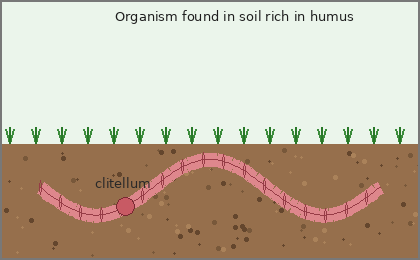
Earthworms are found in soils rich in humus, since humus is organic matter that serves as their primary food source. (Note: the original scanned booklet did not include the source diagram; the image shown is a representative illustration.)
The branch of biology that deals with the principles of classification of organisms is known as
Taxonomy is the science of classification, particularly the classification of organisms into a hierarchical system based on their similarities and evolutionary relationships.
The presence of a large number of ______ is an evidence that a cell utilizes a lot of energy
Mitochondria are the powerhouse of the cell; a cell that utilises a lot of energy will have an appreciable number of mitochondria.
Kreb's cycle occurs in the
The Krebs cycle (citric acid/tricarboxylic acid cycle) occurs in the mitochondria of eukaryotic cells, as a key component of cellular respiration.
A purple colour was obtained when sodium hydroxide solution and a drop of copper sulphate solution were added to a food substance. The food is likely to be a
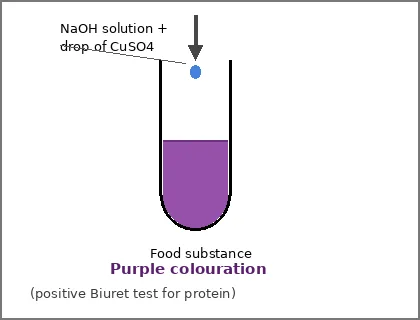
This describes the Biuret test for protein; a purple/violet colour with sodium hydroxide and copper sulphate solution indicates the presence of protein. (Note: the original scanned booklet did not include the source diagram; the image shown is a representative illustration.)
A sample of wet soil of a given weight was heated to constant weight. The loss in weight is due to loss of
When a wet soil sample is strongly heated to a constant weight, both the water and the humus (organic matter) in the soil are lost.
Adenine pairs with thymine because
Two purines do not pair, nor do two pyrimidines; a purine pairs with the appropriate pyrimidine. Adenine (a purine) pairs with thymine (a pyrimidine); guanine pairs with cytosine. In RNA, thymine is replaced by uracil.
What is the role of the red head in male Agama lizard?
The red head in male Agama lizards serves to secure a mate by attracting female lizards.
An example of an endospermous seed is
Endospermous seeds have endosperm, a nutrient-rich tissue that surrounds and nourishes the developing embryo; examples include maize, rice, wheat, castor and coconut.
The movement response of cockroach away from a light source can be described as
Since the cockroach's whole body moves away from the light source, this is a taxis (not tropism, which applies to plants), and movement away from a stimulus is negative - hence negative phototaxis.
If the cross of a red-flowered plant with a white-flowered plant produces a pink-flowered plant, it is an example of
This illustrates incomplete dominance, where instead of one allele completely masking the other, the effects of both alleles are partially expressed, resulting in an intermediate (pink) phenotype different from both parents.
What is the number of alleles controlling blood groups in humans?
Blood groups in humans are controlled by three alleles: A, B and O; these determine the presence or absence of specific antigens on red blood cells, giving rise to four blood types: A, B, AB and O.
In terms of the number of individuals, which of the following taxa is the most inclusive?
In descending order of inclusivity, taxa are arranged: Kingdom > Phylum/Division > Class > Order > Family > Genus > Species; among the options given, Class is the most inclusive and Species the least inclusive.
In the alimentary system of a bird, the function of teeth is carried out by the
Birds don't have teeth; they use their gizzard to mechanically grind their ingested food substances.
Exhaled air differs from inhaled air in that it is
Exhaled air usually has more water vapour and is usually higher (not lower) in temperature than inhaled air; it also has greater CO2 and less oxygen than inhaled air.
The ability of a chameleon to change its colour is an adaptive feature for
Chameleons lack traits such as sharp teeth or claws, venom and speed, so they rely on being able to blend into their surroundings to evade predators - a defensive mechanism.
Primary growth in plants is brought about by the activity of the
Primary growth in plants is controlled by root meristems and shoot apical meristems; lateral meristems control secondary growth.
Which of the following processes is not an example of a reflex action?
Reading is a voluntary action, not an involuntary reflex action like sneezing, heartbeat or blinking.
The following are examples of discontinuous variation except
Skin colour is a continuous variation, while sex type, fingerprint pattern, and the ability to taste phenylthiocarbamide (PTC) are discontinuous variations.
Which of the following is an anabolic process?
Anabolic processes build complex molecules from simpler ones, e.g. photosynthesis and protein synthesis; catabolic processes (like respiration) break complex molecules down into simpler ones.
Amoeba engulfs food particles by means of its
Amoeba engulfs food particles using pseudopodia via phagocytosis, forming a temporary food vacuole that later fuses with lysosomes to digest the food.
The type of association in which one organism benefits and the other neither benefits nor suffers any harm is called
In commensalism, one organism benefits while the other neither benefits nor is harmed; in mutualism both benefit, and in parasitism one benefits at the other's expense.
Intercoastal muscles are found in the ______ region
Intercostal muscles are located between the ribs in the chest region of the human body, essential for breathing (expanding and contracting the ribcage).
Meiosis involves the following except
Meiosis produces four haploid daughter cells (with half the chromosome number of the parent cell), not diploid cells.
The network of blood capillaries in the kidney capsule is referred to as
The glomerulus is a network of tiny blood capillaries within the Bowman's capsule of the nephron, playing a crucial role in the first step of urine formation (glomerular filtration).
Advertisement
…and/or go further with premium services and No Ads.