Free account: track your progress — Sign up free

JAMB Chemistry 2023 Objective Past Questions

All 40 questions from the Joint Admissions and Matriculation Board (JAMB) Chemistry 2023 Objective paper, with the correct answer and a full explanation for each. Free, no signup needed.

Advertisement

Chemistry 2023 Objective — Question 1

Given that the difference in electronegativity of elements X and Y is 2.2, the bond that will be formed between them is

  • A. Polar covalent
  • B. IonicCorrect
  • C. Non-polar covalent
  • D. Coordinate

Explanation

Electronegativity difference >1.7 → ionic bond. 0.5–1.7 → polar covalent. <0.5 → non-polar covalent. A difference of 2.2 gives an ionic bond.

Chemistry 2023 Objective — Question 2

The radiation used in studying the arrangement of particles in giant organic molecules is

  • A. β-particles
  • B. γ-rays
  • C. α-particles
  • D. X-raysCorrect

Explanation

X-ray crystallography is the technique used to study atomic arrangements in giant organic molecules. Crystals are exposed to X-rays and the diffraction patterns are analysed.

Chemistry 2023 Objective — Question 3

i. CaCO₃ ii. Ca(HCO₃)₂ iii. CaSO₄ — Which of the above causes temporary water hardness if present in water?

  • A. i only
  • B. ii onlyCorrect
  • C. iii only
  • D. i & ii

Explanation

Ca(HCO₃)₂ causes temporary hardness (removed by boiling). CaSO₄ causes permanent hardness. CaCO₃ is insoluble and does not cause hardness.

Chemistry 2023 Objective — Question 4

The dispersion of a liquid in a liquid medium will give

  • A. An emulsionCorrect
  • B. A sol
  • C. An aerosol
  • D. A fog

Explanation

Emulsion: liquid dispersed in liquid. Sol: solid in liquid. Aerosol: liquid/solid in gas. Fog: liquid droplets in gas.

Chemistry 2023 Objective — Question 5

The respective basicities of HNO₃, HCl, CH₃COOH and H₂SO₄ are

  • A. 1, 1, 4 & 2
  • B. 1, 1, 3 & 2
  • C. 1, 1, 1 & 2Correct
  • D. 1, 1, 3 & 1

Explanation

Basicity = number of replaceable H⁺ ions per molecule. HNO₃ = 1, HCl = 1, CH₃COOH = 1 (only the –COOH proton), H₂SO₄ = 2.

Chemistry 2023 Objective — Question 6

C(s) + H₂O(g) → CO(g) + H₂(g) — The oxidising agent in the reaction above is

  • A. CO
  • B. H₂
  • C. H₂OCorrect
  • D. C

Explanation

Carbon is oxidised (0 → +2 in CO), so it is the reducing agent. Hydrogen in H₂O is reduced (+1 → 0 in H₂), so H₂O is the oxidising agent.

Chemistry 2023 Objective — Question 7

How many coulombs of electricity will be needed to deposit 22.22 g of silver?

  • A. 20212.3 C
  • B. 14189 C
  • C. 25719 C
  • D. 19854 CCorrect

Explanation

Ag⁺ + e⁻ → Ag. Q = (mass/M) × F × n = (22.22/108) × 96500 × 1 = 0.2057 × 96500 = 19853.98 ≈ 19854 C.

Chemistry 2023 Objective — Question 8

A compound that gives a brick-red colour to a non-luminous flame is likely to contain

  • A. Al³⁺
  • B. Na⁺
  • C. Ca²⁺Correct
  • D. Cu²⁺

Explanation

Flame test: Ca²⁺ → brick-red; Na⁺ → golden yellow; K⁺ → lilac; Cu²⁺ → blue-green; Ba²⁺ → green; Li⁺ → crimson red.

Chemistry 2023 Objective — Question 9

The general formula of haloalkanes where X represents the halide is

  • A. CₙH₂ₙ₋₁X
  • B. CₙH₂ₙ₊₁XCorrect
  • C. CₙH₂ₙ₋₂X
  • D. CₙH₂ₙX

Explanation

Haloalkanes are derived from alkanes (CₙH₂ₙ₊₂) by replacing one H with halogen X. Formula = CₙH₂ₙ₊₁X.

Chemistry 2023 Objective — Question 10

Which of the following is generated when ethyne is passed through a hot tube containing an organo-nickel catalyst?

  • A. BenzeneCorrect
  • B. Polythene
  • C. Butyne
  • D. Phenol

Explanation

3C₂H₂ →(organo-Ni, Δ)→ C₆H₆. Three molecules of ethyne trimerize to form benzene.

Chemistry 2023 Objective — Question 11

The petroleum fraction used in heating furnaces in industries is

  • A. Diesel oilCorrect
  • B. Kerosene
  • C. Petrol
  • D. None

Explanation

Diesel oil has a high energy content and suitable combustion characteristics, making it suitable for industrial heating furnaces.

Chemistry 2023 Objective — Question 12

What is the molar mass of a gas if 2.0 g of the gas occupies a volume of 400 cm³ at STP?

  • A. 28 g mol⁻¹
  • B. 14 g mol⁻¹
  • C. 56 g mol⁻¹
  • D. 112 g mol⁻¹Correct

Explanation

Moles = 400/22400 = 0.01786 mol. Molar mass = mass/moles = 2.0/0.01786 = 112 g mol⁻¹.

Chemistry 2023 Objective — Question 13

The following factors have no effect on the value of the equilibrium constant EXCEPT

  • A. TemperatureCorrect
  • B. Pressure
  • C. Concentration
  • D. None of the above

Explanation

Only temperature changes the equilibrium constant (K). Pressure and concentration change the equilibrium position but not the value of K.

Chemistry 2023 Objective — Question 14

What volume of CO is produced by reacting excess carbon with 5 dm³ of oxygen?

  • A. 5 dm³
  • B. 8 dm³
  • C. 10 dm³Correct
  • D. 2 dm³

Explanation

2C + O₂ → 2CO. 1 mole O₂ produces 2 moles CO. By Gay-Lussac's law, 5 dm³ O₂ produces 10 dm³ CO.

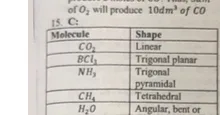
Chemistry 2023 Objective — Question 15

The shape of the carbon(iv) oxide molecule is

Diagram for question 15
  • A. Tetrahedral
  • B. Angular
  • C. LinearCorrect
  • D. Pyramidal

Explanation

CO₂ has two C=O double bonds with no lone pairs on carbon. VSEPR theory gives linear geometry (180°).

Chemistry 2023 Objective — Question 16

What type of bond can be formed between two elements with electronic structures 1s²2s²2p⁶ (oxygen group) and 1s²2s²2p⁴?

  • A. Ionic
  • B. Metallic
  • C. CovalentCorrect
  • D. Dative

Explanation

Both elements are non-metals (no electropositive element). Neither can lose electrons easily to form an ionic bond. They share electrons to form a covalent bond.

Chemistry 2023 Objective — Question 17

When water is added to anhydrous cobalt(ii) chloride (COCl₂), the colour changes from

  • A. Blue to white
  • B. White to blue
  • C. Blue to pinkCorrect
  • D. Pink to white

Explanation

Anhydrous CoCl₂ is blue. When hydrated (water added), it turns pink/red: CoCl₂ + 6H₂O → CoCl₂·6H₂O (pink). Anhydrous CuSO₄ changes white → blue on hydration.

Chemistry 2023 Objective — Question 18

The following are salts EXCEPT

  • A. Zinc nitrate
  • B. Sodium carbonate
  • C. Calcium oxideCorrect
  • D. Magnesium chloride

Explanation

Zn(NO₃)₂, Na₂CO₃ and MgCl₂ are salts. CaO is a base (metal oxide). Bases are not salts — they are oxides, hydroxides, or other compounds that react with acids.

Chemistry 2023 Objective — Question 19

In an electrochemical cell, polarisation is caused by

  • A. Oxygen
  • B. HydrogenCorrect
  • C. Chlorine
  • D. Tetraoxosulphate(vi) acid

Explanation

Hydrogen bubbles form on the anode surface during electrolysis, increasing cell resistance and reducing EMF. This is polarisation, prevented by depolarisers like MnO₂.

Chemistry 2023 Objective — Question 20

A metal that forms soluble trioxosulphate(iv) salt is

  • A. Manganese
  • B. Aluminium
  • C. Barium
  • D. PotassiumCorrect

Explanation

Generally, all sodium, potassium and ammonium salts are soluble in water. Potassium sulphite (K₂SO₃) is soluble.

Chemistry 2023 Objective — Question 21

2-methylpropan-2-ol is a/an

  • A. Primary
  • B. Secondary
  • C. TertiaryCorrect
  • D. Incombustible

Explanation

2-methylpropan-2-ol: the carbon bearing –OH is bonded to three other carbon atoms (three methyl groups). This is a tertiary alcohol.

Chemistry 2023 Objective — Question 22

The decarboxylation of ethanoic acid will produce

  • A. CO₂ and methaneCorrect
  • B. CO₂ and ethane
  • C. CO₂ and ethane
  • D. CO and methane

Explanation

Decarboxylation of RCO₂H gives RH + CO₂. For ethanoic acid (CH₃COOH): CH₃COOH → CH₄ + CO₂. The alkane produced is methane.

Chemistry 2023 Objective — Question 23

Which of the following qualifies elements in the same period?

  • A. Equal number of valence electrons
  • B. Equal number of shellsCorrect
  • C. Equal number of neutrons
  • D. Equal nuclear energy

Explanation

Elements in the same period have the same number of electron shells (energy levels). Elements in the same group have the same number of valence electrons.

Chemistry 2023 Objective — Question 24

A substance is said to be impure if

  • A. It is coloured
  • B. It has a low melting point
  • C. Its melting point range is wideCorrect
  • D. It is insoluble in water

Explanation

Pure substances have sharp, narrow melting point ranges. Impurities broaden and depress the melting point range. A wide melting range indicates impurity.

Chemistry 2023 Objective — Question 25

How many isomers does C₃H₆Cl₂ have?

  • A. 2
  • B. 3
  • C. 4Correct
  • D. 5

Explanation

C₃H₆Cl₂ has four structural isomers: 1,1-dichloropropane; 2,2-dichloropropane; 1,2-dichloropropane; and 1,3-dichloropropane.

Chemistry 2023 Objective — Question 26

Which of the following is non-biodegradable?

  • A. Wood
  • B. PlasticCorrect
  • C. Paper
  • D. Faeces

Explanation

Plastics (like polyethene, PVC) cannot be broken down by micro-organisms and persist in the environment. Wood, paper and organic waste are biodegradable.

Chemistry 2023 Objective — Question 27

Which of the following is a fine chemical?

  • A. DrugsCorrect
  • B. H₂SO₄
  • C. NaOH
  • D. NH₃

Explanation

Fine chemicals are produced in small quantities to high purity (e.g. drugs, dyes, vitamins). Heavy chemicals like H₂SO₄, NaOH and NH₃ are produced in large quantities.

Chemistry 2023 Objective — Question 28

How many unpaired electrons are in the p-orbitals of an oxygen atom?

  • A. 0
  • B. 1
  • C. 2Correct
  • D. 3

Explanation

O (Z=8): 1s²2s²2p⁴. The 2p subshell has 4 electrons: 2px↑↓, 2py↑, 2pz↑. There are 2 unpaired electrons.

Chemistry 2023 Objective — Question 29

The radioactive emission with the least ionisation power is

  • A. α-particles
  • B. β-rays
  • C. γ-raysCorrect
  • D. X-rays

Explanation

Ionising power: α > β > γ. Alpha particles have the highest ionising power but lowest penetrating power. Gamma rays have the highest penetrating power but lowest ionising power.

Chemistry 2023 Objective — Question 30

How many atoms are present in 48 g of magnesium?

  • A. 6.02 × 10²³
  • B. 1.204 × 10²⁴Correct
  • C. 3.01 × 10²³
  • D. 1.51 × 10²³

Explanation

Moles of Mg = 48/24 = 2 mol. Atoms = 2 × 6.02 × 10²³ = 1.204 × 10²⁴.

Chemistry 2023 Objective — Question 31

50 cm³ of gas was collected over water at 10°C and 765 mmHg. Calculate the volume at STP if the SVP of water at 10°C is 5 mmHg.

  • A. 48.55 cm³
  • B. 48.23 cm³Correct
  • C. 49.19 cm³
  • D. 50.59 cm³

Explanation

Actual pressure of gas = 765 − 5 = 760 mmHg. At STP: T₁=283 K, V₁=50 cm³, P₁=760 mmHg; T₂=273 K, P₂=760 mmHg. V₂ = (50 × 273)/283 = 48.23 cm³.

Chemistry 2023 Objective — Question 32

Group VII elements are

  • A. Electron donors
  • B. Monoatomic
  • C. Good oxidising agentsCorrect
  • D. Highly electropositive

Explanation

Group VII (halogens) are diatomic, highly electronegative, good oxidising agents. They are NOT electron donors or electropositive. They accept electrons (reduction).

Chemistry 2023 Objective — Question 33

A substance that absorbs water when exposed to the atmosphere to become ultimately wet or sticky is

  • A. Hygroscopic
  • B. DeliquescentCorrect
  • C. Efflorescent
  • D. Desiccant

Explanation

Deliquescent substances absorb water from the air until they dissolve (e.g. NaOH, CaCl₂). Hygroscopic substances absorb moisture but don't fully dissolve. Efflorescent substances lose water of crystallisation.

Chemistry 2023 Objective — Question 34

This illustrates the law of

  • A. Conservation of mass
  • B. Multiple proportionCorrect
  • C. Constant composition
  • D. Reciprocal proportion

Explanation

The law of multiple proportion states that when two elements combine in more than one ratio, the different masses of one element that combine with a fixed mass of the other are in simple whole-number ratios.

Chemistry 2023 Objective — Question 35

NaOH + NH₄Cl → NaCl + H₂O + Y. Identity Y in the reaction above.

  • A. NH₃Correct
  • B. N₂
  • C. NO
  • D. NO₂

Explanation

NaOH + NH₄Cl → NaCl + H₂O + NH₃. A base heated with an ammonium salt produces ammonia. Ammonia is produced in the laboratory when a base is heated with an ammonium salt.

Chemistry 2023 Objective — Question 36

Due to its high reactivity, sodium is usually stored in

  • A. Alcohol
  • B. Under water
  • C. In paraffin oilCorrect
  • D. Anyhow

Explanation

Sodium is stored under paraffin oil (mineral oil) to prevent contact with air (O₂) and moisture, which would cause it to react violently.

Chemistry 2023 Objective — Question 37

The ability of an element to form long chains with its own atoms is referred to as

  • A. Bonding
  • B. Atomisation
  • C. CatenationCorrect
  • D. Chain reaction

Explanation

Catenation is the property of an atom forming long chains/rings by bonding with its own atoms. Carbon is the best example — it forms millions of organic compounds.

Chemistry 2023 Objective — Question 38

The miscibility of ethanol with water is due to the presence of

  • A. Hydroxyl groupCorrect
  • B. Methyl group
  • C. Hydrogen ion
  • D. Covalent link

Explanation

Ethanol (CH₃CH₂OH) is miscible with water because the –OH (hydroxyl) group forms hydrogen bonds with water molecules, enabling complete mixing.

Chemistry 2023 Objective — Question 39

Which of the following statements about thermoplastic material is correct?

  • A. They do not melt on heating
  • B. They melt on heating
  • C. They soften and melt on heatingCorrect
  • D. They decompose on heating

Explanation

Thermoplastics soften and melt on heating (allowing reshaping), then harden on cooling. This is reversible. Thermosets do not soften on heating — they char or decompose.

Chemistry 2023 Objective — Question 40

The radioactive emission with the least ionisation power is

  • A. α-particles
  • B. γ-rays (least ionisation)Correct
  • C. β-particles
  • D. X-rays

Explanation

Ionising power order: α > β > γ. Gamma rays have the least ionising power but greatest penetrating power. Alpha particles have the highest ionising power.

Advertisement

Sign up free to unlock

  • Score tracking
  • Practice history
  • Saved questions
  • Progress dashboard
  • Personalized sessions
  • Weak-topic breakdown

…and/or go further with premium services and No Ads.