Free account: track your progress — Sign up free

JAMB Economics 2009 Objective Past Questions

All 50 questions from the Joint Admissions and Matriculation Board (JAMB) Economics 2009 Objective paper, with the correct answer and a full explanation for each. Free, no signup needed.

Advertisement

Economics 2009 Objective — Question 1

Musa has a choice of buying a shirt, a book and a bag. What is the opportunity cost of buying a book?

  • A. a bag only
  • B. a book and a bag
  • C. a shirt and a bagCorrect
  • D. a shirt only

Explanation

If he bought only the book, the ones left unbought because of insufficient fund is the opportunity cost. If the scale of preference was given, it will be the next on the scale of preference after the book has been bought.

Economics 2009 Objective — Question 2

A typical feature of a market economy is that

  • A. all producers make profit
  • B. full employment exists
  • C. consumer sovereignty existsCorrect
  • D. there is equality of economic agents

Explanation

Consumer sovereignty is the freedom of the consumer to buy what he likes without any interference. It is a major feature of market economy.

Economics 2009 Objective — Question 3

The privatization exercise in Nigeria is a move towards

  • A. a mixed economy
  • B. subsistence economy
  • C. market economyCorrect
  • D. command economy

Explanation

Market economy is the one characterized with individual ownership of factors of production. Privatization is therefore a move towards a market economy.

Economics 2009 Objective — Question 4

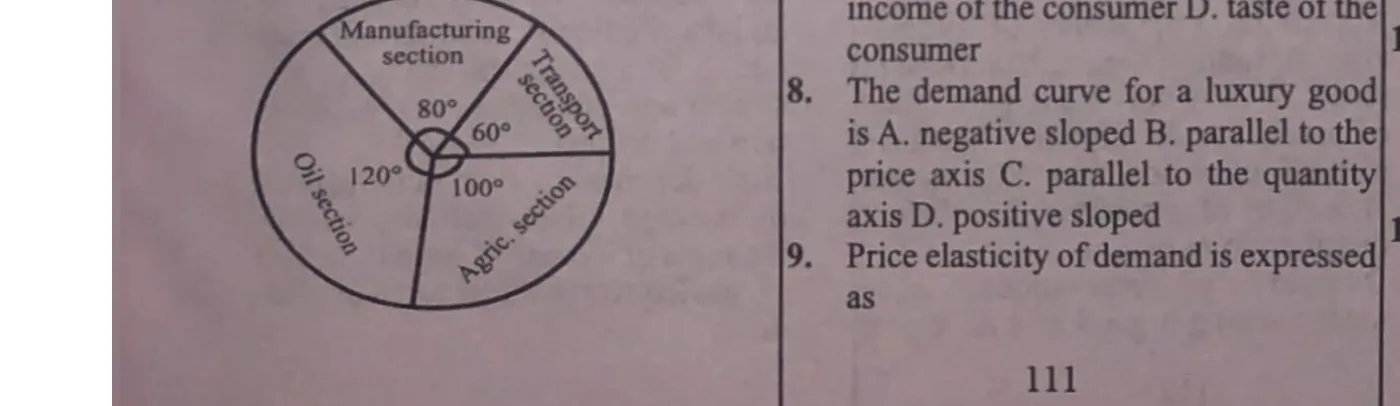
Use the pie chart to answer questions 4 and 5 (Manufacturing 80 degrees, Transport 60 degrees, Oil 120 degrees, Agric 100 degrees). The percentage contribution of the transport sector is

Diagram for question 4
  • A. 600.0%
  • B. 166.7%
  • C. 60.0%
  • D. 16.7%Correct

Explanation

The transport sector has 60 degrees out of 360 degrees; the percentage is (60/360) x 100 = 16.7%.

Economics 2009 Objective — Question 5

If the contribution of the oil sector is N3.6 million, what is the contribution of the other sectors?

  • A. N10.8 million
  • B. N7.2 millionCorrect
  • C. N3.6 million
  • D. N2.4 million

Explanation

If the contribution of oil sector (120 degrees) is N3.6m, then the total GDP is (3.6x360)/120 = N10.8m. Contribution of other sectors = 10.8 - 3.6 = N7.2 million.

Economics 2009 Objective — Question 7

A movement along the same demand curve is caused by the

  • A. price of the productCorrect
  • B. price of other products
  • C. income of the consumer
  • D. taste of the consumer

Explanation

Movement on a single demand curve is caused only by the change in price of the commodity.

Economics 2009 Objective — Question 8

The demand curve for a luxury good is

  • A. negative sloped
  • B. parallel to the price axis
  • C. parallel to the quantity axis
  • D. positive slopedCorrect

Explanation

The demand curve for a luxury good is positively sloped but elastic. It cannot be negatively sloped because it is not a normal good; it is the article of ostentation that has positive slope.

Economics 2009 Objective — Question 9

Price elasticity of demand is expressed as

  • A. percentage change in price / percentage change in quantity demanded
  • B. percentage change in quantity demanded / percentage change in income
  • C. percentage change in income / percentage change in quantity demanded
  • D. percentage change in quantity demanded / percentage change in priceCorrect

Explanation

Price elasticity is expressed as %change in quantity demanded / %change in price.

Economics 2009 Objective — Question 10

A major assumption in cardinal utility theory is that

  • A. utility is measurableCorrect
  • B. utility is not measurable
  • C. total utility equals marginal utility
  • D. total utility is constant

Explanation

The major assumption of the cardinalists is that utility can be measured numerically.

Economics 2009 Objective — Question 11

A supply curve is positively sloped because

  • A. supply always exceeds demand
  • B. demand always exceeds supply
  • C. price is an incentive to consumers
  • D. price is an incentive to producersCorrect

Explanation

Price is an incentive to a producer; higher price induces him to sell more.

Economics 2009 Objective — Question 12

The short-run supply curve for medical doctors is more likely to be

  • A. perfectly elastic
  • B. perfectly inelasticCorrect
  • C. fairly inelastic
  • D. fairly elastic

Explanation

The short run supply of medical doctors is more likely to be perfectly inelastic because of the time period required for the training. An increase in the wages or salaries of doctors might not lead to any change in supply in the short run.

Economics 2009 Objective — Question 13

If the price of an item changes by 8% and quantity supplied changes from 600 units to 660 units, the price elasticity of supply is

  • A. 0.80
  • B. 1.25Correct
  • C. 2.00
  • D. 1000

Explanation

%change in quantity = (660-600)/600 x 100 = 10%. Elasticity = %change in quantity / %change in price = 10%/8% = 1.25.

Economics 2009 Objective — Question 14

In a regulated market, price is determined by

  • A. consumers
  • B. producers
  • C. auction
  • D. governmentCorrect

Explanation

A regulated market is a market that is controlled by the government or its agencies. Prices of goods and services are regulated by the government.

Economics 2009 Objective — Question 15

A decrease in supply without a corresponding change in demand will lead to

  • A. an increase in equilibrium price and a decrease in equilibrium quantityCorrect
  • B. a decrease in equilibrium price and an increase in equilibrium quantity
  • C. a decrease in equilibrium price and equilibrium quantity
  • D. an increase in equilibrium price and quantity

Explanation

There will be an increase in equilibrium price and a decrease in equilibrium quantity as supply shifts left (from S0 to S1), while quantity demanded decreases.

Economics 2009 Objective — Question 16

Production takes place when

  • A. output is transformed into input
  • B. machines replace human effort
  • C. input is transformed into outputCorrect
  • D. there is specialization and division of labour

Explanation

When input is transformed into output, production has taken place. Generally, anytime utility is created, there is production.

Economics 2009 Objective — Question 17

Use the table below to answer questions 17 and 18 (Units of Capital 1-6, Total output (kg) 16,64,126,212,425,684, with AP and MP columns). The marginal product of the 5th unit of capital is

  • A. 42
  • B. 85
  • C. 114
  • D. 213Correct

Explanation

The marginal product of the 5th unit of capital is 425-212=213, i.e. the difference between the total product when the 5th capital was employed and when the 4th capital was employed.

Economics 2009 Objective — Question 18

Determine the average product of the 4th unit of capital

  • A. 53Correct
  • B. 86
  • C. 212
  • D. 213

Explanation

The average product of the 4th capital = TP/K = 212/4 = 53, i.e. the total output when 4 units were employed and the units of capital employed.

Economics 2009 Objective — Question 19

Which of the following can be deduced from law of variable proportions when total output is rising?

  • A. MP is greater than APCorrect
  • B. MP is less than AP
  • C. MP is equal to AP
  • D. MP is equal to zero

Explanation

This has some ambiguity because any of the options can be the answer when there is diminishing return, but generally when total output is rising, MP is greater than AP.

Economics 2009 Objective — Question 20

As the level of output increases, the average fixed cost of a firm will

  • A. continue to increase
  • B. remain unchanged
  • C. continue to decreaseCorrect
  • D. be equal to the total cost

Explanation

As output increases the Average Fixed Cost continues to decrease because the total fixed cost does not change.

Economics 2009 Objective — Question 21

The shape of the long-run average cost curve is best explained by the

  • A. law of diminishing returns
  • B. law of returns to scaleCorrect
  • C. cost of fixed inputs
  • D. cost of variable inputs

Explanation

The shape of the long-run cost curve is explained by the laws of returns to scale while that of the short run is explained by the law of diminishing return.

Economics 2009 Objective — Question 22

The supply curve of a perfectly competitive firm is identical to its

  • A. total cost
  • B. marginal costCorrect
  • C. fixed cost
  • D. variable cost

Explanation

In a perfectly competitive firm, the marginal cost curve of the firm is also the supply curve. This is because the condition for equilibrium is MC=MR and MR=AR=P.

Economics 2009 Objective — Question 23

If a monopolist is incurring short-run losses, this means that his

  • A. selling price is above the short-run marginal cost
  • B. selling price is below the short-run marginal cost
  • C. average cost is greater than marginal revenueCorrect
  • D. average revenue is less than marginal revenue

Explanation

What determines whether a firm is making loss or not is the position of the Average Cost. It is difficult to say P<MC leads to short-run loss. Since the MC must be equal to MR at equilibrium and the AR of the monopolist is always greater than MR.

Economics 2009 Objective — Question 24

In the long run, one of the characteristics of monopolistic competitive firms is that they

  • A. make abnormal profits
  • B. suffer losses
  • C. make normal profitsCorrect
  • D. collude with each other

Explanation

Because there is free entry and free exit in the monopolistic competitive market, they make only normal profits in the long run.

Economics 2009 Objective — Question 25

In developing countries, it is easier to obtain accurate national income estimates through the

  • A. GNP
  • B. GDPCorrect
  • C. NDP
  • D. NNP

Explanation

GDP is easier to determine in developing countries than GNP because of the inaccuracy in the computation of net income from abroad which is required in computing GNP.

Economics 2009 Objective — Question 26

Double counting is a problem in computing national income when using the

  • A. expenditure method
  • B. income method
  • C. output methodCorrect
  • D. value-added method

Explanation

When using the income approach, there is a tendency of including transfer payments which are not payments for production in the current period.

Economics 2009 Objective — Question 27

In the circular flow of income, an increase in savings causes

  • A. an increase in imports
  • B. a decrease in the income streamCorrect
  • C. an increase in household consumption
  • D. a decrease in exports

Explanation

Saving is a withdrawal (leakage), and it causes a decrease in the income stream on the circular flow.

Economics 2009 Objective — Question 28

The ability of commercial banks to create money depends on the

  • A. reserve ratioCorrect
  • B. liquidity ratio
  • C. interest rate
  • D. capital base

Explanation

The reserve ratio is the percentage of the customer's deposit that commercial banks are required to keep with the Central Bank. This ratio determines what will be left for the commercial bank to give out as loans because they create money only by giving out loans to customers.

Economics 2009 Objective — Question 29

The reform in the banking sector in Nigeria is principally motivated by the need to

  • A. increase the capital base of banksCorrect
  • B. provide more money to run the economy
  • C. minimize the rate of bank failures
  • D. enhance efficiency in bank operations

Explanation

The reform is mainly aimed at consolidating the banking sector by increasing their capital base.

Economics 2009 Objective — Question 30

A manufacturer who wants to build a new plant will source funds from

  • A. the commercial banksCorrect
  • B. the money market
  • C. the capital market
  • D. government

Explanation

Manufacturer can source for funds from commercial banks if he has good credit rating.

Economics 2009 Objective — Question 31

Cost-push inflation occurs when

  • A. production cost is highCorrect
  • B. factor prices decrease
  • C. there is too much money in circulation
  • D. government embarks on deficit financing

Explanation

When production cost is high, there will be a pressure on the producer to increase prices of his products. This is called cost push inflation if it cuts across firms and its sustained.

Economics 2009 Objective — Question 32

If government expenditure exceeds revenue, this results a

  • A. balanced budget
  • B. national debt
  • C. budget deficitCorrect
  • D. budget surplus

Explanation

Budget deficit is the type of budget in which the proposed expenditure exceeds the estimated revenue.

Economics 2009 Objective — Question 33

The Basic Needs Approach to development is directed at

  • A. poverty alleviationCorrect
  • B. provision of educational infrastructure
  • C. provision of health services
  • D. improvement in worker's income

Explanation

The basic need approach is to alleviate poverty by providing basic materials for the poor.

Economics 2009 Objective — Question 34

The major reason why countries strive to achieve optimum growth is to

  • A. be self-sufficient
  • B. raise general living standardsCorrect
  • C. raise the level of production
  • D. reduce aggregate expenditure

Explanation

The major reason why countries strive to achieve optimum population is to raise standard of living. Increased production and self-reliance are means to the achievement of this objective.

Economics 2009 Objective — Question 35

According to the theory of comparative advantage, specialization will result in

  • A. a labor-intensive method of production
  • B. a capital-intensive method of production
  • C. efficient allocation of resourcesCorrect
  • D. efficient distribution of output

Explanation

Comparative advantage advocates that country should produce a good which it can produce with a lower opportunity cost. This will lead to efficient allocation of resources.

Economics 2009 Objective — Question 36

Dumping in international trade means selling a good at a

  • A. higher price at home than abroad
  • B. lower price at home than abroadCorrect
  • C. price that equates marginal cost with marginal revenue
  • D. price above marginal cost abroad

Explanation

Dumping is the practice of selling goods at cheaper price abroad than the price in the local market.

Economics 2009 Objective — Question 37

Guided deregulation as currently practiced in Nigeria implies that

  • A. market forces determine interest and exchange rates
  • B. government alone determines interest and exchange rates
  • C. market forces and government determine interest and exchange ratesCorrect
  • D. exchange rate is regulated while interest rate is fixed

Explanation

The use of both the market forces and the government regulation to determine the exchange rate and the interest rates is called guided deregulation.

Economics 2009 Objective — Question 38

An important function of the World Bank is to

  • A. provide short-run term loans to members
  • B. encourage trade between members
  • C. promote capital intensive productions
  • D. provide long term loans to membersCorrect

Explanation

World Bank, also known as the International Bank for Reconstruction and Development provides long-term loans to members.

Economics 2009 Objective — Question 39

The major problem confronting a sole proprietor is

  • A. a high level of risk
  • B. limited expertiseCorrect
  • C. limited source of capital
  • D. high taxation

Explanation

The greatest challenge of a sole proprietor is the limitation he faces in raising funds.

Economics 2009 Objective — Question 40

A public liability company is run on a daily basis by

  • A. the chief executive
  • B. the shareholders
  • C. the board of directorsCorrect
  • D. financial consultants

Explanation

The day-to-day administration of the public limited liability company is done by the board of directors elected by the shareholders.

Economics 2009 Objective — Question 41

The marketing of agricultural products in Nigeria can be improved by

  • A. a massive production of farm produce
  • B. re-establishing the marketing boardsCorrect
  • C. establishing more agricultural banks
  • D. processing of farm produce

Explanation

Re-establishment of the marketing boards with a high level of transparency can improve the marketing of agricultural products in Nigeria.

Economics 2009 Objective — Question 42

To enhance the competitiveness of domestic agricultural products there is need to

  • A. ban the importation of agricultural products
  • B. increase the exportation of agricultural products
  • C. improve the quality of domestic agricultural productsCorrect
  • D. increase the output of domestic agricultural products

Explanation

Improving the quality of agricultural products will make them command higher prices and become more competitive in the world market.

Economics 2009 Objective — Question 43

In Nigeria, the location of a steel industry at Ajaokuta is due to

  • A. the availability of transport network
  • B. the proximity to source of power
  • C. the proximity to large deposits of Iron oreCorrect
  • D. political consideration

Explanation

Steel industry is a raw material oriented industry. Locating close to raw material is economical when it comes to transporting the product.

Economics 2009 Objective — Question 44

Industries for consumer goods are concentrated in urban centres as a result of

  • A. a large marketCorrect
  • B. power supply
  • C. government policy
  • D. weather conditions

Explanation

There is a large ready-made market for consumer goods in the urban centres because of the high population.

Economics 2009 Objective — Question 45

The current industrial development strategy in Nigeria is aimed at encouraging

  • A. small-scale industries
  • B. medium-scale industries
  • C. small-and medium-scale IndustriesCorrect
  • D. medium-and large-Scale Industries

Explanation

The strategy is to encourage small and medium scale industry.

Economics 2009 Objective — Question 46

Activities in the oil and gas industry are classified into

  • A. oil exportation and distribution
  • B. refining and marketing of finished products
  • C. upstream and downstreamCorrect
  • D. exploration and drilling

Explanation

Upstream and downstream is the classification of activities in the oil and gas industry.

Economics 2009 Objective — Question 47

High dependency ratio is influenced by

  • A. high infant mortality rate
  • B. the level of income
  • C. high birth rateCorrect
  • D. inadequate medical care for children

Explanation

High birth rate increases the percentage of children which are part of the dependent population.

Economics 2009 Objective — Question 48

Occupational distribution of population determines the

  • A. size of a population available and willing to work
  • B. population density of a place
  • C. dependency ratio of a country
  • D. size and categories of the labour forceCorrect

Explanation

The occupational distribution is the classification of the population, especially the working population, into primary, secondary and tertiary occupation. This is used to determine the size and categories of the labour force.
Economics 2009 Objective — Question 49

The mobility of labour is mainly determined by

  • A. the age of workers
  • B. government policy
  • C. trade unions
  • D. wage rate differentialsCorrect

Explanation

Wage rate differential is a major incentive for worker to migrate from one job to another or even to move from one industry to another.

Economics 2009 Objective — Question 50

When workers have a union, the supply of labour is said to be

  • A. monopolisticCorrect
  • B. oligopolistic
  • C. monopsonistic
  • D. competitive

Explanation

When workers have a union, they operate as one body which monopolizes the supply of labour.

Advertisement

Sign up free to unlock

  • Score tracking
  • Practice history
  • Saved questions
  • Progress dashboard
  • Personalized sessions
  • Weak-topic breakdown

…and/or go further with premium services and No Ads.