Free account: track your progress — Sign up free

JAMB Economics 2011 Objective Past Questions

All 49 questions from the Joint Admissions and Matriculation Board (JAMB) Economics 2011 Objective paper, with the correct answer and a full explanation for each. Free, no signup needed.

Advertisement

Economics 2011 Objective — Question 1

[Table: Price(N) 1-100kg,2-120kg,3-150kg,4-180kg,5-200kg] The graph of the schedule below will depict

  • A. A. a normal demand curve
  • B. B. an abnormal demand curveCorrect
  • C. C. a diminishing marginal utility curve
  • D. D. a kinked demand curve

Explanation

It will produce an abnormal demand curve because quantity increased as price increased - it will be an upward sloping curve.

Economics 2011 Objective — Question 2

If demand increases without a change in supply, equilibrium price and quantity will

  • A. A. shift inward
  • B. B. fall
  • C. C. riseCorrect
  • D. D. remain unchanged

Explanation

Both price and quantity will rise if it is only demand that increases while supply remains constant.

Economics 2011 Objective — Question 3

In the process of production, total output is at maximum when

  • A. A. MP>0
  • B. B. AP=0
  • C. C. AP>0
  • D. D. MP=0Correct

Explanation

When Total Product is at its maximum, the marginal product (MP) is zero.

Economics 2011 Objective — Question 4

The median of an odd-numbered set of scores is the

  • A. A. highest value in the set
  • B. B. arithmetic mean of the set
  • C. C. most frequently occurring score
  • D. D. middle value in the setCorrect

Explanation

When the number of observations in a set of data is an odd number, the median is the one at the middle after arranging the data in ascending or descending order.

Economics 2011 Objective — Question 5

If the demand for one commodity excludes another, it is said to be

  • A. A. competitive demandCorrect
  • B. B. composite demand
  • C. C. derived demand
  • D. D. complementary demand

Explanation

Competitive demand is the demand in which the two commodities are substitutes. The demand for one excludes the use of the other.

Economics 2011 Objective — Question 6

One of the limitations of PPC assumption is that there is

  • A. A. no recognition of preferred goods for countriesCorrect
  • B. B. technical inefficiency
  • C. C. abundant resources
  • D. D. no indication of technological development

Explanation

On a PPC, two goods are represented, but there is no indication for the one that is preferred out of the two goods. Technical progress or development is indicated with a shift of the curve to the right. Technical inefficiency can be shown with a point inside the PPC, which completely rules out abundance of resources.

Economics 2011 Objective — Question 7

Demand patterns are determined by the market on the basis of

  • A. A. consumer sovereignty
  • B. B. consumer rationality
  • C. C. price of the commodityCorrect
  • D. D. scale of preference

Explanation

The price that consumers are willing to pay for a commodity shows how much they want it, hence the pattern of demand is determined by the price of the commodity.

Economics 2011 Objective — Question 8

A consumer surplus measures the

  • A. A. excess of total expenditure over total utilityCorrect
  • B. B. difference between marginal utility and marginal cost
  • C. C. excess of marginal utility over price
  • D. D. benefits derived from consuming a cheap commodity

Explanation

The consumers' surplus is the difference between total expenditure of a consumer and its expected (planned) expenditure. The planned expenditure is the total utility; it can be represented as consumers' surplus = pq - ∫qdp, where p = price and q = quantity.

Economics 2011 Objective — Question 9

A major disadvantage of the arithmetic mean is that it is

  • A. A. not suitable for further statistical analysis
  • B. B. cumbersome to determine the actual value
  • C. C. affected by extreme dataCorrect
  • D. D. not useful for large data

Explanation

The mean is usually affected by extreme values - when a value in a distribution is too high or too small, it affects the mean value and makes it a biased representative.

Economics 2011 Objective — Question 10

An effective way of controlling inflation in a mixed economy is to

  • A. A. reduce income tax
  • B. B. ration available output
  • C. C. increase imports
  • D. D. increase productivityCorrect

Explanation

If productivity is increased, there will be an increase in total output, and the problem of too much money chasing few goods will be solved.

Economics 2011 Objective — Question 11

The optimal range of output for a perfectly competitive firm is where

  • A. A. AVC is lowest
  • B. B. MC is risingCorrect
  • C. C. MC is falling
  • D. D. AC is lowest

Explanation

The first condition for profit maximization is MC=MR; however, this is necessary but not sufficient. The second condition states that MC must be rising - the firm produces within the range where MC is increasing.

Economics 2011 Objective — Question 12

Ranking is the method used in measuring

  • A. A. ordinal utilityCorrect
  • B. B. cardinal utility
  • C. C. total utility
  • D. D. marginal utility

Explanation

The ordinal approach is one of the approaches used in determining the equilibrium of the consumer. It advocates ranking of utility, as opposed to the cardinalist approach which advocates measuring utility numerically.

Economics 2011 Objective — Question 13

A firm will experience diseconomies of scale when

  • A. A. there is shortage in labour supply
  • B. B. the size of market is small
  • C. C. there is an increase in the price of raw materials
  • D. D. there are difficulties in coordinating productionCorrect

Explanation

Diseconomies of scale occur in the long run when the firm becomes too big such that production coordination becomes a problem.

Economics 2011 Objective — Question 14

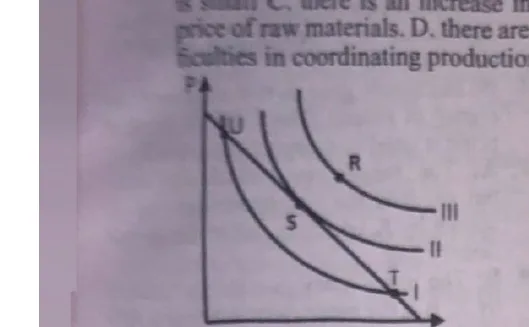
[Diagram: PPC with points R, S, T, U] From the diagram above, the optimal point of production is

Diagram for question 14
  • A. A. T
  • B. B. U
  • C. C. SCorrect
  • D. D. R

Explanation

At point S, the isoquant is tangent to the isocost, which satisfies the condition for equilibrium.

Economics 2011 Objective — Question 15

Minimum price legislation by government will

  • A. A. increase supply
  • B. B. reduce demand and create surplusCorrect
  • C. C. increase demand and create scarcity
  • D. D. reduce supply

Explanation

Minimum price legislation occurs when the price is fixed above equilibrium price. This will increase supply and create a supply surplus (reducing demand and creating surplus).

Economics 2011 Objective — Question 16

The law of variable proportions is applicable only

  • A. A. to large-scale enterprises
  • B. B. to small-scale enterprises
  • C. C. in the short-run periodCorrect
  • D. D. in the long-run period

Explanation

The law of variable proportion is applicable only in the short-run.

Economics 2011 Objective — Question 17

When a consumer is at equilibrium, the MRS is equal to the

  • A. A. product of the two prices
  • B. B. ratio of the two pricesCorrect
  • C. C. difference of the two prices
  • D. D. sum of the two prices

Explanation

The MRS, which is the slope of the indifference curve, will be equal to the slope of the budget line, i.e. the ratio of the two prices.

Economics 2011 Objective — Question 18

If a firm is faced with an elastic supply curve, its revenue will

  • A. A. double at a higher price
  • B. B. increase by more than the percentage increase in priceCorrect
  • C. C. equal percentage change in price
  • D. D. he supplies at a higher price

Explanation

An elastic supply means that the percentage change in quantity is greater than the percentage change in price, so revenue increases by more than the percentage increase in price.

Economics 2011 Objective — Question 19

[Table: Price(N) 1-60(bags), 2-120(bags)] From the table above, the price elasticity of supply is

  • A. A. 25
  • B. B. 1Correct
  • C. C. 2
  • D. D. 4

Explanation

%Δq/%Δp = (120-60)/(2-1) x 1/60, i.e. Δq/Δp x p/q = 60/1 x 1/60 = 1.

Economics 2011 Objective — Question 20

Bank consolidation policy in Nigeria is a measure to increase

  • A. A. employment opportunities in banks
  • B. B. the number of shareholders
  • C. C. the number of branches
  • D. D. the capital base of banksCorrect

Explanation

Bank consolidation is aimed at increasing the capital base of banks.

Economics 2011 Objective — Question 21

In national income accounts, an item counted as part of government spending is

  • A. A. pension
  • B. B. scholarship
  • C. C. social welfare
  • D. D. salaries and wagesCorrect

Explanation

Salaries and wages are part of government spending on production of goods and services in the current period; pensions, scholarships and social welfare are transfer payments, not counted this way.

Economics 2011 Objective — Question 22

The profit of a monopolist can be eliminated where price equals

  • A. A. MC
  • B. B. ACCorrect
  • C. C. AVC
  • D. D. AFC

Explanation

When price and average cost (AC) are equal, only normal profit is made, eliminating any abnormal/monopoly profit.

Economics 2011 Objective — Question 23

An increase in the circulation of money without a corresponding increase in output will lead to

  • A. A. stagflation
  • B. B. deflation
  • C. C. inflationCorrect
  • D. D. a rise in income levels

Explanation

When money supply (money in circulation) increases without a corresponding increase in output, inflation results.

Economics 2011 Objective — Question 24

One of the characteristics of oligopoly is the availability of

  • A. A. few buyers
  • B. B. many sellers
  • C. C. a single seller
  • D. D. few sellersCorrect

Explanation

One of the distinguishing characteristics of an oligopoly market is a few number of sellers.

Economics 2011 Objective — Question 25

During the era of barter, money was generally in the form of

  • A. A. precious metals
  • B. B. coins
  • C. C. commoditiesCorrect
  • D. D. notes

Explanation

During the era of barter, money was generally in the form of commodities.

Economics 2011 Objective — Question 26

If aggregate demand is lower than total output in an economy, national income will

  • A. A. be at equilibrium
  • B. B. increase
  • C. C. fallCorrect
  • D. D. be constant

Explanation

When aggregate demand is lower than the total output, there is a tendency that output will fall, and national income will also fall as a result.

Economics 2011 Objective — Question 27

If real income increases while nominal income remains the same, it can be inferred that

  • A. A. general prices have fallenCorrect
  • B. B. employment rate has risen
  • C. C. general prices have risen
  • D. D. unemployment rate has decreased

Explanation

A decrease in general price level will make goods more affordable, hence the increase in real income while nominal income stays the same.

Economics 2011 Objective — Question 28

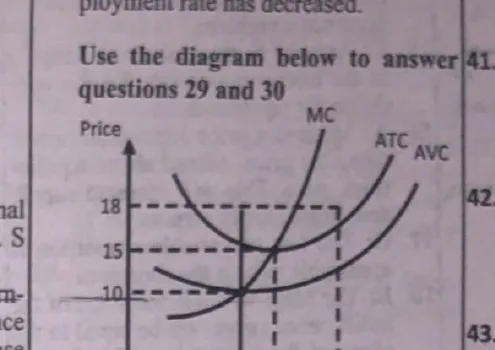
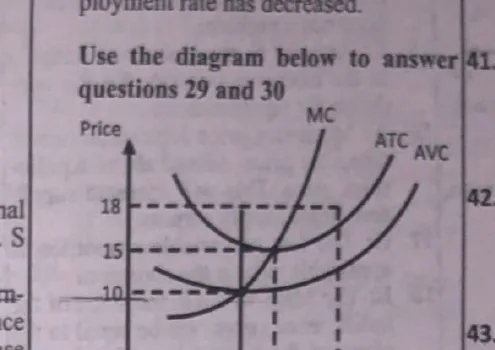
[Diagram: Price/Cost graph with MC, ATC, AVC curves] When 20 units of output is produced, TC will be

Diagram for question 28
  • A. A. #300Correct
  • B. B. #460
  • C. C. #400
  • D. D. #360

Explanation

Total cost is the product of the average cost and the quantity produced, i.e. 15 x 20 = 300.

Economics 2011 Objective — Question 29

[Same diagram as above] The average total cost when 20 units are produced is

Diagram for question 29
  • A. A. #23.00
  • B. B. #13.00
  • C. C. #15.00Correct
  • D. D. #20.00

Explanation

The average total cost when 20 units are produced is #15.

Economics 2011 Objective — Question 30

Agricultural production in Nigeria is constrained by

  • A. A. inadequate demand
  • B. B. poor implementation of policiesCorrect
  • C. C. balance of payments deficits
  • D. D. ineffective use of stabilization measures

Explanation

Policy implementation in Nigeria is poor, though there were several policies made to revive the agricultural sector, but there is a lack of implementation.

Economics 2011 Objective — Question 31

Upstream oil activities involve the

  • A. A. marketing of refined products
  • B. B. exploration of crude oilCorrect
  • C. C. refining of crude oil
  • D. D. management of pollution

Explanation

Upstream activities in the oil sector include exploration and extraction of crude oil.

Economics 2011 Objective — Question 32

A country achieves economic development when there is

  • A. A. an increase in capacity
  • B. B. a sustained increase in per capital incomeCorrect
  • C. C. an even distribution of goods and services
  • D. D. an increase in military expenditure

Explanation

When the income attributed to an average person in an economy increases and it is sustained, it is an indication of development.

Economics 2011 Objective — Question 33

The main function of NNPC is to

  • A. A. develop the oil production
  • B. B. fix the prices of petroleum products
  • C. C. ensure regular supply of products
  • D. D. oversee the development of the oil sectorCorrect

Explanation

NNPC is to see to the development of the oil sector in the country.

Economics 2011 Objective — Question 34

Industrial development in Nigeria can be encouraged through

  • A. A. granting subsidies
  • B. B. the provision of efficient infrastructureCorrect
  • C. C. direct government participation
  • D. D. signing WTO treaty

Explanation

Infrastructural facilities are very instrumental to a meaningful industrial development.

Economics 2011 Objective — Question 35

An indicator of growth over a period of time is the

  • A. A. GDP at factor cost
  • B. B. GDP at market priceCorrect
  • C. C. GDP deflator
  • D. D. GDP gap

Explanation

Economic growth is a sustained increase in output. The GDP at market price is used to measure the growth.

Economics 2011 Objective — Question 36

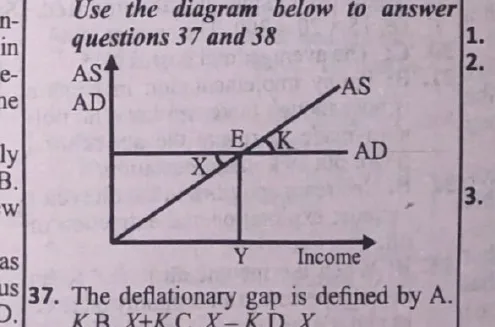
The deflationary gap is defined by

  • A. A. KCorrect
  • B. B. X+K
  • C. C. X-K
  • D. D. X

Explanation

The range over which output exceeds the aggregate demand is shown by K, which is called the deflationary gap.

Economics 2011 Objective — Question 37

[Same AS/AD diagram] What does X represent?

Diagram for question 37
  • A. A. GNP gap
  • B. B. Inflationary gapCorrect
  • C. C. Deflationary gap
  • D. D. Recessionary gap

Explanation

The inflationary gap is represented by X. It is the range over which the AD exceeds the AS.

Economics 2011 Objective — Question 38

The import-substitution strategy of industrialisation is to encourage

  • A. A. large scale production
  • B. B. importation
  • C. C. exportation
  • D. D. domestic productionCorrect

Explanation

The import-substitution strategy is aimed at replacing imports with locally produced goods.

Economics 2011 Objective — Question 39

A country embarks on deficit financing in order to

  • A. A. reduce aggregate demand
  • B. B. curb inflation
  • C. C. stimulate investmentCorrect
  • D. D. increase revenue

Explanation

Deficit financing is used to stimulate investment. It is an act of financing public expenditure on some projects through borrowing.

Economics 2011 Objective — Question 40

Investing heavily in the agricultural sector will lead to

  • A. A. a vibrant commodity market
  • B. B. capital inflow
  • C. C. stable export prices
  • D. D. sufficient food productionCorrect

Explanation

Revamping the agricultural sector will lead to sufficient food production.

Economics 2011 Objective — Question 41

A change from one industry to another by a worker is an example of

  • A. A. horizontal mobilityCorrect
  • B. B. professional advancement
  • C. C. vertical mobility
  • D. D. geographical mobility

Explanation

Moving from one industry to another to perform operations at the same level by a worker is an example of horizontal mobility.

Economics 2011 Objective — Question 42

Optimum population enables an economy to attain the highest level of

  • A. A. income per headCorrect
  • B. B. revenue generation
  • C. C. economic development
  • D. D. industrial development

Explanation

Optimum population is the population that is just sufficient to exploit the available resources. It enables the economy to attain the highest per capita output, hence the highest per capita (per head) income.

Economics 2011 Objective — Question 43

Trade takes place because of

  • A. A. inefficiency in production
  • B. B. opportunity cost
  • C. C. comparative advantageCorrect
  • D. D. marginal utility

Explanation

Comparative advantage determines whether trade should take place or not. When the opportunity cost of production of a commodity is high relative to another country, that commodity should be produced by the country with lower opportunity cost.

Economics 2011 Objective — Question 45

A condition in which official and autonomous exchange rates coexist is

  • A. A. a managed floating rate systemCorrect
  • B. B. market determined exchange rate system
  • C. C. multiple exchange rate system
  • D. D. dual exchange rate system

Explanation

Managed floating rate system is one in which the flexible (floating) exchange rate and fixed (official) exchange rate are used together, with the forces of demand/supply and government both determining the exchange rate.

Economics 2011 Objective — Question 46

The World Trade Organisation is responsible for

  • A. A. ensuring equal participation of countries in trade
  • B. B. modernising world economies
  • C. C. minimizing obstacles to international trade and investmentCorrect
  • D. D. stabilizing and harmonizing oil prices

Explanation

WTO aims at removing barriers to international trade, minimizing obstacles to international trade and investment.

Economics 2011 Objective — Question 47

The record of a country's transactions in international trade is her

  • A. A. balance of paymentsCorrect
  • B. B. current account
  • C. C. balance of trade
  • D. D. capital account

Explanation

Balance of payments is the summary of all transactions between a country and other countries of the world.

Economics 2011 Objective — Question 48

In modern economies, the Malthusian theory of population is ineffective because of

  • A. A. technical progressCorrect
  • B. B. government policies
  • C. C. natural disasters
  • D. D. birth control measures

Explanation

Technical progress has made it possible for countries to increase food production rapidly and increase the means of subsistence, rendering the Malthusian theory invalid.
Economics 2011 Objective — Question 49

The transfer of public shareholding in corporations to private enterprises is

  • A. A. incorporation
  • B. B. commercialization
  • C. C. privatizationCorrect
  • D. D. concession

Explanation

When public corporations are taken over by private enterprises, it is called privatization.

Advertisement

Sign up free to unlock

  • Score tracking
  • Practice history
  • Saved questions
  • Progress dashboard
  • Personalized sessions
  • Weak-topic breakdown

…and/or go further with premium services and No Ads.