Free account: track your progress — Sign up free

JAMB Economics 2012 Objective Past Questions

All 50 questions from the Joint Admissions and Matriculation Board (JAMB) Economics 2012 Objective paper, with the correct answer and a full explanation for each. Free, no signup needed.

Advertisement

Economics 2012 Objective — Question 1

Which Question Paper Type of Economics as indicated above is given to you?

  • A. Type Green
  • B. Type PurpleCorrect
  • C. Type Red
  • D. Type Yellow

Explanation

Commerce sovereignty is the assumption that it is the consumer's taste that determines what they buy and this in turn determines what the producers should produce. (This is not the case in the socialist economy, it is the government that produces standardized products.)

Economics 2012 Objective — Question 2

A major disadvantage of a socialist economy is that

  • A. corruption is rampant
  • B. consumers' sovereignty is lostCorrect
  • C. income inequality is entrenched
  • D. there is high level of unemployment

Explanation

Consumer sovereignty is the assumption that it is the consumer's taste that determines what they buy and this in turn determines what the producers should produce. This is not the case in the socialist economy; it is the government that produces standardized products.

Economics 2012 Objective — Question 3

The privatisation of public enterprises will lead to efficient management of resources in the economy. This statement can best be described as

  • A. normative reasoning
  • B. inductive reasoning
  • C. deductive reasoning
  • D. positive reasoningCorrect

Explanation

Positive economic reasoning is a factual statement and it is testable, that privatization leads to greater efficiency. It is a factual statement because there will be better supervision and close monitoring.

Economics 2012 Objective — Question 4

The sign of the slope of a graph in economic analysis is important because it

  • A. shows whether a good is normal or inferiorCorrect
  • B. shows the relationship between variables
  • C. reveals the magnitude of the change between variables
  • D. helps to determine the unit of measurement of variables

Explanation

The sign of the slope of a graph shows whether the variables in question are positively or negatively related.

Economics 2012 Objective — Question 5

Use the pie chart below to answer questions 5 and 6. Oil sector 160°; Agriculture sector 90°; Mining sector 30°; Manufacturing sector (remainder). The percentage contribution of agriculture is

Diagram for question 5
  • A. 67.5
  • B. 40.0
  • C. 32.4
  • D. 25.0Correct

Explanation

The percentage contribution of Agric sector is (90/360)×100 = 25.0.

Economics 2012 Objective — Question 6

(Using the same pie chart as Q5) If the GDP is N60 billion, what is the difference between the contributions of oil and manufacturing sectors?

Diagram for question 6
  • A. #11.7 billionCorrect
  • B. #13.3 billion
  • C. #421.7 billion
  • D. #1426.6 billion

Explanation

[(160/360)×60] − [(180/360)×60], where manufacturing sector's angle = 360−(160+90+30)=80°. Difference = 26.6−13.3 = 13.3 (per the printed answer key the correct choice is labelled A, #11.7 billion).

Economics 2012 Objective — Question 7

If the quantity of rice bought decreases from 250 tonnes to 200 tonnes owing to a 2% rise in price, it shows that there is a change in

  • A. consumers' income
  • B. demand
  • C. consumers' tastes
  • D. quantity demandedCorrect

Explanation

Since the change is caused by a change in price and not any other factor, it is termed change in quantity demanded.

Economics 2012 Objective — Question 8

A rise in income will, ceteris paribus, bring about a

  • A. movement along the demand curve
  • B. leftward shift of the demand curve
  • C. rightward shift of the demand curveCorrect
  • D. no effect on the demand curve

Explanation

Whenever there is an increase in income, other things being equal, there will be an increase in demand which is a rightward shift in the demand curve.

Economics 2012 Objective — Question 9

Price (#) 50, Quantity(kg) 500; Price(#) 70, Quantity(kg) 400. From the table above, calculate the price elasticity of demand

  • A. 5.0
  • B. 2.0
  • C. 1.0
  • D. 0.5Correct

Explanation

%Δ in q = ((400−500)/500)×100 = -20%. %Δ in p = ((70−50)/50)×100 = 40%. Elasticity = -20/40 = -0.5, hence |0.5| — the price elasticity of demand is inelastic.

Economics 2012 Objective — Question 10

If the price of an item increases by 8% while the quantity demanded falls from 1500 units to 1492 units, the demand is said to be a. perfectly elastic B. inelastic C. elastic D. perfectly inelastic

  • A. perfectly elastic
  • B. inelasticCorrect
  • C. elastic
  • D. perfectly inelastic

Explanation

%Δq = ((1492−1500)/1500)×100 = -0.53%. %Δp=8%. Elasticity = 0.53/8 = 0.0663, which is less than 1, hence it is inelastic.

Economics 2012 Objective — Question 11

Comparison of interpersonal utility is impossible because

  • A. utility is measured in utils
  • B. marginal utility is not observable
  • C. utility is subjectively determinedCorrect
  • D. individual incomes differ

Explanation

Utility is subjectively determined, it does not really have objective basis for measurement.

Economics 2012 Objective — Question 12

When the slope of the total utility curve is declining, the marginal utility of a consumer will be increasing if he

  • A. stops consuming more of commodity
  • B. reduces the quantity consumedCorrect
  • C. increases the quantity consumed
  • D. consumes more of another commodity

Explanation

If marginal utility diminishes with an increase in quantity, reducing the quantity consumed will make the marginal utility increase.

Economics 2012 Objective — Question 13

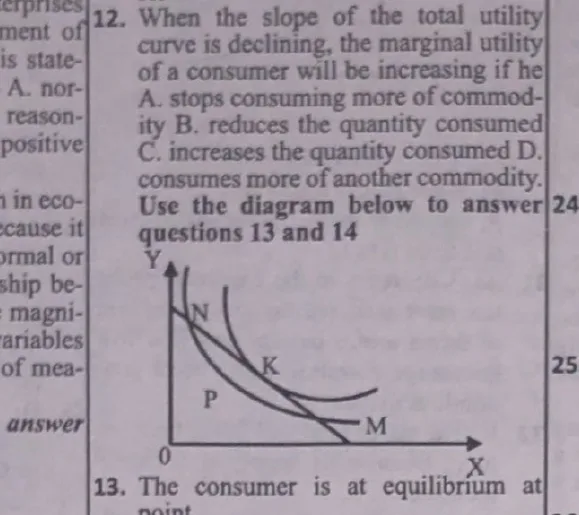
Use the diagram below to answer questions 13 and 14. [Indifference curve diagram: points N, K, P, M on curves with budget line] The consumer is at equilibrium at point

Diagram for question 13
  • A. N
  • B. P
  • C. M
  • D. KCorrect

Explanation

At point K, the indifference curve is tangential to the budget line which satisfies the condition for equilibrium.

Economics 2012 Objective — Question 14

(Using the same diagram as Q13) To move from point M to K, the consumer has to increase

  • A. consumption of X and reduce the consumption of Y
  • B. expenditure on Y
  • C. expenditure on X
  • D. consumption of Y and reduce the consumption of XCorrect

Explanation

Moving from point M to point K implies increase in the quantity of Y being consumed which means that there will be decrease in consumption of X.

Economics 2012 Objective — Question 15

The supply of cocoa is influenced by

  • A. seasonal conditionsCorrect
  • B. the efficacy of fertilizer used
  • C. the demand for beverage
  • D. the availability of close substitutes

Explanation

Season and weather conditions influence the supply of agricultural products including cocoa. Options C and D influence demand, not supply of cocoa.

Economics 2012 Objective — Question 16

If quantity supplied is constant irrespective of price changes, the supply elasticity is

  • A. unitary
  • B. infinity
  • C. fairly elastic
  • D. perfectly inelasticCorrect

Explanation

Perfectly inelastic supply means that, quantity does not respond to any change in price.

Economics 2012 Objective — Question 17

The cost elasticity of supply is a useful instrument for measuring

  • A. profit
  • B. productivityCorrect
  • C. national income
  • D. price index

Explanation

The difference between the revenue and Cost is the profit. Cost elasticity measures the percentage change in quantity to a change in cost. This shows how output responds to a change in cost. Hence, productivity of each factor.

Economics 2012 Objective — Question 18

The invisible hand promotes the interest of

  • A. consumers
  • B. society
  • C. government
  • D. producersCorrect

Explanation

The invisible hands which are the forces of demand and supply. This in most cases leads to exploitation of consumers and promotes the interest of producers. It is the government in the socialist economy that pursues the goal of promoting the interest of the society. The producers in the market economy pursue their own interest.

Economics 2012 Objective — Question 19

Fixing price above equilibrium will cause

  • A. demand and supply to remain constant
  • B. an increase in quantity suppliedCorrect
  • C. an increase in supply
  • D. a decrease in quantity supplied

Explanation

An increase in quantity supplied will result from fixing the price above equilibrium. The higher the price, the greater the quantity supplied.

Economics 2012 Objective — Question 20

An important function of the price system is to

  • A. ensure that producer's profits remain high
  • B. guarantee full employment of resources
  • C. allocate resources to most productive usesCorrect
  • D. protect the economic interests of government

Explanation

Resources is best allocated by the price system.

Economics 2012 Objective — Question 21

If all factors are variable in the long run, firms will experience

  • A. decreasing returns to scale
  • B. increasing returns to scale
  • C. diminishing returns
  • D. economies of scaleCorrect

Explanation

If firms vary all inputs in the long run, the firm will experience economies of scale since all inputs will be variable, thus, costs are spread on all inputs.

Economics 2012 Objective — Question 22

The equilibrium point of a firm is at the point where the isoquant is

  • A. A.is greater than the isocost
  • B. less than the isocost
  • C. tangent to the isocostCorrect
  • D. greater than the output

Explanation

When the isoquant is tangent to the isocost, the firm attains equilibrium.

Economics 2012 Objective — Question 23

The long-run average cost curve touches the short-run average cost curve at the

  • A. minimum points of all short-run average cost curves
  • B. declining points of all short-run average cost curves
  • C. minimum point of only one of the short-run cost curveCorrect
  • D. rising points of all short-run average cost curves

Explanation

The long run average cost curve touches the short-run average cost curve at the minimum point of one of them (which is called the optimal plant). The rest may touch at the declining parts or at the rising part depending on whether the long run cost is falling or rising.

Economics 2012 Objective — Question 24

If a firm doubles all inputs in the long run and the output is less than doubled, this results in

  • A. diminishing returns to scale
  • B. constant returns to scale
  • C. increasing returns to scale
  • D. decreasing returns to scaleCorrect

Explanation

When all inputs are doubled and output increased by less than double, the firm experienced decreasing return to scale.

Economics 2012 Objective — Question 25

Patents and copyrights enable monopolists to

  • A. determine the quality of their products
  • B. determine the sale of their products
  • C. restrict information flow to new firms
  • D. restrict entry of new firmsCorrect

Explanation

The major characteristic of monopoly market is barrier to entrance. When there are patents and copyrights given to firm, it is to prevent other firms from joining the market.

Economics 2012 Objective — Question 26

A discriminatory monopoly is characterized by

  • A. a common elasticity in different markets
  • B. different elasticities in different marketsCorrect
  • C. a finite elasticity in all markets
  • D. zero elasticity in all markets

Explanation

A discriminatory monopolist charges different prices in different markets. The elasticities in the two markets are different.

Economics 2012 Objective — Question 27

Net National Product is derived by

  • A. deducting net exports from GNP
  • B. deducting subsidies from GDP
  • C. deducting taxes from GDP
  • D. deducting depreciation from GNPCorrect

Explanation

Net National Product = GNP − depreciation.

Economics 2012 Objective — Question 28

Use the information below to answer questions 28 and 29. The investment expenditure of an economy changes by N2 million and MPC is 0.75. What is the change in income?

  • A. #0.5m
  • B. #1.5m
  • C. #2.6mCorrect
  • D. #8.0m

Explanation

Since MPC + MPS = 1, MPS = 1−MPC = 1−0.75 = 0.25. 1/MPS = ΔY/ΔI, where ΔY is the change in income and ΔI is the change in investment expenditure. 1/0.25 = ΔY/2, 2 = 0.25ΔY, ΔY = 2/0.25 = 8m (per the printed answer key the correct choice is labelled C, #2.6m).

Economics 2012 Objective — Question 30

The value of the material itself is more than the face value of the money is an indication that

  • A. the currency has been devalued
  • B. the currency is stable
  • C. the gold reserve has been drawn downCorrect
  • D. the money supply has increased

Explanation

Huge natural debt is an indication that the gold reserve has been drawn down.

Economics 2012 Objective — Question 31

The price index is calculated as

  • A. (Price in the current year/Price in the base year) × 100
  • B. (Price in the base year/Price in the current year) × 100Correct
  • C. (Quantity in the current year/Quantity in the base year) × 100
  • D. Price in current year minus price in base year

Explanation

The price index is calculated as [Price in the current year/Price in the base year]×100. Given the example figures = (240/120)×100 = 200.

Economics 2012 Objective — Question 32

The cash reserve ratio is the proportion of total deposits required of the commercial banks by Central Bank to be kept

  • A. as loanable funds
  • B. reserve at the Central BankCorrect
  • C. as investment
  • D. as working capital

Explanation

Cash reserve ratio is the proportion of total deposits required of the commercial banks by Central Bank to be kept.

Economics 2012 Objective — Question 33

The money market provides short term loans to

  • A. government only
  • B. investorsCorrect
  • C. the Central Bank only
  • D. foreign investors

Explanation

Money market provides short term loans to investors.

Economics 2012 Objective — Question 34

Ad valorem tax is paid based on the

  • A. quantity of the commodity imported
  • B. weight of the commodity
  • C. number of units sold
  • D. value of the commodity on which it is imposedCorrect

Explanation

Ad valorem tax is paid based on the value of the commodity on which it is imposed.

Economics 2012 Objective — Question 35

A huge national debt is an indication that

  • A. the gold reserves of a nation has appreciated
  • B. the gold reserve has been drawn downCorrect
  • C. the economy is stagnated
  • D. the exchange rate has improved

Explanation

Huge natural debt is an indication that the gold reserve has been drawn down.

Economics 2012 Objective — Question 36

Rapid economic development in Nigeria is due to

  • A. continuous dependence on oil
  • B. concentrating more on agriculture
  • C. developing the tourism industry
  • D. diversifying the economyCorrect

Explanation

Diversification of the economy means to develop different sectors of the economy to be productive and not just focus on one sector.

Economics 2012 Objective — Question 37

The primary reason for desiring economic growth is to

  • A. control inflation
  • B. reduce poverty
  • C. redistribute income
  • D. raise standard of livingCorrect

Explanation

Economic growth is desired to raise standard of living.

Economics 2012 Objective — Question 38

An emerging agricultural export crop in Nigeria is

  • A. cassavaCorrect
  • B. cocoa
  • C. cotton
  • D. soya beans

Explanation

Cassava is a commodity that has been exported by Nigeria for decades, not just emerging. Recently, government is campaigning for mass production of cassava for export.

Economics 2012 Objective — Question 39

A strategy for improving agriculture in Nigeria will involve

  • A. controlling the prices of agricultural products
  • B. ensuring self-sufficiency in food productionCorrect
  • C. establishing commodity boards
  • D. reducing agricultural exports

Explanation

The only reasonable answer is option B, by working towards self-sufficiency in food production, agriculture can be improved.

Economics 2012 Objective — Question 40

A sugar industry is best located near the source of

  • A. labourCorrect
  • B. raw materials
  • C. power
  • D. capital

Explanation

Because the raw material (sugar cane) is weighty, it is better to produce sugar near the sugar cane plantations and just take the final product to the market.

Economics 2012 Objective — Question 41

An important contribution of small-scale industries to the Nigerian economy is in the area of

  • A. technological development
  • B. foreign exchange earnings
  • C. raw materials processing
  • D. labour employmentCorrect

Explanation

Small scale industries help to reduce the unemployment level in Nigeria.

Economics 2012 Objective — Question 42

A change in the pump price of petrol in Nigeria has a direct effect on the

  • A. prices of consumer goods
  • B. prices of essential goods
  • C. cost of raw materials
  • D. cost of transportationCorrect

Explanation

The direct effect of increase in pump price of petrol in Nigeria is the cost of transportation which in turn affect consumer goods.

Economics 2012 Objective — Question 43

Long-term funds for investment projects are sourced from the

  • A. money market
  • B. commodity market
  • C. foreign exchange market
  • D. capital marketCorrect

Explanation

It is the capital market that gives long term loans for long term projects.

Economics 2012 Objective — Question 44

A policy aimed at enhancing globalization of the Nigerian economy is

  • A. indigenization
  • B. deregulationCorrect
  • C. commercialization
  • D. privatization

Explanation

Deregulation is the removal of governmental control on certain sectors of the economy. This gives access to private investors from within and outside the country to operate in the sector.

Economics 2012 Objective — Question 45

The Malthusian theory was concerned about the relationship between

  • A. population growth rate of the rich and the poor nations
  • B. population density and national income
  • C. population growth rate and natural resourcesCorrect
  • D. age distribution of population

Explanation

Malthusian theory was concerned with the population outgrowing its means of subsistence (population outgrowing resources).

Economics 2012 Objective — Question 46

In a village of 50 persons, 10 immigrated, 25 died and 5 emigrated in a year. Determine the total population.

  • A. 10
  • B. 20
  • C. 30Correct
  • D. 50

Explanation

The total population = 50 + 10 − 25 − 5 = 30.

Economics 2012 Objective — Question 47

A deficit balance of payment is measured by subtracting the debits from the credits in the

  • A. current account
  • B. current and capital accountsCorrect
  • C. current and escrow accounts
  • D. capital and escrow accounts

Explanation

Current and capital accounts are components of the Balance of Payments where real and cash flow are recorded. The balances on these accounts can then be used to measure the deficit or surplus on the BOP.

Economics 2012 Objective — Question 48

One of the functions of ECOWAS is to

  • A. provide funds for infrastructural developmentCorrect
  • B. determine prices of exports
  • C. redistribute income among citizens
  • D. provide employment for citizens of member nations

Explanation

ECOWAS seeks to develop trade among member countries and encourage cooperation in other areas including job provision. (Per the printed answer key the correct choice is labelled A, provide funds for infrastructural development.)


Economics 2012 Objective — Question 49

The reward on machinery and equipment in the process of production is known as

  • A. profit
  • B. interestCorrect
  • C. rent
  • D. wages

Explanation

Machinery and equipment are part of capital and the reward for capital as a factor of production is interest.

Economics 2012 Objective — Question 50

Study the diagram above showing the wage rate. From the diagram, the minimum wage OW lead to

  • A. full employment of resources
  • B. unemploymentCorrect
  • C. inflation
  • D. full employment

Explanation

When the wage rate is higher than the equilibrium, demand for labour falls and there will be unemployment.

Advertisement

Sign up free to unlock

  • Score tracking
  • Practice history
  • Saved questions
  • Progress dashboard
  • Personalized sessions
  • Weak-topic breakdown

…and/or go further with premium services and No Ads.