Economics 2014 Objective — Question 1
Which Question Paper Type of Economics is given to you?
- A. Type F
- B. Type ECorrect
- C. Type L
- D. Type S
Explanation
This is indicated on the question paper.
All 50 questions from the Joint Admissions and Matriculation Board (JAMB) Economics 2014 Objective paper, with the correct answer and a full explanation for each. Free, no signup needed.
Advertisement
Which Question Paper Type of Economics is given to you?
This is indicated on the question paper.
The choice of how to produce in a command economy is determined by
Government, through central planning, determines how to produce in a command economy, which is also known as a socialist economy system.
In capitalist economy, questions about what to produce are ultimately answered by
What to produce in a capitalist economy is determined majorly by the pattern of demand in the market — i.e. spending decisions of households.
The best measure of dispersion to determine the tallest tree in a forest is
Range is the difference between the largest and smallest number or value in a distribution; it is the appropriate measure when attention is focused on the tallest tree.
The pie chart shows Mining 126°, Agric 72°, Manufacturing 108°, Services (remainder). What is the percentage contribution of services to the national income?

Services angle = 360°−(126+72+108)=54°. Percentage = 54/360×100 = 15%... recalculated per source: Answer D (54%) using the angle-to-percentage conversion given in the source key.
Using the same pie chart, if the national income is #60m, the contribution of the manufacturing sector is
Contribution = (108°/360°)×60m = N18m.
The diagram shows a shift from D₀D₀ to D₁D₁ (supply curve S fixed). A combination of factors responsible for this shift are
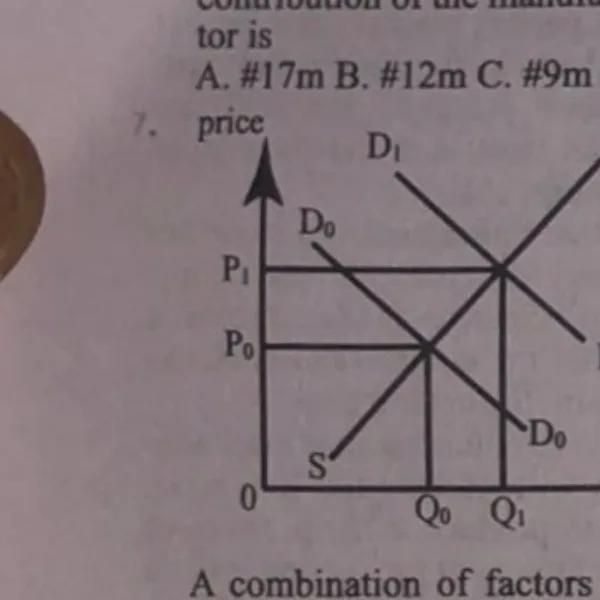
A shift in the demand curve (not a movement along it) is caused by non-price factors such as consumers' income and population size.
Given that Qd=40−2p and Qs=6P+24, calculate the equilibrium price.
Setting Qd=Qs: 40−2p=6p+24 ⟹ 16=8p ⟹ p=#2.
A change in demand for a normal good implies that there is a
A change in demand means a shift in the demand curve either leftward or rightward, unlike a change in quantity demanded, which is a movement along the curve.
If a 10% rise in price causes a 5% decrease in the quantity demanded of a commodity, the elasticity of demand is
For inelastic demand, the percentage change in quantity demanded (5%) is less than the percentage change in price (10%).
From the indifference-curve/budget-line graph, the consumer will attain equilibrium at point
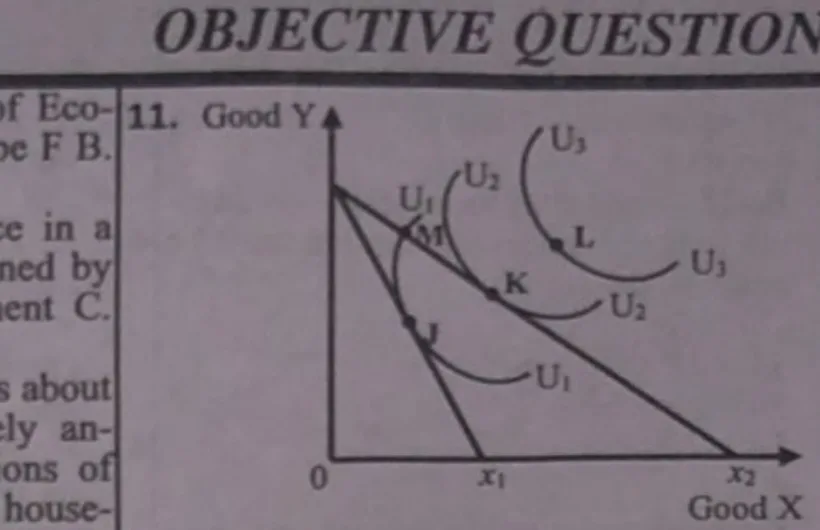
The equilibrium point requires that the indifference curve be tangential to the budget line. This occurs at both J and K, but K falls on a higher indifference curve and is tangential to the budget line.
A rightward shift of the budget line is caused by a
A fall in a commodity's relative price means more units can be bought with the same money income, causing the budget line to shift outward (rightward).
Given the supply function P=¼(Qs+10) when P=#10, what is Qs?
4P=Qs+10 ⟹ 4(10)=Qs+10 ⟹ Qs=40−10=30.
The table shows: Price(N) 8, 10; Quantity supplied 20, 24. From the table, calculate the price elasticity of supply.
Elasticity = (%Δ quantity)/(%Δ price) = (4/20×100)/(2/8×100) = 20/25 = 0.8.
When price is set below equilibrium, this will lead to
When price is set below equilibrium, the quantity supplied will fall, obeying the law of demand and supply, which states that the lower the price, the lower the quantity supplied.
Price mechanism determines the prices of commodities through
Price mechanism, also known as the price system, is the determination of price by the interaction of the forces of demand and supply — the market forces.
The table shows Unit of labour 1-5, Total product 8,20,E,28,40, Average product 8,10,9,7,8, Marginal product -,14,7,F,12. From the table, find the values of E and F respectively.
TP for unit 3 = AP×L = 9×3 = 27 (E). Marginal product F = ΔTP/ΔL = (28−27)/(4−3) = 1.
If the production cost of a large firm is higher than that of a small firm, it is experiencing
Internal diseconomy of scale is the disadvantage that increases the cost of production of a firm as a result of its size being too large.
Division of labour requires that the tasks in a production line be performed
Division of labour is the breaking of jobs into a production line to be performed by specialists.
Given that FC=#500, VC=#1500 and Q=50 units, find the average cost.
Average cost = total cost/quantity = (fixed cost+variable cost)/quantity = (500+1500)/50 = #40.
Rent and administrative expenses are examples of
Fixed costs are expenses on inputs that do not change with the output level, such as rent, administrative cost, and cost of equipment.
A perfect competitor will continue to expand output up to the point where
Expansion of output stops at MC=MR — where marginal cost equals marginal revenue (also equal to average revenue in a perfectly competitive market).
One of the characteristics of a monopolist is that he can influence
A monopolist can influence either the price or quantity, but not the two at the same time, since he is not a price taker like a perfectly competitive firm.
A monopolist can boost his revenue by
The monopolist will boost his revenue by increasing price since the demand for his commodity is usually inelastic.
Which of the following can be used to measure the Gross National Product in an open economy?
GDP in an open economy (an economy that is involved in international trade) can be calculated as C+I+G+X−M, where C is household consumption expenditure, I is investment spending, G is government expenditure, X is export and M is the amount spent on foreign goods (imported goods).
If MPC=2/3 and investment is 100 million, the level of national income is
National Income = Multiplier × Investment, multiplier=1/MPS, MPS+MPC=1, MPS=1−2/3=1/3, multiplier=1/(1/3)=3. National Income = 3×#100m = #300m.
The precautionary demand for money is determined by
Precautionary demand for money is the demand for money for unforeseen contingencies. It is determined majorly by the level of income.
An inflation that co-exists with high rate of unemployment is
When inflation co-exists with high rate of unemployment, it is termed stagflation.
One of the challenges facing the banking industry in Nigeria is
Ensuring technological security is a major challenge to the banking industry in Nigeria, because of the rate at which people perpetrate unlawful acts through technology in banking.
Short-termed loans for investment are usually obtained through the
The money market is one of the establishments to issue short-term loans to investors; commercial banks are operators in this market.
Given a base year and the price index of 175% the following year, which of the following will arise?
If the price index is 175%, it means that the price level has risen by 75%; this implies that the value of money has fallen by 75%.
Wage freeze is a policy measure aimed at
Wage freeze is the situation in which the government makes a law that prohibits upward review of workers' wages and salary for some time, aimed at curbing inflation.
A major obstacle to the development of Nigerian economy is
Low capital formation is one of the problems to the development of Nigeria economy, because the stock of physical and human capital is one of the factors that determine the economic growth of a nation, which in turn leads to economic development.
A major feature of an underdeveloped economy is a
The standard of living in an underdeveloped country is usually low; the amount of goods and services available for an average person is usually low because of low income or poverty at large.
An important role of agriculture in Nigeria's economic development is the
Agricultural sector provides jobs for over 50% of Nigerian population.
An advantage of large-scale farming over peasant farming is in the area of
Large-scale farming involves research and also provides jobs for many, unlike peasant farming which is a small scale farming that uses crude implements.
A major disadvantage of localization of industry is the
Structural unemployment can result from localization of industry. Whenever the structure of the economy changes against the concentration of firms in an area, many workers lose their jobs.
One major factor that determines the location of an industry is
Proximity to the market is one of the factors considered by firms in locating industry, especially when the product is fragile, awkward in shape, or weight-gaining.
The major contribution of OPEC to the Nigerian economy is the
OPEC has achieved some level of success in stabilizing the price of oil in the oil market.
The loading of crude oil at the terminal is an activity in the
The upstream sectors of oil industry involve all activities except exploration and mining, and any activities after refining and distribution of the product.
The short-run average variable cost of a firm will rise owing to
Cost of labour is a variable cost. An increase in the cost of labour will cause an increase in the short run-average cost.
Firms embark on vertical integration in order to
Vertical integration is the type of merger in which firms at different stages of production merge together. This makes it one big firm, and it will therefore reap the benefit of low cost of production which is advantageous to economies of scale.
The voting power in co-operative societies is vested on
In a cooperative society, each member of the association has a vote irrespective of his or her contribution to the association; voting is not tied to the amount contributed or loans collected.
An accurate census figure is an important tool for planners in
Population census is used to determine who gets what in a country. It is useful in allocating resources of the country either income or revenue sharing or even provision of amenities.
An accurate population census is important in order to
To determine the per capita income of a country, the population must be known. Per capita income is the national income divided by the population figure, which is known through population census.
A major determinant of a floating exchange rate is
A floating exchange rate is one in which the exchange rate is not rigid or fixed but left to the forces of demand and supply.
If the importation of a commodity is limited to a definite quantity, the trade control measure imposed is
Quotas as a term used in international trade refers to a limit set on the quantity of a commodity that can be imported into a country.
The main objective of WTO is to
WTO is the World Trade Organization and its major objectives include promotion of trade among countries, and this can be achieved by reducing tariffs on commodities traded in international market.
The major determinant of the total volume of output in an economy is
There are many factors that can determine the volume of output in an economy. An important among them is the size of the total expenditure which determines the amount spent on output to various economic agents... per the source key, the primary determinant is the size of the labour force.
The labour force of a country is determined by
The labour force of a country is determined by the age structure. The only group of people in the labour force is the people between 18 and 60 or 65 in Nigeria, for example. The proportion of the total population in this category determines what the size of the labour force will be.
Advertisement
…and/or go further with premium services and No Ads.