Mathematics 2023 Objective — Question 1
What is the remainder if 4x³-3x+5 is divided by 2x-1?
- A. 1
- B. 2
- C. 3
- D. 4Correct
Explanation
By the remainder theorem, R=f(1/2)=4(1/8)-3(1/2)+5=1/2-3/2+5=4.
All 40 questions from the Joint Admissions and Matriculation Board (JAMB) Mathematics 2023 Objective paper, with the correct answer and a full explanation for each. Free, no signup needed.
Advertisement
What is the remainder if 4x³-3x+5 is divided by 2x-1?
By the remainder theorem, R=f(1/2)=4(1/8)-3(1/2)+5=1/2-3/2+5=4.
A motorcycle dealer bought a used motorcycle for ₦125,000 and spent ₦35,000 refurbishing it. He then sold it for ₦200,000. What is the percentage gain?
Total cost=₦160,000. %gain=(200,000-160,000)/160,000×100%=25%.
If α and β are the roots of the equation 3x²+5x-2=0, find the value of 1/α + 1/β.
Sum of roots=-5/3, product=-2/3. 1/α+1/β=(α+β)/αβ=(-5/3)/(-2/3)=5/2.
In a school of 300 students, 120 offer French while 160 offer English. How many students offer both subjects if 40 offer neither?
n(E∩F)=n(E)+n(F)-[n(U)-n(neither)]=160+120-(300-40)=280-260=20.
Each exterior angle of a regular polygon is 72°. Which of the following identifies the polygon?
Number of sides = 360°/72° = 5, which is a pentagon.
Evaluate ∫(cos4x + sin3x)dx.
∫cos4x dx = 1/4 sin4x; ∫sin3x dx = -1/3 cos3x. Sum = 1/4 sin4x - 1/3 cos3x + k.
From the diagram (circle with points A, B, C, D and angle ABC=92°), find the value of angle ADC.
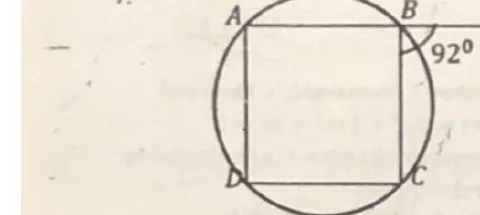
∠ABC+92°=180° (angles on a straight line) ⇒ ∠ABC=88°. Since ABCD is a cyclic quadrilateral, ∠ABC+∠ADC=180° ⇒ ∠ADC=92°.
Find the value of 110111₂ + 10100₂.
Adding in binary: 110111 + 10100 = 1001011₂.
If log6.5 = 0.8129, evaluate 2log65 + log650.
log65=log6.5+1=1.8129; log650=log6.5+2=2.8129. 2(1.8129)+2.8129=6.4387.
Simplify (2√2-√3)/(√2+√3).
Multiplying by the conjugate (√2-√3): result simplifies to 3√6-7.
If ab²-c-d=0, express 'a' as the subject of the formula.
ab²=c+d ⇒ a=(c+d)/b².
Find the value of m if x-1 is a factor of x³+4x²+mx-6.
f(1)=0: 1+4+m-6=0 ⇒ m=1.
The 4th term of an A.P is 13 while the 10th term is 31. Find the 24th term.
a+3d=13, a+9d=31 ⇒ 6d=18, d=3, a=4. T24=a+23d=4+69=73.
Simplify (3^(-5x))/(9^(1-x)) × 27^(2x+1).
Expressing all terms in base 3 and simplifying the exponents gives 3¹=3.
If s = √(t²-4t+4), find t in terms of s.
s²=t²-4t+4. Solving the quadratic in t gives t=2+s.
If a binary operation * is defined by x*y=x+2y, find 2*(3*4).
3*4=3+2(4)=11. 2*(11)=2+2(11)=24.
Find the inverse of A=[[5,3],[6,4]].
|A|=(5)(4)-(3)(6)=2. A⁻¹=(1/2)[[4,-3],[-6,5]]=[[2,-3/2],[-3,5/2]].
If y=(2x+2)³, find dy/dx.
Let u=2x+2. dy/dx=3u²×2=6(2x+2)².
In how many ways can a student select 5 subjects from 8 subjects?
Number of ways = ⁸C₅ = 8!/(3!5!).
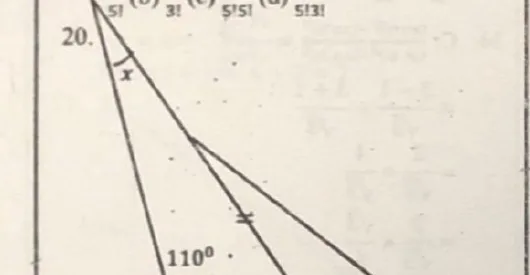
From the diagram (a triangle with an exterior angle of 110° and a base angle of 15°), find the value of x.
Using the isosceles triangle and angle sum properties: x+110°+30°=180°, so x=40°.
If 2q3₅ = 77₈, find q.
2q3₅ in base 10 = 53+5q. 77₈ in base 10 = 63. 53+5q=63 ⇒ q=2.
If x, y and z are in the ratio 5:4:3, find the value of (2y-z)/x.
With x=5,y=4,z=3: (2(4)-3)/5 = 5/5 = 1.
Solve the inequality x²+2x > 15.
x²+2x-15>0 ⇒ (x-3)(x+5)>0 ⇒ x>3 or x<-5.
The second term of a G.P is 4 while the fourth term is 16. Find the sum of the first five terms.
r²=4 ⇒ r=2, a=2. S5=a(r⁵-1)/(r-1)=2(31)/1=62.
Find the equation of a line which passes through the point (4,2) and is perpendicular to the line 2y=5x+4.
Gradient of given line=5/2, so perpendicular gradient=-2/5. y-2=-2/5(x-4) ⇒ 5y+2x-18=0.
Find the value of x at the minimum point of the curve y=x³+x²-x+1.
dy/dx=3x²+2x-1=0 ⇒ (3x-1)(x+1)=0 ⇒ x=1/3 or -1. Since d²y/dx²>0 at x=1/3, this is the minimum.
The sum of four consecutive integers is 34. Find the largest of these integers.
x+(x+1)+(x+2)+(x+3)=34 ⇒ 4x+6=34 ⇒ x=7. Largest integer = x+3 = 10.
What is the angle subtended at the centre of a circle by a chord which is equal in length to the radius of the circle?
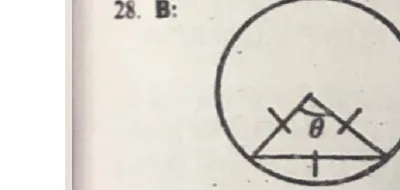
A chord equal to the radius forms an equilateral triangle with the two radii, so the subtended angle is 60°.
Evaluate ∫₁²(6x²-2x)dx.
∫(6x²-2x)dx=2x³-x². Evaluating from 1 to 2: (16-4)-(2-1)=12-1=11.
Factorize completely (4x+3y)²-(3x-2y)².
Using difference of two squares: (7x+y)(x+5y).
If p-2q+1=q+3p and p-2=0, find q.
p=2. Substituting: -2p-3q=-1 ⇒ -4-3q=-1 ⇒ q=-1.
If tan x=1, evaluate sin x + cos x in surd form.
tanx=1 ⇒ x=45°. sin45°+cos45°=1/√2+1/√2=√2.
Given the sets X={1,2,3,4} and Y={2,3,5,9}. If a number is selected at random from set Y, what is the probability that the number is prime?
Prime numbers in Y are 2,3,5 (3 out of 4). Probability=3/4.
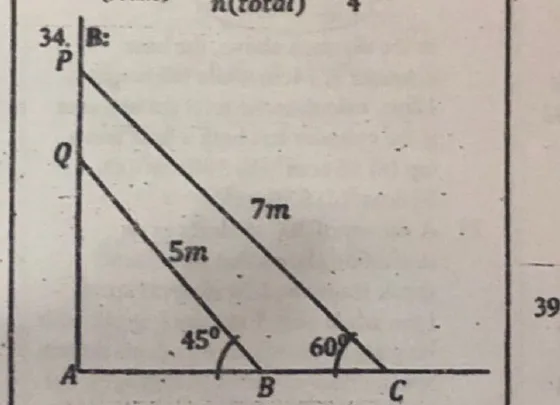
Two ladders of length 5m and 7m lean against a pole and make angles 45° and 60° with the ground respectively. What is the distance apart on the pole, correct to two decimal places?
|PA|=7sin60°=6.0622m; |QA|=5sin45°=3.5355m. Distance=6.0622-3.5355≈2.53m.
The probability that event A occurs is 1/2 and the probability that event B occurs is 1/3. What is the probability that only one of them occurs?
P(only one)=P(A)P(B')+P(B)P(A')=(1/2)(2/3)+(1/3)(1/2)=1/3+1/6=1/2.
Find the coefficient of xy in the expansion of (x-4y)(3x+2y).
(x-4y)(3x+2y)=3x²-10xy-8y². Coefficient of xy = -10.
If n + 1/n = 9, evaluate n² + 1/n².
(n+1/n)²=81=n²+2+1/n² ⇒ n²+1/n²=79.
If 321₄ divided by 23₄ leaves a remainder t, what is the value of t?
321₄=57ten, 23₄=11ten. 57÷11=5 remainder 2. So t=2.
The radius r of a cylinder disc is increasing at the rate of 0.5cm/s. At what rate is the area of the disc increasing when its radius is 6cm?
A=πr², dA/dt=2πr(dr/dt)=2π(6)(0.5)=6πcm²/s.
For what values of y is the expression (6y-1)/(y²-y-6) undefined?
Denominator zero: y²-y-6=0 ⇒ (y+2)(y-3)=0 ⇒ y=-2 or 3.
Advertisement
…and/or go further with premium services and No Ads.