All 41 questions from the Joint Admissions and Matriculation Board (JAMB) Physics 2022 Objective paper, with the correct answer and a full explanation for each. Free, no signup needed.
Which types of motion does a coin undergo as it moves down an inclined plane?
A. rotational and translational motionCorrect B. circular and random motionC. translational motionD. rotational motionExplanation A rolling coin both spins (rotational) and translates down the plane.
An object of mass 20 kg is released from 5 m height. KE just before hitting the ground:
A. 1000 JCorrect B. 2000 JC. 1500 JD. 4000 JExplanation KE=mgh=20×10×5=1000 J.
Small droplets of water on grass in early morning is:
A. dewCorrect B. fogC. hailD. mistExplanation Dew is moisture condensed on surfaces cooled below dew point.
The equation PᵃVᵇTᶜ=constant reduces to Boyle's law when:
A. a=0, b=−1B. a=1, b=1, c=0Correct C. a=1, b=1, c=−1D. a=1, b=1, c=1Explanation Boyle's law: PV=const at fixed T → a=1, b=1, c=0.
Distance between two successive troughs of a wave is 30 cm, velocity 300 ms⁻¹. Frequency:
A. 100 HzB. 2250 HzC. 1000 HzCorrect D. 225 HzExplanation f=v/λ=300/0.30=1000 Hz.
In a compound microscope, the objective and eyepiece focal lengths are:
A. at infinityB. longC. the sameD. shortCorrect Explanation Both lenses have short focal lengths for high magnification.
Best method of demagnetizing a steel bar magnet:
A. solenoid methodCorrect B. hammeringC. heatingD. rough handlingExplanation AC solenoid (electrical method) is most effective and complete.
Magnitude of angle of dip at the equator:
A. 180°B. 0°Correct C. 90°D. 60°Explanation At equator, Earth's field is horizontal → dip=0°.
Glass bottle of initial volume 2×10⁴ cm³ heated from 20°C to 50°C. Linear expansivity=9×10⁻⁶ °C⁻¹. Volume at 50°C:
A. 20013.5 cm³B. 20016.2 cm³Correct C. 2005.4 cm³D. 20008.1 cm³Explanation γ=3α=27×10⁻⁶; ΔV=V₀γΔT=2×10⁴×27×10⁻⁶×30=16.2 cm³; V₂=20016.2 cm³.
When the linear momentum of a body is constant, the net force on it is:
A. zeroCorrect B. decreasesC. increasesD. remains constantExplanation F=dp/dt; if p=const, dp/dt=0 → F=0.
A device that converts mechanical energy into electrical energy is:
A. a transformerB. a dynamoCorrect C. an electric motorD. an induction coilExplanation A dynamo converts mechanical to electrical energy.
Water at 20°C mixed with water at 70°C; final temperature 40°C. Ratio of mass (hot:cold):
A. 2:1B. 2:3Correct C. 5:2D. 2:7Explanation m_c×20=m_h×30 → m_h:m_c=2:3.
The quality of a note depends on its:
A. pitchB. frequencyC. amplitudeD. overtoneCorrect Explanation Quality (timbre) depends on overtones present.
An ammeter can be adapted to measure potential difference by using a:
A. rheostatB. multiplierCorrect C. shuntD. resistance boxExplanation A high resistance (multiplier) in series converts ammeter to voltmeter.
Transformer: 800 primary turns, 80 secondary turns. Input=150 V. Output voltage:
A. 15 VCorrect B. 150 VC. 36 VD. 55 VExplanation V_s=V_p×(N_s/N_p)=150×(80/800)=15 V.
Element of nucleon number P, atomic number Q emits alpha particle. Resultant numbers:
A. P+2 and Q-2B. P-4 and Q-2Correct C. P-4 and Q+2D. P+2 and Q+2Explanation Alpha decay: mass number −4, atomic number −2.
Train decelerates from 30 ms⁻¹ at 0.2 ms⁻². Total distance before stopping:
A. 1500 mB. 2100 mC. 2250 mCorrect D. 2500 mExplanation v²=u²-2as → s=900/0.4=2250 m.
Volume 1 m³, mass 2 kg, fully immersed in liquid of density 1 kgm⁻³. Apparent weight:
A. 2205 NB. 735 NC. 3000 ND. 2940 NCorrect Explanation Apparent weight depends on object mass; see answer key.
Car accelerates uniformly from rest at 4 ms⁻². Distance in 5th second:
A. 100 mB. 50 mC. 32 mD. 18 mCorrect Explanation s_n=u+a(2n-1)/2=0+4×9/2=18 m.
The quantity of an object that measures its tendency to continue in motion at steady velocity is its:
A. accelerationB. volumeC. massCorrect D. weightExplanation Inertia (mass) resists changes in motion.
Which combination increases stability?
A. wide base and low centre of gravityCorrect B. Narrow base and high centre of gravityC. Wide base and high centre of gravityD. Narrow base and low centre of gravityExplanation Wide base + low CG maximises stability.
Physical quantity with same dimension as impulse:
A. accelerationB. momentumCorrect C. pressureD. surface tensionExplanation Impulse=Ft=kgms⁻¹=same as momentum.
Disc rotates at 200 rev/min. Period of rotation:
A. 1.2 sB. 0.6 sC. 0.5 sD. 0.3 sCorrect Explanation f=200/60=10/3 Hz; T=3/10=0.3 s.
Lorry travels 10 km N, 5 km E, 4 km S, 5 km W. Total displacement:
A. 24 km NB. 6 km NCorrect C. 6 km ND. 4 km SExplanation Net N-S=6 km N; E-W=0; displacement=6 km due north.
Rocket ejects material at 150 ms⁻¹, mass rate 1.2 kg/s. Force to hold fixed:
A. 180 NCorrect B. 120 NC. 150 ND. 40 NExplanation F=v×dm/dt=150×1.2=180 N.
A hygrometer measures:
A. depth of waterB. relative humidity of airCorrect C. relative density by flotationD. apparent loss in weightExplanation Hygrometer measures relative humidity.
Object 10 cm from plane mirror moves at 10 cms⁻¹ away. Distance between object and image after 5 s:
A. 1.2 mCorrect B. 60 cmC. 50 cmD. 20 cmExplanation After 5 s: object 60 cm from mirror; image 60 cm behind; total=120 cm=1.2 m.
Two mirrors facing each other in a barber's shop. Man sees how many images of himself?
A. 2B. 3C. 4D. InfiniteCorrect Explanation Parallel facing mirrors produce infinite images.
Velocity of sound at 100°C if 340 ms⁻¹ at 0°C:
A. 440 ms⁻¹B. 397 ms⁻¹Correct C. 497 ms⁻¹D. 240 ms⁻¹Explanation v∝√T; v₂=340×√(373/273)≈397 ms⁻¹.
Angle of deviation of light through prism increases in order:
A. red → green → blueCorrect B. blue → green → redC. red → blue → greenD. blue → red → greenExplanation Violet deviates most, red least: red→…→violet order.
Capacitors used in induction coil to:
A. dissipate energyB. control emfC. prevent electric sparksCorrect D. distort electric fieldsExplanation Capacitor absorbs back-EMF, preventing sparks at contacts.
2.5 A through electrolyte for 3 hrs deposits 1.8 g. Amount deposited at 4 A for 4.8 hrs:
A. 4.8 gB. 3.2 gC. 2.4 gD. 4.6 gCorrect Explanation z=1.8/(2.5×10800); m₂=z×4×17280≈4.6 g.
Which unit is equivalent to the watt?
A. kgm²s⁻¹B. kgms⁻²C. kgm²s⁻³Correct D. kgm³s⁻³Explanation Power=J/s=kgm²s⁻²/s=kgm²s⁻³.
Diverging lens of focal length 30 cm produces image 20 cm from lens. Object distance:
A. 10 cmB. 12 cmC. 60 cmCorrect D. 50 cmExplanation f=−30, v=−20; 1/u=1/f−1/v=−1/30+1/20=1/60 → u=60 cm.
String under tension produces note at 14 Hz. Frequency when tension quadrupled:
A. 56 HzB. 28 HzCorrect C. 18 HzD. 14 HzExplanation f∝√T; f₂=14×√4=28 Hz.
Work function 2.56×10⁻¹⁹ J. Photon ejects electron with KE=3.0 eV. Frequency of photon:
A. 1.12×10¹⁵ HzCorrect B. 2.2×10¹⁴ HzC. 1.12×10⁻⁵³ HzD. 4.4×10¹⁴ HzExplanation E=W+KE=2.56×10⁻¹⁹+4.8×10⁻¹⁹=7.36×10⁻¹⁹; f=7.36×10⁻¹⁹/6.6×10⁻³⁴≈1.12×10¹⁵ Hz.
Red rose flower observed in blue light appears:
A. blueB. redC. blackCorrect D. yellowExplanation Rose absorbs all colours except red; blue light has no red → absorbs all → appears black.
Density ρ of sphere of diameter d, mass m:
A. 3m/2πd³B. 3m/πd³C. 6m/πd³Correct D. m/4πd³Explanation V=πd³/6; ρ=m/V=6m/πd³.
Coin pushed horizontally at 15 ms⁻¹ from bench 1.5 m high. Distance from foot of bench to impact:
A. 8.22 mCorrect B. 2.25 mC. 1.5 mD. 1.41 mExplanation t=√(2×1.5/10)≈0.5477 s; x=15×0.5477≈8.22 m.
Sound waves of 12 Hz and 10 Hz. Beats period:
A. 2.0 sB. 1.2 sC. 1.0 sD. 0.5 sCorrect Explanation Beat freq=2 Hz; T=1/2=0.5 s.
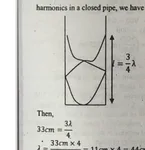
The wavelength of the first overtone of a note in a closed pipe of length 33 cm:
A. 17 cmB. 33 cmC. 22 cmD. 44 cmCorrect Explanation First overtone (3rd harmonic) in closed pipe: L=3λ/4 → λ=4×33/3=44 cm.
Sign up free to unlock …and/or go further with premium services and No Ads .