All 40 questions from the Joint Admissions and Matriculation Board (JAMB) Physics 2025 Objective paper, with the correct answer and a full explanation for each. Free, no signup needed.
Which of the following is an example of a non-contact force?
A. frictionB. tensionC. gravitational forceCorrect D. normal forceExplanation Gravitational force acts at a distance without physical contact, unlike friction, tension, and normal force which require contact.
A body is projected vertically upward with a speed of 40 m/s. Calculate the maximum height reached. (g = 10 m/s²)
A. 80 mCorrect B. 160 mC. 200 mD. 400 mExplanation Using v²=u²-2gh: 0=1600-20h → h=80 m.
A ray of light is incident at 30° on a surface with refractive index 1.5. What is the angle of refraction? (n_air=1)
A. 20°B. 42°C. 19.5°Correct D. 22.6°Explanation Snell's law: sin θ₂=sin30°/1.5=0.3333 → θ₂≈19.5°.
A wire of length 10 m, cross-section 2 mm² has resistance 0.5 Ω. What is the resistivity?
A. 1×10⁻⁷ ΩmCorrect B. 1.5×10⁻⁶ ΩmC. 0.1 ΩmD. 2.33×10⁻⁵ ΩmExplanation ρ=RA/l=(0.5×2×10⁻⁶)/10=1×10⁻⁷ Ωm.
A 0.2 kg block of ice at −10°C is heated until it melts. How much energy is required? (c_ice=2.1×10³ J/kg°C, L=3.3×10⁵ J/kg)
A. 66700 JB. 4200 JC. 70,200 JCorrect D. 11500 JExplanation Q₁=mcΔθ=4200 J; Q₂=mL=66000 J; Total=70,200 J.
The displacement-time graph of a moving object is a straight line with positive slope. Which quantity is constant?
A. DisplacementB. velocityCorrect C. accelerationD. momentumExplanation Slope of displacement-time graph = velocity; a straight line means constant velocity.
A motorist at 20 ms⁻¹ sees a child 50 m ahead and decelerates at 5 ms⁻². The stopping distance is:
A. 10 mB. 20 mC. 40 mCorrect D. 60 mExplanation v²=u²+2as → 0=400-10s → s=40 m.
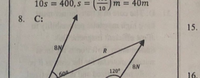
Two forces 8 N and 6 N act at 60° to each other. The magnitude of their resultant is approximately:
A. 10 NB. 14 NC. 12.2 NCorrect D. 2 NExplanation R=√(8²+6²+2×8×6×cos60°)=√148≈12.2 N.
A 5 kg mass hangs from a spring balance in an elevator accelerating upward at 3 ms⁻². The balance reads:
A. 35 NB. 50 NC. 65 NCorrect D. 80 NExplanation R=m(g+a)=5(10+3)=65 N.
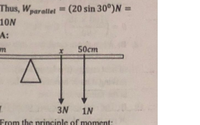
A block of weight 20 N rests on an incline at 30°. The component of its weight parallel to the incline is:
A. 10 NCorrect B. 20 NC. √3 ND. 0 NExplanation W∥=W sinθ=20×0.5=10 N.
A uniform metre rule of weight 1 N is pivoted at 20 cm. A 0.2 kg mass hangs at 0 cm. Where should a 0.3 kg mass be hung to balance it horizontally? (g=10 ms⁻²)
A. 23 cm markCorrect B. 60 cm markC. 81 cm markD. 36 cm markExplanation Taking moments about pivot: 2×20+1×(x-20)=3×(x-20)+30 → x≈23.33 cm.
A 60 W lamp is on for 5 hours. The electrical energy consumed is:
A. 1.08×10⁶ JCorrect B. 1.08×10⁵ JC. 300 JD. 3600 JExplanation E=Pt=60×5×3600=1.08×10⁶ J.
A steel wire 2 m long, cross-section 1.0 mm², Young's modulus 2×10¹¹ Nm⁻². Extension under 200 N load:
A. 0.5 mmB. 2 mmCorrect C. 10 mmD. 20 mmExplanation e=FL/AY=(200×2)/(10⁻⁶×2×10¹¹)=2 mm.
In an ideal pulley system, a 400 N load is lifted 0.5 m by an effort moving 2.0 m. The mechanical advantage is:
A. 0.25B. 4.0Correct C. 1.5D. 2.5Explanation MA=VR=2.0/0.5=4 (ideal system).
A glass block is completely immersed in water. The upthrust acting on it:
A. equals the weight of the blockB. equals the weight of displaced waterCorrect C. is greater at the sidesD. acts horizontallyExplanation Archimedes' principle: upthrust = weight of fluid displaced.
Water flows in a pipe of cross-section 4×10⁻⁴ m² at 5 ms⁻¹. Volume discharged in 1 minute:
A. 1.2×10⁻³ m³B. 1.2×10⁻¹ m³Correct C. 6×10⁻³ m³D. 1.2×10⁻² m³Explanation V=Avt=4×10⁻⁴×5×60=0.12 m³=1.2×10⁻¹ m³.
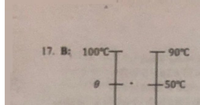
A thermometer reads 10°C in ice and 90°C in steam. Actual temperature when it reads 50°C:
A. 40°CB. 50°CCorrect C. 60°CD. 75°CExplanation θ=((50-10)/(90-10))×100=50°C.
Steam at 100°C causes a more severe burn than water at 100°C because:
A. it depends on relative humidityB. steam contains more latent heat per unit massCorrect C. steam is at higher pressureD. steam has higher thermal conductivityExplanation Steam releases additional latent heat of vaporisation (~2260 kJ/kg) when it condenses on skin.
In a gas, the root mean square speed of molecules is proportional to the:
A. absolute temperatureB. square root of absolute temperatureCorrect C. cube of absolute temperatureD. reciprocal of absolute temperatureExplanation v_rms=√(3RT/M) ∝ √T.
According to the first law of thermodynamics, when a system receives heat Q and does work W, the increase in internal energy ΔU equals:
A. Q − WCorrect B. Q + WC. W − QD. QWExplanation First law: ΔU=Q-W.
A stretched string of length 1.0 m has wave speed 200 ms⁻¹. The fundamental frequency is:
A. 50 HzB. 100 HzCorrect C. 200 HzD. 400 HzExplanation f₀=v/2L=200/2=100 Hz.
The pitch of a note depends on its:
A. amplitudeB. frequencyCorrect C. wavelengthD. speedExplanation Pitch is determined by frequency.
An object 10 cm tall is placed 30 cm from a concave mirror of focal length 20 cm. The image produced is:
A. 20 cm behind the mirror and uprightB. 60 cm in front of the mirror and invertedCorrect C. 60 cm behind the mirrorD. 10 cm in front of the mirrorExplanation 1/f=1/u+1/v → v=60 cm; real, inverted, 60 cm in front.
Two point charges +5μC and −3μC are 0.2 m apart. k=9×10⁹ Nm²C⁻². The force between them is approximately:
A. 0.375 NB. 1.35 NC. 3.38 NCorrect D. 7.5 NExplanation F=kq₁q₂/r²=9×10⁹×15×10⁻¹²/0.04=3.375 N≈3.38 N.
Which statement about electric field lines is correct?
A. they intersect where fields are equalB. they indicate direction of motion of a negative test chargeC. they originate from positive charges and end on negative chargesCorrect D. they are circles around a source chargeExplanation Field lines go from + to − charges; direction shows force on positive test charge.
The power dissipated in a 4 Ω resistor carrying 3 A is:
A. 9 WB. 12 WC. 18 WD. 36 WCorrect Explanation P=I²R=9×4=36 W.
A battery of emf 12 V and internal resistance 2 Ω is connected to a 10 Ω resistor. The terminal voltage is:
A. 2 VB. 10 VCorrect C. 11 VD. 14 VExplanation I=12/12=1 A; V_t=E-Ir=12-2=10 V.
The induced emf in a coil increases when:
A. the coil's resistance increasesB. a stronger magnet is usedCorrect C. the magnet is moved more slowlyD. the coil has fewer turnsExplanation Faraday: emf ∝ dΦ/dt; stronger magnet increases flux change, increasing emf.
An AC generator produces maximum emf 100 V. The r.m.s. value is:
A. 70.7 VCorrect B. 50 VC. 141.4 VD. 100 VExplanation V_rms=V_max/√2=100/√2≈70.7 V.
A transformer has 500 primary turns and 100 secondary turns. If 240 V AC is applied, the secondary voltage is:
A. 48 VCorrect B. 80 VC. 1200 VD. 120 VExplanation V_s=V_p×(N_s/N_p)=240×(100/500)=48 V.
The most suitable material for the core of a transformer is:
A. brassB. woodC. copperD. soft ironCorrect Explanation Soft iron has high permeability and low hysteresis loss.
The energy of a photon with wavelength 50 cm is about: (h=6.63×10⁻³⁴ Js, c=3×10⁸ ms⁻¹)
A. 3.98×10⁻²⁵ JCorrect B. 2.49×10⁻¹⁹ JC. 6.63×10⁻²⁶ JD. 1.99×10⁻²⁵ JExplanation E=hc/λ=(6.63×10⁻³⁴×3×10⁸)/0.5=3.978×10⁻²⁵ J≈3.98×10⁻²⁵ J.
Half-life of a radioactive isotope is 3 hours. Fraction remaining after 9 hours:
A. 1/8Correct B. 1/9C. 1/27D. 1/32Explanation n=9/3=3 half-lives; fraction=(1/2)³=1/8.
The work function of a metal is 2.0 eV. The threshold frequency for photoemission is:
A. 2.4×10¹⁴ HzB. 4.8×10¹⁴ HzCorrect C. 3.2×10¹⁵ HzD. 6.6×10¹³ HzExplanation f₀=W/h=(2×1.6×10⁻¹⁹)/(6.63×10⁻³⁴)≈4.8×10¹⁴ Hz.
Which statement about the photoelectric effect is correct?
A. electrons emitted only when intensity exceeds a thresholdB. emission begins immediately once frequency exceeds thresholdCorrect C. KE of emitted electrons is independent of frequencyD. number of electrons decreases as intensity increasesExplanation Emission is instantaneous once frequency exceeds threshold; no time delay.
A current of 2 A flows through a wire 0.4 m long in a field of 0.5 T (perpendicular). The force on the wire is:
A. 0.2 NB. 0.8 NC. 0.4 NCorrect D. 1.0 NExplanation F=BIL sin90°=0.5×2×0.4=0.4 N.
The electrostatic potential energy of two point charges q₁, q₂ separated by r is:
A. U=kq₁q₂B. U=kq₁q₂/r²C. U=q₁q₂/rD. U=kq₁q₂/rCorrect Explanation U=kq₁q₂/r (Coulomb potential energy formula).
An ideal gas undergoes isothermal expansion. Which quantity remains constant?
A. internal energyCorrect B. pressureC. volumeD. temperatureExplanation For ideal gas, internal energy depends only on T; isothermal → T constant → U constant.
Work function is 3 eV. Light of frequency 8×10¹⁴ Hz strikes the metal. Max KE of photoelectrons:
A. 0.2 eVB. 0.5 eVC. 0.3 eVCorrect D. 0.4 eVExplanation E_photon=hf≈3.315 eV; KE_max=3.315-3=0.315 eV≈0.3 eV.
Kirchhoff's first law (junction rule) states that:
A. sum of currents entering = sum leaving a junctionCorrect B. sum of all PDs in a loop is zeroC. total resistance in series = sum of individualD. voltage across conductor ∝ currentExplanation KCL is based on conservation of charge: currents in = currents out at a junction.
Sign up free to unlock …and/or go further with premium services and No Ads .