All 9 questions from the West African Examinations Council (WAEC) Accounting 2020 Theory paper, with the correct answer and a full explanation for each. Free, no signup needed.
1(a) Outline two differences between bookkeeping and accounting. (b) List one source document used for each of the following transactions: (i) sales; (ii) purchases; (iii) cash deposit; (iv) salary; (v) returns outwards. (c) State three purposes of source documents.
Model answer
(a) Differences between Bookkeeping and Accounting: i. Bookkeeping has to do with recording, while accounting deals with computation/interpretation of financial data. ii. Bookkeeper provides data that will be used by the accountant; thus bookkeeping is feeder while accounting is the beneficiary.
(b) Source document for each transaction: (i) Sales - Sales day book/Sales invoice. (ii) Purchases - Purchase day book/Purchase invoice. (iii) Cash deposit - Teller. (iv) Salary - Payroll. (v) Returns outward - Purchase day book/Debit note.
(c) Purposes of source documents: i. It serves as evidence for a transaction. ii. It helps in the imputation of accounts. iii. It serves as reference for future purposes.
2(a) What is a not-for-profit making organisation? (b) Outline two differences between a for-profit organisation and a not-for-profit making organisation. (c) Explain the following sources of funding in a not-for-profit making organisation: (i) subscription; (ii) life membership fee; (iii) entrance fee; (iv) donation.
Model answer
(a) A not-for-profit making organisation is the type of organization in which the main purpose is the promotion of welfare of the society. Thus, it is an organization that is not business-oriented; for this reason, it makes surplus and not profit.
(b) Differences between for-profit and not-for-profit making organisation: i. The sole purpose of for-profit making is to maximize profit, while not-for-profit making aims to maximize welfare. ii. While for-profit making has accumulated capital, not-for-profit making has an accumulated fund.
(c)(i) Subscription: This can be defined as the annual compulsory payment made by members of an organization to signify their membership with the organization.
(ii) Life membership fee: This is a fee paid by members of the organization to indicate perpetuity of his/her membership with the organization.
(iii) Entrance fee: This can be referred to as the fee charged by an organization before members can be allowed to attend some particular events.
(iv) Donation: This is a voluntary gift by members and non-members to promote the organization. It is non-compulsory payment.
3(a) Explain the term fixed capital account. (b) State three conditions that would result in a change in profit and loss sharing ratio of a partnership. (c) Outline three circumstances that would give rise to the creation of goodwill in a partnership.
Model answer
(a) Fixed capital account: This is a fixed interest account with a maturity date. It is referred to as term deposit. The holder will give a notification if he intends to make withdrawal from the account before the maturity date.
(b) Conditions that can lead to change in profit sharing ratio of partners: i. Admission of new partner. ii. Death of a partner. iii. Retirement of a partner.
(c) Circumstances that can result in the creation of goodwill in a partnership business: i. Admission of new partner. ii. Revaluation of asset in the partnership business. iii. Conversion of the partnership business to a public company.
4(a) List: (i) three books of accounts used in public sector accounting; (ii) four users of public sector accounting information. (b) State four differences between the private sector and the public sector accounting.
Model answer
(a)(i) Books of accounts used in public sector accounting: Consolidated revenue fund account; Development fund account; Federation account.
(ii) Users of public sector accounting information: The government; The citizens; Labour union; The international organisation.
(b) Differences between public sector accounting and private sector accounting: i. In the public sector, accounting is on cash basis while it is accrual basis in the private sector. ii. Public sector accounting is for government/parastatals while private sector accounting is for commercial undertakings that aim to make profit. iii. Legislation for public sector accounting is drawn from the constitution while the company's act serves as basic law for private sector accounting. iv. Public sector accounting is prepared to show how revenues are generated and funds dispensed, while private sector accounting determines the profit and financial position of the company.
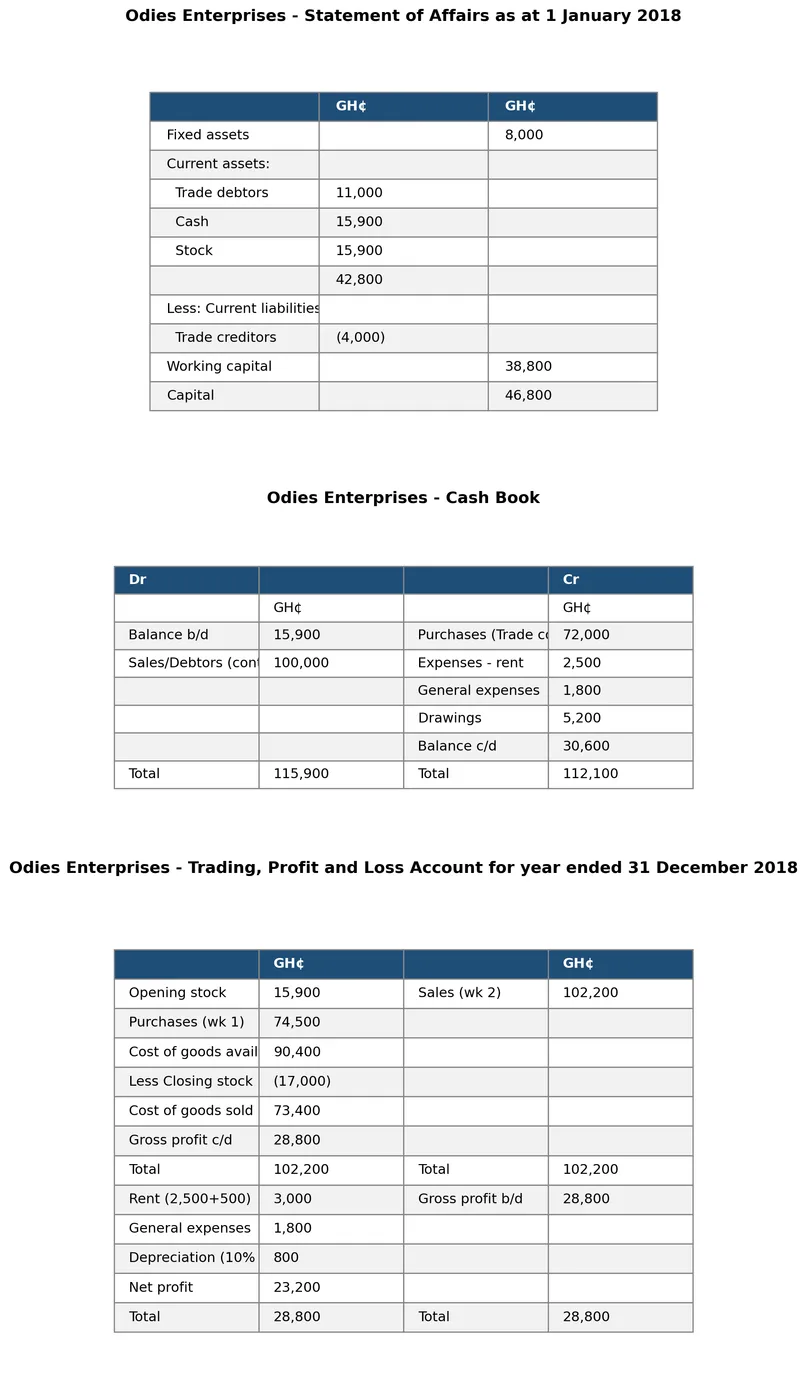
The following transactions were extracted from the books of Odies Enterprises for the year ended 31st December 2018: (i) cash received from trade debtors GH¢100,000; (ii) cash paid to suppliers GH¢72,000; (iii) expenses paid during the year were: rent GH¢2,500, general expenses GH¢1,800; (iv) cash of GH¢5,200 was withdrawn by the proprietor for personal use; (v) fixed assets valued at GH¢8,000 on 31st December 2017 were to be depreciated at 10% per annum. Additional information (31 Dec 2017 / 31 Dec 2018): Trade debtors GH¢11,000 / GH¢13,200; Trade creditors GH¢4,000 / GH¢6,500; Rent owing - / GH¢500; Cash GH¢15,900 / GH¢12,100; Stock GH¢15,900 / GH¢17,000. You are required to prepare: (a) Statement of Affairs as at 1st January 2018; (b) Cash Book; (c) Trading, Profit and Loss Account for the year ended 31st December 2018.
Model answer
(a) See the Statement of Affairs table in the Diagram column (Fixed assets GH¢8,000 + working capital GH¢38,800 = Capital GH¢46,800, derived from opening current assets of GH¢42,800 less current liabilities of GH¢4,000).
(b) See the Cash Book table in the Diagram column (Balance b/d GH¢15,900 + Cash from debtors GH¢100,000 = Total receipts GH¢115,900; less Purchases GH¢72,000, Rent GH¢2,500, General expenses GH¢1,800, Drawings GH¢5,200 = Balance c/d GH¢30,600 with total payments of GH¢112,100 balanced against workings for credit sales/purchases via the control accounts).
(c) See the Trading, Profit and Loss Account table in the Diagram column. Workings: Purchases ledger control account and Sales ledger control account are used to determine credit purchases (GH¢74,500) and credit sales (GH¢102,200) respectively, from which cost of goods sold (GH¢73,400), gross profit (GH¢28,800) and net profit (GH¢23,200) for the year are computed.
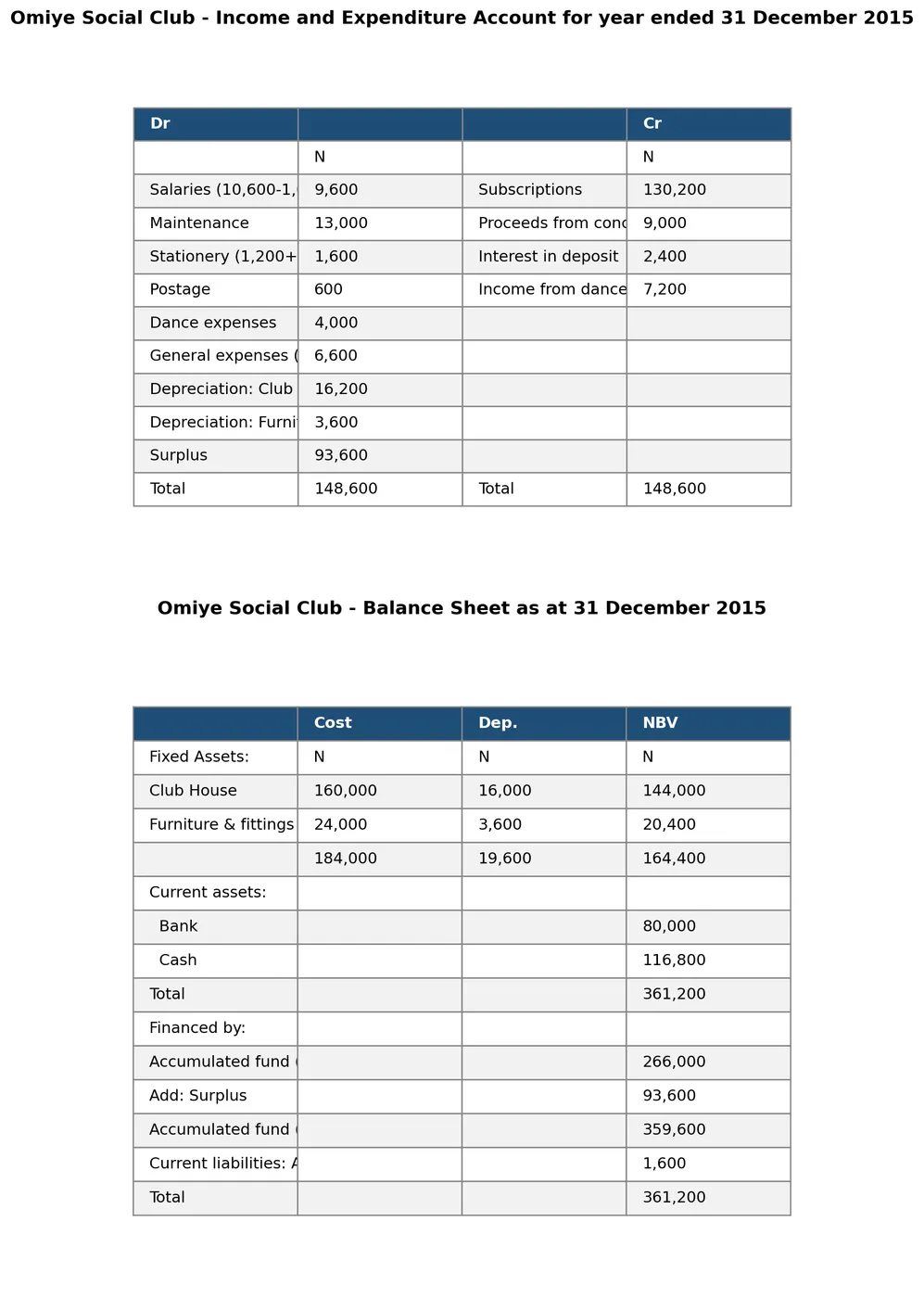
The books of Omiye Social Club showed the following information for the year ended 31st December 2015: Receipts and Payments Account — Balance 01/01/2015 N3,000; Subscriptions N130,000; Proceeds from concert N9,000; Interest on deposit N2,400; Income from dance N7,200; Salaries N10,600; Maintenance N13,000; Stationery N1,200; Postage N600; Dance expenses N4,000; General expenses N5,400; Balance c/d N116,800. Balances as at 1st January 2015: Accumulated fund N266,000; Bank deposit N80,000; Club house N160,000; Furniture and fittings N24,000. Additional information: (i) Outstanding as at 31st December 2015: Stationery N400, general expenses N1,200; (ii) Salaries of N10,600 paid including N1,000 owed since 2014; (iii) Depreciate club house by 10% and furniture and fittings by 15%. You are required to prepare: (a) Income and Expenditure Account for the year ended 31st December 2015; (b) Balance Sheet as at that date.
Model answer
(a) See the Income and Expenditure Account table in the Diagram column. The surplus for the year is N93,600, after charging adjusted Salaries (N9,600, i.e. N10,600 paid less N1,000 owed from the prior year), Maintenance (N13,000), Stationery adjusted for the N400 outstanding (N1,600), Postage (N600), Dance expenses (N4,000), General expenses adjusted for N1,200 outstanding (N6,600), and Depreciation on Club house (N16,200) and Furniture and fittings (N3,600), against total income of Subscriptions (N130,200, net of arrears/prepayments per the subscription account), Proceeds from concert (N9,000), Interest on deposit (N2,400) and Income from dance (N7,200).
(b) See the Balance Sheet table in the Diagram column, showing Fixed assets (Club house and Furniture and fittings) at net book value of N164,400, plus Current assets (Bank N80,000, Cash N116,800), financed by the Accumulated fund (N266,000 opening plus N93,600 surplus = N359,600) and Current liabilities (accrued expenses N1,600), giving a balance sheet total of N361,200.
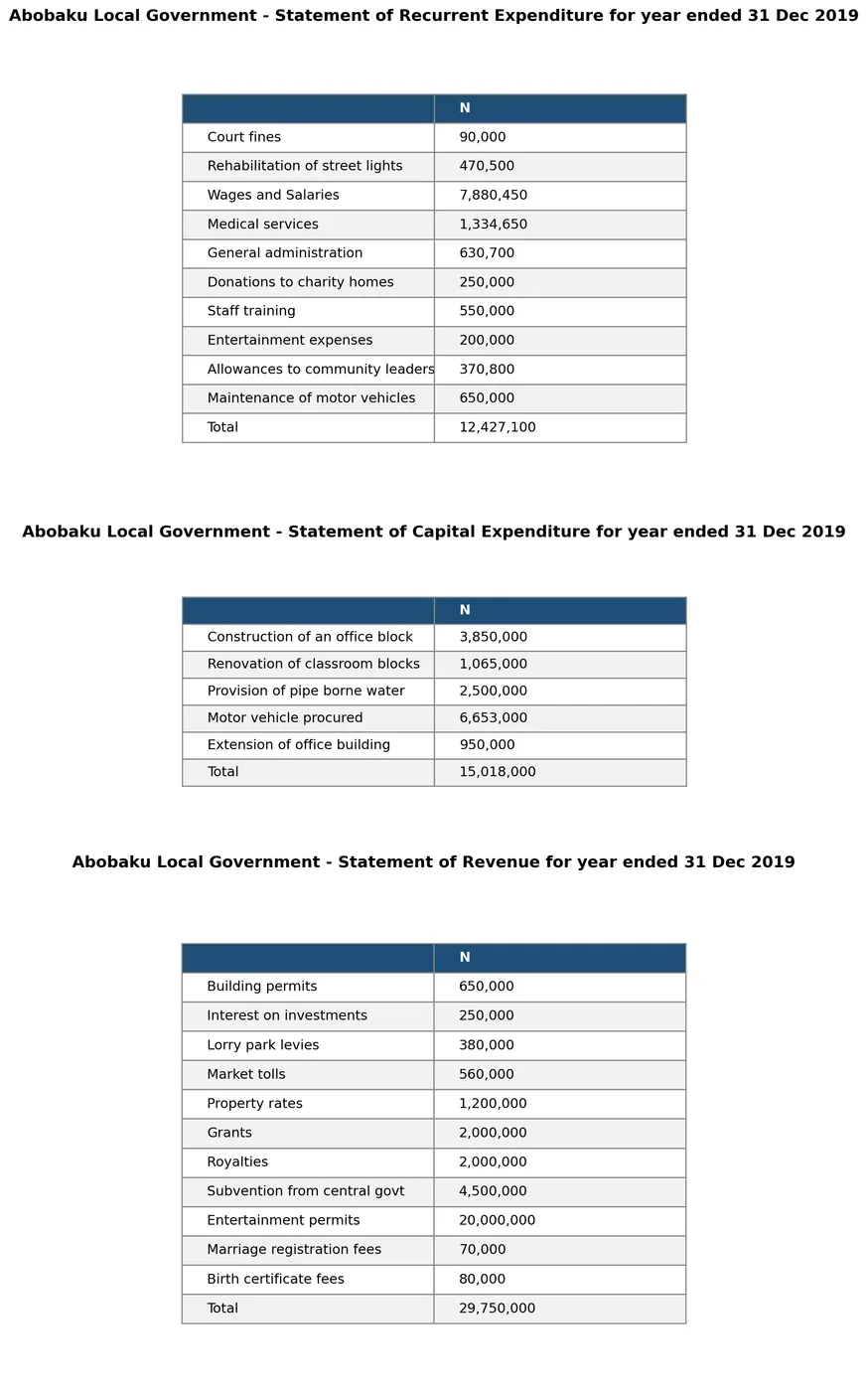
The following balances were extracted from the books of Abobaku Local Government for the year ended 31st December 2019: Construction of an office block N3,850,000; Renovation of classroom blocks N1,065,000; Court fines N90,000; Building permits N650,000; Rehabilitation of street lights N470,500; Wages and salaries N7,880,450; Medical services N1,334,650; Provision of pipe borne water N2,500,000; Interest on investments N250,000; Lorry park levies N380,000; Market tolls N560,000; Property rates N1,200,000; General administration N630,700; Motor vehicle procured N6,653,000; Extension of office building N950,000; Grants from donor agencies N2,000,000; Royalties N2,000,000; Subvention from Central/Federal Government N20,000,000; Donations to charity homes N250,000; Entertainment permits N70,000; Staff training N550,000; Entertainment expenses N200,000; Marriage registration fees N80,000; Allowances to community leaders N370,800; Birth certificate fees N160,000; Maintenance of motor vehicles N650,000; Subvention from central government N4,500,000. You are required to prepare, for the year ended 31st December 2019: (a) Statement of Recurrent Expenditure; (b) Statement of Capital Expenditure; (c) Statement of Revenue.
Model answer
(a) See the Statement of Recurrent Expenditure table in the Diagram column: total recurrent expenditure N12,427,100, comprising Court fines, Rehabilitation of street lights, Wages and Salaries, Medical services, General administration, Donations to charity homes, Staff training, Entertainment expenses, Allowances to community leaders and Maintenance of motor vehicles.
(b) See the Statement of Capital Expenditure table in the Diagram column: total capital expenditure N15,018,000, comprising Construction of an office block, Renovation of classroom blocks, Provision of pipe borne water, Motor vehicle procured and Extension of office building.
(c) See the Statement of Revenue table in the Diagram column: total revenue N29,750,000, comprising Building permits, Interest on investments, Lorry park levies, Market tolls, Property rates, Grants, Royalties, Subvention from central government, Entertainment permits, Marriage registration fees and Birth certificate fees.
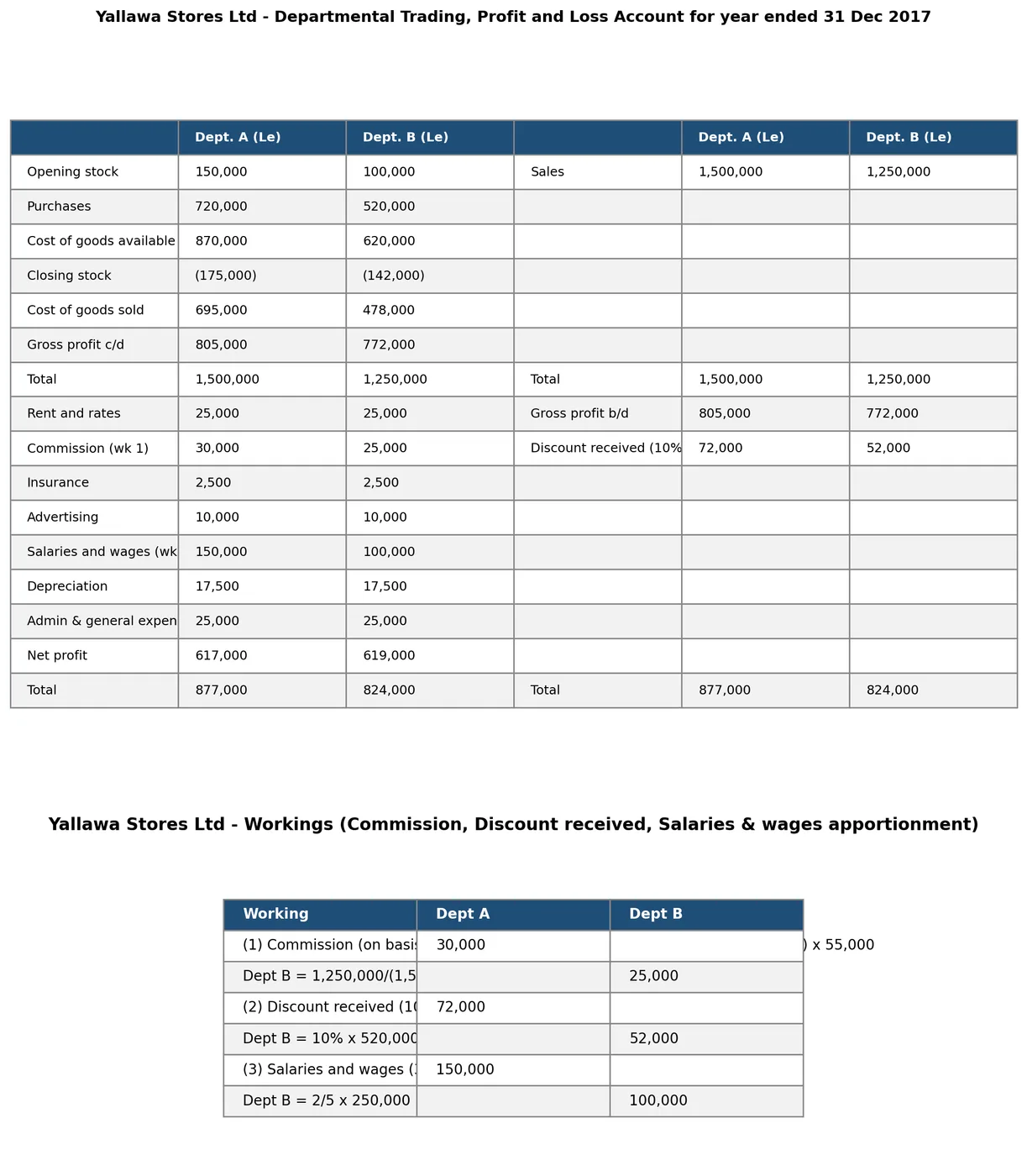
Yallawa Stores Ltd has two departments. The following balances were extracted from its books as at 31st December 2017 (in Le): Purchases: Department A Le720,000, Department B Le520,000. Rent and rates Le50,000; Commission Le55,000; Insurance Le5,000. Sales: Department A Le1,500,000, Department B Le1,250,000. Discount received Le124,000; Advertising Le20,000; Salaries and wages Le250,000; Depreciation Le35,000. Administration and general expenses Le50,000. Opening stock: Department A Le150,000, Department B Le100,000. Closing stock: Department A Le175,000, Department B Le142,000. Additional information — Expenses are to be apportioned to the departments as follows: (i) commission — on the basis of sales; (ii) salaries and wages — 3:2 for Department A and B respectively; (iii) discount received — 10% of purchases; (iv) other expenses to be apportioned equally. You are required to prepare a Departmental Trading, Profit and Loss Account for the year ended 31st December 2017.
Model answer
See the Departmental Trading, Profit and Loss Account table in the Diagram column, along with the supporting workings table for the apportionment of Commission, Discount received, and Salaries and wages between Department A and Department B. Department A records a net profit of Le617,000 while Department B records a net profit of Le619,000, after apportioning Rent and rates, Insurance, Advertising, Depreciation and Administration and general expenses equally between the two departments, and apportioning Commission by sales ratio (30,000:25,000), Discount received at 10% of each department's purchases (72,000:52,000), and Salaries and wages in the ratio 3:2 (150,000:100,000).
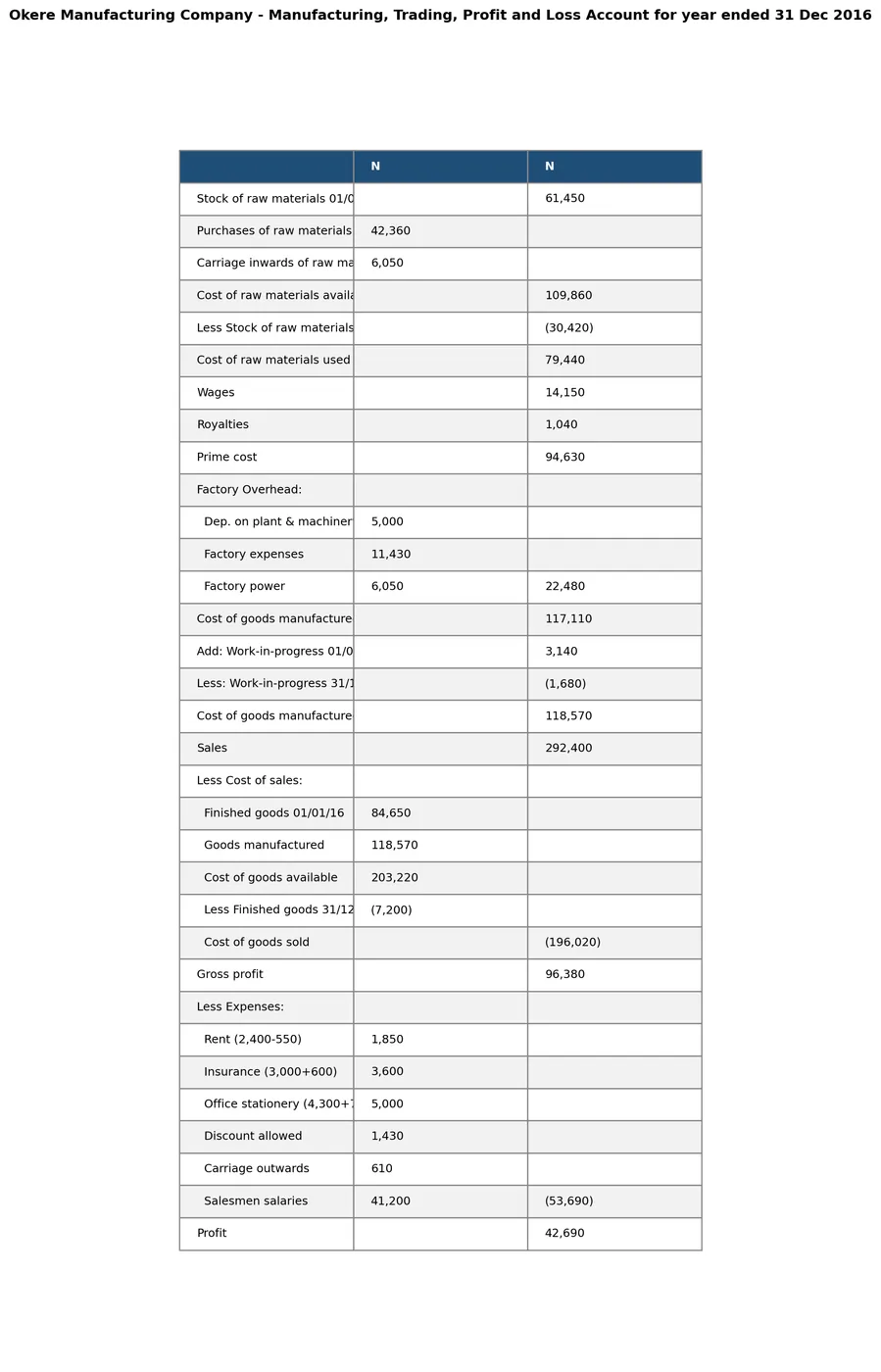
The following information was extracted from the books of Okere Manufacturing Company for the year ended 31st December 2016 (in N): Stock of raw materials (01/01/16) 61,450; Purchases of raw materials 42,360; Carriage inwards of raw materials 6,050; Wages 14,150; Royalties 1,040; Plant and machinery ($50,000) 40,000; Factory expenses 11,430; Factory power 6,050; Rent 2,400; Insurance 3,000; Discount allowed 1,430; Carriage outwards 610; Sales 292,400; Salesmen salaries 41,200; Office stationery 4,300; Finished goods (01/01/16) 84,650; Work-in-progress (01/01/16) 3,140. Additional information: (i) Closing stock as at 31/12/16 — raw materials N30,420, finished goods N7,200, work-in-progress N1,680; (ii) Insurance outstanding N600; (iii) Rent paid in advance N550; (iv) Office stationery accrued N700; (v) Depreciation on plant and machinery at 10% per annum on cost. You are required to prepare a Manufacturing, Trading and Profit and Loss Account for the year ended 31st December 2016.
Model answer
See the Manufacturing, Trading and Profit and Loss Account table in the Diagram column. Prime cost is computed as N94,630 (cost of raw materials used N79,440 + Wages N14,150 + Royalties N1,040). Adding Factory Overhead of N22,480 (Depreciation on plant and machinery N5,000 + Factory expenses N11,430 + Factory power N6,050) gives a Cost of goods manufactured (within the year) of N117,110, which is adjusted for opening and closing work-in-progress to give N118,570. Cost of goods sold is N196,020, giving a Gross profit of N96,380. After deducting adjusted expenses (Rent N1,850, Insurance N3,600, Office stationery N5,000, Discount allowed N1,430, Carriage outwards N610, and Salesmen salaries N41,200, totalling N53,690), the final Profit for the year is N42,690.
Advertisement
Sign up free to unlock
Score tracking
Practice history
Saved questions
Progress dashboard
Personalized sessions
Weak-topic breakdown
…and/or go further with premium services and No Ads.