WAEC Agricultural Science 2022 Objective Past Questions
All 50 questions from the West African Examinations Council (WAEC) Agricultural Science 2022 Objective paper, with the correct answer and a full explanation for each. Free, no signup needed.
To reduce rural-urban migration, the government should
A. establish commodity boards
B. provide social infrastructureCorrect
C. establish tractor-hiring units
D. provide extension services to farmers
Explanation
Providing social infrastructure (roads, electricity, water, schools, hospitals) in rural areas makes rural life more attractive and reduces the incentive for young people to migrate to cities.
The establishment of cooperative farming is encouraged by governments because it
A. enables farmers to control soil erosion
B. facilitates the use of hand tools
C. enables individual farmers to acquire capitalCorrect
D. allows farmers to cultivate small scattered plots
Explanation
Cooperative farming allows farmers to pool their resources together, which enables individual farmers — who might not qualify alone — to access loans and acquire capital collectively.
A non-governmental organization involved in agricultural development in West Africa is
A. Operation Feed the Nation
B. River Basin Development Authority
C. Agricultural Development Project
D. International Institute of Tropical AgricultureCorrect
Explanation
The International Institute of Tropical Agriculture (IITA) is a non-profit institution that generates agricultural innovations; the other options are government-run programmes/authorities.
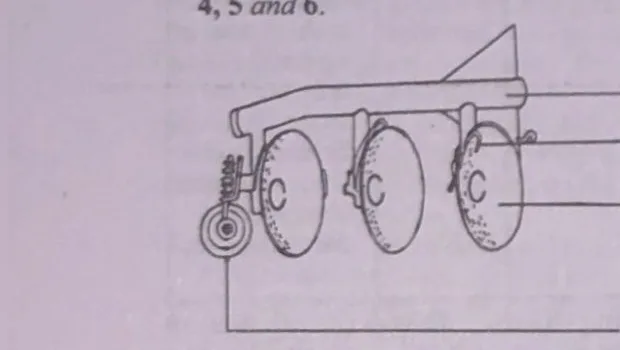
The diagram below illustrates a farm implement. Use it to answer questions 4, 5 and 6.
The illustrated farm implement is used for
A. pulverizing soil into fine tilth
B. breaking up soil into clodsCorrect
C. gathering topsoil
D. levelling soil surface
Explanation
The implement shown is a disc plough. Its main function is initial soil turning and breaking up of soil into clods/rough furrows, ahead of finer tilling operations.
A combine harvester can be used simultaneously to harvest
A. legumes and apply fertilizer
B. grains and eradicate weeds
C. tubers and distribute fertilizer
D. cereals and winnow grainsCorrect
Explanation
A combine harvester combines harvesting and threshing of cereal/grain crops — it cuts the crop, separates the grain from the stalks, and cleans (winnows) the grain by separating it from the chaff, all in one pass.
Decomposition of soil organic matter is mainly caused by
A. bacteriaCorrect
B. algae
C. fungi
D. nematodes
Explanation
Bacteria are the most abundant and important microscopic decomposers responsible for breaking down soil organic matter, alongside fungi and other organisms.
The main factors responsible for rock weathering in the desert are high
A. temperature and animal activityCorrect
B. wind and root growth
C. water and wind
D. root growth and water
Explanation
In desert environments, high daytime/low nighttime temperature fluctuations (thermal expansion/contraction) combined with animal activity are the main drivers of rock weathering, given the scarcity of water.
A difference between physical and chemical weathering is that
A. there is a change in the mineral composition of rock in physical weathering
B. the mineral composition of rock is changed in chemical weatheringCorrect
C. carbonation is necessary in physical weathering
D. wind is necessary in chemical weathering
Explanation
Physical weathering breaks down a rock's physical structure without changing its chemical/mineral composition, while chemical weathering alters the rock's mineral/chemical composition (e.g. through carbonation, oxidation, hydrolysis).
Use the information below to answer questions 12 and 13.
In an experiment on soil porosity, the following results were obtained:
Volume of dry soil = 52 cm³
Volume of water = 48 cm³
Volume of soil and water = 78 cm³
Determine the volume of airspace in the soil sample.
A. 22 cm³Correct
B. 26 cm³
C. 30 cm³
D. 100 cm³
Explanation
Volume of airspace = (Volume of dry soil + Volume of water) − Volume of soil and water mixture = (52 + 48) − 78 = 22 cm³.
The diagram below illustrates a tool used to analyse a soil sample in an experiment. Use it to answer questions 14, 15 and 16.
The aim of the experiment is to determine the soil
A. structure
B. textureCorrect
C. mineral matter
D. organic matter
Explanation
This apparatus (a sedimentation/settling jar) is used to determine soil texture, by observing how particles of different sizes (sand, silt, clay) settle into distinct layers.
In a soil sedimentation jar, particles settle by size — the middle layer (III) typically contains silt, since silt particles are intermediate in size between sand (which settles first/bottom) and clay (which settles last/top).
Potassium deficiency in cereal crops is indicated by
A. browning of leaves from the tips and marginsCorrect
B. yellowing of younger leaves
C. purpling of leaves
D. white and irregular spots on leaves
Explanation
Potassium deficiency in cereal grains typically appears as a scorching/browning of the older, lower leaves, beginning at the leaf tip and moving down the margins.
A. mulching, strip cropping and cover croppingCorrect
B. weeding, strip cropping and clean clearing
C. clean clearing, mulching and strip cropping
D. cover cropping, mulching and weeding
Explanation
Mulching, strip cropping and cover cropping all help reduce evaporation and runoff, conserving soil moisture. Clean clearing (bare soil) increases water loss.
Oil palm, rice, and plantain are monocotyledonous crops. (Note: plantain is sometimes mistaken for a dicot due to its broad leaves, but it is botanically a monocot; the other listed crops in options B–D are dicots.)
The practice of placing the correct number of seeds in the soil with definite intra-row and inter-row spacing is called
A. seed drilling
B. centrifugal distribution
C. precision plantingCorrect
D. seed broadcasting
Explanation
Precision planting involves placing seeds at a precise spacing and depth, in contrast to broadcast seeding where seed is scattered over an area without definite spacing.
Soil-borne diseases could be controlled in the nursery by
A. mulching
B. manuring
C. heat treatmentCorrect
D. provision of shade
Explanation
Heating (sterilizing) the soil is a very effective method of controlling soil-borne diseases — most pathogens are killed by brief exposure to high temperature (about 140°F for 30 minutes).
Use the information below to answer question 33.
I. Yellowing of leaves II. Raised brown spots on the leaves III. Drying up of leaves IV. Exudation of gum
The disease of citrus described above is
A. die-backCorrect
B. gummosis
C. tristeza
D. blight
Explanation
The symptoms described (yellowing, raised brown spots, drying leaves, gum exudation) are characteristic of die-back disease of citrus, caused by a Phytophthora pathogen.
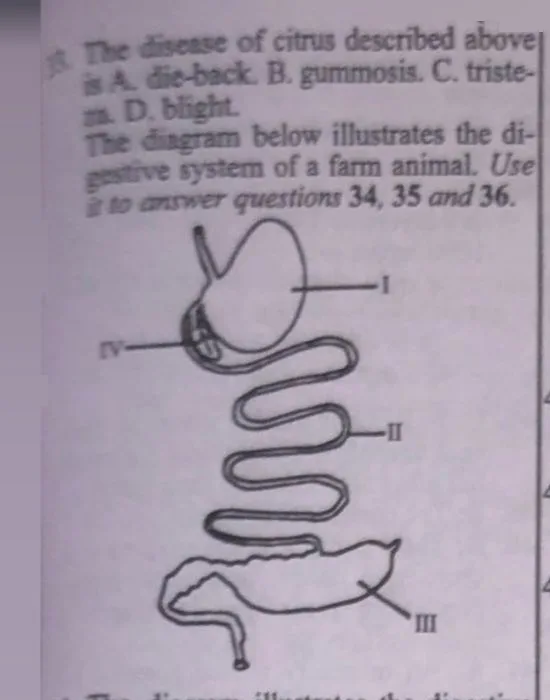
The diagram below illustrates the digestive system of a farm animal. Use it to answer questions 34, 35 and 36.
The diagram illustrates the digestive system of a
A. chicken
B. turkey
C. sheep
D. rabbitCorrect
Explanation
The diagram illustrates the digestive tract of a rabbit, identifiable by its characteristic large, coiled caecum.
Which of the following statements about silage are true?
I. has laxative effect II. is acidic in reaction III. has a strong aroma when well prepared
A. I and II only
B. I and III only
C. II and III onlyCorrect
D. I, II and III
Explanation
Well-prepared silage is acidic (due to fermentation) and has a strong, distinct aroma; it does not typically have a laxative effect, so statements II and III are true.
In farming enterprise, short term loans are used to
A. purchase farm machinery
B. construct new farm buildings
C. construct an irrigation dam
D. purchase agrochemicalsCorrect
Explanation
Short-term loans meet short-term recurring needs such as purchasing fertilizers/agrochemicals, seeds, and paying wages to hired workers — not large capital projects.
Use the following information to answer questions 47 to 49.
The table below illustrates a farm record for Goodness Farms in the year 1970.
Date | Number of hens | Total eggs collected | Total eggs sold
4th June | 362 | 176 | 96
5th June | 360 | 199 | 108
6th June | 360 | 177 | 48
The table illustrates
A. an inventory recordCorrect
B. a production record
C. a labour record
D. an input record
Explanation
This kind of farm record — tracking assets (hens) and outputs (eggs collected/sold) over time in physical terms — is classified as an inventory record.
Gross profit is the profit made after deducting the cost of producing and selling goods/services from total sales — total sales less cost of production.
Advertisement
Sign up free to unlock
Score tracking
Practice history
Saved questions
Progress dashboard
Personalized sessions
Weak-topic breakdown
…and/or go further with premium services and No Ads.