WAEC Agricultural Science 2022 Theory Past Questions
All 6 questions from the West African Examinations Council (WAEC) Agricultural Science 2022 Theory paper, with the correct answer and a full explanation for each. Free, no signup needed.
1(a) State five reasons why government should enact laws to regulate the use of land for agriculture.
(b) A cocoa farmer has just acquired 10 hectares of farmland and is considering the type of farm power to use for tillage operations.
(i) Advise the farmer on the most appropriate type of farm power to use.
(ii) State four reasons for the answer in 1b(i).
(c) Mention one function each of the following parts of a seed planter: (i) seed tube; (ii) furrow opener; (iii) hopper; (iv) seed metering device; (v) furrow wheel.
(d) List three machines used in processing crops after harvesting.
Model answer
(a) Reasons for enacting laws to regulate agricultural land use:
- Security of tenure: to safeguard farmers against unreasonable eviction
- Land litigation: to reduce the number of land disputes among citizens
- Government projects: to make large portions of land available for government-sponsored development of large-scale farms
- Freedom of enterprise: to encourage freedom of farming where there are regulations or traditional views that militate against such freedom
- Ensuring proper land use: to ensure agricultural land is not unnecessarily diverted to non-agricultural purposes
(b)(i) Mechanical power should be recommended (e.g. tractor) for tillage on 10 hectares.
(ii) Reasons: it works faster and more efficiently; it reduces labour cost; it makes farm work less tedious; it saves time.
(c)(i) Seed tube: conducts/directs the seeds from the base of the hopper into the hole dug.
(ii) Furrow opener: digs holes/furrows in front into which the seeds drop.
(iii) Hopper: contains the seeds to be planted.
(iv) Seed metering device: meters seeds at the desired depth and desired location.
(v) Furrow wheel: presses the soil to cover the seeds dropped into the hole.
(d) Common postharvest processing machines: shellers, decorticators, driers, grain mills, etc.
2(a) Explain each of the following cropping systems:
(i) monocropping; (ii) mixed cropping; (iii) mixed farming; (iv) crop rotation
(b) A crop farmer observed that the leaves of the orange plants on the farm turned purple with most of the immature fruits dropping.
(i) Identify the nutrient deficient in the orange plants.
(ii) List four inorganic fertilizers that could correct the nutrient deficiency observed in the orange plants.
(c) Name five materials that could be used to attract bees to a new beehive.
Model answer
(a)(i) Monocropping: the practice of growing a single crop year after year on the same land.
(ii) Mixed cropping: a practice that involves planting two or more types of crops simultaneously on the same piece of land.
(iii) Mixed farming: a type of farming that involves both the growing of crops and the raising of livestock.
(iv) Crop rotation: the practice of growing different crops in succession on the same land, in a regular recurring sequence.
(b)(i) The nutrient deficient is Phosphorus. (NB: Phosphorus deficiency results in a reddish-purple discolouration of leaves, and premature fall of leaves, flower buds and fruits.)
(ii) Inorganic fertilizers to correct phosphorus deficiency: Single Superphosphate (SSP); Triple Superphosphate (TSP); Monoammonium phosphate (MAP); Diammonium phosphate (DAP).
(c) Materials to attract bees to a new beehive: beeswax; granulated sugar; lavender; lime; sweet juices/lemon grass.
3(a) Explain four causes of damage to maize during storage.
(b) Two heterozygous tall plants, Tt, were crossed in an experiment. Using a genetic diagram: (i) show the possible offspring that could result from the cross; (ii) determine the: I. genotypic ratio of the offspring; II. phenotypic ratio of the offspring.
(c) State Mendel's law(s) of inheritance.
(d) Mention two forage grasses.
Model answer
(a) Causes of damage to maize during storage: insect pests; rodents; fungi (moulds); poor storage conditions (e.g. hot and humid conditions).
(b)(i) Genetic cross Tt × Tt:
Parents: Tt × Tt
Gametes: T, t × T, t
Offspring genotypes: TT, Tt, Tt, tt
(ii) I. Genotypic ratio = 1 TT : 2 Tt : 1 tt (1:2:1)
II. Phenotypic ratio = 3 tall : 1 short (3:1)
(c) Mendel's first law (Law of Segregation): the characteristics of an organism are controlled by genes which occur in pairs; only one of such a pair of genes can be carried in a single gamete.
Mendel's second law (Law of Independent Assortment): alleles of one trait assort independently from the alleles of another trait, and are distributed to daughter nuclei with equal probability.
(d) Forage grasses: Guinea grass; Elephant grass; Fescues; Bromegrasses.
4(a) Complete the table below.
Crop | Botanical name | Classification based on use | Method of propagation
Onion | ? | ? | ?
Ginger | ? | ? | ?
Jute | ? | ? | ?
(b) A poultry farmer plans to rear broilers in a deep litter house measuring 36 m long and 10 m wide. If a floor space of 0.36 m² per adult chicken is recommended for broiler production, calculate the number of broilers that the farmer can rear.
(c) State five advantages of introducing legumes in a pasture.
Model answer
(a) Completed table:
Onion — Botanical name: Allium cepa; Classification: Spices; Propagation: Through bulbs
Ginger — Botanical name: Zingiber officinale; Classification: Spices; Propagation: Through rhizome
Jute — Botanical name: Corchorus spp.; Classification: Fibre; Propagation: Through seeds
(b) Total floor area of the litter house = 36m × 10m = 360 m². Since a floor space of 0.36 m² is required per chicken: Number of broilers = 360 ÷ 0.36 = 1,000 broilers.
(c) Advantages of introducing legumes in a pasture:
- Legumes have a higher protein content than grasses
- They improve digestibility
- They improve palatability
- They offer rich amounts of calcium and minerals
- They have a nitrogen-fixing ability (improving soil fertility)
5(a) Explain each of the following terms as used in animal nutrition: (i) balanced diet; (ii) maintenance ration; (iii) production ration; (iv) malnutrition.
(b) State six effects of malnutrition on farm animals.
(c) Mention four nursery practices in the production of tomato.
Model answer
(a)(i) Balanced diet: feed that contains all the nutrients required in the right proportion.
(ii) Maintenance ration: the amount of feed given to an animal to sustain/maintain its live weight (with no gain or loss).
(iii) Production ration: the amount of feed supplied to an animal, in addition to maintenance ration, to promote growth and production (e.g. milk, eggs, meat, growth).
(iv) Malnutrition: an unhealthy condition that manifests in farm animals when they are fed with inadequate, excess, or unbalanced feed/diet.
(b) Effects of malnutrition on farm animals:
- Retarded growth
- Low production
- High mortality rate in young animals
- Emergence of diseases
- Weight loss
- Physical deformities
(also constipation)
(c) Nursery practices for tomato production:
- Nursery beds/seed boxes/trays are prepared with top soil mixed and sterilized
- Seeds are sown in drills 5cm apart and 2.5cm deep
- Shading, watering, weeding and mulching are regularly done
- Transplanting is done when seedlings are 3 weeks old on the nursery
The table below illustrates a basic economic principle in agriculture.
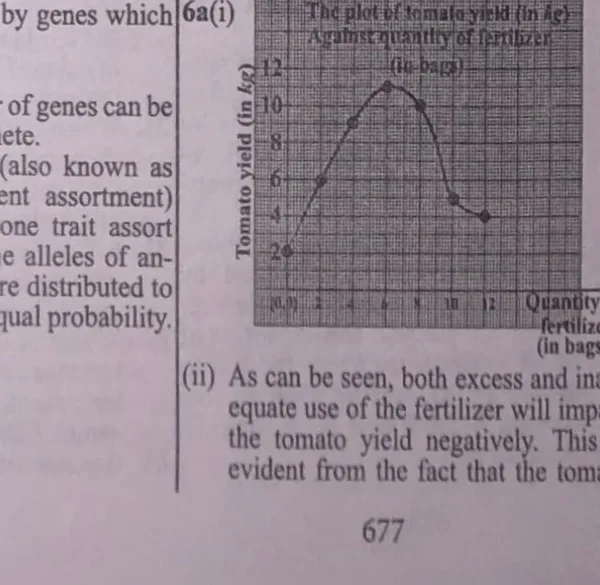
Quantity of fertilizer used (bags) | Tomato yield (kg)
0 | 2
2 | 6
4 | 9
6 | 11
8 | 10
10 | 5
12 | 4
(a)(i) On the graph sheet provided, plot a graph showing the relationship between fertilizer used and tomato yield. Use a scale of 2cm to 2 units on the x-axis and 2cm to 2 units on the y-axis.
(ii) Describe the relationship between the fertilizer used and tomato yield.
(iii) Suggest the most appropriate quantity of fertilizer to be applied on the tomato farm.
(b) State three effects of subsidy withdrawal on agricultural production.
(c) List four print media that could be used to disseminate information about a new variety of maize to farmers.
(d) Name two insect pests each of the following crops: (i) maize; (ii) orange.
Model answer
(a)(i) [See graph: quantity of fertilizer (bags) plotted on the x-axis against tomato yield (kg) on the y-axis, showing yield rising from 2kg at 0 bags to a peak of 11kg at 6 bags, then declining to 4kg at 12 bags.]
(ii) As the quantity of fertilizer increases, tomato yield initially increases; then after a point (6 bags), additional fertilizer results in a lower yield. This shows the law of diminishing returns — both insufficient and excessive fertilizer use negatively affect yield.
(iii) Since the optimum yield of tomato (11kg) is recorded when 6 bags of fertilizer are applied, the most appropriate quantity of fertilizer to apply on the tomato farm is 6 bags.
(b) Effects of subsidy withdrawal on agricultural production:
- Decrease in cost effectiveness (higher input costs)
- Increase in risks absorbed by farmers
- Decrease in agricultural productivity
(c) Print media for disseminating information about a new maize variety:
- Pamphlets
- Posters
- Newspapers
- Booklets/Magazines/Journals
(d)(i) Maize insect pests: Grasshopper, aphids, earworm, army worm
(ii) Orange insect pests: Fruit borer, white louse, citrus psyllid, mealybug
Advertisement
Sign up free to unlock
Score tracking
Practice history
Saved questions
Progress dashboard
Personalized sessions
Weak-topic breakdown
…and/or go further with premium services and No Ads.