WAEC Agricultural Science 2023 Objective Past Questions
All 50 questions from the West African Examinations Council (WAEC) Agricultural Science 2023 Objective paper, with the correct answer and a full explanation for each. Free, no signup needed.
A combing harvester is mainly used for harvesting A.
A. groundnut.
B. pepper.
C. rice.Correct
D. tomato.
Explanation
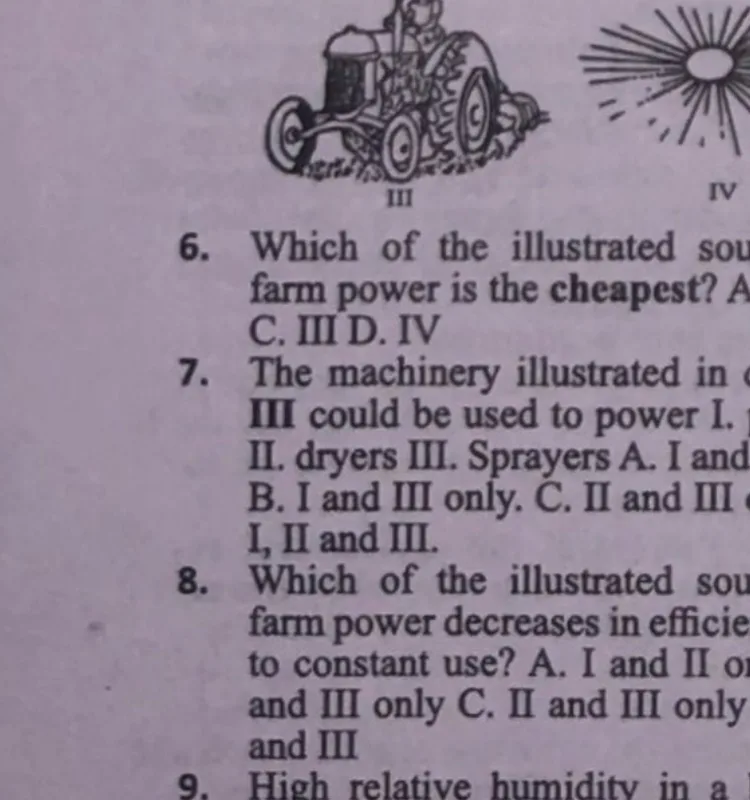
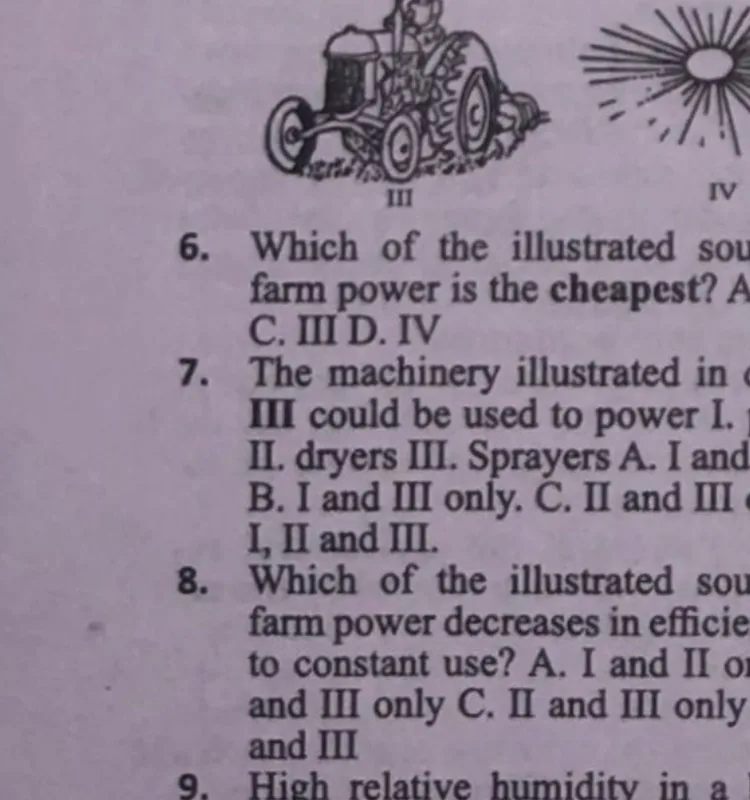
A combine harvester is used mainly for harvesting grain crops -- wheat, oats, rice, sorghum, millet, barley etc. (The diagrams below illustrate different sources of farm power. Study them and answer questions 6, 7 and 8.)
Which of the illustrated sources of farm power decreases in efficiency due to constant use?
A. I and II only
B. I and III only
C. II and III only
D. I, II and IIICorrect
Explanation
Due to wear and tear and lack of adequate maintenance, mechanical power can decrease in efficiency over time. Human power and the use of farm animals can also decrease in efficiency over time due to constant use, attributed to fatigue, injury, health issues and ageing.
Day-neutral crops are crops that produce flowers regardless of A.
A. extremely low temperature.
B. daylength being longer than the length of night.
C. extremely high temperature.
D. amount of sunlight received by flowering plants.Correct
Explanation
A day-neutral plant is a plant that produces flowers, regardless of the length of the period of light it is exposed to. Tomatoes, corn and cucumbers are good examples of day-neutral plants.
If 200 ml of water was poured on a soil sample in a beaker and 25% of the water drained through the soil, determine the amount of water retained in the soil.
A. 25 ml
B. 50 ml
C. 150 mlCorrect
D. 175 ml
Explanation
Total volume of water poured = 200ml. % drained = 25%. Volume of water drained = 25/100 x 200ml = 50ml. Volume of water retained = 200ml-50ml = 150ml.
A. increases the population of soil microorganisms.
B. encourages the regeneration of grasses.Correct
C. increases the organic matter of soil.
D. replenishes oxygen in the atmosphere.
Explanation
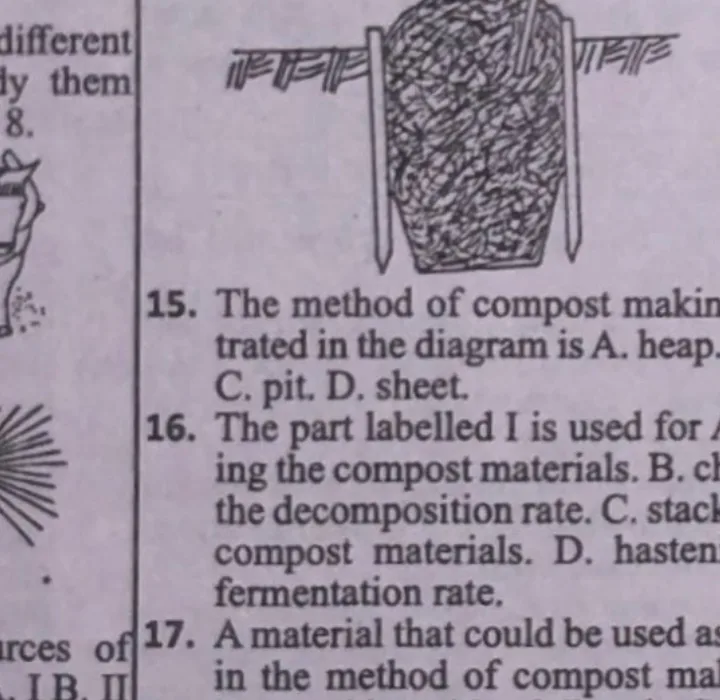
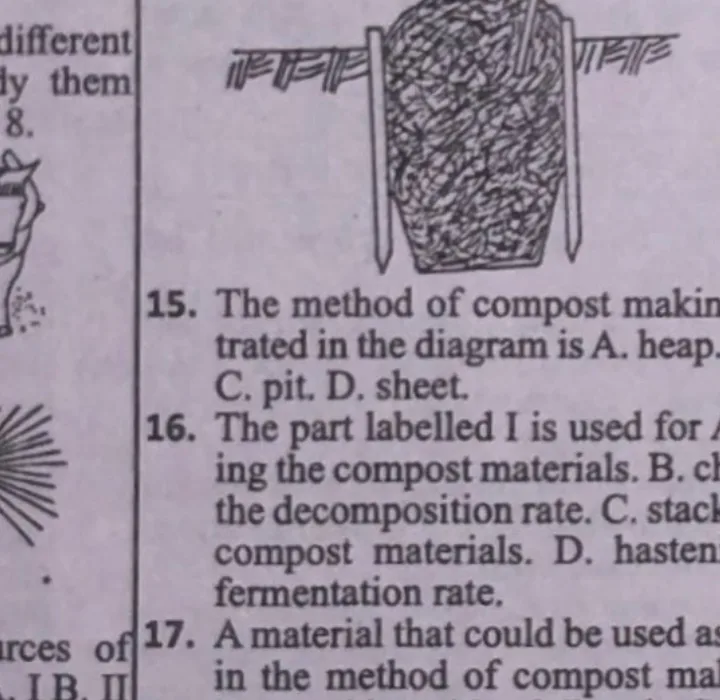
Bush burning has a tendency to encourage rapid regeneration of grasses. (The diagram below illustrates a method of compost making. Study it and answer questions 15, 16 and 17.)
If the seed rate for the cultivation of cowpea is 25 kg per hectare, determine the quantity of cowpea seeds required to cultivate a farmland measuring 100 m by 500 m.
A. 50 kg
B. 125 kgCorrect
C. 250 kg
D. 1,250 kg
Explanation
1 hectare = 10,000 sq.m. Size of farmland = 100m x 500m = 50,000 sq.m. Since 25kg is required per hectare, mass required for 50,000 sq.m = (25kg/10,000 sq.m) x 50,000 sq.m = 125 kg.
Cotton seeds often require a nursery stage before being transplanted into the field. The purpose of a nursery is to provide a controlled environment where the seeds can germinate and develop into healthy seedlings before being transferred to the main field for further growth.
A. Soya bean
B. Cotton seedCorrect
C. Yam
D. Rubber
Explanation
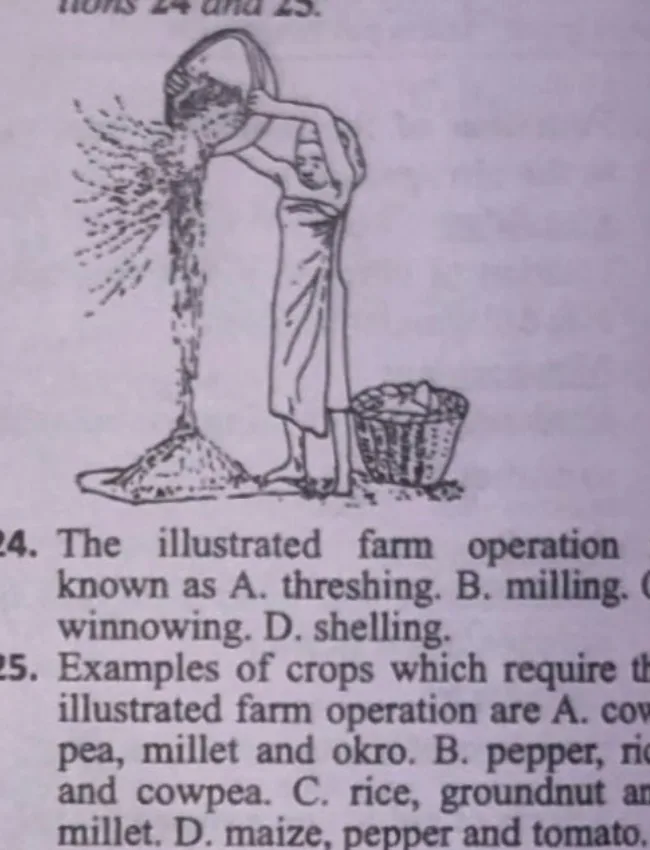
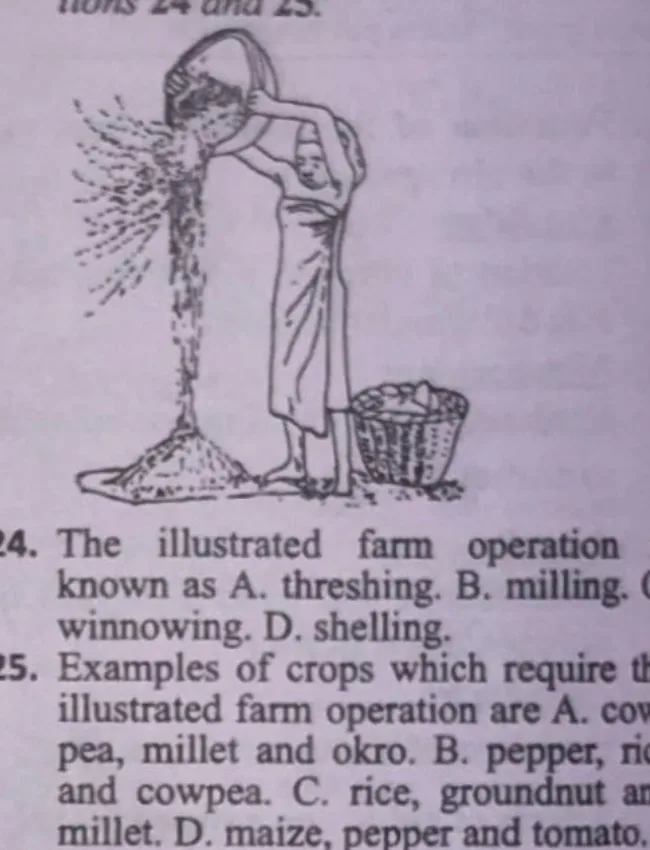
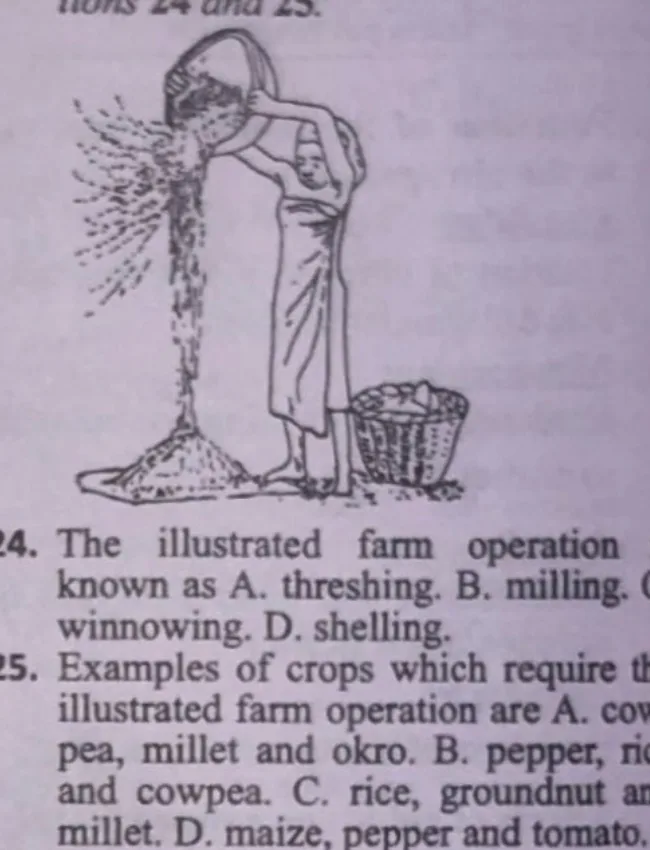
Cotton seeds require a nursery stage before being transplanted into the field. The purpose of a nursery is to provide a controlled environment where the seeds can germinate and develop into healthy seedlings before being transferred to the main field for further growth. (The diagram below illustrates a farm operation. Study it and answer questions 24 and 25.)
Winnowing is the process of separating the lighter chaff or husks from the heavier grains or seeds by allowing them to be carried away by the wind or through the use of air currents.
Centrosema pubescens is grown as a cover crop because it naturally suppresses weeds and is very resistant to drought. Mucuna is also a very good cover crop.
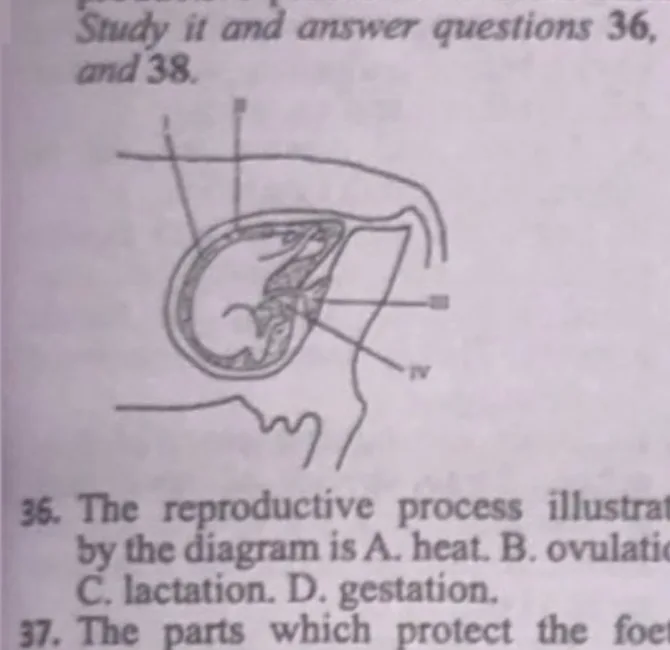
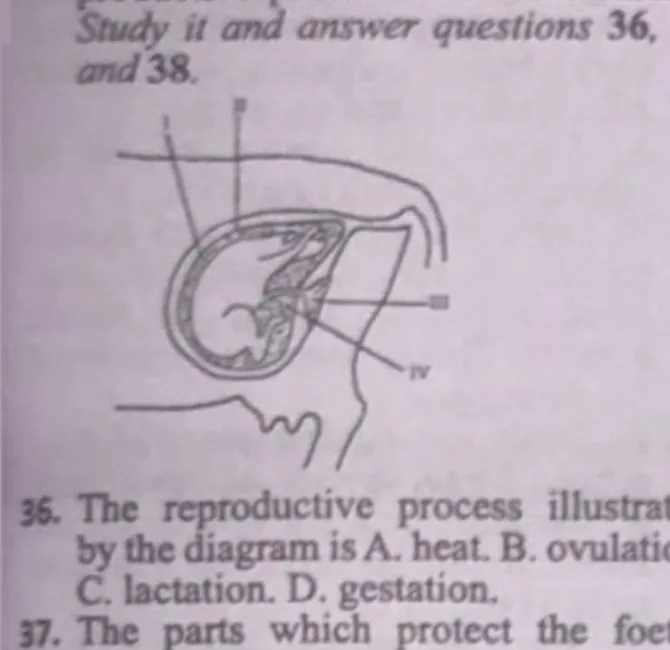
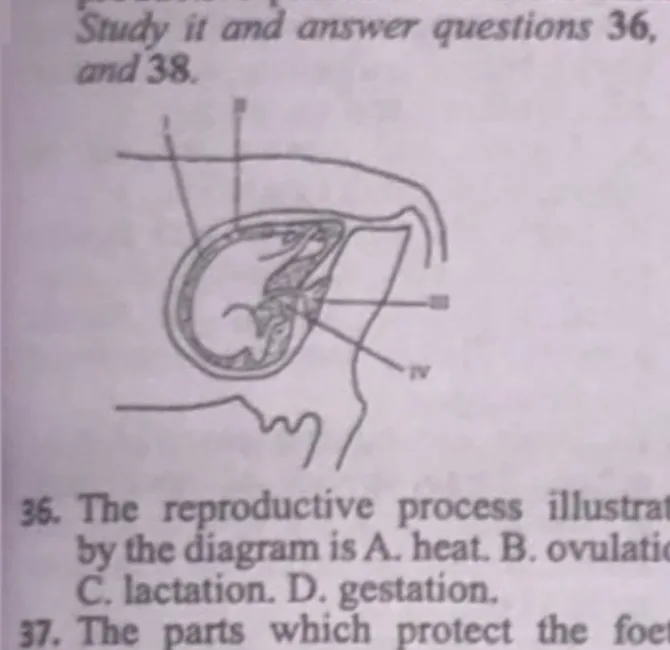
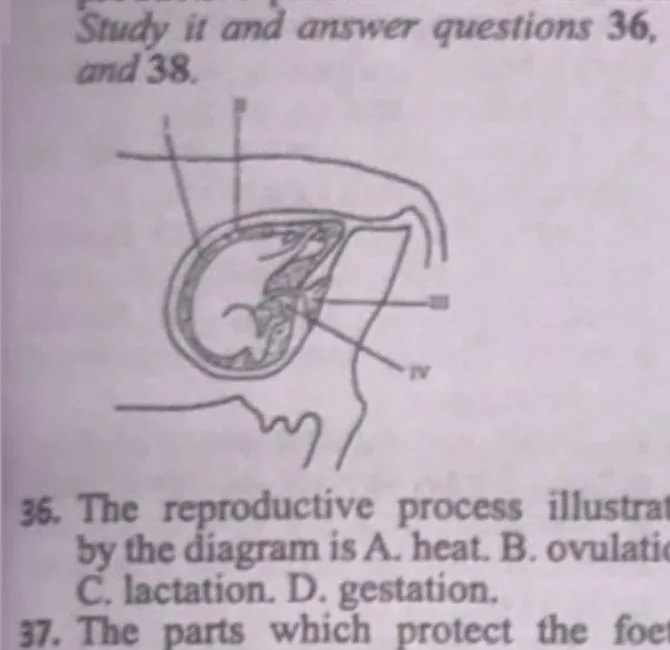
The udder of a cow has four quarters, with each quarter having a teat. (The diagram below illustrates a reproductive process in a farm animal. Study it and answer questions 36, 37 and 38.)
The foetus obtains dissolved oxygen and nutrients from the dam through the parts labelled A.
A. I and II.
B. I and III.
C. II and III.
D. II and IV.Correct
Explanation
The foetus obtains dissolved oxygen and nutrients from the dam (mother animal) through the placenta (labelled III) here. The umbilical cord (labelled IV) connects the placenta to the foetus.
Assuming a sow was serviced on May 1 and conceived the same day, the expected date of parturition is A.
A. June 2.
B. August 24.Correct
C. October 2.
D. September 30.
Explanation
The gestation period of a sow is 115 days. Thus, if a sow is serviced on May 1 and conceived the same day, the expected date of parturition is August 24.
In a poultry farm, 2,000 birds were laying an average of 1,680 eggs per day. What is the percentage of birds that did not lay eggs? A.
A. 16%Correct
B. 19%
C. 46%
D. 84%
Explanation
Generally, birds lay one egg per day. So, if 1,680 eggs are obtained per day and there are 2,000 birds, it means 1,680 birds are laying while the rest are not. Number of birds not laying = 2,000-1,680=320. % not laying = 320/2000 x100% = 16%.
If an egg tray contains 30 eggs, how many trays of eggs would be collected in one week?
A. 240
B. 286
C. 392Correct
D. 526
Explanation
Number of eggs collected per day = 1,680. In one week, we have 1,680x7=11,760. Since an egg tray contains 30 eggs, number of trays collected = 11,670/30 = 392 (per the worked key).
Steaming up refers to the practice of giving extra and highly nutritious diet to a pregnant animal for a few weeks before parturition to stimulate milk synthesis and secretion.
Which of the following farm enterprise could best be combined with fish farming for mutual benefits? I. Vegetable production II. Beekeeping III. Poultry production
A. I and II only
B. I and III onlyCorrect
C. II and III only
D. I, II and III
Explanation
Vegetable production and poultry production can efficiently be combined with fish farming for mutual benefits. This is known as integrated fish farming.
Birds are notable pests of honeybee. Some species of birds such as starlings, magpies and crows are known to raid beehives and steal honey and bees. (Study the table below and use it to answer questions 46 and 47: Cost Price #20,000, Useful life 5 Years, Salvage value #1,000, Annual Depreciation #15,000, Total Depreciation Y; Cost Price #60,000, Useful life 10 Years, Salvage value #18,000, Annual Depreciation #4,200/annum, Total Depreciation Z.)
Grading of farm produce is important because it A.
A. maintains produce quality.
B. prolongs storability.
C. facilitates transportation.
D. facilitates pricing.Correct
Explanation
Grading of farm produce is the process of categorizing and classifying agricultural products based on their quality. Grading provides a basis for price determination.