WAEC Agricultural Science 2025 Objective Past Questions
All 50 questions from the West African Examinations Council (WAEC) Agricultural Science 2025 Objective paper, with the correct answer and a full explanation for each. Free, no signup needed.
Under the Land Use Act, certificate of occupancy permits an individual to use a piece of land for
A. 20 years
B. 59 years
C. 99 yearsCorrect
D. 100 years
Explanation
A certificate of occupancy (C of O), as provided under Nigeria's Land Use Act, gives legal permission to occupy and use land, and the law sets a maximum term of 99 years for such occupancy right.
The seasonality of agricultural produce could be eliminated through
A. practicing irrigationCorrect
B. better extension services
C. employing cultural cultivation practices
D. exportation during scarce periods
Explanation
Irrigation enables farmers to provide water to crops year-round, overcoming the limitations of seasonal rainfall. This ensures steady crop growth regardless of the season.
Agricultural research is important in crop production because it
A. promotes the use of local varieties of crops
B. develops crops that have short maturity periodCorrect
C. develops crops that are susceptible to local diseases
D. produces crops with reduced resistance to pests
Explanation
One of the key outcomes of agricultural research is the development of crop varieties that mature faster. This leads to quicker harvests and allows for more than one cropping season, boosting food availability.
A hygrometer is used to measure relative humidity - the percentage of water vapour in the air compared to the maximum it can hold. Monitoring humidity helps in managing plant diseases and irrigation schedules.
The diagram below illustrates a brooding equipment in poultry production. A disadvantage of using the illustrated equipment for brooding is that
A. it is difficult to maintain
B. fumes emitted from it could suffocate chicksCorrect
C. it is expensive to install
D. technical know-how is required to operate it
Explanation
Using local lamps for brooding can be risky because they release smoke and toxic fumes. These emissions can suffocate or weaken young chicks, which are especially sensitive to air quality.
Other equipment that could perform similar functions as the illustrated equipment in a brooder house are I. hover II. coal pot III. gas lamp
A. I and II
B. I and III
C. II and III
D. I, II and IIICorrect
Explanation
All listed (hover, coal pot and gas lamp) can serve as heat sources in a brooder. Though they differ in cost, cleanliness and efficiency, they all meet the essential need for warmth in chick rearing.
The finger-like projections of the hand fork are known as
A. gangs
B. rings
C. rods
D. prongsCorrect
Explanation
The finger-like projections of a hand fork are known as prongs. These sharp, pointed parts are designed for breaking up soil, removing weeds and mixing compost effectively during farming.
Which of the following statements is not a reason for maintaining farm machines?
A. To reduce the salvage valueCorrect
B. To prolong the useful life
C. To prevent avoidable accidents
D. To keep in good working condition
Explanation
Maintenance is done to extend the lifespan of machines and ensure they function safely and preserve their value. Reducing salvage value is not correct - it is the opposite of what maintenance aims to achieve.
Groundwater which is available for plant root absorption is
A. precipitation water
B. gravitational water
C. capillary waterCorrect
D. hygroscopic water
Explanation
Capillary water resides in the small spaces between soil particles and is held loosely enough for plant roots to absorb it. It moves slowly through the soil and is the main source of moisture available to plants.
A student obtained the following results in a certain soil experiment: Mass of empty dish = 10g, Mass of dish + fresh soil = 70g, Mass of dish + dried soil = 55g. The mass of fresh soil is
A. 15g
B. 25g
C. 45g
D. 60gCorrect
Explanation
Mass of fresh soil = Mass of dish + fresh soil - Mass of empty dish = 70g - 10g = 60g.
In a soil profile, granular structure is usually found in
A. horizon ACorrect
B. horizon B
C. horizon C
D. horizon D
Explanation
The A horizon (topsoil) is the uppermost layer of soil and is typically rich in organic material and biological activity. This layer often forms a loose, crumbly granular structure - ideal for root penetration and water infiltration.
The diagram below illustrates a tool used in soil analysis. The illustrated tool is used for determining soil
A. capillarity
B. textureCorrect
C. structure
D. porosity
Explanation
The tool shown is a soil sieve, used to analyze soil texture by separating particles based on size (e.g. sand, silt, clay). It is a common tool in mechanical soil analysis for classifying the proportions of each particle type in a sample.
Assuming the diameter of the illustrated tool is 0.05mm, which of the following soil particles would pass through it? I. silt II. fine sand III. coarse sand
A. I and IICorrect
B. I and III
C. II and III
D. I, II and III
Explanation
If a soil sieve has a mesh diameter of 0.05mm, only particles equal to or smaller than this size can pass through. Silt and fine sand are small enough to pass, while coarse sand is too large and will be retained by the mesh.
A farmer observed purple colouration on cowpea leaves in the field. This deficiency symptom could be corrected by applying
A. calcium carbonate
B. ammonium sulphate
C. single superphosphateCorrect
D. muriate of potash
Explanation
A purple tinge on cowpea leaves is an indication of phosphorous deficiency. Single superphosphate is a fertilizer rich in phosphorous, and applying it can quickly correct the imbalance.
Which of the following statements correctly defines overhead irrigation?
A. It involves the use of little volume of water
B. It supplies water to crops on the surface of farmlandCorrect
C. It delivers water through underground pipes to crops
D. It delivers water directly to the roots of crops
Explanation
Overhead irrigation mimics natural rainfall by spraying water over crops through sprinklers positioned above the ground. It irrigates both the plant canopy and the soil surface, making it suitable for a wide range of crops and field layouts.
Organic farming minimizes agricultural pollution by avoiding harmful synthetic chemicals. It relies on natural methods (such as compost and crop rotation) to improve soil health and reduce runoff into nearby water bodies.
Using the diagram above, the moisture content of the illustrated crop should be reduced before harvesting in order to reduce contamination due to
A. nematodes
B. viruses
C. fungiCorrect
D. bacteria
Explanation
Maize with high moisture content creates ideal conditions for fungal growth. Prompt and proper drying after harvest is critical to minimize spoilage and preserve the quality of the crop.
Blackarm is a serious bacterial infection that affects cotton plants. It manifests as dark, sunken lesions on stems and branches, weakening the plant structure. Affected branches may snap under wind or weight, reducing yield and fibre quality.
During polishing, the outer bran and germ layers of rice grains are removed to produce white rice. While it improves appearance, this process strips the grain of key nutrients, making it less nutritious than unpolished/brown rice.
The budding of sweet orange scion on sour orange stock is to prevent
A. gummosisCorrect
B. canker
C. citrus scab
D. powdery mildew
Explanation
Gummosis is a disease in citrus trees characterized by gum oozing from bark wounds. It weakens the tree and invites secondary infections. Grafting sweet orange scions onto sour orange rootstock (which has natural resistance) improves plant resilience.
Plantation agriculture is commonly practiced in the production of I. fruits II. vegetables III. beverages
A. I and II
B. I and IIICorrect
C. II and III
D. I, II and III
Explanation
Plantation agriculture involves larger scale production of crops, usually for export. This method is capital-intensive and suited to cash crops like coffee, banana, rubber and oil palm.
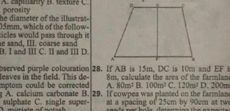
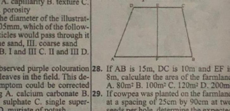
A farmland was surveyed and mapped as shown in the diagram below. If AB is 15m, DC is 10m and EF is 8m, calculate the area of the farmland
A. 80m²
B. 100m²Correct
C. 120m²
D. 200m²
Explanation
Since the farmland is shaped like a trapezium, area = 1/2(a+b) x h, where a = DC = 10m, b = AB = 15m, h = EF = 8m. Thus, area = 1/2(10+15) x 8 = 100m².
Using the diagram above, if cowpea was planted on the farmland at a spacing of 25cm by 90cm at two seeds per hole, determine the expected plant population of cowpea plants
A. 355 plants
B. 444 plants
C. 667 plants
D. 888 plantsCorrect
Explanation
Area = 100m². Spacing = 25cm x 90cm = 0.25m x 0.9m = 0.225m². Number of holes = 100m² / 0.225m² = 444.44 ≈ 444. Since there are two seeds per hole, number of plants = 444 x 2 = 888.
Seeds with physical dormancy have hard coats that block water and gas exchange. Heat treatment, such as dry oven heating or soaking in warm water, can soften or crack the seed coating, allowing germination to proceed under favourable conditions.
A nitrogen fixing forest tree that could be used in alley cropping is
A. Tectona grandis
B. Leucaena leucocephalaCorrect
C. Terminalia superba
D. Tertulia Africana
Explanation
Leucaena is a fast-growing leguminous tree that provides significant benefits to soil health. By fixing nitrogen, it enriches the soil and enhances fertility. It is commonly used in alley cropping systems where it is planted in rows with food crops, improving nutrient availability.
Which of the following diseases of crops could be controlled by the application of fungicides?
A. cassava mosaic
B. swollen shoot of cocoa
C. cotton leaf curl
D. sigatoka disease of bananaCorrect
Explanation
Sigatoka is a fungal disease that attacks banana plants. It is caused by the fungus Mycosphaerella spp and leads to the formation of lesions on banana leaves, which limits photosynthesis and weakens the plant. Fungicides can help manage it by limiting spore production.
Talinum triangulare (water leaf) disperses its seeds through explosive dehiscence. When the mature fruit capsules burst open, they scatter seeds over a wide area, ensuring the plant's propagation.
The White Fulani is a highly popular cattle breed in Nigeria, known for its dual-purpose use - providing both milk and meat. This breed is particularly valued for its high milk yield compared to other indigenous breeds.
Which of the following products is obtained from a living farm animal? I. Egg II. Chevon III. Milk
A. I and II
B. I and IIICorrect
C. II and III
D. I, II and III
Explanation
Eggs and milk are harvested from living animals (poultry and mammals respectively) without harm to the animal. Chevon, however, is meat from a goat and requires the goat to be slaughtered.
The rumen performs the following functions except I. temporary storage of feed II. fermentation of feed III. synthesis of vitamin A and D
A. I only
B. II only
C. III onlyCorrect
D. I and III
Explanation
The rumen plays a key role in fermenting fibrous feed and temporarily storing it. However, it is not involved in the production of vitamins A or D, which are primarily synthesized in the animal's body or provided by their diet.
Which of the following methods is not used in collecting semen from farm animals?
A. use of artificial vagina
B. massage
C. use of catheterCorrect
D. electro ejaculation
Explanation
A catheter is typically used for urinary functions or artificial insemination, not for semen collection. Common methods for semen collection include artificial vaginas, electro-ejaculation, or manual massage of accessory sex glands.
Heat stress causes physical discomfort in animals, leading to reduced feed intake and physiological strain. For dairy animals, this often results in a significant drop in milk yield.
If the recommended floor space for chickens is 0.36m² per adult chicken, determine the number of chickens that could be reared in a deep litter house measuring 9m by 20m
A. 65
B. 81
C. 180
D. 500Correct
Explanation
Total floor area = 9m x 20m = 180m². Number of chickens = floor area / floor space per chicken = 180m² / 0.36m² = 500.
A building with open sides is preferable in a poultry house because it
A. protects birds from strong winds
B. promotes adequate ventilationCorrect
C. keeps the birds warm
D. facilitates easy cleaning
Explanation
Open-sided poultry houses allow better air circulation, which helps reduce heat buildup and ammonia accumulation. Proper ventilation is key to maintaining the birds' well-being and productivity.
Which of the following poultry diseases could be treated with drugs containing sulphur? I. coccidiosis II. ringworm III. fowl pox
A. I and IICorrect
B. I and III
C. II and III
D. I, II and III
Explanation
Sulphur-based drugs are effective against coccidiosis (a protozoal infection) and ringworm (a fungal infection). However, they do not treat fowl pox, which is a viral disease.
The most important function of bees to humans is to
A. produce beeswax
B. provide raw materials for industry
C. act as agent of pollinationCorrect
D. be used for research purposes
Explanation
Bees are crucial for pollination. They transfer pollen grains from one flower to another. Even though bees also produce beeswax, their role in pollination has a far greater ecological and economic impact.
Cocoa is one of the primary cash crops grown in West Africa. Its export value supports the regional economy, providing livelihoods for millions of farmers and playing a major role in the global chocolate industry.
The farmer earned N500,000.00 from the sale of the rest of the trays of eggs after incurring a marketing cost of N30,000.00. The farmer's net profit is
A. N120,000.00Correct
B. N123,800.00
C. N150,000.00
D. N153,800.00
Explanation
Total cost = production cost + marketing cost = N350,000 + N30,000 = N380,000. Net profit = Revenue - total cost = N500,000 - N380,000 = N120,000.
Which of the following marketing functions could enable farmers fix better prices for their produce? I. advertisement II. processing III. grading
A. I and II
B. I and IIICorrect
C. II and III
D. I, II and III
Explanation
Advertisement plays a crucial role in increasing the visibility and demand for a farmer's products, which helps drive up prices. Grading involves sorting products based on quality, size or other attributes, allowing farmers to sell higher-quality items at better prices.
Advertisement
Sign up free to unlock
Score tracking
Practice history
Saved questions
Progress dashboard
Personalized sessions
Weak-topic breakdown
…and/or go further with premium services and No Ads.