Biology 2012 Objective — Question 1
The science of life is referred to as
- A. anatomy
- B. biologyCorrect
- C. ecology
- D. phylogeny
Explanation
Biology is the science of life.
All 60 questions from the West African Examinations Council (WAEC) Biology 2012 Objective paper, with the correct answer and a full explanation for each. Free, no signup needed.
Advertisement
The science of life is referred to as
Biology is the science of life.
The epidermis of a leaf is considered an example of a tissue because the cells
The epidermis of a leaf is considered an example of a tissue because the cells possess a similar structure and function.
The organism at the organ level of organisation of life is a
Ginger exists at the organ level of organization of life.
The disadvantage of complexity of organisation in the higher organisms is that it leads to
Complexity, which is noted in higher organisms, makes diffusion an inefficient means of transport, hence the slower rate of diffusion of oxygen to individual cells.
In which of the following multicellular organisms is interdependence of cells maintained?
Volvox, Eudorina and Pandorina are all colonial organisms. In Eudorina and Pandorina, the cells forming the colony are independent. In Volvox, each cell cannot live independently; the cells have become specialized — some for reproduction, others for photosynthesis and locomotion.
Which of the following processes occurs in the second phase of meiosis?
At the metaphase of the second meiotic division, nuclear membrane gets dissolved in the cytoplasm; chromosomes are attached to the spindle by their centromeres. The two chromatids of the chromosomes become more distinct, and two daughter cells are formed.
The muscle cell fluid of an athlete was tested immediately after a 100m race and was found to contain a high concentration of lactic acid. Explain what could have caused this.
The athlete's muscle must have carried out anaerobic respiration. In plants, the products of anaerobic respiration are alcohol and CO2, whereas in animals, the products are CO2 and lactic acid.
The graph below represents the growth pattern of an animal. Which of the following groups of animal shows this pattern of growth?
This is the pattern of growth of insects, which grow in a stepwise manner corresponding to periods of moulting.
The pulmonary circulation involves movement of the blood to and from the
Pulmonary circulation involves movement of blood between the heart and the lungs. The table below shows the blood composition of four individuals. Use the table to answer questions 10 and 11: Blood Composition | Plasma | Red blood cells | White blood cells | Platelets Individual I: Normal, Normal, High, Normal Individual II: Normal, Normal, Normal, Normal Individual III: Normal, Normal, Low, Normal Individual IV: Normal, Normal, Normal, Low
Which of the individuals is likely to be suffering from haemophilia?
Low level of platelets (thrombocytes) in the blood causes haemophilia. Individual IV shows low platelets.
Which of the individuals is likely to have HIV?
The blood of a person having HIV must be deficient of white blood cells — they are being continually destroyed. Individual III shows low white blood cells.
A student dissecting an animal specimen discovered that it has two auricles and one ventricle. The animal is likely to be a/an
Amphibians have a three-chambered heart — two auricles and one ventricle. (Fishes have a two-chambered heart — one auricle, one ventricle; reptiles have two auricles and a partially divided ventricle; birds and mammals have four-chambered hearts.)
The diagrams above are parts of a human lung. Which of the labeled parts is diagram Z taken from?
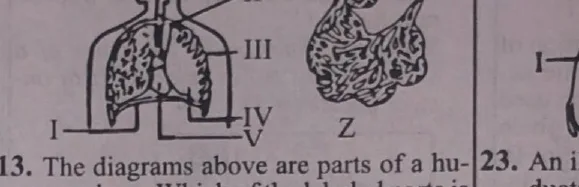
The structure given in the diagram is extracted from the left lung (labelled II in the source figure).
The diagram above is an illustration of the human excretory system. Which of the labeled parts contains the highest amount of nitrogenous wastes?
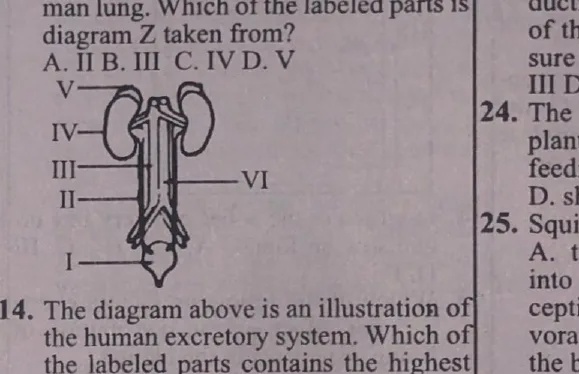
The part labeled 'I' is the urinary bladder. It stores urine (which contains huge amounts of nitrogenous wastes) before it is finally expelled via the urethra.
Increasing adrenaline content of the blood would be expected to decrease the flow of blood to the
Increasing adrenaline content increases the rate of heart contraction, which leads to increase in blood pressure. This means blood flowing back to the heart is limited as the amount of blood leaving the heart is increased.
The following are all examples of a simple reflex action, except
Sneezing, swallowing and blinking are reflex actions while walking is a voluntary action.
Impulses are conducted towards the nerve cell through the
Dendrons/Dendrites are branched projections of the neuron cytoplasm and are the receptive surface of a neuron. Dendrons conduct impulses towards the cell body while axons carry impulses away from the cell body.
The function of the convex lens in the correction of eye defects is to
The convex lens is used for correcting long sightedness (hypermetropia). It does this by converging light rays from far objects to focus their image on the retina.
Which of the following parts of the eye contains light sensitive cells?
The retina contains light-sensitive cells called rods and cones. Rods are sensitive to dim light; cones detect colour and are sensitive to bright light.
The hair on the human skin will stand erect when the person is
When cold, the hair on human skin stands erect to trap air around the skin and conserve body heat. An air-conditioned room is cold.
When fertilization occurs that leads to formation of a zygote, which of the following processes takes place?
During fertilization, the tail of the sperm disintegrates after entering the oocyte cytoplasm, and the nucleus of the sperm fuses with the ovum, forming the zygote.
Which of the following structures in a flower develops into the seed?
The ovule develops into a seed while the ovary develops into a fruit.
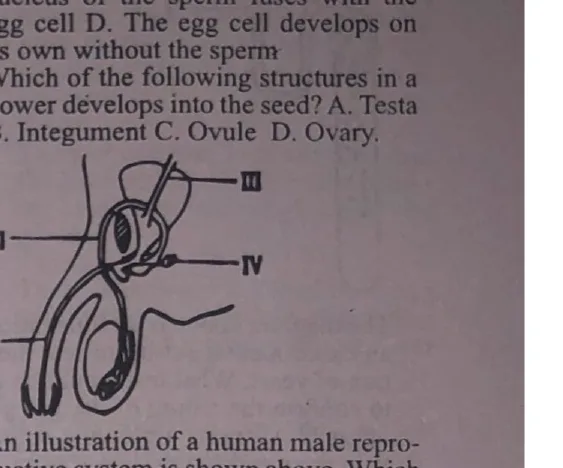
An illustration of a human male reproductive system is shown above. Which of the labelled parts can be cut to ensure permanent sterility?
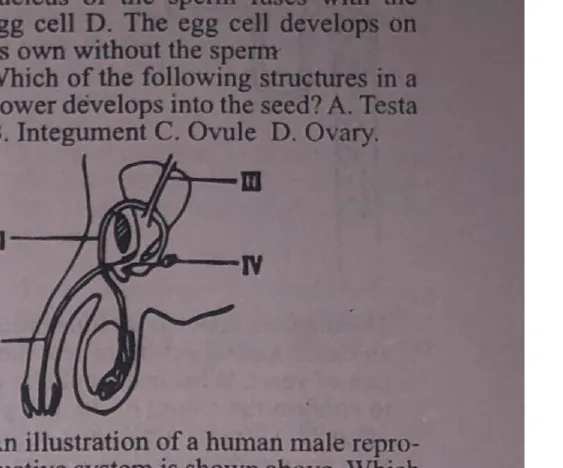
Sterilization of a man is done by cutting the sperm duct (vasectomy). The part labeled 'II' is the sperm duct.
The brightly coloured petals in some plants is an adaptive colouration for
It is to attract insects for pollination.
Squirrels easily kill some trees because
It is because the phloem may get destroyed as squirrels gnaw the bark of those trees.
The major role played by accessory pigments during photosynthesis is to
The major role played by accessory pigments during photosynthesis is to trap light energy that chlorophyll cannot absorb, e.g. carotenes.
The main raw materials required for photosynthesis are
The main raw materials required for photosynthesis are carbon dioxide and water.
What is the benefit of thunder and lightning to farmers?
Thunder and lightning cause nitrogen in air to combine with oxygen to form nitrogen oxide, which dissolves in rain water to form a nitrate solution added to the soil.
Which of the following substances must be present in the soil for growth of a healthy green plant?
A plant can only be green if it has sufficient chlorophyll. The elements required for chlorophyll formation include magnesium, iron and nitrogen.
The appropriate food to be given to the child in the picture above is a
Protein is a body-building food, needed by a child (e.g. one with a protein-deficiency condition).
Which of the following food substances will have little or no calorific value?
Water contains no calories.
The purpose of proteins in the diet of a mammal is to
The purpose of proteins in the diet of a mammal is to promote growth and repair worn out tissues, and to serve as body-building material.
The child in a given picture suffers from kwashiorkor, caused by deficiency of protein. The bones of the legs of a six-year old boy were observed to be weak and crooked. Which of the following elements were deficient in his mother's diet at pregnancy?
Calcium and phosphorus are essential for strong and healthy teeth and bones. A child with weak and crooked legs suggests these elements were deficient in the mother's diet during pregnancy.
Which of the following processes acts anaerobically to release alcohol and carbon (IV) oxide?
Yeast respires anaerobically to release alcohol and carbon (IV) oxide, a gas known to turn lime water milky.
Fats and oils are also known as lipids. Thus, the enzymes acting on fats and oils are collectively known as
Bile is known to emulsify fat. Fats and oils are lipids, and the enzymes acting on them are collectively known as lipase.
Of all the given food classes, water has the
Of all the given food classes, water has the least calorific value.
A space containing a group of interactive organisms is referred to as a
A space containing a group of interactive organisms is referred to as a community.
The area around the earth where all life activities go on is known as the
The area around the earth where life activities go on is known as the biosphere. Its liquid, solid and gaseous parts are respectively the hydrosphere, lithosphere and atmosphere.
The following are abiotic components of an ecosystem except
Biotic components of an ecosystem are the living components; bacteria, being living organisms, are biotic, not abiotic.
Which of the following instruments is used for measuring wind?
The anemometer is the instrument with which wind speed is measured. (Note: per the printed answer key the labelled correct option is D.)
Study the diagram below of a food web and use it to answer questions 41 and 42. The best title for the above diagram is
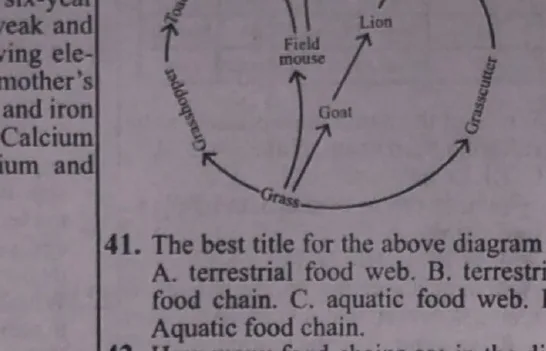
This is a food web since it contains many food chains, and all the organisms involved are terrestrial organisms. Thus, it is a terrestrial food web.
(Using the same diagram as Q41) How many food chains are in the diagram?
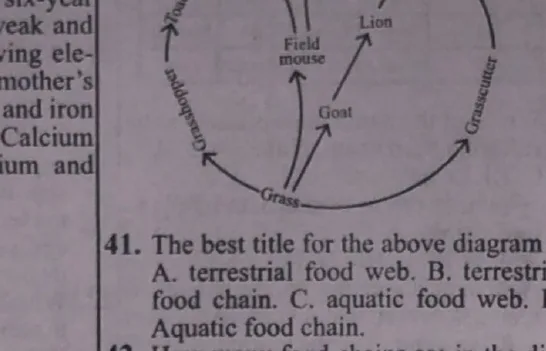
The food web contains a total of five food chains.
Plants with breathing roots are characteristic features of vegetation in
Plants with breathing roots (pneumatopores) are characteristic features of vegetation in salt water swamp.
Study the diagram below to answer questions 44 to 45. In which of the zones can very few or living organisms be found?
The zone receiving the least amount of light is where the fewest organisms are found, since light is a major factor governing the distribution of organisms in a marine habitat.
Which of the following factors exerts a major effect on the distribution of living organisms in the habitat?
Light is the major factor affecting the distribution of organisms found in a marine or aquatic habitat, as it decreases with depth.
The use of water closet and septic tanks is preferred to the use of pit, bucket and pail latrines because it is
The use of water closet and septic tanks ensure contaminated faeces are completely kept away from flies, reducing the incidence of cholera.
Which organism is the causative agent of cholera, contamination of drinking water by which unequivocally leads to a cholera outbreak?
Vibrio cholerae is the causative organism of cholera. A water sample containing vibrio cholerae has unequivocally been contaminated by faecal matter.
Which of the following factors is likely to increase the incidence of cholera?
Buildup of waste products, predation and parasitism are density-dependent factors while unfavourable climate is a density-independent factor — these buildups increase disease incidence including cholera.
Which of the following habitats does not favour continuous existence of a species?
Disappearing habitats due to human activity are regarded as a primary cause of species endangerment.
Which of the following traits are continuous variations in man?
Body weight, height, skin colour and eye colour are continuous variations, while tongue rolling, blood group and fingerprints are discontinuous.
Which of the following statements about the ABO blood group system is true?
Antigens are located on the surface of red blood cells while antibodies are located in the blood plasma.
The main classes of fingerprints in man are
The main classes of fingerprints in man are whorl, arch, compound and loop.
Which of the following diseases are transmissible through genes?
Sickle-cell anaemia is transmitted through genes while HIV/AIDS, diabetes and presbyopia are acquired conditions.
Two plants with red flowers were test crossed. Which of the following results indicate that the plants are heterozygous for red flowers?
If the two plants are homozygous red, all offspring will also be red. Since the two are heterozygous for red flower colour, the ratio of red flower to white flower will be 3:1 (75% red; 25% white).
In the structure of DNA, which of the following statements is true?
Guanine and cytosine are complementary bases; thymine and adenosine are complementary bases.
In a case of complete dominance, what is the phenotype ratio of the cross Bb (where B=black and b=white) x Bb?
Bb x Bb will be black since black colour is dominant over white colour. 3 out of every 4 will be black while the remaining one will be white.
Two yellow-flowered hybrid plants each carrying a recessive factor for flowers with green colour were crossed. Which of the following ratios shows the correct proportion of offspring that have green flowers?
The correct proportion of offspring with the recessive (green) phenotype in a heterozygote x heterozygote cross is 1 in 4.
What name is given to a sudden change in a gene or chromosome?
Mutation is the name given to a sudden change in the genetic constituent of an organism.
Bees are of great importance to the farmer because they
Bees are of great importance to farmers because they are good pollinators.
Which of the following sequences is the correct evolutionary trend?
The correct sequence of the organisms according to their evolutionary advancement is: Algae → liverworts → mosses → ferns.
Advertisement
…and/or go further with premium services and No Ads.