All 60 questions from the West African Examinations Council (WAEC) Biology 2013 Objective paper, with the correct answer and a full explanation for each. Free, no signup needed.
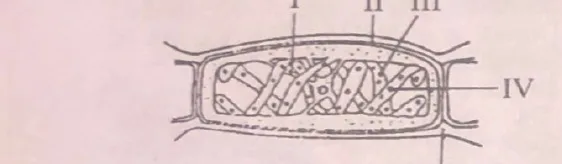
Use the diagram below to answer questions 2 and 3.
The diagram represents a
A. cellCorrect
B. filament
C. colony
D. part of a living organism
Explanation
The diagram shown is the diagram of Spirogyra. Spirogyra is an unbranched filamentous alga; the single cell shown, with its labelled parts, represents a cell.
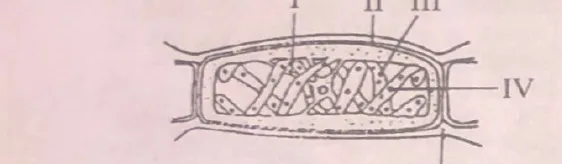
(Using the same diagram as Q2) Pyrenoid is present in the structure labelled
A. IV
B. IIICorrect
C. II
D. I
Explanation
Pyrenoids are structures adapted for storing starch in algae. They are located within the chloroplasts. The part labelled 'IV' is the pyrenoid while the part labelled 'III' is the chloroplast on which the pyrenoid is borne.
Which of the following pairs of structures in living organisms do not perform similar functions?
A. Lungs and spiracles
B. Root hairs and mammalian hairsCorrect
C. Feathers and scales
D. Contractile vacuole and kidneys
Explanation
Root hairs and mammalian hairs do not perform similar functions. Root hairs are for absorption of water from the soil, while mammalian hairs aid in temperature conservation.
The opening of the guard cells of the epidermis in plants is by the process of
A. osmosisCorrect
B. diffusion
C. active transport
D. transpiration
Explanation
The opening and closing of the stomata is osmotically guarded: water flows into a guard cell by osmosis (due to its relatively high osmotic potential), it becomes turgid, and the stoma opens.
What happens to a plant if the shoot tip is cut off and replaced by an agar block containing auxin?
A. It will stop growing
B. It will grow rapidly
C. It will continue to grow normallyCorrect
D. It will die completely
Explanation
Auxin, a plant growth substance, is produced at the apices. Growth is expected to be affected when the shoot tip is cut off; however, replacing the tip with an agar block containing auxin will arrest the situation, and the plant will continue to grow normally.
Anaerobic respiration results in the production of
A. more energy than aerobic respiration
B. no energy
C. an equal amount of energy to aerobic respiration
D. less energy than aerobic respirationCorrect
Explanation
Anaerobic respiration produces less energy than aerobic respiration. The former produces 2 ATPs per molecule of glucose while the latter produces a whopping amount of 36 ATPs.
Which of the following organs are used for gaseous exchange in a mature toad?
A. Gills, lungs and eardrum
B. Lungs, mouth and eardrum
C. Mouth, skin and epithelial cells
D. Skin, lungs and mouthCorrect
Explanation
The structures used for gaseous exchange in a mature toad are the skin, lungs and mouth. Gas exchange through the skin is cutaneous respiration, through the lungs is pulmonary respiration, and through the mouth is buccal respiration.
Which of the following statements about the diaphragm of a mammal is not correct?
A. It separates the thorax and the abdomen
B. It is a thick layer of muscle
C. It is made of epithelial cellsCorrect
D. It is part of the human respiratory apparatus
Explanation
The diaphragm separates the thoracic and abdominal cavity, is part of the respiratory apparatus, and is a thick layer of muscle — not made of epithelial cells, so C is the incorrect statement.
Which of the following conditions would result in a decrease in the production of antidiuretic hormone?
A. Abnormally high blood sugar level
B. Drinking large quantities of waterCorrect
C. Increase in osmotic pressure of blood
D. period of strenuous exercise
Explanation
Drinking large quantities of water results in a decrease in anti-diuretic hormone (ADH) secretion, i.e. more water, less ADH — the higher the ADH secretion, the higher the blood pressure.
Which of the following structures is not essential in a wind pollinated flower?
A. Anther
B. Ovary
C. Stigma
D. PetalCorrect
Explanation
The petal, an attractive part of a flower, is necessary/essential for an insect-pollinated flower only. A wind-pollinated flower does not need to be conspicuous.
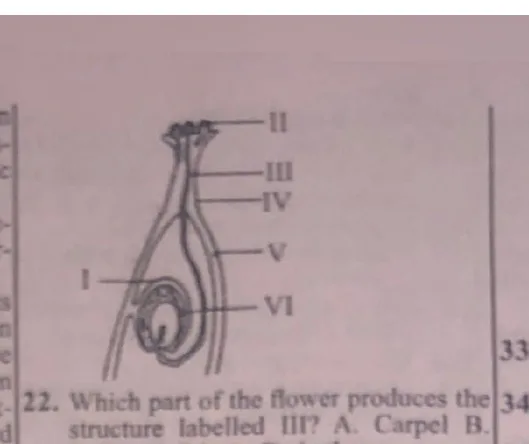
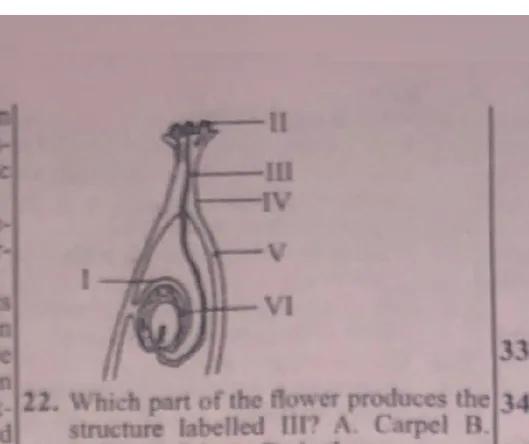
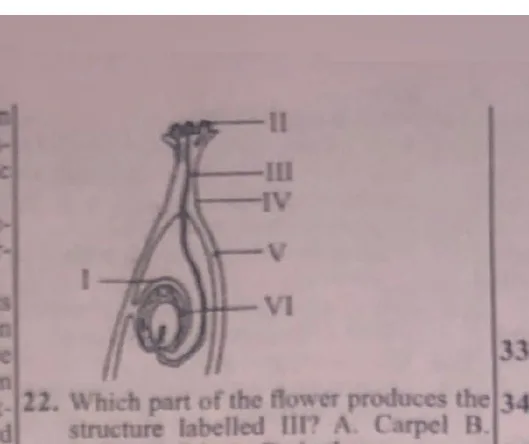
Study the diagram below and use it to answer questions 22 to 24.
Which part of the flower produces the structure labelled III?
A. Carpel
B. Pollen
C. Stigma
D. AntherCorrect
Explanation
The part labelled 'III' is the pollen tube. Note that pollen grains are produced at the anther of a flower; the ovum (the female reproductive cell) is produced at the stigma.
Which of the following factors is likely to increase the rate of transpiration in plants?
A. A reduction in the number of stomata per unit surface area
B. Increase in humidity around the leaves of plants
C. An increase in leaf surface area to volume ratioCorrect
D. Removal of leaves from plant
Explanation
The larger the surface area of a leaf, the higher the rate of transpiration — so an increase in leaf surface area to volume ratio increases transpiration.
The name of the enzyme that catalyses the conversion of glucose to glucose-6-phosphate at the beginning of glycolysis is a
A. phospho-fructokinase
B. glucose isomerase
C. hexokinaseCorrect
D. glucose-6-kinase
Explanation
Phosphorylation of glucose is the first step in glycolysis. Here, glucose is converted to glucose-6-phosphate (by hexokinase). This is converted in two steps to fructose 1,6-diphosphate, and the latter splits into two 3-carbon segments, which are converted through five successive steps into molecules of pyruvic acid.
The correct arrangement of food classes of the same quantity in the order of magnitude of energy value in animals in descending order is
A. Carbohydrates, fats and oils, water, protein
B. Fats and oils, carbohydrates, protein, waterCorrect
C. Water, facts and oils, carbohydrates, protein
D. Protein, fats and oils, water and carbohydrates
Explanation
The energy value of fats and oils is higher than that of carbohydrate. For instance, 1g of carbohydrate has an energy value of 16.7 kJ whereas 1g of fat has a whopping 37.6 kJ.
Which of the following substances is not a complex carbohydrate?
A. Glycogen
B. Cellulose
C. Starch
D. GlucoseCorrect
Explanation
Complex carbohydrates are the polysaccharides. They include glycogen, cellulose, starch and inulin. Glucose is a monosaccharide and such is not a complex carbohydrate.
Which of the following associations is an example of epiphytism?
A. Lice in the human hair
B. Mistletoe on citrus fruit
C. Egret on cow
D. Fern on palm treeCorrect
Explanation
An epiphyte is a plant which dwells on another plant without causing any apparent harm to the host plant. Fern on a palm tree is an example of epiphytism.
A pyramid of numbers involves living organism, not non-living things. The pyramid of numbers represents the number of individuals at each trophic level of a food chain at a particular time.
Rhizobium which lives in the root nodules of leguminous plants is an example of the association known as
A. commensalism
B. epiphytism
C. mutualismCorrect
D. saprophytism
Explanation
Rhizobium and root nodules of leguminous plants show mutualistic association. The organism helps the plant in nitrogen fixation while the plant, in return, provides food and shelter for the organism.
In genetics, linkages refer to the linking of genes of the
A. same chromosomes
B. different chromosomesCorrect
C. same nucleus
D. different nuclei
Explanation
Linkage or genetic linkage describes the way in which two genes that are close together on the same chromosome are inherited during meiosis. (Note: per the printed answer key the labelled correct option is B.)
A gene that is only located on the X-chromosome is said to be
A. expressed in females only
B. defective
C. sex-linkedCorrect
D. expressed in males only
Explanation
A gene that is located on the X-chromosome is said to be sex-linked. Examples of characters that are controlled by sex-linked genes are baldness, haemophilia and colour blindness.
A man who suffers from haemophilia marries a woman who is a carrier, what percentage of their children are likely to be haemophilic?
A. 25%
B. 50%Correct
C. 75%
D. 100%
Explanation
As explained in the related genetics question on incompatibility of Rhesus factor between an intending couple leading to still-births, using the cross for haemophilia carriers, 50% of the children are expected to be affected (note that females will only suffer from the disease when both X-chromosomes are affected).
Which of the following traits may be considered in marriage counselling?
A. Height
B. Fingerprints
C. Rhesus factorCorrect
D. Colour of skin
Explanation
As explained on the Rh-incompatibility question, incompatibility of Rhesus factor between intending couples may lead to still-births, so this is considered in marriage counselling.
Darwin noticed that organisms in similar habitats across the world looked alike. This illustrates
A. convergent evolutionCorrect
B. adaptive radiation
C. co-evolution
D. descent with modification
Explanation
Convergent evolution: a single ancestor gives rise to many species that come to resemble each other due to similar habitats/adaptive pressures, though this general statement is more typically associated with convergence of unrelated organisms adapting similarly to similar environments.
Advertisement
Sign up free to unlock
Score tracking
Practice history
Saved questions
Progress dashboard
Personalized sessions
Weak-topic breakdown
…and/or go further with premium services and No Ads.