Biology 2015 Objective — Question 1
Which of the following organisms is not a protozoan?
- A. Amoeba
- B. AscarisCorrect
- C. Plasmodium
- D. Paramecium
Explanation
Amoeba, Plasmodium and Paramecium are protozoans, while Ascaris is a worm (nematode).
All 50 questions from the West African Examinations Council (WAEC) Biology 2015 Objective paper, with the correct answer and a full explanation for each. Free, no signup needed.
Advertisement
Which of the following organisms is not a protozoan?
Amoeba, Plasmodium and Paramecium are protozoans, while Ascaris is a worm (nematode).
The structure of the cell membrane is a
The cell membrane is made up of proteins and lipids held together by non-covalent interactions - the protein part is sandwiched between two lipid layers, i.e. a middle bi-layer of protein with a lipid layer on either surface.
Which of the following cells is a specialized cell?
The guard cell is a specialized cell which controls the opening and closing of stomata.
The following organisms have structures for movement except
Amoeba, Volvox and Paramecium are motile (have structures for movement), while Spirogyra is non-motile.
Which of the following statements about protoplasm of a cell is not correct? It
Protoplasm is the entire living part of the cell, not merely the liquid part of the nucleus.
When a spirogyra filament is placed in a concentrated salt solution for 30 minutes, the cell would become
Since the salt solution is hypertonic to the cell content of Spirogyra, the organism loses water to the solution by osmosis and eventually becomes plasmolysed.
The diagram below is an illustration of a crocodile. Use it to answer questions 7 and 8. Which of the labelled parts enable the animal to stay underwater most of the time?
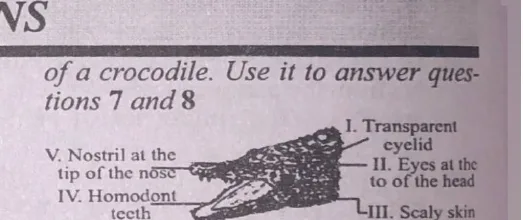
The possession of a transparent eyelid (I), eyes located at the top of the head (II), and a nostril at the tip of the nose (V) adapts the crocodile to staying underwater for long periods.
Two characteristic features of the class to which the crocodile belongs are labelled
The possession of scaly skin (III) and homodont teeth (IV) qualifies the crocodile as a reptile.
Water and salts are both lost from the human body in
Water and salts are both lost from the human body in urine and sweat; note that water (but not salts) is also lost through breathing (exhalation) as water vapour.
Which of the following features could be used to determine the growth of a seedling?
The growth of a seedling can be evaluated by measuring the length of its radicle (or plumule).
The following diagram shows the sequence of events in early cell division. Study the diagram and answer question 11. In which of the following cells is the division likely to take place?
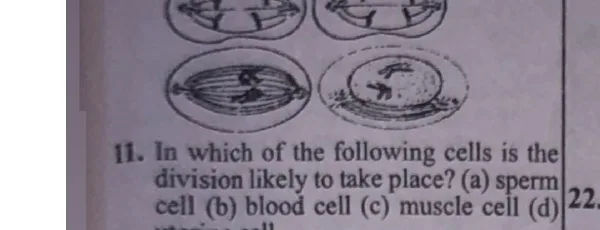
The diagram represents meiosis, which occurs only in reproductive cells, such as the sperm cell (used to produce sperms/eggs).
A plant that commonly undergoes vegetative propagation by means of leaves is
Bryophyllum is a plant that commonly undergoes vegetative propagation by means of its leaves.
The diagram below illustrates a part of the mammalian skeleton. Use it to answer questions 13 and 14. The part of the mammalian skeleton illustrated in the diagram is the
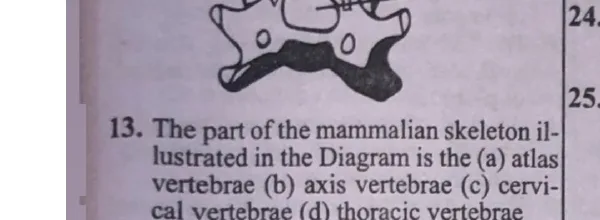
This is the diagram of a typical cervical vertebra.
The function of the part I is to
The part labelled 'I' is the neural canal, which is for the passage of (i.e. supports/protects) the spinal cord.
Blood pressure is higher in the arteries as a result of
The contraction and relaxation of the heart (and arterial walls) are responsible for the higher blood pressure found in the arteries.
A farmer who wants to keep seeds for three years before planting and wants to prevent them from sprouting out uses
Abscisin (abscisic acid) promotes/induces seed dormancy, suppressing sprouting/germination until the farmer is ready to plant.
A person had an accident that affected the skull but not the nose and later lost the sense of smell. The accident must have affected the
The olfactory lobes of the brain are the part connected with the perception of smell; damage to them (rather than the nose itself) would cause loss of smell.
Ability of the human eye to focus images accurately on the retina is called
The ability of the human eye to focus images accurately on the retina is called accommodation.
Which of the following characteristic features is not associated with monocotyledonous plants?
Monocots typically have an undifferentiated perianth (not clearly differentiated sepals and petals), unlike dicots; they do have a fibrous root system, narrow (parallel-veined) leaves, and floral parts in multiples of three.
The main difference between a seed and a fruit is that a fruit
A fruit bears remains of the style/stalk, giving it two scars, while a seed has only one scar (the hilum), formed by the attachment of the funicle to the placenta.
Which of the following processes removes carbon (IV) oxide from the atmosphere?
Burning of fuels, putrefaction and respiration all release CO₂ into the atmosphere; photosynthesis, on the other hand, removes CO₂ from the atmosphere.
A student used the following steps in testing for non-reducing sugar: (i) added Benedict's solution to the sugar solution (ii) added dilute hydrochloric acid to the sugar solution and boiled it (iii) added sodium hydroxide solution to the solution in II and boiled it (iv) added Benedict's solution to the cooled solution in III. Why did the student add dilute hydrochloric acid to the sugar solution in step II?
Dilute hydrochloric acid is added and boiled to hydrolyse the (non-reducing) sugar solution, breaking it down into reducing sugars.
What is the importance of step II [addition of sodium hydroxide] in the testing process?
Sodium hydroxide is added to neutralize the acid that was added earlier (in the hydrolysis step).
The colour change to be observed in step IV is
After the hydrolysis and neutralization, Benedict's test on the resulting reducing sugar gives a colour change to brick-red.
Which of the following organs of the alimentary canal is not correctly matched with its function?
The appendix does not produce any enzyme; it is believed to have no active digestive function in humans.
A person suffering from obstruction of the bile duct is advised not to eat fats and oil because
Emulsification of fats and oils cannot be done without bile; without bile (due to the obstruction), fats and oils cannot be properly broken down/absorbed.
A community reaches a climax when
A community is said to reach a climax when its composition and size remain fairly constant over a long period of time.
Which of the following components make up an ecosystem?
An ecosystem comprises the living component (biotic) and the non-living component (abiotic).
The major problem experienced by organisms living in small water bodies is
The major problem experienced by organisms living in small water bodies is desiccation (drying up).
The capillarity of a soil refers to
The capillarity of a soil refers to how well water rises up through the soil.
An organism at the start of a food chain which provides the total input of energy into an ecosystem is the
The organism at the start of a food chain is the producer (green plant), which captures energy (originally from the sun) and introduces it into the ecosystem.
Study the diagram (a pitcher plant) below and use it to answer questions 32-34. The mode of nutrition of the plant in the diagram is
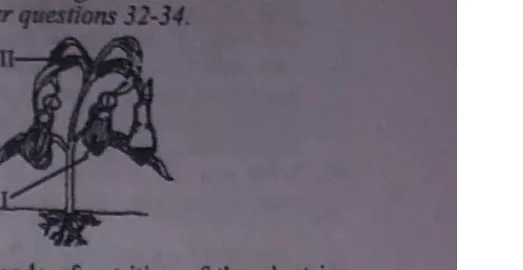
This is a pitcher plant - a carnivorous plant that is still capable of photosynthesis; it is therefore simultaneously photosynthetic and carnivorous.
The structure labelled I is a
The part labelled 'I' is known as the pitcher, the actual device with which the plant traps insects.
In which type of soil is the plant found? Soil that is
Carnivorous (pitcher) plants are typically found in nitrogen-deficient soils, and trap insects to obtain the nitrogen they need.
Which of the following organisms is an endo-parasite?
Tapeworm is an endo-parasite (lives inside its host), while flea, tick and aphid are ecto-parasites (live on the outside of their hosts).
Oil applied to the surface of water kills the larvae of mosquitoes through
The oil layer prevents air from entering the water, so the mosquito larvae, which need to breathe atmospheric air, die of suffocation.
Which of the following natural resources is most readily available to all organisms?
Air is the natural resource most readily available to all organisms.
Which of the following resources is non-renewable?
Mineral deposits are non-renewable resources, unlike forest reserves, water and wildlife, which can regenerate/replenish over time.
Soil erosion could be prevented by
Cover-cropping is an effective way of preventing soil erosion, as plant cover protects the soil surface from being washed or blown away.
Which of the following statements about human blood groups is not true?
Neither A nor B is dominant over the other (they are co-dominant); this is why blood group AB exists. O is recessive (OA=A, OB=B).
Which of the following traits is not inheritable?
The ability to taste phenylthiocarbamide (PTC) is not an inheritable trait.
A woman with blood group A gives birth to a child with blood group O. Which of the following blood groups cannot belong to the father?
The father cannot be AB, since a cross involving AB can never yield an offspring with blood group O (AB always contributes either A or B, never O).
How many chromosomes will be in a gamete if the normal (somatic) cell has 4 chromosomes?
A gamete cell has half the number of chromosomes present in a normal (somatic) cell; if a normal cell has 4 chromosomes, a gamete will have 2 chromosomes.
Use the diagram below (cross between a spotted leopard and a black panther, giving F₁ and F₂) to answer questions 44 and 45. Which of the following statements about the cross is correct?
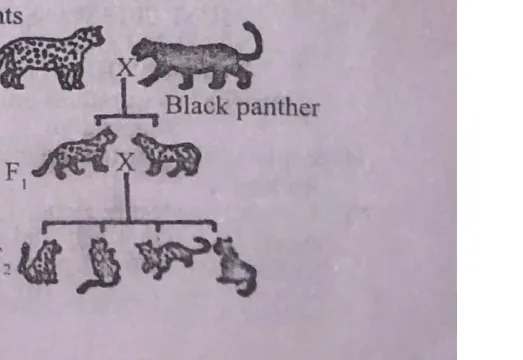
The gene for the spotted coat is dominant over the gene for the black coat, which is why the F₁ generation is made up entirely of the spotted coat pattern.
What are the genotypes of the parents if the gene for skin colour is H?
The genotype of the spot-coated leopard (dominant, homozygous) is HH, while that of the black-coated panther (recessive, homozygous) is hh.
According to Mendel's first law of inheritance, segregation of genes occur when
Mendel derived his first law of inheritance (the Law of Segregation) from crosses between tall pea plants and short pea plants.
Which of the following statements about sex-linked characters is not true?
Males are either free from a particular sex-linked character or they suffer from it directly; since males have only one X-chromosome, they cannot be carriers (a carrier state requires two X-chromosomes, one normal and one affected).
In explaining the term camouflage to a class, the diagram below showing four varieties, P, Q, R and S, of the same species of fish living amongst water plants in a river were used. Use the diagram to answer questions 48 to 50. Which of the varieties is likely to decrease most in number if a predatory fish is introduced into the river?
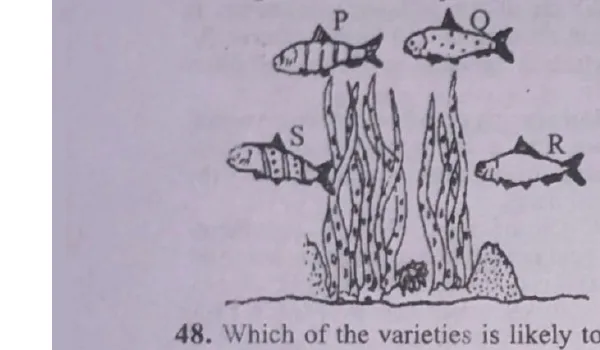
The fish variety R is susceptible to the greatest predation since it does not blend with its environment, making it easy for predators to locate.
Which of the varieties is most likely to outlive the others?
Fish variety S blends the most with its environment, making it the most likely to outlive the others, as predators would find it difficult to locate.
The variety selected in question 49 will outlive the others because the
As already explained, variety S will outlive the others because its markings are similar to those of the environment (effective camouflage).
Advertisement
…and/or go further with premium services and No Ads.