Free account: track your progress — Sign up free

WAEC Biology 2016 Objective Past Questions

All 50 questions from the West African Examinations Council (WAEC) Biology 2016 Objective paper, with the correct answer and a full explanation for each. Free, no signup needed.

Advertisement

Biology 2016 Objective — Question 1

1. An example of an organism that exists as a colony is A. spirogyra B. paramecium C. euglena D. Volvox

  • A. spirogyra
  • B. paramecium
  • C. euglena
  • D. VolvoxCorrect

Explanation

Some organisms are made of similar cells which are joined together and cannot be differentiated from each other. This is known as a colony. Volvox and Pandorina are good examples of colonial organisms.

Biology 2016 Objective — Question 2

2. Gymnosperms bear naked seeds because they lack A. ovary B. colourful flowers C. pollen grains D. stigma

  • A. ovaryCorrect
  • B. colourful flowers
  • C. pollen grains
  • D. stigma

Explanation

Gymnosperms do not bear enclosed seeds. Their seeds are borne on special structures known as cones (they lack an ovary).

Biology 2016 Objective — Question 3

3. DNA formation is associated with A. Golgi bodies B. lysosomes C. mitochondria D. nucleus

  • A. Golgi bodies
  • B. lysosomes
  • C. mitochondria
  • D. nucleusCorrect

Explanation

Within the nucleus is a small spherical body called nucleolus and chromatin materials which condense during cell division into chromosomes. The chromosomes are made up of DNA.

Biology 2016 Objective — Question 4

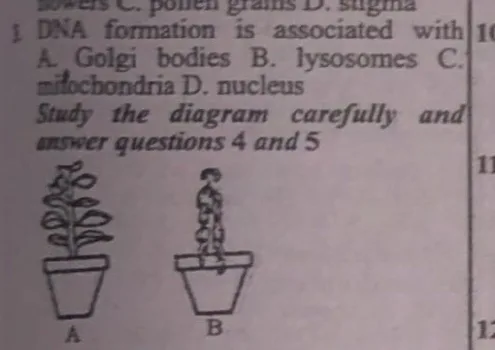
4. Study the diagram carefully (plants A and B) and answer questions 4 and 5. The term that can be used to describe what happened to plant A after seven hours is A. wilting B. competition C. transpiration D. osmosis

Diagram for question 4
  • A. wiltingCorrect
  • B. competition
  • C. transpiration
  • D. osmosis

Explanation

This is known as wilting. A plant undergoes wilting (becomes flaccid) when it has lost a great amount of water.

Biology 2016 Objective — Question 5

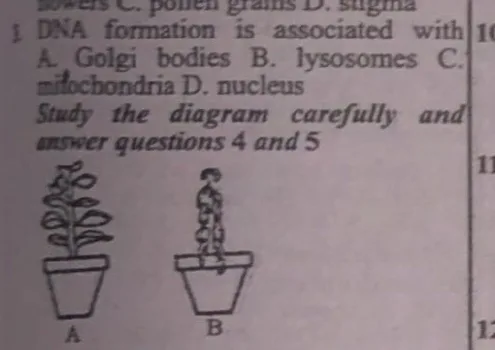
5. The environmental factors responsible for the condition in plant B are A. low humidity and low temperature B. high humidity and low temperature C. low humidity and high temperature D. high humidity and high temperature

Diagram for question 5
  • A. low humidity and low temperature
  • B. high humidity and low temperature
  • C. low humidity and high temperatureCorrect
  • D. high humidity and high temperature

Explanation

Wilting may occur if there is little amount of water vapour in the air (low humidity) and when the temperature is high.

Biology 2016 Objective — Question 6

6. Hydra is considered to be at a tissue level of organization of life because it A. has numerous cells that perform different functions B. has developed organs and systems C. has poorly developed nervous system D. reproduces by budding

  • A. has numerous cells that perform different functionsCorrect
  • B. has developed organs and systems
  • C. has poorly developed nervous system
  • D. reproduces by budding

Explanation

Hydra is considered to be at a tissue level of organization of life because it has numerous cells that perform different functions.

Biology 2016 Objective — Question 7

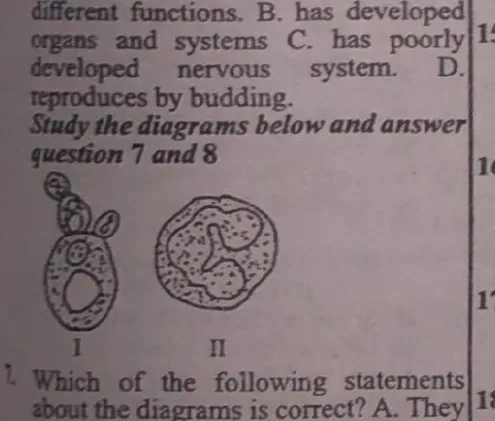
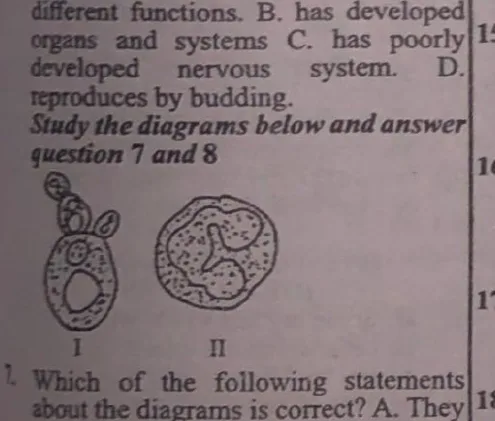
7. Study the diagrams below (I and II) and answer question 7 and 8. Which of the following statements about the diagrams is correct? A. They are both organs B. One of them is an organism C. They both form part of tissues D. They are both harmful to humans

Diagram for question 7
  • A. They are both organs
  • B. One of them is an organismCorrect
  • C. They both form part of tissues
  • D. They are both harmful to humans

Explanation

I=Yeast cell forming buds; II=White blood cell. One of them (yeast) is an organism while the other is a cell.

Biology 2016 Objective — Question 8

8. A decrease in the number of II will result in A. an increase in urine production B. an increase in energy production C. a decreased population D. decreased Immunity

Diagram for question 8
  • A. an increase in urine production
  • B. an increase in energy production
  • C. a decreased population
  • D. decreased ImmunityCorrect

Explanation

As white blood cells serve to protect the body, a decrease in the number of white blood cells will lower the immunity of the body.

Biology 2016 Objective — Question 9

9. Flaccidity in plants is associated with A. cessation of photosynthesis B. wilting C. turgidity D. discolouration of leaves

  • A. cessation of photosynthesis
  • B. wiltingCorrect
  • C. turgidity
  • D. discolouration of leaves

Explanation

When the leaves of a plant become limp and flaccid, it is called wilting.

Biology 2016 Objective — Question 10

10. Which of the following substances is not usually present in the urine of a healthy person? A. Urea B. Mineral salts C. Glucose D. Water

  • A. Urea
  • B. Mineral salts
  • C. GlucoseCorrect
  • D. Water

Explanation

The urine of a healthy person must not contain glucose because as the glomerular filtrate passes into the first convoluted tubule, all amino acids and glucose are reabsorbed into the body by blood capillaries surrounding the tubule.

Biology 2016 Objective — Question 11

11. Muscles act in opposite directions in order to A. cause a bone to move B. prevent dislocation at joints C. prevent muscle fatigue D. regulate bodily activities

  • A. cause a bone to moveCorrect
  • B. prevent dislocation at joints
  • C. prevent muscle fatigue
  • D. regulate bodily activities

Explanation

Muscles act in opposite directions in order to cause a bone to move. For instance, to bend the arm at the elbow, the biceps contract while the triceps relax.

Biology 2016 Objective — Question 12

12. Lateral meristem in flowering plants is found in the A. cortex B. pericycle C. cambium D. pith

  • A. cortex
  • B. pericycle
  • C. cambiumCorrect
  • D. pith

Explanation

Secondary or lateral meristems, which are found in all woody plants and in some herbaceous ones, consist of the vascular cambium and the cork cambium.

Biology 2016 Objective — Question 13

13. The cells and tissues of the nose, throat, chest diaphragm and lungs form the A. circulatory system B. respiratory system C. transport system D. digestive system

  • A. circulatory system
  • B. respiratory systemCorrect
  • C. transport system
  • D. digestive system

Explanation

The cells and tissues of the nose, throat, chest, diaphragm and lungs form the respiratory system.

Biology 2016 Objective — Question 14

14. The exchange of gases between the environment and the respiratory organs of vertebrates is referred to as A. inhalation B. respiration C. expiration D. breathing

  • A. inhalation
  • B. respiration
  • C. expiration
  • D. breathingCorrect

Explanation

This is simply regarded as breathing. The term respiration may refer to the catabolic process where energy is obtained from glucose.

Biology 2016 Objective — Question 15

15. The maintenance of a constant internal environment in an organism is known as A. homeostasis B. homoiothermic C. diuresis D. dialysis

  • A. homeostasisCorrect
  • B. homoiothermic
  • C. diuresis
  • D. dialysis

Explanation

The maintenance of a constant internal environment in an organism is known as homeostasis.

Biology 2016 Objective — Question 16

16. Which of the following organs is responsible for the production of insulin? A. Spleen B. Adrenal gland C. Thyroid gland D. Pancreas

  • A. Spleen
  • B. Adrenal gland
  • C. Thyroid gland
  • D. PancreasCorrect

Explanation

Apart from its role in digestion, the pancreas also secretes hormones (insulin and glucagon) which help in the regulation of blood sugar.

Biology 2016 Objective — Question 17

17. Which of the following actions is not a voluntary action? A. Stealing B. Sneezing C. Fighting D. Cheating

  • A. Stealing
  • B. SneezingCorrect
  • C. Fighting
  • D. Cheating

Explanation

Stealing, fighting and cheating are voluntary actions while sneezing is not.

Biology 2016 Objective — Question 18

18. In both dicotyledonous and monocotyledonous plants, the root hairs originate from the A. piliferous layer B. epidermal layer C. endodermal layer D. cortical layer

  • A. piliferous layer
  • B. epidermal layerCorrect
  • C. endodermal layer
  • D. cortical layer

Explanation

Lateral roots originate endogenously (from the pericycle) while root hairs are simply the outgrowths of epidermal cells.

Biology 2016 Objective — Question 19

19. Which of the following parts of the ear does not contain endolymph? A. Semi-circular canals B. Utriculus C. Tympanum D. Sacculus

  • A. Semi-circular canals
  • B. Utriculus
  • C. TympanumCorrect
  • D. Sacculus

Explanation

Tympanum does not contain endolymph. Tympanum is another word for ear drum.

Biology 2016 Objective — Question 20

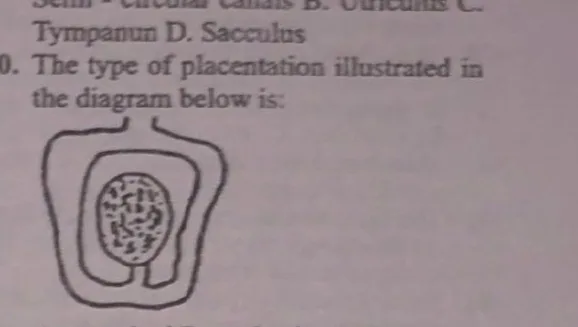
20. The type of placentation illustrated in the diagram below is: A. marginal B. parietal C. axile D. basal

Diagram for question 20
  • A. marginal
  • B. parietal
  • C. axile
  • D. basalCorrect

Explanation

The diagram represents basal placentation. In basal placentation, the ovules are attached to the base of a syncarpous ovary.

Biology 2016 Objective — Question 21

21. The steps below are involved in the testing of a leaf for starch. Study them carefully and answer questions 21 and 22. I. Decolorize leaf II. Dip decolorized leaf in warm water III. Place leaf in boiling water IV. Add iodine solution. The correct order for the test is A. I, II, II and IV B. I, II, II and IV C. II, III, I and IV D. III, I, II and IV

  • A. I, II, II and IV
  • B. I, II, II and IV
  • C. II, III, I and IV
  • D. III, I, II and IVCorrect

Explanation

The correct order is III → I → II → IV (Place leaf in boiling water, then decolorize, then dip in warm water, then add iodine solution).

Biology 2016 Objective — Question 22

22. The best time to pluck the leaf for the experiment is A. after being exposed to sunlight B. three hours after sunset C. before sunrise D. six hours after sunset

  • A. after being exposed to sunlightCorrect
  • B. three hours after sunset
  • C. before sunrise
  • D. six hours after sunset

Explanation

This is to ensure that the leaf has already photosynthesized.

Biology 2016 Objective — Question 23

23. In which of the plant tissues are guard cells located? A. Epidermis B. Mesophyll C. Vascular bundles D. Meristems

  • A. EpidermisCorrect
  • B. Mesophyll
  • C. Vascular bundles
  • D. Meristems

Explanation

Guard cells are located in the epidermis. It must be remembered that guard cells are the only epidermal cells that contain chloroplasts.

Biology 2016 Objective — Question 24

24. The association between two organisms in which one of the organism gains and the other loses is referred to as A. saprophytism B. commensalism C. mutualism D. parasitism

  • A. saprophytism
  • B. commensalism
  • C. mutualism
  • D. parasitismCorrect

Explanation

The type of association in which one organism gains and suffers harm is known as parasitism. The organism that gains is known as the parasite while the one that loses is known as the host.

Biology 2016 Objective — Question 25

25. The function of the villi in the alimentary canal is to A. secrete gastric juice B. curdle milk C. emulsify fat D. increase the surface area for absorption

  • A. secrete gastric juice
  • B. curdle milk
  • C. emulsify fat
  • D. increase the surface area for absorptionCorrect

Explanation

The function of the villi in the alimentary canal is to increase the surface area for absorption.

Biology 2016 Objective — Question 26

26. Which of the following structures is not an organ of the digestive system? A. Oesophagus B. Pancreas C. Stomach D. Kidney

  • A. Oesophagus
  • B. Pancreas
  • C. Stomach
  • D. KidneyCorrect

Explanation

Oesophagus, pancreas and stomach are parts of the digestive system while the kidney serves excretory roles.

Biology 2016 Objective — Question 27

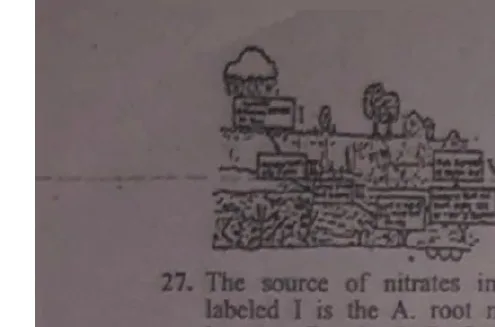
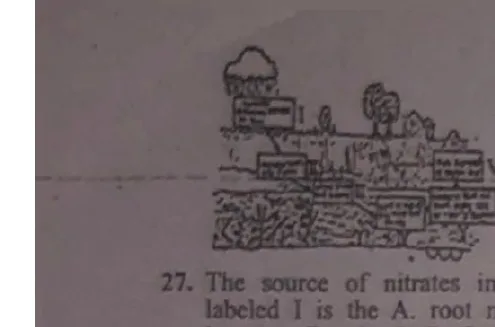
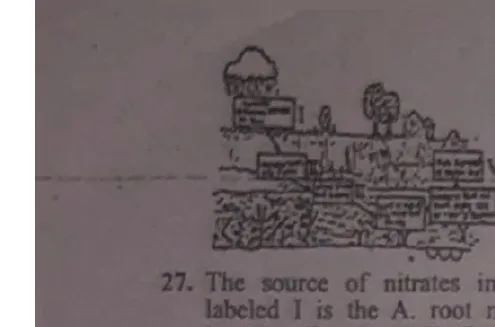
27. The diagram below shows the effect of nitrate on water bodies. Study it carefully and answer question 27 to 29. The source of nitrates in the part labeled I is the A. root nodules of legumes B. cloud C. fertilizers D. organic matter

Diagram for question 27
  • A. root nodules of legumes
  • B. cloud
  • C. fertilizersCorrect
  • D. organic matter

Explanation

The source of nitrates in the soil may be from excessive use of fertilizers.

Biology 2016 Objective — Question 28

28. The phenomenon in the diagram is termed A. denitrification B. conservation C. eutrophication D. global warming

Diagram for question 28
  • A. denitrification
  • B. conservation
  • C. eutrophicationCorrect
  • D. global warming

Explanation

The phenomenon is known as eutrophication.

Biology 2016 Objective — Question 29

29. Another cause that could lead to phenomenon in the diagram is A. exhaust from cars B. oil spillage C. dumping of sewage D. excess rainfall

Diagram for question 29
  • A. exhaust from cars
  • B. oil spillage
  • C. dumping of sewageCorrect
  • D. excess rainfall

Explanation

Dumping of sewage may also result in excessive algal growth which may clog up our water ways.

Biology 2016 Objective — Question 30

30. In ecology, a community refers to A. a number of individuals of a given species B. groups of different organisms living in a habitat C. existing species in an abandoned farmland D. the dominant species in the habitat

  • A. a number of individuals of a given species
  • B. groups of different organisms living in a habitatCorrect
  • C. existing species in an abandoned farmland
  • D. the dominant species in the habitat

Explanation

It refers to groups of different organisms living in a habitat. Note that when only organisms of a particular species are considered, we are describing population not community.

Biology 2016 Objective — Question 31

31. The direction of wind is determined by A. an anemometer B. a Secchi disc C. a wind vane D. a barometer

  • A. an anemometer
  • B. a Secchi disc
  • C. a wind vaneCorrect
  • D. a barometer

Explanation

The wind vane is used to determine the direction of wind while anemometer measures the speed of the wind.

Biology 2016 Objective — Question 32

32. Food webs are complex because A. the number of producers are large B. many animals feed directly on producers C. they include primary, secondary and tertiary consumers D. some animals form part of several food chains

  • A. the number of producers are large
  • B. many animals feed directly on producers
  • C. they include primary, secondary and tertiary consumers
  • D. some animals form part of several food chainsCorrect

Explanation

A food web is a complex feeding relationship consisting of interrelated food chains.

Biology 2016 Objective — Question 33

33. Special modifications which enable an organism to survive in its habitats known as A. adaptation B. tolerance C. mimicry D. colouration

  • A. adaptationCorrect
  • B. tolerance
  • C. mimicry
  • D. colouration

Explanation

Special modifications which enable an organism to survive in its habitat are known as adaptation. Note that the modification may be structural, functional or behavioural.

Biology 2016 Objective — Question 34

34. Which of the following relationships does not involve two organisms? A. Commensalism B. Saprophytism C. Symbiosis D. Parasitism

  • A. Commensalism
  • B. SaprophytismCorrect
  • C. Symbiosis
  • D. Parasitism

Explanation

Saprophytism involves only one organism. In saprophytism, the organism obtains its nutrient from dead and decaying organic matter.

Biology 2016 Objective — Question 35

35. Overcrowding in a population does not result in A. death B. commensalism C. competition D. migration

  • A. death
  • B. commensalismCorrect
  • C. competition
  • D. migration

Explanation

Overcrowding may result in migration, competition and/or death.

Biology 2016 Objective — Question 36

36. A pandemic is an outbreak of diseases that A. is confined to a tow B. is widespread C. will not spread D. has limited spread

  • A. is confined to a town
  • B. is widespreadCorrect
  • C. will not spread
  • D. has limited spread

Explanation

A pandemic is an outbreak of diseases that is widespread. Endemic disease, on the other hand, is peculiar to a particular area or region.

Biology 2016 Objective — Question 37

37. The rational and prudent use of natural resources is known as? A. preservation B. conservation C. utilization D. management

  • A. preservation
  • B. conservationCorrect
  • C. utilization
  • D. management

Explanation

The rational and prudent use of natural resources is known as conservation.

Biology 2016 Objective — Question 38

38. Which of the following natural resources cannot be conserved? A. Soil B. Water C. Wildlife D. air

  • A. Soil
  • B. Water
  • C. Wildlife
  • D. airCorrect

Explanation

Since the rate at which air is used cannot be regulated, it cannot be conserved. Recall that 'renewability' and being able to be conserved are two different things.

Biology 2016 Objective — Question 39

39. Which of the following actions support conservation? To A. protect endangered species B. preserve trees for timber C. permit hunting activities D. provide income for the government

  • A. protect endangered speciesCorrect
  • B. preserve trees for timber
  • C. permit hunting activities
  • D. provide income for the government

Explanation

Protection of endangered species is one of the steps in the conservation of wild life.

Biology 2016 Objective — Question 40

40. A noticeable physical appearance of individuals of the same species is called A. physical variation B. physiological variation C. morphological variation D. discontinuous variation

  • A. physical variation
  • B. physiological variation
  • C. morphological variationCorrect
  • D. discontinuous variation

Explanation

This is known as morphological variation. The difference in the ways in which the body functions constitutes physiological variation.

Biology 2016 Objective — Question 41

41. A blend of inherited and acquired characteristics shows A. variation B. inheritance C. evolution D. heredity

  • A. variationCorrect
  • B. inheritance
  • C. evolution
  • D. heredity

Explanation

Inherited characteristics come from gene while acquired characteristics come from the environment. This is why it is said that the phenotype of an organism depends on gene and environment.

Biology 2016 Objective — Question 42

42. A Cross between two parents produced four offspring with blood groups AB, BB, BO AO What is the blood group of their parents? A. AA and BO B. BB and AO C. AB and BO D. AB,and AO

  • A. AA and BO
  • B. BB and AO
  • C. AB and BOCorrect
  • D. AB and AO

Explanation

A cross between AB and BO will produce AB, BB, BO and AO.

Biology 2016 Objective — Question 43

43. A sick baby was successfully transfused with blood from the father who has blood group AB, what is the group of the sick baby? A. AB B. A C. B D. O

  • A. ABCorrect
  • B. A
  • C. B
  • D. O

Explanation

Although AB is a universal recipient, it can only donate to another AB. So, for the father whose blood group is AB to successfully donate to a baby, the blood group of the baby must also be AB.

Biology 2016 Objective — Question 44

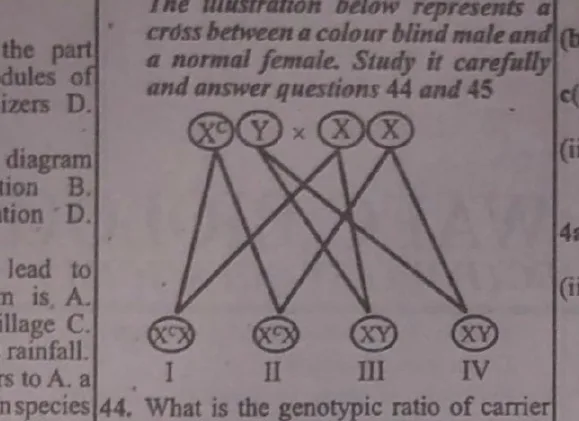
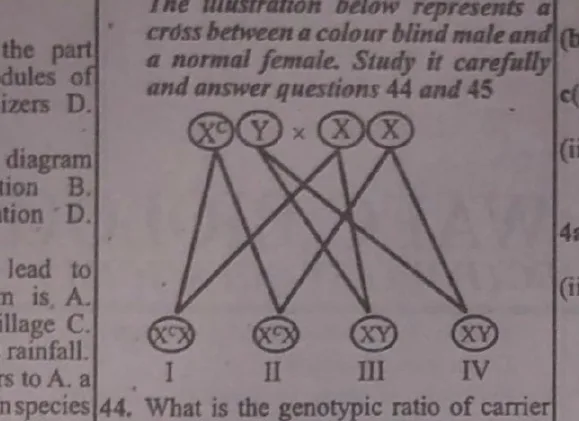
44. The illustration below represents a cross between a colour blind male and a normal female. Study it carefully and answer questions 44 and 45. What is the genotypic ratio of carrier female to normal males in the cross? A. 1:1 B. 2:3 C. 3:4 D. 4:1

Diagram for question 44
  • A. 1:1Correct
  • B. 2:3
  • C. 3:4
  • D. 4:1

Explanation

The two females in the diagram are carriers while the two males are normal. Then, carrier female: normal male = 2:2 = 1:1.

Biology 2016 Objective — Question 45

45. Which of the genotypes are carriers of colour blindness? A. I and II only B. I and III only C. II and III only D. I, II and III only

Diagram for question 45
  • A. I and II onlyCorrect
  • B. I and III only
  • C. II and III only
  • D. I, II and III only

Explanation

As explained, only the two females (I & II) are carriers of colour blindness. The two males (III & IV) are normal.

Biology 2016 Objective — Question 46

46. Scientists who study genetics are known as A. genealogists B. geneticists C. mendelists D. genescientists

  • A. genealogists
  • B. geneticistsCorrect
  • C. mendelists
  • D. genescientists

Explanation

Scientists who study genetics are known as geneticists.

Biology 2016 Objective — Question 47

47. Which of the following scientists did not contribute to the development of genetics? A. Wilhem Johnson B. Thomas Morgan C. Gregor Mendel D. Felix Durjadin

  • A. Wilhem Johnson
  • B. Thomas Morgan
  • C. Gregor Mendel
  • D. Felix DurjadinCorrect

Explanation

The contribution of Felix Durjadin is in the Cell Theory. He was a French biologist who discovered that the cell was made up of living substance (which he called protoplasm).
Biology 2016 Objective — Question 48

48. Which of the following terms is associated with natural selection? A. Adaptive radiation B. Differential reproduction C. Population variability D. Survival of the fittest

  • A. Adaptive radiation
  • B. Differential reproduction
  • C. Population variability
  • D. Survival of the fittestCorrect

Explanation

Survival of the fittest is associated with natural selection.

Biology 2016 Objective — Question 49

49. In which of the following insects is group instinct not displayed? A. Soldier ants B. Cockroaches C. Honeybees D. Termites

  • A. Soldier ants
  • B. CockroachesCorrect
  • C. Honeybees
  • D. Termites

Explanation

Ants, honeybees and termites are social or group insects while cockroaches are not.

Biology 2016 Objective — Question 50

50. The inability of an organism to adapt to its habitat can lead to A. dormancy B. adaptation C. extinction D. survival

  • A. dormancy
  • B. adaptation
  • C. extinctionCorrect
  • D. survival

Explanation

The inability of an organism to adapt to its habitat can lead to extinction.

Advertisement

Sign up free to unlock

  • Score tracking
  • Practice history
  • Saved questions
  • Progress dashboard
  • Personalized sessions
  • Weak-topic breakdown

…and/or go further with premium services and No Ads.