Free account: track your progress — Sign up free

WAEC Biology 2017 Objective Past Questions

All 50 questions from the West African Examinations Council (WAEC) Biology 2017 Objective paper, with the correct answer and a full explanation for each. Free, no signup needed.

Advertisement

Biology 2017 Objective — Question 1

Which of the following groups of animals do not possess a nervous system?

  • A. A. PoriferaCorrect
  • B. B. Cnidaria
  • C. C. Platyhelminthes
  • D. D. Nematoda

Explanation

Porifera (sponges) do not have nervous, digestive or circulatory systems. Instead, they rely on a constant water flow through their bodies to obtain food, oxygen and to remove wastes.

Biology 2017 Objective — Question 2

The structural similarities in Paramecium and Euglena are in the

  • A. A. shape of locomotory organs
  • B. B. blunt anterior and pointed posteriorCorrect
  • C. C. presence of micro and mega nuclei in both
  • D. D. presence of anterior and posterior contractile vacuoles

Explanation

Both Paramecium and Euglena have a blunt anterior and pointed posterior. Their locomotory structures differ (Paramecium uses cilia while Euglena uses a whip-like flagellum), and only Paramecium has micro/mega nuclei.

Biology 2017 Objective — Question 3

Which of the following organisms cannot exist freely on its own?

  • A. A. Chlamydomonas
  • B. B. Amoeba
  • C. C. Paramecium
  • D. D. PlasmodiumCorrect

Explanation

Chlamydomonas, Amoeba and Paramecium are free-living organisms, while Plasmodium is parasitic and cannot exist freely on its own.

Biology 2017 Objective — Question 4

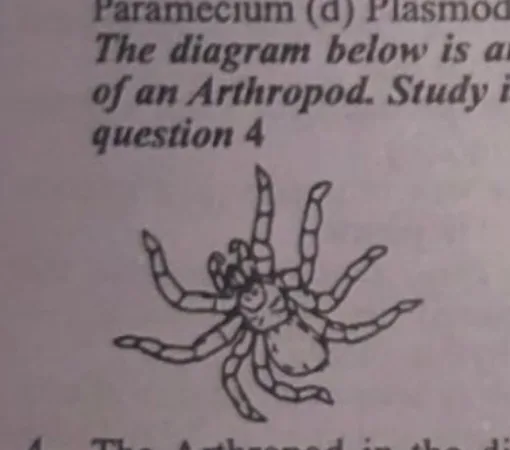
The Arthropod in the diagram is not an insect because it

Diagram for question 4
  • A. A. has a big head which is almost equal to the thorax
  • B. B. has eight legs and no wingsCorrect
  • C. C. does not have visible eyes on its head
  • D. D. has head, thorax and abdomen

Explanation

Insects have six legs (three pairs); a spider is not an insect as it has eight legs (four pairs) and no wings.

Biology 2017 Objective — Question 5

Which of the following cell organelles is the site for the production of ATP?

  • A. A. Lysosome
  • B. B. Nucleus
  • C. C. MitochondrionCorrect
  • D. D. Ribosome

Explanation

The mitochondrion (also known as the power house of the cell) is the site of production of energy/ATP.

Biology 2017 Objective — Question 6

An example of osmosis in plants is the

  • A. A. movement of water through the xylem
  • B. B. loss of water vapour from the stomata
  • C. C. translocation of food through the phloem
  • D. D. absorption of water from the soil by the rootCorrect

Explanation

Absorption of water from the soil by the root is by osmosis (PAWO - Plant Absorb Water by Osmosis).

Biology 2017 Objective — Question 7

The organism that can carry out both autotrophic and heterotrophic modes of nutrition is

  • A. A. Chlamydomonas
  • B. B. Endorina
  • C. C. EuglenaCorrect
  • D. D. Spirogyra

Explanation

Euglena can carry out both autotrophic and heterotrophic modes of nutrition. When there is light, it photosynthesizes; it is also able to carry out holozoic feeding in the absence of sunlight, since it has a gullet to ingest food particles.

Biology 2017 Objective — Question 8

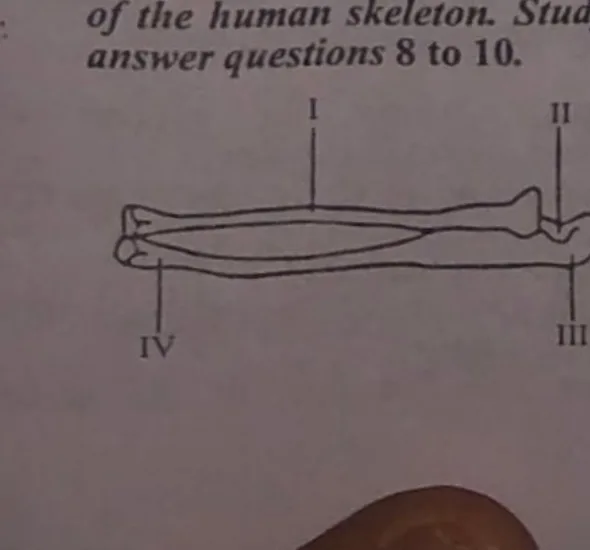
The diagram represents the bones of the

Diagram for question 8
  • A. A. upper arm
  • B. B. lower armCorrect
  • C. C. upper leg
  • D. D. lower leg

Explanation

The diagram represents the bones of the lower arm (ulna and radius).

Biology 2017 Objective — Question 9

Which of the labelled parts articulates with the head of the trochlea to form a hinge joint?

  • A. A. I
  • B. B. IICorrect
  • C. C. III
  • D. D. IV

Explanation

Part labelled II is the sigmoid notch which articulates with the trochlea of the humerus to form the elbow joint.

Biology 2017 Objective — Question 10

The labelled part that provides surface for the attachment of the triceps is

  • A. A. I
  • B. B. II
  • C. C. IIICorrect
  • D. D. IV

Explanation

Part labelled III is the olecranon process, which provides attachment for the triceps.

Biology 2017 Objective — Question 11

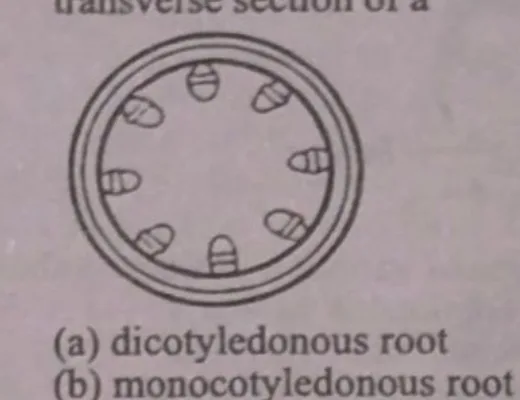
The diagram below illustrates the transverse section of a

Diagram for question 11
  • A. A. dicotyledonous root
  • B. B. monocotyledonous rootCorrect
  • C. C. dicotyledonous stem
  • D. D. monocotyledonous stem

Explanation

This is the diagram of a dicotyledonous stem transverse section, based on the arrangement of vascular bundles. Note: you can guess options A and B (root diagrams) out as the absence of root hairs makes it neither a monocot nor dicot root.

Biology 2017 Objective — Question 12

Which of the following actions does not occur during exhalation in man?

Diagram for question 12
  • A. A. Thoracic cavity decreases in volume
  • B. B. Diaphragm flattensCorrect
  • C. C. Ribs move down and in
  • D. D. Air pressure increases in the thoracic cavity

Explanation

It is during inhalation that the diaphragm contracts and becomes flattened. During exhalation, the diaphragm relaxes and assumes its dome shape.

Biology 2017 Objective — Question 13

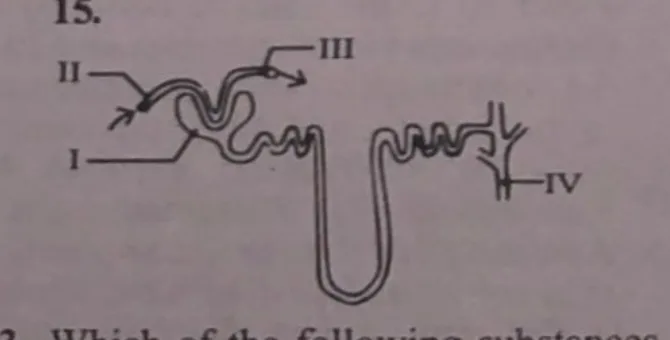
Which of the following substances is found in the part labelled II only?

  • A. A. Lipid
  • B. B. ProteinCorrect
  • C. C. Salts
  • D. D. Water

Explanation

Blood cells and plasma proteins (such as prothrombin and fibrinogen) are too big to pass through the glomerulus, so they remain in the blood.

Biology 2017 Objective — Question 14

The part which contains lowest concentration of urea is labelled

  • A. A. I
  • B. B. II
  • C. C. IIICorrect
  • D. D. IV

Explanation

Part labelled III is the efferent arteriole from the glomerulus. Of all the indicated parts, III has the lowest concentration of urea.

Biology 2017 Objective — Question 15

Which of the following substances is greater in concentration in the part labelled IV when compared to the part labelled I?

  • A. A. Lipid
  • B. B. Glucose
  • C. C. UreaCorrect
  • D. D. Uric acid

Explanation

Part IV (collecting duct) has a greater concentration of urea than part I (Bowman's capsule).

Biology 2017 Objective — Question 16

Deamination of amino acids in the liver produces

  • A. A. blood sugar
  • B. B. glycogen
  • C. C. bile
  • D. D. ureaCorrect

Explanation

Deamination of amino acids in the liver produces urea. Note that every excess amino acid, the carboxyl part is converted to other food classes while the amino part is converted to urea.

Biology 2017 Objective — Question 17

Which of the following glands also serves as an exocrine gland?

  • A. A. Ovary
  • B. B. PancreasCorrect
  • C. C. Adrenal
  • D. D. Thyroid

Explanation

Pancreas has both the exocrine and the endocrine roles. Its exocrine role is to produce digestive enzymes such as lipase, amylopsin and trypsin. Its endocrine role is to produce the hormones insulin and glucagon.

Biology 2017 Objective — Question 18

Which of the following sequences is the correct route of the transmission of impulses along a reflex arc?

  • A. A. Receptor → sensory neurone → synapse → intermediate neurone → synapse → motor neurone → effectorCorrect
  • B. B. Receptor → motor neurone → synapse → intermediate neurone → synapse → sensory neurone → effector
  • C. C. Effector → intermediate neurone → synapse → motor neurone → synapse → sensory neurone → receptor
  • D. D. Effector → motor neurone → synapse → sensory neurone → synapse → intermediate neurone → receptor

Explanation

The pathway of a reflex arc can be summarized as: Stimulus → Receptor → Sensory neurone → Intermediate neurone → Motor neurone → Effector.

Biology 2017 Objective — Question 19

When viewing an object that is close to the human eye, the

  • A. A. eye lens becomes thin
  • B. B. ciliary muscles relax
  • C. C. suspensory ligaments become taut
  • D. D. eye lens become fatCorrect

Explanation

When viewing near objects: (i) the ciliary muscles contract and become thicker (ii) the suspensory ligament slackens (iii) the lens become fat and more convex.

Biology 2017 Objective — Question 20

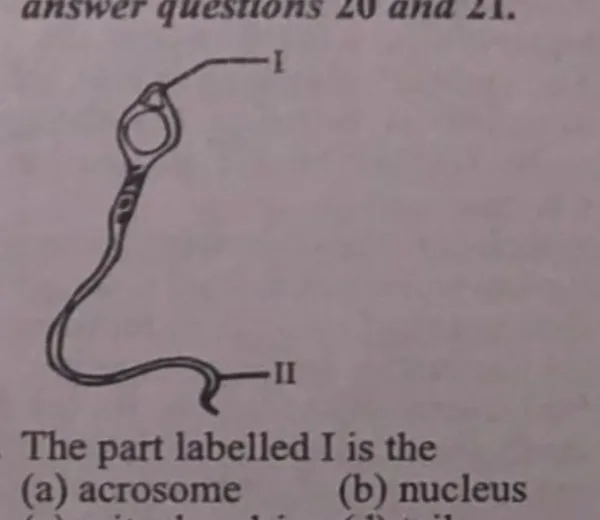
The part labelled I is the

Diagram for question 20
  • A. A. acrosomeCorrect
  • B. B. nucleus
  • C. C. mitochondrion
  • D. D. tail

Explanation

The part labelled 'I' is the acrosome, while the part labelled 'II' is the tail.

Biology 2017 Objective — Question 21

The function of the part labelled II is to

  • A. A. fuse with the ovum during fertilization
  • B. B. generate the energy for the sperm to swim to the fallopian tube
  • C. C. help the sperm to swim forwardCorrect
  • D. D. dissolve the membrane of the egg during fertilization

Explanation

The tail (labelled II) helps the sperm to swim forward.

Biology 2017 Objective — Question 22

Which of the following types of placentation is not common amongst syncarpous pistils?

  • A. A. MarginalCorrect
  • B. B. Axile
  • C. C. Parietal
  • D. D. Free central

Explanation

Marginal placentation is not common among syncarpous pistils. Note that in marginal placentation, the ovules are arranged in a single row at the margin of the ovary.

Biology 2017 Objective — Question 23

The complex energy-rich organic matter which living organisms need for life is

  • A. A. water
  • B. B. air
  • C. C. foodCorrect
  • D. D. mineral salts

Explanation

The complex energy-rich organic matter which living organisms need for life is food. You may think water also fits the description, however, note that the part "energy-rich organic matter" has betrayed water. Water is not organic; it is inorganic. Also, the calorific value of water is zero.

Biology 2017 Objective — Question 24

Which of the following processes are associated with photosynthesis? I. Energy from sunlight is absorbed II. Carbon dioxide is evolved III. Oxygen is given off IV. Glucose is synthesized.

  • A. A. I and II only
  • B. B. I, III and IV onlyCorrect
  • C. C. I, II and IV only
  • D. D. I, II, III and IV only

Explanation

During photosynthesis, CO2 is not evolved. Instead, it is used up! By-product of photosynthesis is O2. 6CO2+6H2O→C6H12O6+6O2. So I, III and IV are correct (energy absorbed, oxygen given off, glucose synthesized), but II (CO2 evolved) is incorrect.

Biology 2017 Objective — Question 25

Which of the following function is associated with calcium in plants?

  • A. A. Formation of cell wallCorrect
  • B. B. Formation of ribosomes
  • C. C. Formation of proteins
  • D. D. Formation of cell membrane

Explanation

Calcium aids in the formation of cell wall.

Biology 2017 Objective — Question 26

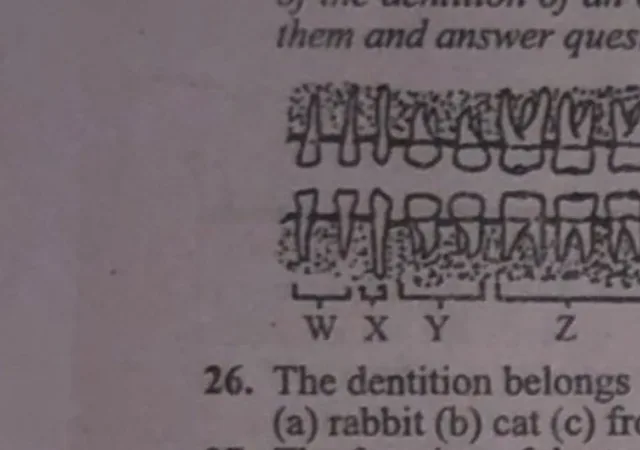
The dentition belongs to a

Diagram for question 26
  • A. A. rabbit
  • B. B. cat
  • C. C. frog
  • D. D. manCorrect

Explanation

The dentition belongs to man. The total number of teeth in the jaw of an animal is obtained by multiplying the number of teeth in the dental formula by 2. For a man, the dental formula gives a total of 32 teeth.

Biology 2017 Objective — Question 27

The function of the teeth labelled X is for

  • A. A. biting and grasping
  • B. B. chewing and grinding
  • C. C. tearing and graspingCorrect
  • D. D. chewing and tearing

Explanation

The teeth labelled X is canine. Canine is used for tearing flesh and for catching prey (tearing and grasping).

Biology 2017 Objective — Question 28

The teeth which are absent in the young of the organism are labelled

  • A. A. W
  • B. B. X
  • C. C. Y
  • D. D. ZCorrect

Explanation

W=Incisors, X=Canine, Y=Premolar, Z=Molar. The first type of teeth possessed by young humans is known as milk teeth, which may number up to twenty; milk teeth comprise incisors, canines and premolars. Molars (Z) are absent — the permanent teeth, which comprise incisors, canines, premolar and molar, only grow after the milk teeth have fallen off.

Biology 2017 Objective — Question 29

The number of individuals that the environment can support over a long period of time is its

  • A. A. growth rate
  • B. B. total capacity
  • C. C. population capacity
  • D. D. carrying capacityCorrect

Explanation

The carrying capacity is defined as the number of individuals that a particular environment can support over a long period of time.

Biology 2017 Objective — Question 30

A good site for secondary succession would be

  • A. A. a sand dune
  • B. B. a bare rock
  • C. C. a land that has just had forest fireCorrect
  • D. D. a stretch of barren land

Explanation

A good site for secondary succession must be one that has been previously colonized (e.g. a land that has just had forest fire), unlike sand dunes and bare rock which are typical sites for primary succession.

Biology 2017 Objective — Question 31

A population which exceeds its carrying capacity and then collapses is represented graphically by a

  • A. A. bell-shaped curveCorrect
  • B. B. linear curve
  • C. C. sigmoid Curve
  • D. D. skewed curve

Explanation

A population which exceeds its carrying capacity and then collapses is represented graphically by a bell-shaped curve.

Biology 2017 Objective — Question 32

The natural dwelling place of an organism is called

  • A. A. ecological niche
  • B. B. habitatCorrect
  • C. C. population
  • D. D. environment

Explanation

The naturally dwelling place of an organism is called its habitat. Note that the exact position and its role in a habitat is known as the ecological niche of the organism.

Biology 2017 Objective — Question 33

Which of the following ecological factors will result in food shortage?

  • A. A. DroughtCorrect
  • B. B. Low rate of reproduction
  • C. C. Emigration
  • D. D. Topography

Explanation

Drought refers to a long period of little or no rain. Drought causes food shortage.

Biology 2017 Objective — Question 34

Soil permeability refers to

  • A. A. how easily water passes through the soilCorrect
  • B. B. the proportion of air in the soil
  • C. C. the proportion of water the soil holds
  • D. D. how well water rises up the soil

Explanation

Soil permeability refers to how easily water passes through the soil. How much water rises up a given sample of soil is a function of soil capillarity.

Biology 2017 Objective — Question 35

Which of the following groups of organisms do not have members that can be called autotrophs?

  • A. A. Protists
  • B. B. Mosses
  • C. C. Chlorophyta
  • D. D. FungiCorrect

Explanation

Fungi are heterotrophic. They are not able to manufacture their own food.

Biology 2017 Objective — Question 36

Which of the following pyramids gives the most accurate picture of the relationships between the organisms at the various trophic levels in a food chain?

  • A. A. Pyramid of numbers
  • B. B. Pyramid of energyCorrect
  • C. C. Pyramid of biomass
  • D. D. Pyramid of size

Explanation

Pyramid of energy is defined as the amount of energy present in the living organisms at the different trophic levels of a food chain — it gives the most accurate picture of these relationships.

Biology 2017 Objective — Question 37

Which of the following statements is not associated with pyramids of energy?

  • A. A. Efficiency of energy transfer between trophic levels can be studied
  • B. B. Comparisons of pyramids for different ecosystems can be made
  • C. C. More accurate comparisons of trophic levels
  • D. D. Representation of numbers of organisms at different trophic levelsCorrect

Explanation

The numbers of organisms at different trophic levels can be represented by the pyramid of number, not pyramid of energy.

Biology 2017 Objective — Question 38

Which of the following materials is not easily biodegradable?

  • A. A. Polythene bagCorrect
  • B. B. Cotton bag
  • C. C. Hides and skin bag
  • D. D. Paper bag

Explanation

Non-biodegradable substances are those that cannot be broken down into simple harmless substances by living organisms, e.g. glass, stone, plastic, etc. Paper, cotton, hides and skin are biodegradable while polythene is non-biodegradable.

Biology 2017 Objective — Question 39

Which of the following pairs of organisms is in a mutualistic relationship?

  • A. A. Hydra and Sea anemone
  • B. B. Hermit crab and sea anemoneCorrect
  • C. C. Dodder plant and Cocoa plant
  • D. D. Mistletoe and Kolanut

Explanation

The sea anemone attaches itself to the shell containing the hermit crab. The sea anemone eats pieces of food left by the hermit crab and in turn protects the crab. This is a good example of mutualism.

Biology 2017 Objective — Question 40

The establishment of game reserves and parks is a method of

  • A. A. conserving natural resourcesCorrect
  • B. B. cultivating game
  • C. C. controlling pollution
  • D. D. cultural awareness

Explanation

The establishment of game reserves and parks is an effective method for conserving natural resources.

Biology 2017 Objective — Question 41

Which of the following practices is not used in conserving water?

  • A. A. Afforestation
  • B. B. Damming
  • C. C. DeforestationCorrect
  • D. D. Reforestation

Explanation

Deforestation does not conserve water in any way.

Biology 2017 Objective — Question 42

Which of the following resources cannot be renewed?

  • A. A. Air
  • B. B. PetroleumCorrect
  • C. C. Food crop
  • D. D. Soil

Explanation

Petroleum is not renewable. Air, food crop and soil are all renewable resources.

Biology 2017 Objective — Question 43

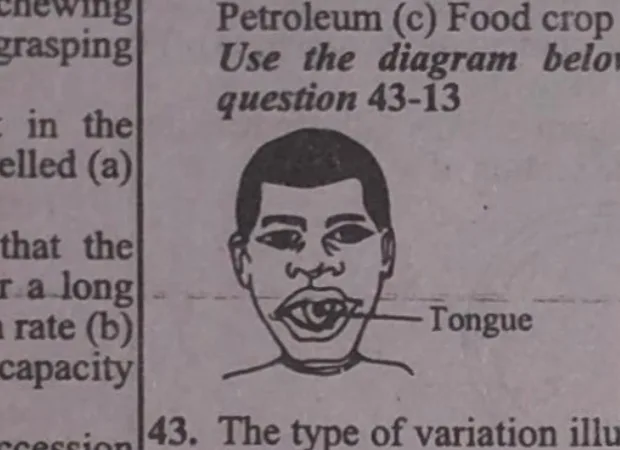
The type of variation illustrated above is

Diagram for question 43
  • A. A. continuous variation
  • B. B. discontinuous variationCorrect
  • C. C. morphological variation
  • D. D. environmental variation

Explanation

The ability to roll one's tongue is a discontinuous variation, as one is only either able to roll the tongue or not; there is no intermediate.

Biology 2017 Objective — Question 44

Which of the following characters is not a morphological variation?

  • A. A. shape of the nose
  • B. B. colour of skin
  • C. C. colour of hair
  • D. D. tongue rollingCorrect

Explanation

Morphological variation deals with forms and structures while physiological variation deals with how the body functions. The ability to roll the tongue is a physiological variation.

Biology 2017 Objective — Question 45

An apple plant can produce sexually and asexually and it has 40 chromosomes in its leaf cells. How many chromosomes would be in each gamete and somatic cell?

  • A. A. 20 chromosomes in the gametes and 40 in the somatic cellsCorrect
  • B. B. 40 in the gametes and 20 in the somatic cells
  • C. C. 20 chromosomes in the gametes and 20 in the somatic cells
  • D. D. 40 chromosomes in the gametes and 40 in the somatic cells

Explanation

Since leaf cells are somatic cells, the number of chromosomes in the somatic cell is 40. Always, the number of chromosomes in the gamete is half that in the somatic cell. Then, the gamete will contain 20 chromosomes.

Biology 2017 Objective — Question 46

Assuming that A is the gene for normal skin colour and is dominant, while a is the gene for albinism and is recessive, what is the likely genotype of the couple which had 50% normal and 50% albino offspring?

  • A. A. AA, aa
  • B. B. Aa, aaCorrect
  • C. C. AA, Aa
  • D. D. Aa, Aa

Explanation

Thus, only a cross between Aa and aa can produce 50% albino and 50% normal. Don't forget that A is dominant over a.

Biology 2017 Objective — Question 47

Which of the following statements is true about mutation?

  • A. A. phenotype is not involved
  • B. B. genotype is not involved
  • C. C. Artificial induction is not possible
  • D. D. Genotype is involvedCorrect

Explanation

Mutation is the sudden change in the genetic make-up of an organism, so genotype is involved.

Biology 2017 Objective — Question 48

One of the structural adaptations of mammals for movement on land is the development of the

  • A. A. hollow bones
  • B. B. pentadactyl limbCorrect
  • C. C. fused thoracic bones
  • D. D. streamlined body

Explanation

The pentadactyl limb arrangement enhances movement on land for mammals.

Biology 2017 Objective — Question 49

Which of the following traits is not characteristic of social insects?

  • A. A. All members are identicalCorrect
  • B. B. There is division of labour
  • C. C. The members dwell in the same habitat
  • D. D. Some members protect the queen

Explanation

All members of social insects must not be identical. There must be differences both structurally and functionally. The occurrence of division of labour among the members further buttresses this.

Biology 2017 Objective — Question 50

The gradual cumulative, adaptive and heritable changes in an organism over a long period of time resulting in new species is called

  • A. A. adaptation
  • B. B. survival
  • C. C. organic evolutionCorrect
  • D. D. interspecific competition

Explanation

The gradual, cumulative, adaptive and heritable changes in an organism over a long period of time resulting in new species is known as organic evolution.

Advertisement

Sign up free to unlock

  • Score tracking
  • Practice history
  • Saved questions
  • Progress dashboard
  • Personalized sessions
  • Weak-topic breakdown

…and/or go further with premium services and No Ads.