Biology 2017 Theory — Question 1
1(a)(i) What is classification of living things?
Model answer
Classification of living things refers to the grouping of living things according to their similar characteristics.
All 26 questions from the West African Examinations Council (WAEC) Biology 2017 Theory paper, with the correct answer and a full explanation for each. Free, no signup needed.
Advertisement
1(a)(i) What is classification of living things?
Model answer
Classification of living things refers to the grouping of living things according to their similar characteristics.
1(a)(ii) Name the scientist that developed the Binomial System of Classification
Model answer
The binomial system of naming was discovered by a scientist known as Carolus Linnaeus.
1(a)(iii) State three reasons why it is necessary to classify living things
Model answer
Reasons for classification: (i) Identification purpose (ii) Research purpose (iii) Reference purpose.
1(a)(iv) List seven major groups into which taxonomists classify living things in order of hierarchy
Model answer
In order of hierarchy: Kingdom, Phylum, Class, Order, Family, Genus, Species.
1(b) State two features each which viruses have in common with: (i) Living things (ii) Non-living things
Model answer
(i) Features in common with living things: Possession of DNA; Possession of protoplasm. (ii) Features in common with non-living things: It has a crystalline structure; It becomes totally non-living if it is taken out of the living system (host cell).
1(c) Name two viral disease each of: (i) Plants (ii) Humans
Model answer
(i) Plant viral diseases: Groundnut rosette disease; Tobacco mosaic disease. (ii) Human viral diseases: Measles; Mumps; Influenza; AIDS (any two).
2(a) State four characteristics of enzymes
Model answer
Characteristics of enzymes: They are specific in their actions; They are proteinous in nature; They are sensitive to pH; They are destroyed when the temperature is too high.
2(b)(i) List two digestive enzymes produced in the duodenum of humans and name the substrate that each enzyme acts on.
Model answer
The enzymes released into the duodenum include lipase, amylase and trypsin. Lipase acts on fats and oils; Amylase acts on starch; Trypsin acts on protein (peptone).
2(b)(ii) State the products of each enzyme activity in 2(b)
Model answer
Lipase converts fats and oils to fatty acid and glycerol; Amylase converts starch to maltose; Trypsin converts peptone to polypeptide.
2(c)(i) State one way in which chlorophyll is important in plants
Model answer
Chlorophyll is required by plants for photosynthesis.
2(c)(ii) Name two macro-elements that are required for the formation of chlorophyll in plants, and state one deficiency symptom of each.
Model answer
The elements needed for chlorophyll formation are iron, nitrogen and magnesium. Magnesium deficiency leads to poor growth and chlorosis. Iron deficiency causes chlorosis and stunted growth. Nitrogen deficiency causes chlorosis and poor flower development (any two elements with their deficiency symptoms).
2(d) Outline the procedure used for testing for starch in a leaf.
Model answer
How to test for starch in a leaf: Heat the leaf in boiling water; Heat it in boiling ethanol; Wash the leaf with water and then spread it on a white tile; Add iodine solution and allow it to stand for a few minutes. NB: If starch is present, the leaf turns blue-black.
3(a)(i) Name one instrument used for collecting: Soil organisms from a soil sample; Tiny insects from a leaf or a stem
Model answer
We use a Tullgren funnel for collecting soil organisms. We use a pooter (potter) for collecting tiny insects from a leaf or stem.
3(a)(ii) Make a diagram 6cm-8cm long of the instrument named in 3a(i) above and label fully
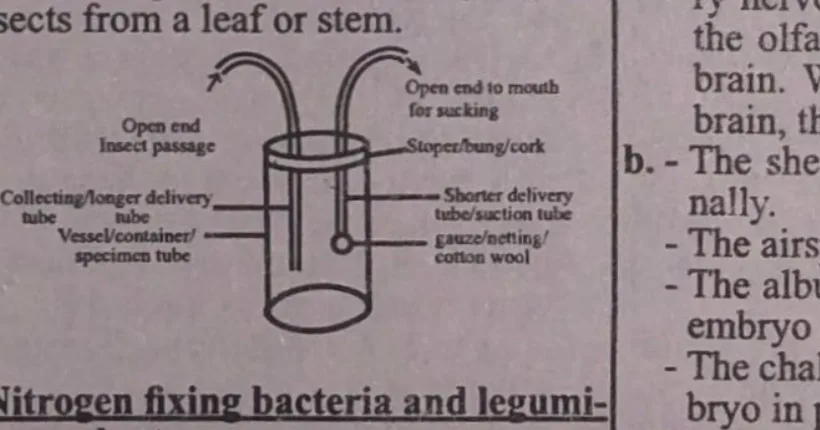
Model answer
A labelled diagram of a pooter (potter), showing: the open end for insect passage, the longer delivery tube leading to the vessel/container (specimen tube), the gauze/netting/cotton wool (to prevent insects being inhaled), the shorter delivery/suction tube, the stopper/bung/cork, and the open end to mouth for sucking.
3(b) Explain briefly the relationship between three examples of symbiotic organisms.
Model answer
(i) Nitrogen fixing bacteria and leguminous plants: The nitrogen fixing bacteria (e.g. Rhizobium) helps the leguminous plant in nitrogen fixation. In return, the plants provide food and shelter for the bacteria. (ii) Algae and fungi in a lichen: The fungi protect the algae and also help in the absorption of water while the food manufactured by the algae benefits the fungi as well. (iii) Sea Anemone and hermit crab: The sea anemone eats the leftover food from the hermit crab. In return, the sea anemone protects the hermit crab from predators.
4(a) A child belongs to blood group O and the mother belongs to blood group B. With the aid of genetic cross, state the possible blood groups of the father.
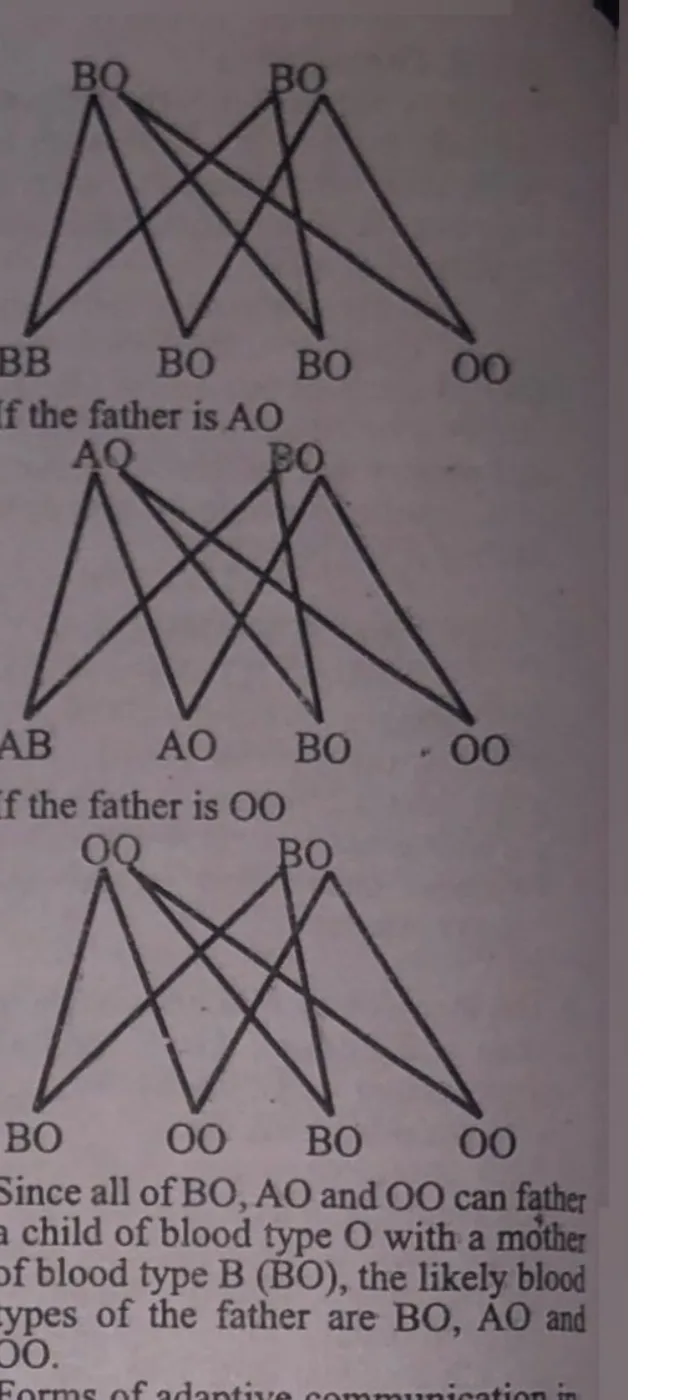
Model answer
Testing each possible father genotype against the mother (BO) to see which can produce an O-blood-type child: If the father is BO: BO x BO gives BB, BO, BO, OO offspring (includes OO). If the father is AO: AO x BO gives AB, AO, BO, OO offspring (includes OO). If the father is OO: OO x BO gives BO, OO, BO, OO offspring (includes OO). Since all of BO, AO and OO can father a child of blood type O with a mother of blood type B (BO), the likely blood types of the father are BO, AO and OO.
4(b)(i) Name two forms of adaptive communication in animals
Model answer
Forms of adaptive communication in animals include display, visual communication, auditory communication and chemical communication (any two).
4(b)(ii) State two reasons why organisms communicate with one another.
Model answer
The reasons for communication among organisms include reproduction and danger alertness.
6(a) Explain briefly the process of perceiving smell in humans.
Model answer
The substance to be perceived dissolves in the moist membrane in the nostril and then stimulates the sensory nerve endings which unite to form the olfactory nerve that passes to the brain. When the impulse reaches the brain, the type of smell is interpreted.
6(b) State the adaptive features of the egg of a domestic fowl.
Model answer
The shell of the egg protects it externally; The airspace enhances respiration; The albumen and the yolk nourish the embryo; The chalaza holds the yolk and the embryo in position within the albumen.
6(c)(i) What are autotrophs?
Model answer
Autotrophs are organisms that are able to manufacture their own food.
6(c)(ii) Name two unicellular organisms that are autotrophs
Model answer
Euglena and Chlamydomonas are examples of unicellular organisms that exhibit autotrophy.
6(d) State five functions of the World Health Organization
Model answer
WHO provides vaccines and drugs in emergency cases; It prevents the spread of diseases; It educates the public about diseases; It assists poor countries with their medical needs; It helps in the training of medical personnel.
6(e) Name two examples each of plants and animals that live in a freshwater pond.
Model answer
Duck weed, water lily and water fern are examples of plants that live in a freshwater pond. Mosquito larva and water bugs are examples of animals that live in a freshwater pond.
6(f) In the table below, state five differences between the skin of a mammal and the epidermis of a leaf.
Model answer
Mammalian Skin vs Epidermis of a leaf: It has blood vessels / It lacks blood vessels. It has sweat pores / It lacks sweat pores. It synthesizes vitamin D / It doesn't synthesize vitamin D. It lacks cuticle / It has cuticle. It lacks stomata / It has stomata.
6(g) A farmer has two plots of land, plots A and B. On plot A, the farmer planted several seeds of maize. On plot B, the farmer planted several seeds of maize and pepper in a small area. What type of competition would be observed on (i) Plot A (ii) Plot B
Model answer
(i) The type of competition that would be observed on plot A would be intraspecific competition, since the plants on plot A are of the same species. (ii) The type of competition that would be observed on plot B is interspecific competition, since plot B has plants of different species.
Advertisement
…and/or go further with premium services and No Ads.