All 50 questions from the West African Examinations Council (WAEC) Biology 2019 Objective paper, with the correct answer and a full explanation for each. Free, no signup needed.
A structural similarity between Paramecium and Amoeba is the presence of
A. one food vacuole
B. two contractile vacuolesCorrect
C. two nuclei
D. one gullet
Explanation
Paramecium has two of each of food vacuole, contractile vacuole and nucleus, while Amoeba has only one of each of these organelles; thus, the presence of two contractile vacuoles is a similarity noted here as they both possess contractile vacuoles (with Amoeba having one and Paramecium two) - the structural feature common to both is the possession of contractile vacuole(s).
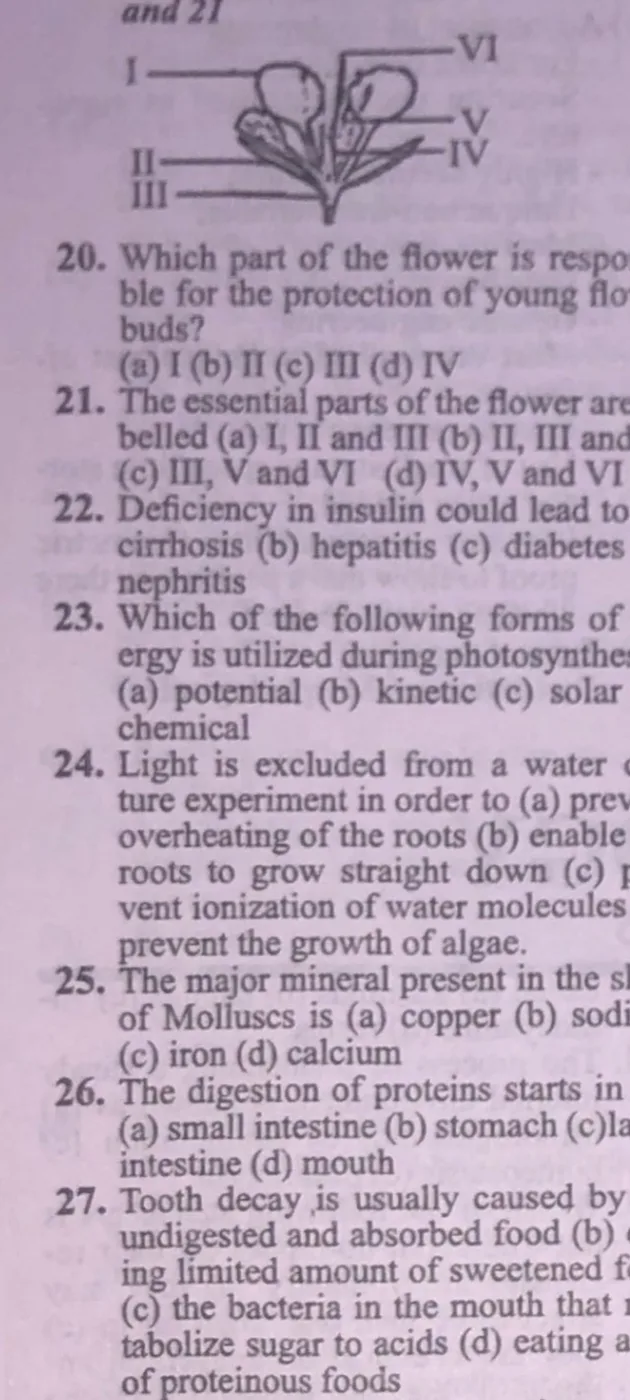
[The diagram below is an illustration of the longitudinal section of a flower] Which part of the flower is responsible for the protection of young flower buds?
A. I
B. IICorrect
C. III
D. IV
Explanation
The flower part that protects other floral parts is the sepal, labelled II.
The conversion of ammonium salts into nitrates is called
A. putrefaction
B. denitrification
C. fixation
D. nitrificationCorrect
Explanation
The conversion of ammonium salts into nitrates is called Nitrification. Nitrosomonas first converts the ammonium salts into nitrite; Nitrobacter then converts the nitrite into nitrate.
Organisms in an ecosystem are usually grouped according to their trophic level into
A. carnivores and omnivores
B. consumers and parasites
C. producers and saprophytes
D. producers and consumersCorrect
Explanation
Organisms are classified according to their trophic levels into producers and consumers. Consumers are further classified into primary consumers, secondary consumers and tertiary consumers.
In the pyramid of energy illustrated below, the organism with the least amount of transferred energy is
A. spirogyra
B. tadpole
C. fish
D. birdCorrect
Explanation
As we move from a lower trophic level to a higher trophic level, the amount of available energy decreases; thus the organism at the highest/last trophic level shown (bird) has the least amount of transferred energy.
Which of the following roles is not performed by a government agency responsible for forest maintenance?
A. regulating the harvest of timber and poaching
B. creating, protecting and managing the forest reserves
C. tracking the movement of timber, and wildlife
D. regulating mining activities in the forestCorrect
Explanation
Mining activities should be totally forbidden wherever forest conservation is intended, hence regulating mining activities is not a function performed by a government agency responsible for forest maintenance.
Which of the following factors is not a source of variation in living organisms?
A. environment
B. inheritance
C. mitosisCorrect
D. meiosis
Explanation
Variations are as a result of genes and environment. Since genetic dissimilarity results from meiosis, meiosis can also be linked to variation. Mitosis has nothing to do with variation.
In a complete dominance monohybrid cross between a pure breeding yellow flowered plant Y and a pure breeding white flowered plant y, the result of the first filial generation is
A. 5% yellow flowers
B. 75% yellow flowers
C. all yellow flowersCorrect
D. all white flowers
Explanation
Thus, all the offspring will be yellow, albeit in a heterozygous fashion.
A man whose blood group is heterozygous B is married to a woman whose blood group is also heterozygous B. Which of the following statements is correct about the blood group of their four offspring?
A. three of them belong to blood group B
B. three of them belong to blood group O
C. none of them belongs to blood group O
D. two of them belong to blood group BCorrect
Explanation
Thus, three out of four offspring will belong to group B while one will belong to group O.