Free account: track your progress — Sign up free

WAEC Biology 2020 Objective Past Questions

All 50 questions from the West African Examinations Council (WAEC) Biology 2020 Objective paper, with the correct answer and a full explanation for each. Free, no signup needed.

Advertisement

Biology 2020 Objective — Question 1

The cell as the basic unit of life consist of

  • A. cell wall and vacuole
  • B. nucleus and cell wall
  • C. cytoplasm and nucleusCorrect
  • D. cytoplasm and vacuole

Explanation

The cell is divided into the nucleus and the cytoplasm, where other cell organelles are found.

Biology 2020 Objective — Question 2

Which members of the classes live mainly in an aquatic habitat? (I-Crustacea; II-Insecta; III-Arachinda; IV-Chilopoda)

  • A. ICorrect
  • B. II
  • C. III
  • D. IV

Explanation

Class Crustacea comprises mainly aquatic organisms. Examples are crabs, crayfish, prawn, shrimps.

Biology 2020 Objective — Question 3

Which of the classes is characterized by the possession of two pairs of antennae? (I-Crustacea; II-Insecta; III-Arachinda; IV-Chilopoda)

  • A. ICorrect
  • B. II
  • C. III
  • D. IV

Explanation

Crustaceans are the only arthropods that have two pairs of antennae.

Biology 2020 Objective — Question 4

The organism with spiral chloroplasts and nucleus suspended by cytoplasmic strands is

  • A. volvox
  • B. spirogyraCorrect
  • C. paramecium
  • D. euglena

Explanation

The organism with spiral chloroplasts and nucleus suspended by cytoplasmic strands is spirogyra; spirogyra is an unbranched multicellular filamentous alga.

Biology 2020 Objective — Question 5

The network of double membrane that conveys materials through the cytoplasm is the

  • A. plasma membrane
  • B. nuclear membrane
  • C. mitochondrion
  • D. endoplasmic reticulumCorrect

Explanation

The network of double membrane that conveys material through the cytoplasm is the endoplasmic reticulum. It may be rough or smooth; rough endoplasmic reticulum has ribosomes on its outer membrane while the smooth type does not.

Biology 2020 Objective — Question 6

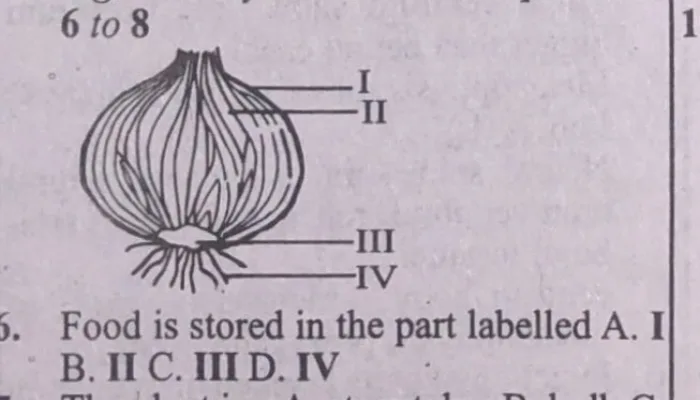
Food is stored in the part labelled (using the plant organ longitudinal section diagram, labels I-IV)

Diagram for question 6
  • A. I
  • B. IICorrect
  • C. III
  • D. IV

Explanation

Food is stored in the part labelled II of the diagram (this illustrates an onion bulb).

Biology 2020 Objective — Question 8

The part labelled I is the

  • A. apical bud
  • B. scale leafCorrect
  • C. adventitious root
  • D. fleshy leaf

Explanation

The part labelled I is the membranous or scale leaf of the bulb.

Biology 2020 Objective — Question 9

Which of the following materials is not a living semi-permeable membrane?

  • A. pig's bladder
  • B. unripe paw-paw fruit
  • C. yam tuber
  • D. sheet of cellophaneCorrect

Explanation

Pig's bladder, unripe pawpaw fruit and yam tuber can function as living semi-permeable membranes; a sheet of cellophane is a non-living (artificial) semi-permeable membrane.

Biology 2020 Objective — Question 10

In an experiment, mould and yeast cells were transferred into an environment with low oxygen concentration. After a few days, the mould died while the yeast cells did not. Which of the following statements best explains the above observation?

  • A. The yeast cells carried out photosynthesis while the mould did not
  • B. photosynthesis does not take place in the absence of oxygen
  • C. respiration can take place in yeast cells in the absence of oxygenCorrect
  • D. respiration does not occur in the mould

Explanation

This shows that respiration can take place in yeast cells in the absence of oxygen (anaerobic respiration/fermentation), unlike the mould which requires oxygen.

Biology 2020 Objective — Question 11

Which of the following tissue does not provide support in flowering plants?

  • A. collenchyma
  • B. parenchyma
  • C. xylem
  • D. phloemCorrect

Explanation

Collenchyma, parenchyma and xylem all provide mechanical/structural support in plants; phloem's main function is the transport of manufactured food (translocation), not support.

Biology 2020 Objective — Question 12

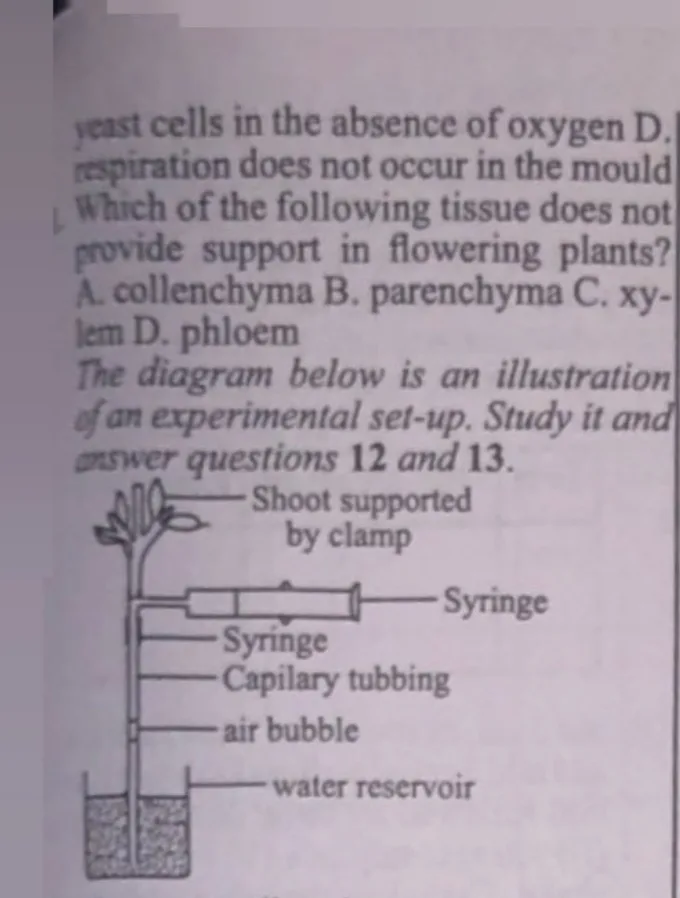
The set-up directly measures

Diagram for question 12
  • A. transpiration of water by the shootCorrect
  • B. evaporation of water from the leaves
  • C. absorption of water by the shoot
  • D. loss of mineral salts from the leaves

Explanation

The experimental set-up (photometer/potometer, with syringe, capillary tubing and air bubble) directly measures the rate of water transpired/absorbed by the shoot, indicated by the movement of the air bubble.

Biology 2020 Objective — Question 13

The set-up measure comparatively the rate of

  • A. evaporation from leaves on a single shoot under different conditions
  • B. salt uptake by shoots from different plants
  • C. transpiration of a single shoot of a plant under different experimental conditionsCorrect
  • D. water uptake by roots of different plants

Explanation

The set-up is used to comparatively measure the rate of transpiration of a single shoot of a plant under different experimental conditions (e.g. varying humidity, light, wind).

Biology 2020 Objective — Question 14

The respiratory organ of a cockroach is the

  • A. air sac
  • B. tracheaCorrect
  • C. lung book
  • D. lung

Explanation

Trachea is the respiratory organ in cockroach and other insects.

Biology 2020 Objective — Question 15

The excretory product of some reptile, birds and insects is

  • A. urea
  • B. uric acidCorrect
  • C. ammonia
  • D. phlome

Explanation

Mammals such as humans excrete urea, while birds, reptiles and some terrestrial invertebrates (like insects) produce uric acid as their nitrogenous excretory product.

Biology 2020 Objective — Question 16

The part of the mammalian kidney that stores urine is the

  • A. capsule
  • B. medulla
  • C. pelvis
  • D. bladderCorrect

Explanation

Urine is produced by the mammalian kidney and stored in the urinary bladder.

Biology 2020 Objective — Question 17

The properties of endocrine system include the following except

  • A. secretion of hormone
  • B. transportation by blood to target organs
  • C. having specific effect
  • D. release of secretions into ductCorrect

Explanation

Endocrine glands are ductless glands; they do not release their secretions into ducts (that is a property of exocrine glands). Their hormones are secreted directly into the bloodstream to target organs.

Biology 2020 Objective — Question 18

The part of the central nervous system that controls unconsciousness actions in humans is the

  • A. cerebellum
  • B. cerebrum
  • C. spinal cordCorrect
  • D. optic nerves

Explanation

Reflex actions (unconscious/involuntary actions) are not controlled by the brain but by the spinal cord.

Biology 2020 Objective — Question 19

What happens when the ciliary muscles of the eye contract?

  • A. The lens become more concave
  • B. lens become more convexCorrect
  • C. lens get a longer focal length
  • D. suspensory ligament becomes suspensory light

Explanation

When the ciliary muscles contract, the suspensory ligaments loosen and the lens becomes more spherical/convex, increasing its refractive power for near vision.

Biology 2020 Objective — Question 20

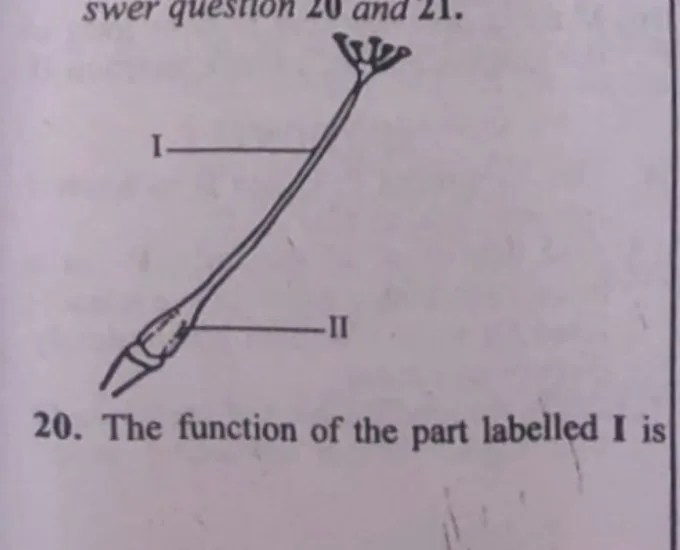
The function of the part labelled I is

Diagram for question 20
  • A. (see explanation)
  • B. (see explanation)Correct
  • C. (see explanation)
  • D. (see explanation)

Explanation

The style is the tube-like structure which connects the ovary and the stigma, through which the pollen grain enters the ovary.

Biology 2020 Objective — Question 21

The part labelled II is the

  • A. unfused stigma
  • B. fused style
  • C. fused ovariesCorrect
  • D. unfused anther

Explanation

The part labelled I is the style while the part labelled II is the ovary.

Biology 2020 Objective — Question 22

The part labelled II is the

  • A. receiving the pollen grain
  • B. passage for the male gamete to the ovaryCorrect
  • C. germination of the pollen grain
  • D. site for double fertilization in the plant

Explanation

The style provides the passage through which the male gamete (pollen tube) travels to reach the ovary for fertilization.

Biology 2020 Objective — Question 23

The reagent used in testing for carbon (IV) oxide is

  • A. copper sulphate solution
  • B. lime waterCorrect
  • C. hydrochloric acid
  • D. sodium hydroxide solution

Explanation

The reagent used in testing for carbon (IV) oxide is lime water. Carbon (IV) oxide is known to turn lime water milky.

Biology 2020 Objective — Question 24

Oxygen comes out of the stomata during photosynthesis through the process known as

  • A. diffusionCorrect
  • B. transpiration pull
  • C. osmosis
  • D. active transport

Explanation

Oxygen comes out of the stomata during photosynthesis through the process of diffusion.

Biology 2020 Objective — Question 25

The first stable product of photosynthesis is

  • A. starch
  • B. fructose
  • C. glucoseCorrect
  • D. sucrose

Explanation

The first stable product of photosynthesis is glucose.

Biology 2020 Objective — Question 26

An example of a trace element is

  • A. potassium
  • B. calcium
  • C. magnesium
  • D. copperCorrect

Explanation

Copper is a trace element. Trace elements are those nutrients required in very small quantities.

Biology 2020 Objective — Question 27

Which of the following statements about a mixture of a protein-digesting enzyme and starch solution would be correct?

  • A. The protein-digesting enzyme has no effect on the starch solutionCorrect
  • B. leads to the production of amino acids
  • C. leads to the production of glucose
  • D. digest the starch

Explanation

Since enzymes are specific in their actions, a protein-digesting enzyme will show no effect on starch solution.

Biology 2020 Objective — Question 28

A mutualism type of relationship is different from a parasitic relationship because in mutualism, A. both organisms benefit B. none of the organisms benefit or harm each other C. both organism harm each other D. only one of the organism is harmed

  • A. both organisms benefitCorrect
  • B. none of the organism benefit or harm each other
  • C. both organism harm each other
  • D. only one of the organism is harmed

Explanation

In mutualism, both organisms benefit. In parasitism, one organism benefits while the other organism suffers harm.

Biology 2020 Objective — Question 29

What type of habitat is W? (using the given habitat table of organisms)

  • A. rainforest
  • B. pondCorrect
  • C. desert
  • D. ocean

Explanation

This type of organism present indicates that the habitat is not likely to be terrestrial. Therefore, the correct choice is pond (a freshwater habitat where plankton, tilapia, and waterflea can live comfortably).

Biology 2020 Objective — Question 30

The number of lions and antelopes in habitat Y shows that the lion

  • A. is the prey while the antelope is the predator
  • B. is the predator while the antelope is the preyCorrect
  • C. and the antelope are preys to each other
  • D. and the antelopes are predators

Explanation

Lion is the predator while the antelope is the prey (lions typically have a much lower population than their prey in a food chain/web).

Biology 2020 Objective — Question 31

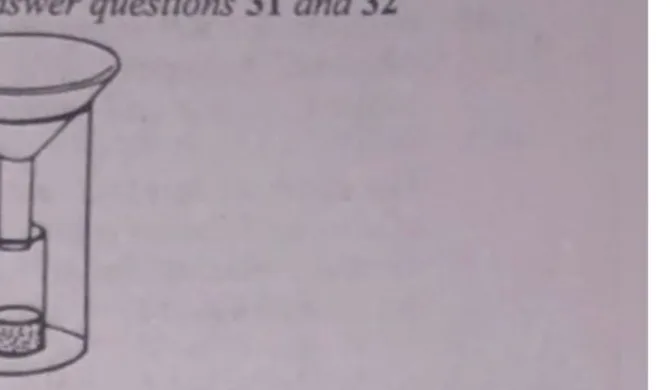
A disadvantage of the abiotic factor measured by the instrument is that it

Diagram for question 31
  • A. is an agent of pollination
  • B. is necessary for germination
  • C. leads to flooding when in excessCorrect
  • D. is used for irrigation

Explanation

The instrument is known as a rain gauge; it measures the amount of rainfall. Excessive rain (measured by this instrument) may lead to flooding.

Biology 2020 Objective — Question 32

When the instrument is in use, it is usually

  • A. placed slightly above soil levelCorrect
  • B. placed on a table
  • C. suspended in air
  • D. suspended on moving water

Explanation

When the rain gauge is in use, it is usually placed slightly above soil level.

Biology 2020 Objective — Question 33

Soil with the finest texture is

  • A. silt
  • B. clayCorrect
  • C. sand
  • D. gravel

Explanation

Clay is the soil type with the finest texture, while sandy soil is the coarsest form of soil.

Biology 2020 Objective — Question 34

The position occupied by an organism in a food chain is the

  • A. energy level
  • B. niche
  • C. trophic levelCorrect
  • D. biomass

Explanation

The position occupied by an organism in a food chain/habitat is the trophic level. In an ecosystem/habitat, the role and location of an organism is its ecological niche.

Biology 2020 Objective — Question 35

The depletion of the ozone layer will result in the earth surface receiving more

  • A. gamma rays
  • B. infra-red rays
  • C. ultraviolet raysCorrect
  • D. X-rays

Explanation

The ozone layer protects the earth surface from receiving excessive ultraviolet rays. Thus, the depletion of ozone layer exposes the earth surface to excessive ultraviolet rays.

Biology 2020 Objective — Question 36

The insects whose activities are both beneficial and harmful to humans are (using the list: I-cotton stainer, II-honeybee, III-termite, IV-weevil)

  • A. I and II
  • B. II and IIICorrect
  • C. II and IV
  • D. III and IV

Explanation

Honeybee and termite are both beneficial and harmful to humans. For instance, honeybees sting but also provide honey; termites are decomposers but also eat/destroy wood.

Biology 2020 Objective — Question 37

Which of the insects destroys grains? (using the list: I-cotton stainer, II-honeybee, III-termite, IV-weevil)

  • A. I
  • B. II
  • C. III
  • D. IVCorrect

Explanation

Weevils are known to destroy grains.

Biology 2020 Objective — Question 38

Conservation of natural resources does not

  • A. maintain a balanced ecosystem
  • B. preserve the beauty of nature
  • C. attracts tourist
  • D. threaten the survival of speciesCorrect

Explanation

The purpose of conservation of natural resources is to enhance the survival of species, not threaten it.

Biology 2020 Objective — Question 39

A company was prohibited from producing bags made from natural leopard skin. This is an attempt to conserve

  • A. land
  • B. water
  • C. wildlifeCorrect
  • D. minerals

Explanation

Prohibiting a company from producing bags from natural leopard skin is an adaptation to conserve wildlife.

Biology 2020 Objective — Question 40

Which of the following natural resources is not conservable?

  • A. mineral
  • B. airCorrect
  • C. soil
  • D. water

Explanation

Mineral, soil and water are conservable natural resources; air is generally considered non-conservable/inexhaustible in this context.

Biology 2020 Objective — Question 41

A child that can receive blood donation from anybody belongs to the blood group

  • A. O
  • B. A
  • C. B
  • D. ABCorrect

Explanation

A child from blood group AB can receive blood donation from anybody. This is why AB is known as the universal recipient.

Biology 2020 Objective — Question 42

Variation which exhibits a wide range from one extreme to the other is

  • A. phenotypic variation
  • B. discontinuous variation
  • C. continuous variationCorrect
  • D. genotypic variation

Explanation

Variation which exhibits a wide range from one extreme to the other is said to be continuous. That which does not is said to be discontinuous.

Biology 2020 Objective — Question 43

Measurements of height and weight of students in a class show A. discontinuous variation B. continuous variation C. shortness is more prevalent D. fatness is less prevalent

  • A. discontinuous variation
  • B. continuous variationCorrect
  • C. shortness is more prevalent
  • D. fatness is less prevalent

Explanation

Measurements of height and weight of students in a class show continuous variation since these variations exhibit a wide range from one extreme to the other.

Biology 2020 Objective — Question 44

Which of the following statements about chromosomes is correct?

  • A. all the chromosome of a species are the same shape
  • B. the number present in a species is constantCorrect
  • C. they are neatly arranged in the cytoplasm
  • D. they bear ribosomes on their outer membranes

Explanation

All members of a given species have a fixed chromosome number. For instance, the diploid chromosome number in humans is 46.

Biology 2020 Objective — Question 45

Which of the following disease can be inherited?

  • A. pneumonia
  • B. whooping cough
  • C. sickle cell anaemiaCorrect
  • D. malaria

Explanation

Sickle cell anaemia can be inherited, while pneumonia, whooping cough and malaria cannot be inherited (they are caused by pathogens/environmental factors).

Biology 2020 Objective — Question 46

If the F1 generation are plants with high yield and resistance, the genotype of the F1 generation plants would be

  • A. YYRR
  • B. YyRrCorrect
  • C. yyRr
  • D. yyrr

Explanation

Given the parent genotypes YYrr (high yield, low resistance) and yyRR (low yield, high resistance), the F1 generation (crossing these) would have the genotype YyRr.

Biology 2020 Objective — Question 47

The process that gave rise to the F1 generation is

  • A. self-fertilization
  • B. cross fertilizationCorrect
  • C. out-breeding
  • D. test cross

Explanation

The F1 generation is obtained from the parent generation through cross fertilization.

Biology 2020 Objective — Question 48

Replication of DNA molecules is catalysed by an enzyme called

  • A. polymeraseCorrect
  • B. ptyalin
  • C. pepsin
  • D. amylase

Explanation

Replication of DNA molecules is catalysed by an enzyme called polymerase.

Biology 2020 Objective — Question 49

Who proposed the theory of evolution by natural selection?

  • A. A. DarwinCorrect
  • B. B. Lamarck
  • C. C. Aristotle
  • D. D. Linnaeus

Explanation

The theory of evolution by natural selection was propounded by Charles Darwin.

Biology 2020 Objective — Question 50

Which of the following statement best explains the reason why termites swarm at night?

  • A. light is unnecessary
  • B. they avoid day-flying birdsCorrect
  • C. light destroys their wings
  • D. they can only see in the dark

Explanation

Termites swarm after their colony has reached a certain capacity level and is ready to expand; swarming at night helps them avoid day-flying birds (predators).

Advertisement

Sign up free to unlock

  • Score tracking
  • Practice history
  • Saved questions
  • Progress dashboard
  • Personalized sessions
  • Weak-topic breakdown

…and/or go further with premium services and No Ads.