All 6 questions from the West African Examinations Council (WAEC) Biology 2020 Theory paper, with the correct answer and a full explanation for each. Free, no signup needed.
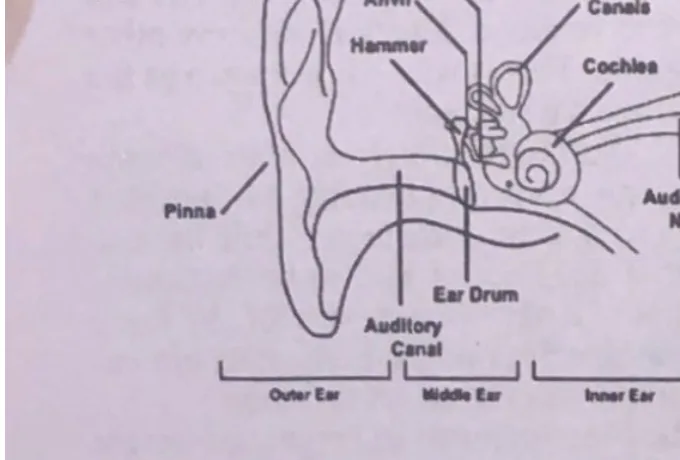
1(a) Explain briefly how the human ear carries out its function of balancing. (b) Make a drawing 8 cm - 10 cm long of the structure of the human ear and label fully.
Model answer
(a) When the head is moved in a particular direction, it affects the fluid (endolymph) in the corresponding semi-circular canal. This causes the sensory cells in the ampulla to set up impulses through the auditory nerve to the brain, where the impulse is interpreted. The brain then sends impulses to the muscles so that balancing occurs. NB: The cochlea is the part of the ear concerned with hearing, while the semi-circular canal is concerned with the maintenance of balance.
(b) [Drawing: fully labelled diagram of the human ear, showing the outer ear (pinna, auditory canal), middle ear (ear drum, hammer, anvil, stirrup) and inner ear (semicircular canals, cochlea, auditory nerve).]
2(a)(i) What is a deficiency disease? (ii) Complete the table by naming five nutrient deficiency diseases in humans and stating one remedy each for the diseases. (b) Outline a chemical test for: (i) starch in a tuber of yam; (ii) glucose in orange fruit.
Model answer
(a)(i) A deficiency disease is a disease that occurs as a result of lack of important nutrient(s).
(ii) Nutrient Deficiency Disease and Remedy: Kwashiorkor - the child should be fed with food with adequate amount of protein. Scurvy - intake of food that is rich in vitamin C. Night blindness - intake of food that is rich in vitamin A. Beriberi - intake of food that is rich in Vitamin B1. Rickets - intake of food that is rich in calcium and vitamin D. Goitre - intake of food that is rich in iodine.
(b)(i) Test for starch in a tuber of yam: After the tuber of yam is peeled and sliced, few drops of iodine solution should be added. A blue-black colouration confirms the presence of starch.
(ii) Test for glucose in orange fruit: The juice of the orange should be squeezed and then Fehling's reagent should be added. The mixture should then be gently heated. Formation of a brick-red precipitate shows the presence of glucose.
3(a) Complete the table below on diseases (Cholera, Trypanosomiasis, Malaria, Ringworm), naming the causative organism, vector and control for each. (b) Explain briefly the biological basis of preserving foods using each of the following methods: (i) salting; (ii) irradiation; (iii) smoking.
Model answer
(a) Disease/Causative Organism/Vector/Control table: Cholera - Vibrio cholerae / Housefly / By maintaining food hygiene. Trypanosomiasis (Sleeping sickness) - Trypanosome / Tsetsefly / Elimination of Tsetsefly. Malaria - Plasmodium spp / Female anopheles mosquito / Elimination of mosquito, use of mosquito net. Ringworm - Tinea spp, Microsporum, Trichophyton, Epidermophyton / Kittens, puppies, cows, goats (infected animals and persons) / Maintaining good hygiene, avoiding contact with infected persons, animals capable of spreading ringworm to people.
(b)(i) Salting is a very effective method of food preservation. Use is made of normal edible salt. Salting is used because most bacteria, fungi and other potentially pathogenic organisms cannot survive in a highly salty environment, due to the hypertonic nature of salt, causing the microorganisms to lose water through osmosis and die.
(ii) Food irradiation refers to the treatment of foods by exposing them to ionizing radiation. Non-ionizing radiation has a considerable health risk if not controlled. Irradiation inactivates the micro-organisms in food, preventing spoilage.
(iii) Meats and fish are the most common food types that are preserved by smoking. The food is exposed to smoke from burning or smouldering material, most often wood, during the drying process. Also, the reduced water content makes it unfavourable for micro-organisms to survive in the food.
4(a)(i) Explain briefly what is meant by independent assortment of genes. (ii) Give the reason blood group O in humans can only exist in homozygous form while blood groups A and B can exist in both homozygous and heterozygous forms. (b) Complete the table below by naming the classes of vertebrates in their evolutionary trends and giving one example each of the classes.
Model answer
(a)(i) Independent assortment of genes refers to the fact that a gamete receives for one gene does not influence the allele received for another gene. Mendel's law of independent assortment states that the alleles of two or more different genes get sorted into gametes independently of one another.
(ii) Generally speaking, a trait that can only be expressed in the homozygous form is said to be recessive. Blood group O is recessive to A and B. Thus, AO leads to Heterozygous A, AA leads to Homozygous A, BO leads to Heterozygous B, BB leads to Homozygous B. If O is combined with either A or B, O will not be phenotypically expressed since O is recessive; only OO can be phenotypically expressed as O.
(b) Class of vertebrate and example: Pisces (fishes) - Tilapia, Salmon. Amphibia - Toad, frog, salamander, newts. Reptilia - Lizards, snakes. Aves (Birds) - Pigeons, ducks, domestic fowls, woodpeckers. Mammalia - Man, rabbit, rat.
(c)(i) If the placenta in a pregnant woman is detached from the uterine wall, give three effects this would have on the foetus. (ii) Name three other features present in the uterus of a pregnant woman that are useful for the development of the foetus. (d) Explain briefly how the activities of organisms bring about dynamic equilibrium in the habitat. (e) State four problems that organism in the infertidal zone of a marine habitat could encounter. (f) Explain briefly the reason the following factors are necessary for germination: (i) moisture; (ii) viable seed. (g) Explain briefly the reason light energy is considered a limiting factor in the production of food by autotrophs.
Model answer
(c)(i) Effects on the foetus if the placenta is detached: It will cause the foetus to stop receiving food. It will stop the removal of waste products from the foetal blood. It may lead to still birth.
(ii) Other features present in the uterus of a pregnant woman useful for foetal development: Chorion; Allantois; Amnion; Amniotic fluid.
(d) The activities of organisms are a driving tool for the dynamic equilibrium in a habitat. For instance, the activities of decomposers (such as bacteria, fungi and some protists) help to release nutrients into the soil; the CO2 released during respiration is harnessed during photosynthesis, and the O2 released during photosynthesis is used for respiration.
(e) Problems that organisms in the intertidal zone of a marine habitat could encounter: Desiccation/drying up; Oxygen deficiency; Reduced visibility; Varied osmotic balance; Fluctuation of water temperature.
(f)(i) Moisture is necessary for germination to soften the testa or seed coat so that the plumule and radicle can easily come out. It is also required to activate the cell.
(ii) For a seed to germinate, it must be alive or viable. Seeds that are already damaged by insects, birds etc cannot germinate as they are not viable.
(g) Sunlight is needed to split water into hydrogen ions and hydroxyl ions (in a process known as photolysis). Photolysis is an important step in photosynthesis, and light energy provides the energy needed for this process; hence it is a limiting factor in food production by autotrophs.
6(a) Explain briefly the following types of fertilization in animals: (i) external fertilization; (ii) internal fertilization. (b) Name two groups of animals each that exhibit the types of fertilization in 6(a). (c) If the placenta in a pregnant woman detached from the uterine wall, give three effects this would have on the foetus.
Model answer
(a)(i) In external fertilization, the female organism releases the eggs to the external environment, after which the male organism releases sperm on them.
(ii) In internal fertilization, the egg is retained in the body of the female organism and sperm is then introduced into the body of the female organism so that fertilization can take place.
(b)(i) Examples of animal groups that exhibit external fertilization are Pisces (fishes) and amphibians.
(ii) Examples of animal groups that exhibit internal fertilization are mammals, reptiles and Aves (birds).
(c) Effects if the placenta is detached from the uterine wall: It will cause the foetus to stop receiving food; it will stop the removal of waste products from the foetal blood; it may lead to still birth.
Advertisement
Sign up free to unlock
Score tracking
Practice history
Saved questions
Progress dashboard
Personalized sessions
Weak-topic breakdown
…and/or go further with premium services and No Ads.