Free account: track your progress — Sign up free

WAEC Biology 2022 Objective Past Questions

All 50 questions from the West African Examinations Council (WAEC) Biology 2022 Objective paper, with the correct answer and a full explanation for each. Free, no signup needed.

Advertisement

Biology 2022 Objective — Question 1

Which of the following statements about living things is correct?

  • A. Animals respire using carbon (IV) oxide as a raw material
  • B. Growth in plants is limited after some time
  • C. Most plants respond to stimulus slowlyCorrect
  • D. Higher animals can reproduce asexually

Explanation

Plants generally respond to stimuli more slowly than animals do, due to their lack of a nervous system; animals respire using oxygen (not CO2) as a raw material, plant growth is typically continuous (not limited), and higher animals reproduce sexually, not asexually.

Biology 2022 Objective — Question 2

Organ level of organization in living things is found in

  • A. waterleaf plant
  • B. virus particle
  • C. kidneyCorrect
  • D. spermatozoon

Explanation

The kidney is an organ, made up of different tissues working together — representing organ-level organization.

Biology 2022 Objective — Question 3

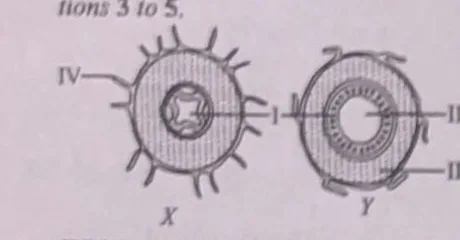
Diagrams X and Y below are illustrations of transverse sections of a part of plants. Which of the following statements is not correct? Diagrams X and Y are sections of

Diagram for question 3
  • A. rootsCorrect
  • B. a dicotyledonous root and a monocotyledonous root respectively
  • C. vascular bundles
  • D. stems

Explanation

Diagrams X and Y are cross-sections of roots (a dicotyledonous root and a monocotyledonous root respectively), so describing them simply as 'roots' without distinguishing the root type is the less precise/incorrect general statement intended here — per the source answer key, 'A' is marked as not correct.

Biology 2022 Objective — Question 4

The part responsible for conducting water and dissolved mineral salts from the soil to the leaves is labelled

  • A. I
  • B. IICorrect
  • C. III
  • D. IV

Explanation

Part II corresponds to the xylem tissue, which is responsible for conducting water and dissolved mineral salts from the roots to the leaves.

Biology 2022 Objective — Question 5

The part labelled II is the

  • A. pith
  • B. xylemCorrect
  • C. phloem
  • D. endodermis

Explanation

Part II is the xylem, responsible for water and mineral conduction.

Biology 2022 Objective — Question 6

The organelles in cells which are also referred to as suicidal bags are the

  • A. mitochondria
  • B. lysosomesCorrect
  • C. ribosomes
  • D. nuclei

Explanation

Lysosomes are referred to as 'suicidal bags' because they contain digestive enzymes that can destroy the cell itself (autolysis) if released, e.g. during cell death.

Biology 2022 Objective — Question 7

The process that brings about the shrinking of a Spirogyra cell when placed in a strong solution is

  • A. osmosis
  • B. autolysis
  • C. plasmolysisCorrect
  • D. diffusion

Explanation

Plasmolysis is the shrinking of a plant cell's cytoplasm when placed in a hypertonic (strong) solution, due to loss of water from the cell by osmosis.

Biology 2022 Objective — Question 8

The region of a plant stem in which cells divide to increase its diameter is the

  • A. cambiumCorrect
  • B. phloem
  • C. xylem
  • D. collenchyma

Explanation

The cambium is meristematic tissue responsible for secondary growth (increase in diameter) of plant stems, through cell division.

Biology 2022 Objective — Question 9

The total number of caudal vertebrae in animals X and Y is 4 and 27 respectively. The animals are likely to be A. fish and human.

  • A. toad and rat
  • B. toad and fishCorrect
  • C. humans and rat

Explanation

A human (X, few caudal vertebrae ~4, forming the coccyx) and a rat (Y, many caudal vertebrae ~27, having a long tail) match this description.

Biology 2022 Objective — Question 10

Which of the following blood components has the greatest affinity for oxygen and carbon (IV) oxide?

  • A. Lymphocyte
  • B. ErythrocyteCorrect
  • C. Blood plasma
  • D. Thrombocyte

Explanation

Erythrocytes (red blood cells) contain haemoglobin, which has the greatest affinity for binding oxygen and carbon dioxide for transport.

Biology 2022 Objective — Question 11

Use the following processes to answer questions 11 and 12. I – Ribs move upward and outward II – Diaphragm relaxes III – Volume of thorax increases IV – Air is forced out of the lungs Which of the processes take place during inspiration?

  • A. I and III onlyCorrect
  • B. II and III only
  • C. II and IV only
  • D. III and IV only

Explanation

During inspiration, the ribs move upward and outward (I) and the volume of the thorax increases (III), drawing air into the lungs.

Biology 2022 Objective — Question 12

Which of the processes is a direct result of contraction of the intercostal muscles?

  • A. I. B. II C. IIICorrect
  • B. IV

Explanation

The contraction of the intercostal muscles directly causes the ribs to move upward and outward (I), which then leads to the other changes.

Biology 2022 Objective — Question 13

The process by which the amount of water and solutes in the blood are controlled is known as

  • A. haemolysis
  • B. diffusion
  • C. turgidity
  • D. osmoregulationCorrect

Explanation

Osmoregulation is the process by which the body controls/regulates the water and solute (osmotic) balance in the blood and body fluids.

Biology 2022 Objective — Question 14

Use the following table to answer questions 14 and 15. The table below shows the effect of hormones I, II, III and IV on some parts of the human body. (✓) represents effect and (✗) represents no effect of hormone on the corresponding part of the body. Hormone | Heart | Digestive system | Kidney | Uterus I | ✓ | ✓ | ✓ | ✓ II | ✗ | ✗ | ✗ | ✓ III | ✗ | ✗ | ✗ | ✓ IV | ✗ | ✓ | ✗ | ✗ Which of the following hormones are I, II, III and IV respectively?

  • A. ADH, Glucagon, Oestrogen, Adrenaline
  • B. Adrenaline, Glucagon, Oestrogen, ADH
  • C. Glucagon, ADH, Oestrogen, Adrenaline
  • D. Adrenaline, ADH, Oestrogen, GlucagonCorrect

Explanation

Based on the pattern of effects shown: I (affects all — Adrenaline, general fight-or-flight effects), II (affects uterus only — ADH acting on kidney/related systems), III (affects uterus — Oestrogen), IV (affects digestive system — Glucagon). Matching to option D: Adrenaline, ADH, Oestrogen, Glucagon.

Biology 2022 Objective — Question 15

The hormone responsible for anxiety is

  • A. ACorrect
  • B. B. II
  • C. C. III
  • D. D. IV

Explanation

Adrenaline (hormone I, which affects the heart, digestive system, kidney and uterus broadly) is the hormone responsible for the body's anxiety/stress ('fight or flight') response.

Biology 2022 Objective — Question 16

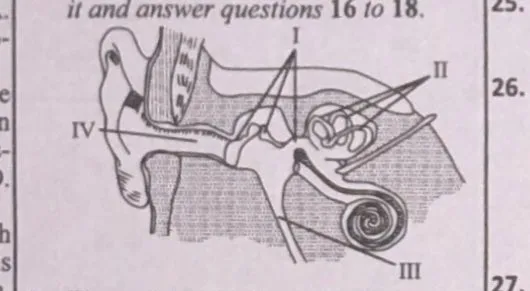
The diagram below is an illustration of some parts of a mammalian ear. Study it and answer questions 16 to 18. The parts labelled I are the

Diagram for question 16
  • A. semi circular canalsCorrect
  • B. ossicles
  • C. cochlea
  • D. external auditory meatus

Explanation

Part I in the diagram represents the semi-circular canals, part of the inner ear responsible for balance.

Biology 2022 Objective — Question 17

Which of the parts are correctly grouped? Inner ear | Middle ear | Outer ear

  • A. I, IV | III | IICorrect
  • B. III | II, IV | I
  • C. I | II | III, IV
  • D. II | I, II | IV

Explanation

The correct grouping (per the diagram) is: Inner ear (I, IV), Middle ear (III), Outer ear (II).

Biology 2022 Objective — Question 18

The middle ear is connected to the pharynx by the part labelled

  • A. I
  • B. IICorrect
  • C. III
  • D. IV

Explanation

The middle ear is connected to the pharynx via the Eustachian tube, which corresponds to part II in the diagram.

Biology 2022 Objective — Question 19

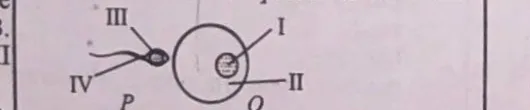
The diagrams below are illustrations of two different cells involved in a biological process in mammals. Study them and answer questions 19 to 21. Which parts of P and Q fuse to complete the biological process?

Diagram for question 19
  • A. the endospermal nuclei of P and Q
  • B. the nuclei of P and QCorrect
  • C. the cytoplasm of P and Q
  • D. the cell membranes of P and Q

Explanation

P and Q represent the male and female gametes; fertilization occurs when the nuclei of the male gamete (P) and female gamete (Q) fuse.

Biology 2022 Objective — Question 20

Which of the following statements about P and Q is correct?

  • A. Both P and Q are structures for asexual reproduction
  • B. Both P and Q normally belong to the same individual
  • C. Both cells are found in plants
  • D. The union of both cells gives rise to a new mammalCorrect

Explanation

P and Q represent the male and female gametes; their fusion (fertilization) gives rise to a new offspring (mammal).

Biology 2022 Objective — Question 21

If the number of chromosomes in the skin cells of mammals is 46, how many chromosomes would be found in P and Q respectively?

  • A. 23 and 23Correct
  • B. 23 and 46
  • C. 46 and 23
  • D. 46 and 46

Explanation

Gametes (P and Q, sex cells) are haploid, containing half the number of chromosomes found in body/somatic cells. Since somatic cells have 46, each gamete (P and Q) has 23 chromosomes.

Biology 2022 Objective — Question 22

In which of the following structures is a simple sugar produced?

  • A. Vacuole
  • B. Cytoplasm
  • C. ChloroplastCorrect
  • D. Cell wall

Explanation

Simple sugar (glucose) is produced in the chloroplast, the site of photosynthesis in plant cells.

Biology 2022 Objective — Question 23

An evidence of the occurrence of photosynthesis in an experiment is the

  • A. release of carbon (IV) oxide
  • B. release of oxygenCorrect
  • C. formation of water molecules
  • D. formation and release of fructose

Explanation

The release of oxygen gas (as a by-product) during an experiment is a key evidence that photosynthesis is occurring in a plant.

Biology 2022 Objective — Question 24

The major sources of vitamin A are

  • A. egg yolk, carrot and palm oilCorrect
  • B. mango, pawpaw and eggs
  • C. sorghum, soya bean and liver
  • D. rice bran, green vegetables and milk

Explanation

Egg yolk, carrot, and palm oil are all rich sources of vitamin A (or its precursor, beta-carotene).

Biology 2022 Objective — Question 25

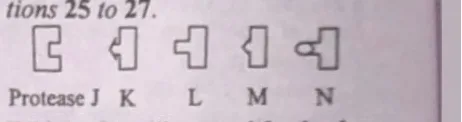
Diagram J is a protease while diagrams K, L, M and N are food substances. Study them and answer questions 25 to 27. Which of the illustrated food substances would form a reaction with protease J?

Diagram for question 25
  • A. K
  • B. L
  • C. M
  • D. NCorrect

Explanation

Since protease J is an enzyme that specifically acts on proteins, it would react with food substance N, which represents a protein-based food.

Biology 2022 Objective — Question 26

Protease J would react with the particular illustrated substance because enzymes are

  • A. denatured at a high frequency
  • B. specific in their actionCorrect
  • C. remain unchanged after a reaction
  • D. speed up the rate of chemical reaction

Explanation

Enzymes are specific in their action — a given enzyme (protease) acts only on a particular substrate (protein), consistent with the lock-and-key hypothesis.

Biology 2022 Objective — Question 27

After a reaction between protease J and the food substance, the end-product would be A. fatty acids.

  • A. glucose
  • B. amino acids
  • C. waterCorrect

Explanation

Since protease J acts on protein, the digestion of protein by a protease yields amino acids as the end-product.

Biology 2022 Objective — Question 28

The property of clayey soil that prevents it from supporting thick vegetation is its

  • A. composition of chemically weathered granite rocks
  • B. inability to retain much water
  • C. tendency of becoming waterloggedCorrect
  • D. porosity and low water-retention ability

Explanation

Clayey soil has very fine particles that pack tightly, causing poor drainage and a tendency to become waterlogged, which prevents it from supporting thick vegetation (roots become oxygen-starved).

Biology 2022 Objective — Question 29

Which of the following practices will not maintain soil fertility?

  • A. Preventing soil erosion
  • B. Bush fallowing
  • C. Leaving the land bare for over cropsCorrect
  • D. Planting cover crops

Explanation

Leaving land bare exposes soil to erosion and nutrient loss, and does not maintain soil fertility, unlike preventing erosion, bush fallowing, or planting cover crops.

Biology 2022 Objective — Question 30

A group of organisms of the same species living in a particular place is known as A. colony.

  • A. community
  • B. ecosystem
  • C. population

Explanation

A population is defined as a group of organisms of the same species living together in a particular place at a particular time.

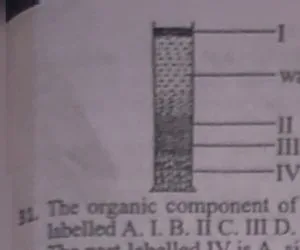
Biology 2022 Objective — Question 31

The diagram below is an illustration of an experiment on sedimentation of soil. Use it to answer questions 31 and 32. The organic component of the soil is labelled

Diagram for question 31
  • A. ICorrect
  • B. II
  • C. III
  • D. IV

Explanation

In a soil sedimentation experiment, the organic matter (humus) — being the lightest — settles as the topmost layer, corresponding to part I.

Biology 2022 Objective — Question 32

The part labelled IV is

  • A. silt
  • B. sand
  • C. humus
  • D. clayCorrect

Explanation

In sedimentation, the heaviest/densest soil particles settle first at the bottom — part IV, the bottom-most layer, corresponds to clay.

Biology 2022 Objective — Question 33

Which of the following pyramids is not used in ecology?

  • A. Pyramid of energy
  • B. numbers
  • C. biomass
  • D. organismsCorrect

Explanation

Ecological pyramids include pyramids of energy, numbers, and biomass — there is no recognized 'pyramid of organisms' in ecology.

Biology 2022 Objective — Question 34

Study the food chain illustrated below and use it to answer questions 34 to 36. J → K → L → M → N Organism J is normally sustained by energy from

  • A. green plants
  • B. carbohydrates
  • C. sunlightCorrect
  • D. organism K

Explanation

Organism J, as the first (producer) level in the food chain, obtains its energy directly from sunlight through photosynthesis.

Biology 2022 Objective — Question 35

Which of the following statements about organism L is correct? It

  • A. feeds on organism M
  • B. is a primary consumer
  • C. is the producer
  • D. is a secondary consumerCorrect

Explanation

In the food chain J(producer)→K(primary consumer)→L(secondary consumer)→M(tertiary consumer)→N, organism L, being the third link, is a secondary consumer.

Biology 2022 Objective — Question 36

The position occupied by each of organisms J, K, L, M and N in the food chain is known as the

  • A. energy level
  • B. trophic levelCorrect
  • C. food web
  • D. pyramid of numbers

Explanation

The position an organism occupies in a food chain (based on its feeding relationship) is known as its trophic level.

Biology 2022 Objective — Question 37

Which of the following features is not an adaptation of plants to aquatic habitats?

  • A. Breathing roots for entry of air
  • B. Flowers are raised above water to attract pollinators
  • C. Spongy tissues containing gases for buoyancy
  • D. Hairy structures on the leaves to reduce water lossCorrect

Explanation

Hairy leaf structures reduce water loss, which is an adaptation to conserve water in dry (xerophytic) conditions, not an adaptation for aquatic habitats — aquatic plants generally don't need to conserve water.

Biology 2022 Objective — Question 38

The biological association that contributes directly to succession in a community is

  • A. competitionCorrect
  • B. predation
  • C. commensalism
  • D. parasitism

Explanation

Competition among organisms for resources drives ecological succession, as species better adapted to conditions outcompete others over time.

Biology 2022 Objective — Question 39

The conservation of natural resources is enhanced by the following practices except

  • A. controlling farming activities
  • B. protecting endangered species
  • C. poaching in game reservesCorrect
  • D. establishing parks and gardens

Explanation

Poaching in game reserves depletes wildlife populations and does not in any way support conservation of natural resources; it is destructive, unlike the other listed practices.

Biology 2022 Objective — Question 40

The burning of farmlands should be discouraged because it A. destroys the organic components of the soil.

  • A. increases the population of wild animals on the farmCorrect
  • B. increases the dormancy period of some plant pests

Explanation

Burning farmlands destroys organic matter in the soil (humus), harming soil fertility and microorganisms.

Biology 2022 Objective — Question 41

The use of a lighter instead of match sticks is a way of conserving A. petroleum.

  • A. forest
  • B. waterCorrect
  • C. wildlife

Explanation

Since matchsticks are made from wood, using a lighter instead helps conserve forest resources.

Biology 2022 Objective — Question 42

An accident victim was successfully transfused with blood from the father whose blood group is AB. The blood group of the accident victim is A. B.

  • A. O
  • B. C. AB
  • C. D. ACorrect

Explanation

Blood group AB individuals are universal recipients, but as a donor, AB blood can only be given to another AB recipient — so the accident victim's blood group must also be AB for a successful (compatible) transfusion.

Biology 2022 Objective — Question 43

Which of the following traits in humans is an example of physiological variation?

  • A. Skin colour
  • B. Finger-print
  • C. Tongue rollingCorrect
  • D. Height

Explanation

Tongue rolling is a physiological/functional trait variation (an ability), distinguishing it from purely physical/structural traits like skin colour, fingerprint pattern, or height.

Biology 2022 Objective — Question 44

Individuals belonging to blood group O are universal donors because

  • A. antigens are absent in their blood cellsCorrect
  • B. members of the group constitute the highest number of humans
  • C. there are no antibodies in their blood plasma
  • D. the antigens of the blood cells are easily destroyed

Explanation

Blood group O red blood cells lack A and B antigens, meaning they won't trigger an immune (antigen-antibody) reaction in recipients of any blood type, making group O individuals universal donors.

Biology 2022 Objective — Question 45

Two tall plants were crossed and all the F₁ plants were tall. When the F₁ plants were selfed, some of the F₂ plants were tall while others were short. What are the possible genotypes of the original tall plants?

  • A. Tt and tt
  • B. TT and TT
  • C. tt and tt
  • D. TT and TtCorrect

Explanation

Since all F₁ are tall (dominant trait) and F₂ shows segregation (tall and short), one tall parent must be homozygous dominant (TT) and cross partner genotype consistent with producing the observed F1/F2 ratio; per the source's answer, the possible genotypes are TT and Tt.

Biology 2022 Objective — Question 46

Which of the following statements best describes a test cross? It is A. to determine the genotype of an individual whose phenotype is known.

  • A. to determine the phenotype of an individual whose genotype is knownCorrect
  • B. between the progeny of parents to ascertain their external expressions
  • C. between two homozygous recessive individuals to confirm the genotypes of the offspring

Explanation

A test cross is used to determine the genotype of an individual with a known dominant phenotype, by crossing it with a homozygous recessive individual and observing the offspring ratio.

Biology 2022 Objective — Question 47

Which of the following statements about sex-linked traits is not correct?

  • A. Males inherit sex-linked traits from their fathersCorrect
  • B. Sex-linked traits are more common in males
  • C. Females can be carriers because they are heterozygous for the trait
  • D. Males only receive one sex chromosome

Explanation

Males inherit their single X chromosome (and any sex-linked traits on it) from their MOTHER, not their father (who contributes the Y chromosome) — making this statement incorrect.

Biology 2022 Objective — Question 48

When two carriers of sickle cell anaemia produce an offspring, the probability of the offspring being a sickler is

  • A. ¾
  • B. ¼Correct
  • C. ½
  • D.

Explanation

Two carriers (heterozygous, AS×AS) have offspring in the ratio 1 AA : 2 AS : 1 SS, so the probability of a sickler (SS) offspring is ¼.

Biology 2022 Objective — Question 49

Which of the following organisms exhibits adaptive colouration?

  • A. Rabbit
  • B. ChameleonCorrect
  • C. Mouse
  • D. Dog

Explanation

The chameleon is well known for its adaptive colouration (camouflage), changing skin colour to blend with its surroundings.

Biology 2022 Objective — Question 50

Which of the following sequences is the correct evolutionary trend in organisms?

  • A. Algae → Liverwort → Ferns → AngiospermsCorrect
  • B. Liverwort → Ferns → Angiosperms → Algae
  • C. Angiosperms → Algae → Ferns → Liverwort
  • D. Ferns → Liverwort → Algae → Angiosperms

Explanation

The evolutionary trend of plants progresses from simple algae to liverworts (bryophytes), to ferns (pteridophytes), to angiosperms (flowering plants) — the correct sequence is Algae→Liverwort→Ferns→Angiosperms.

Advertisement

Sign up free to unlock

  • Score tracking
  • Practice history
  • Saved questions
  • Progress dashboard
  • Personalized sessions
  • Weak-topic breakdown

…and/or go further with premium services and No Ads.