All 50 questions from the West African Examinations Council (WAEC) Biology 2025 Objective paper, with the correct answer and a full explanation for each. Free, no signup needed.
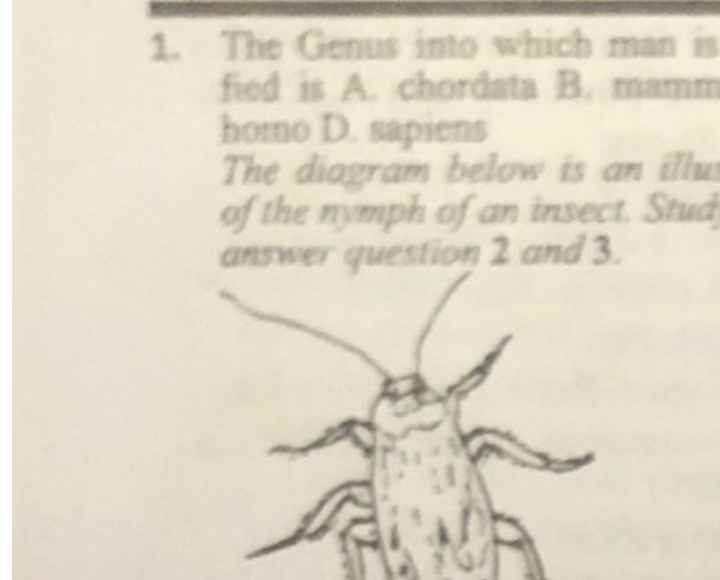
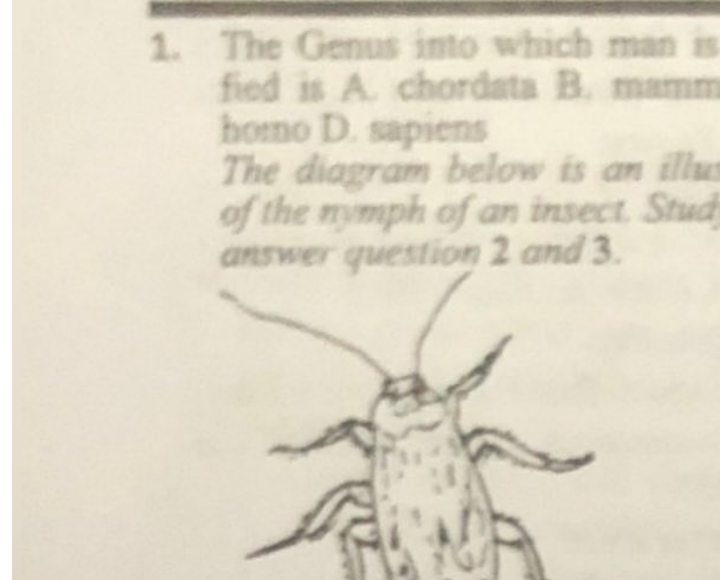
The growth process that would occur in the organism before it becomes an adult is
A. Respiration
B. Locomotion
C. MoultingCorrect
D. Sensitivity
Explanation
The nymph undergoes moulting (shedding of the exoskeleton) several times to grow into an adult, allowing it to increase in size and develop adult features like wings.
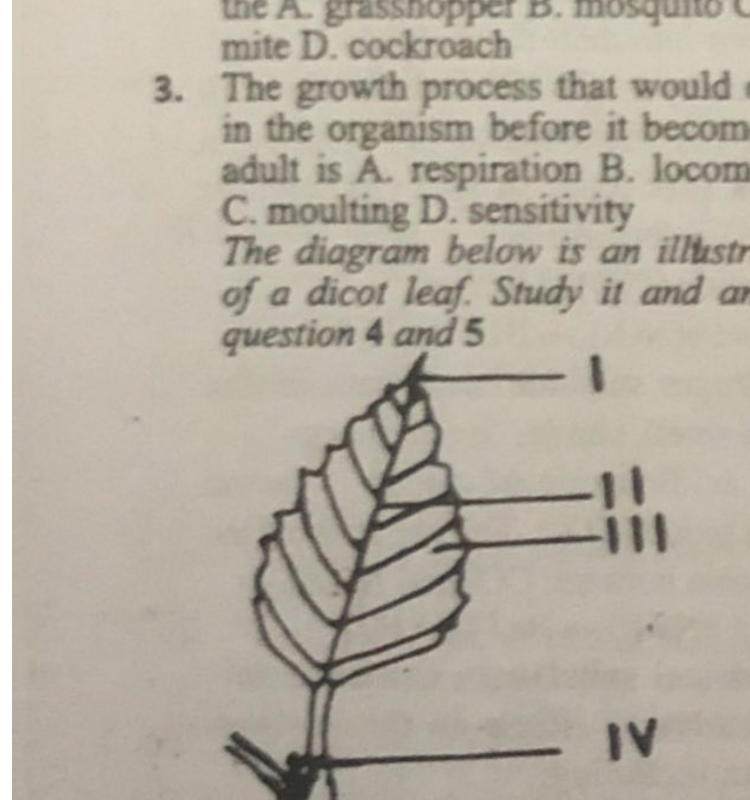
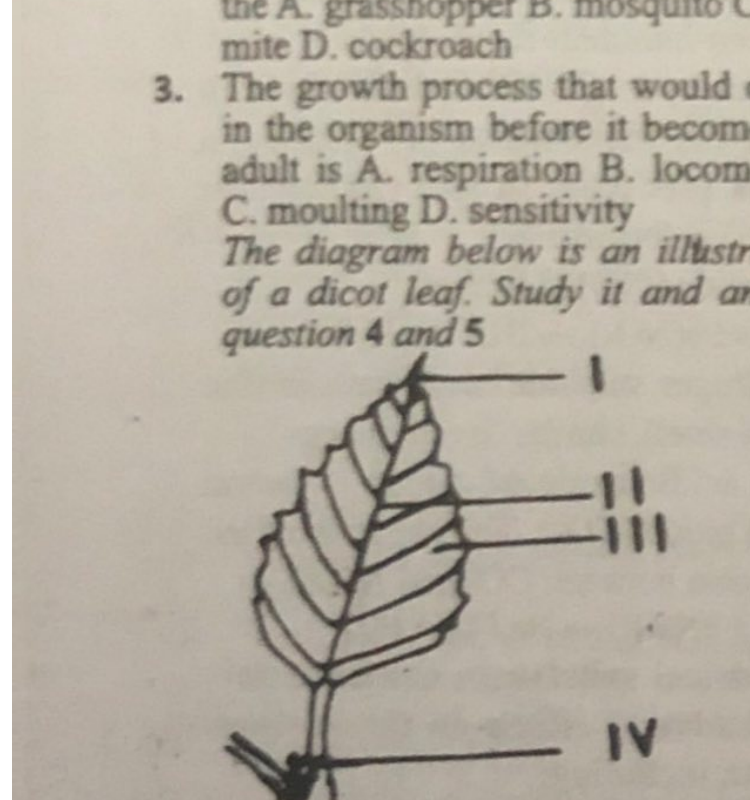
The part that contains the phloem and xylem is labelled
A. I
B. II
C. IIICorrect
D. IV
Explanation
Phloem and xylem are vascular tissues located in the midrib and veins of a leaf. From the diagram, III (lamina, which contains the midrib/veins) corresponds to this.
The functions of vacuoles in plants are storage and
A. Protection
B. Strength
C. SupportCorrect
D. Sensitivity
Explanation
Vacuoles store water, salts, minerals, sugars and waste products, and help maintain internal (turgor) pressure, which pushes the cell membrane against the cell wall, helping the plant maintain rigidity and support (turgidity).
Four cells each with osmotic potential of about 3% salt solution were immersed respectively into solutions of different concentrations as follows: I - 1% salt solution, II - 3% salt solution, III - 6% salt solution, IV - 10% salt solution. Which of the solutions would cause an increase in osmotic pressure within the cell?
A. ICorrect
B. II
C. III
D. IV
Explanation
Osmotic pressure increases when water moves into the cell due to the concentration gradient of solutes. Solution I (1%) is hypotonic relative to the cell's internal solution (3%), so water moves into the cell, increasing osmotic pressure.
If the cells are plant cells, what would happen to the cell in solution III?
A. It would become turgid
B. It would become crenated
C. It would become haemolysed
D. It would become plasmolyzedCorrect
Explanation
Solution III (6% salt) is hypertonic relative to the cell's internal solution (3%), causing water to move out of the cell, resulting in the cell shrinking and the plasma membrane pulling away from the cell wall - plasmolysis.
The primary function of sclerenchyma is to provide mechanical support and strength to the plant, helping it remain rigid. It is not involved in conduction or storage.
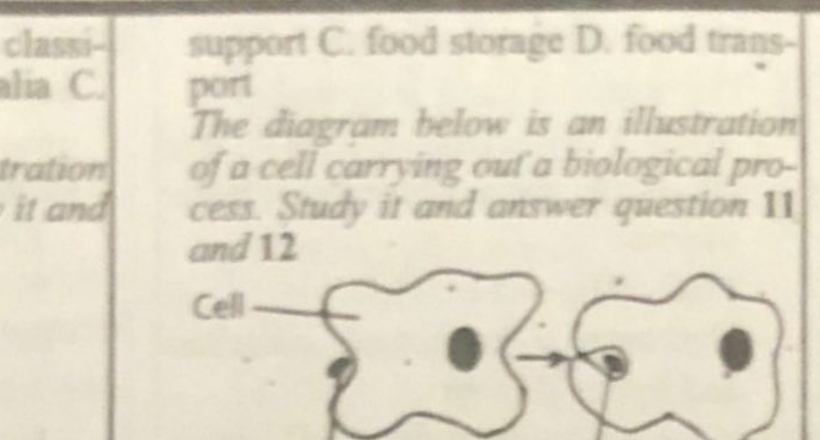
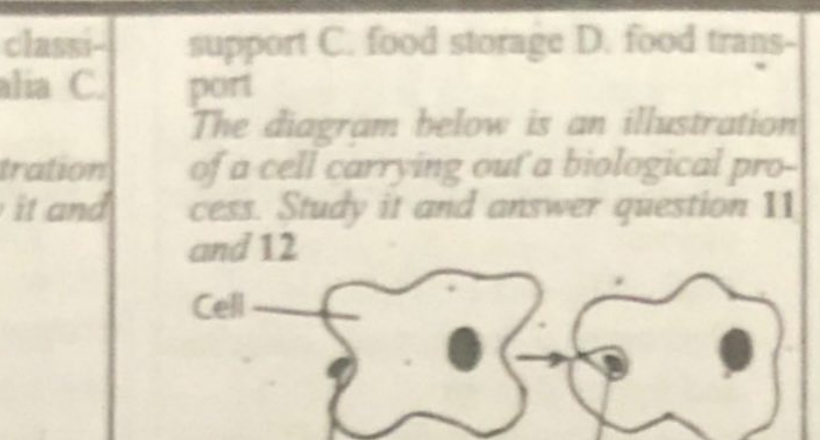
The process illustrated below (bacterium being engulfed by a cell) is referred to as
A. PhagocytosisCorrect
B. Pinocytosis
C. Endocytosis
D. Exocytosis
Explanation
This process involves a cell engulfing a bacterium. The correct term for this is phagocytosis, where a cell surrounds and ingests large particles such as bacteria or dead cells.
Which of the following statements is not correct about respiration in plants?
A. It occurs in all plant tissues
B. Light and chlorophyll must be present for it to occurCorrect
C. Energy is produced as the end product
D. It occurs in the presence of oxygen
Explanation
Photosynthesis is the process that requires light and chlorophyll, not respiration. Respiration occurs in all living plant tissues, produces energy, and (aerobic respiration) requires oxygen.
Urine when compared with blood in mammals is hypertonic because
A. Urine contains high percentage of all cells
B. All traces of sugar have been removed from urine
C. Urea is actively secreted into the renal tubules
D. Much water has been removed from urineCorrect
Explanation
Urine is hypertonic compared to blood because much water has been removed from the urine in the kidneys. The kidneys filter the blood, reabsorb water and useful substances, and excrete the remaining waste and water as urine.
The primary naturally occurring auxin in plants is Indole Acetic Acid (IAA). Auxins are plant hormones that play a significant role in growth regulation.
The sympathetic nervous system is responsible for the 'fight-or-flight' response, which prepares the body to react to stress or danger. One of its effects is vasoconstriction (constriction of blood vessels).
Long-sightedness (hypermetropia) is corrected with a convex (converging) lens. Short-sightedness (myopia) is corrected with a concave (diverging) lens.
During the process of hearing in mammals, the structure in the middle ear which receives the first vibration is the
A. Oval window
B. Round window
C. Incus
D. MalleusCorrect
Explanation
The malleus is the first bone in the middle ear that receives the vibrations from the eardrum. The vibration is passed through the malleus to the incus and then to the stapes, which transmits it to the oval window.
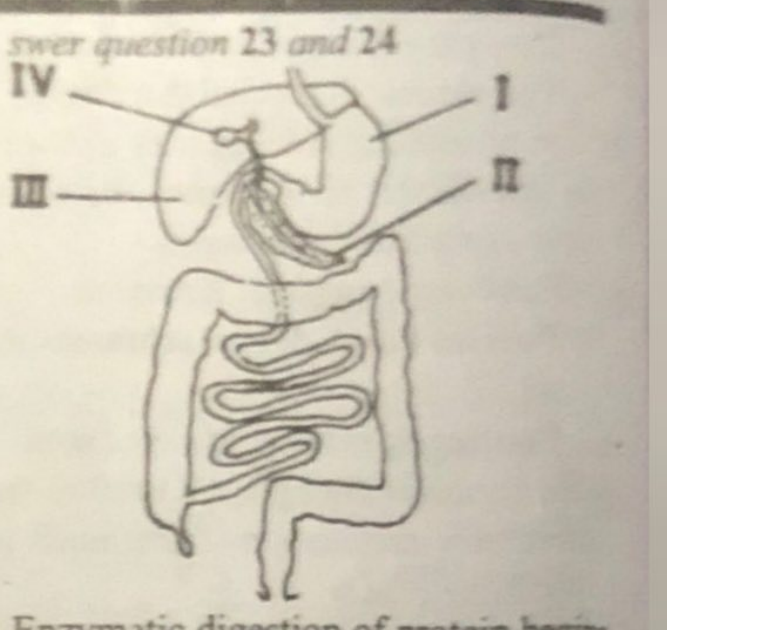
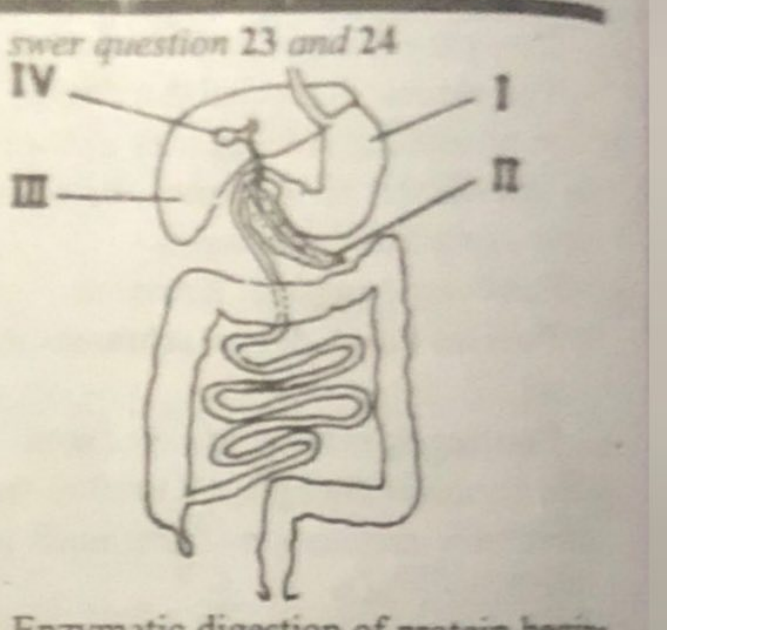
The parts that secrete substances involved in the digestion of fats are labelled
A. I, II and III
B. I and III
C. II and IIICorrect
D. I, III and IV
Explanation
The pancreas (II) produces pancreatic juice containing enzymes, including pancreatic lipase for the digestion of lipids (fats and oils). The liver (III) produces bile, which aids in the emulsification of fats.
If the small intestine of an organism does not have villi, the organism will have a problem with
A. Digestion of food only
B. Absorption of water only
C. Absorption of nutrients onlyCorrect
D. Digestion of food and absorption of nutrients
Explanation
The villi in the small intestine are essential for nutrient absorption. They dramatically increase the surface area for absorption of nutrients from digested food. Without villi, the surface area for absorption is drastically reduced.
Which of the following statements is not correct about the dental formula of humans?
A. One pair of canines is on the upper jaw and three pairs of premolars are on the lower jaw
B. Two pairs of incisors are on the upper jaw and three pairs of premolars are on the lower jaw
C. Two pairs of incisors are on the upper jaw and three pairs of molars are on the lower jawCorrect
D. One pair of canines is on the upper jaw and four pairs of molars are on the lower jaw
Explanation
Dental formula of humans: i=2/2, c=1/1, p=2/2, m=3/3, giving 2 pairs of incisors, 1 pair of canines, 2 pairs of premolars and 3 pairs of molars on both the upper and lower jaws. Statements A, B and D correctly describe this arrangement, so C is the statement that is NOT correct.
The relationship between a bean plant and a Tridax plant on a farmland is
A. CompetitionCorrect
B. Predation
C. Parasitism
D. Epiphytism
Explanation
Competition occurs when two organisms vie for the same resource. In this case, both the bean plant and the Tridax plant would be competing for nutrients, light and space in the soil of the farmland.
The following ecological factors affect all habitats except
A. Temperature
B. Humidity
C. Light
D. PressureCorrect
Explanation
The effect of pressure is not significant in all habitats. It mainly affects aquatic habitats and high-altitude environments, unlike temperature, humidity and light which affect all habitats.
A Secchi disc is lowered into a body of water; the depth at which the disc is no longer visible is recorded as an indicator of water clarity (turbidity).
When tilapia population in a pond reaches the carrying capacity, the population
A. Alternately increases and decreases
B. Remains unchangedCorrect
C. Increases only
D. Decreases only
Explanation
Carrying capacity is the maximum number of individuals that an environment can support sustainably with its available resources. When the tilapia population reaches this point, births and death rates balance out, meaning there is no further increase or decrease in population.
Which of the following statements about the pyramid of energy is correct?
A. Energy remains constant across trophic levels
B. Energy decreases from the base to the apex of the pyramidCorrect
C. Energy increases from the base to the apex
D. Each trophic level is an independent energy source
Explanation
The pyramid of energy represents the flow of energy through an ecosystem. At each trophic level, energy is lost primarily as heat due to metabolism and other biological processes, so energy decreases from the base to the apex.
Which of the following sequences represents the trend in eutrophication?
A. Heavy mineralization - lack of oxygen - massive algal growth
B. Excessive nitrates - massive algal growth - lack of oxygen - death of aquatic organismsCorrect
C. Excessive phosphates - lack of oxygen - massive algal growth - death of aquatic organisms
D. Massive algal growth - excessive nitrates - lack of oxygen - death
Explanation
Eutrophication is the process in which a body of water becomes enriched with nutrients (like nitrates and phosphates), leading to excessive algal growth. As the algae die and decompose, oxygen is consumed, resulting in oxygen depletion in the water, which can lead to the death of aquatic organisms.
What is the population density of Ageratum sp. of frequency 1,850 on a land area measuring 100m²?
A. 18.50/m²Correct
B. 18.05/m²
C. 0.50/m²
D. 0.05/m²
Explanation
Population density is calculated by dividing the total number of individuals by the area they inhabit: 1850 individuals / 100m² = 18.5 individuals per m².
Which of the following activities does not control pathogens?
A. Exposure to ultraviolet radiation
B. Use of disinfectants
C. Eating balanced dietsCorrect
D. Destroying the habitats of pathogens
Explanation
Eating a balanced diet is important for maintaining general health and supporting the immune system, but it does not directly control pathogens. Ultraviolet radiation, disinfectants and destroying habitats are direct methods used to control and reduce pathogens.
D. Reduction of carbon (IV) oxide in the atmosphere
Explanation
Trees and vegetation play a crucial role in protecting soil from erosion. When trees are removed, the soil becomes more vulnerable to erosion by wind and water, leading to loss of fertile topsoil.
Which of the following resources cannot be conserved?
A. Mineral resources
B. Soil and water
C. Forest and wildlife
D. Domestic wastesCorrect
Explanation
Domestic wastes are by-products of human activities (e.g. garbage, sewage). They are managed or recycled but not conserved because they are not useful natural resources.
Which of the following activities is not suitable for forest conservation?
A. Felling of treesCorrect
B. Planting seedlings
C. Preventing bush fires
D. Planting tree crops
Explanation
The felling of trees (cutting down trees) is not suitable for forest conservation. This activity leads to the destruction of forests, negatively impacts biodiversity and accelerates soil erosion. Forest conservation efforts focus on maintaining or increasing tree cover.
The ability of some individuals to taste phenylthiocarbamide is
A. Morphological variation
B. Physiological variationCorrect
C. Morphological adaptation
D. Physiological adaptation
Explanation
Phenylthiocarbamide (PTC) tasting ability is a physiological variation, not a morphological one, since it relates to how the body functions rather than form/structure.
Alleles are different versions of a gene. Genes are located on chromosomes, which are found in the nucleus of cells. Each gene occupies a specific position (locus) on a chromosome.
A couple heterozygous for albino genes have normal skin colour. What is the probability that their child will be an albino?
A. 1/2
B. 1/3Correct
C. 3/4
D. 1
Explanation
Albinism is caused by a recessive allele. A heterozygous parent (Aa) has one dominant (normal pigment) allele and one recessive (albino) allele. In a cross of Aa x Aa, only 1 out of 4 (1/4) offspring would be albino (aa); the closest matching option provided is B.
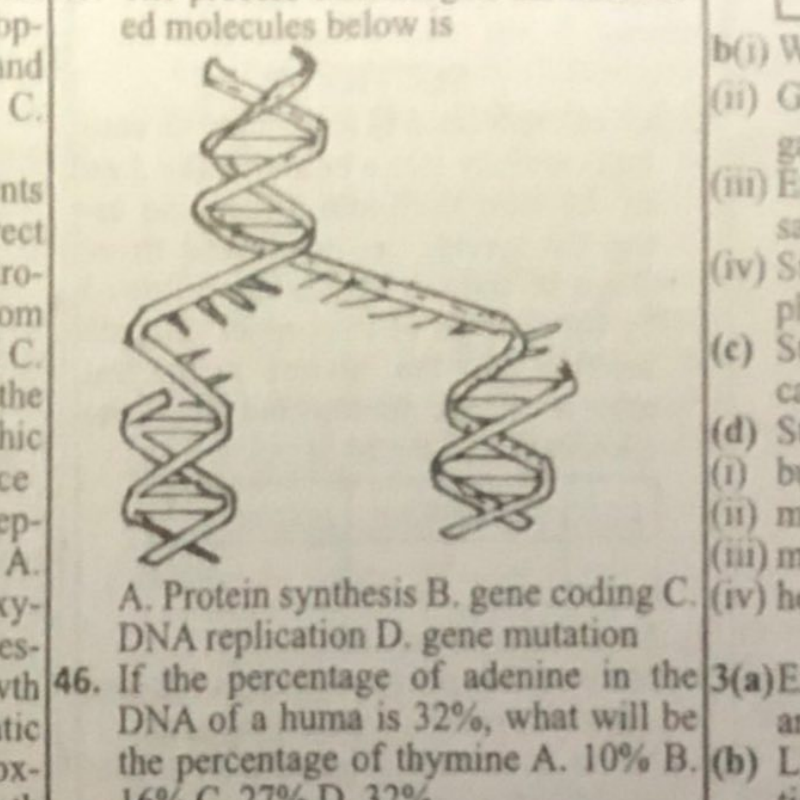
The process occurring in the illustrated molecules below is
A. Protein synthesis
B. Gene coding
C. DNA replicationCorrect
D. Gene mutation
Explanation
The image depicts the unwinding of the DNA double helix, which is characteristic of DNA replication, where the DNA makes an exact copy of itself before cell division.
Which of the following statements is not correct about colour blindness?
A. It is a sex-linked trait
B. Males are often carriersCorrect
C. Females are not carriers
D. The trait is controlled by a recessive gene
Explanation
Colour blindness is X-linked, and males express the trait if they inherit the allele. In other words, males cannot be carriers - they are either normal or they suffer from the trait. Females (with two X chromosomes) are carriers if they have one X with the colour blindness allele, or sufferers if both X chromosomes are defective. This makes 'males are often carriers' the incorrect statement.
A. Characteristics of organisms are not the sum of the characters of their parents
B. Characteristics of organisms are determined by mutation
C. Organisms transfer acquired characters to their offspringCorrect
D. Organisms acquire genes from their parents
Explanation
In his theory of evolution, Lamarck proposed that organisms can acquire characteristics as a result of use or disuse of organs, and that these acquired traits are then transmitted to their offspring. This concept is referred to as the inheritance of acquired characteristics (now considered incorrect, since acquired characteristics do not alter DNA and cannot be passed on).
The castes of the organisms found in a beehive are
A. Drones, queen and workersCorrect
B. Workers, soldiers and reproductives
C. Soldiers, workers and king
D. King, queen and soldiers
Explanation
In a beehive, there are three main castes: Queen (the reproductive female), Drones (males, whose only role is to mate with the queen), and Workers (sterile females who gather food, clean and protect the hive).
The theory of natural selection in evolution was formulated by
A. Mathias Schleiden
B. Louis Pasteur
C. Charles DarwinCorrect
D. Jean Lamarck
Explanation
Charles Darwin developed the theory of natural selection, stating that organisms with favourable traits are more likely to survive and reproduce. (Jean Baptiste Lamarck instead propounded the theory of use and disuse.)
Advertisement
Sign up free to unlock
Score tracking
Practice history
Saved questions
Progress dashboard
Personalized sessions
Weak-topic breakdown
…and/or go further with premium services and No Ads.