All 40 questions from the West African Examinations Council (WAEC) Book Keeping 2024 Objective paper, with the correct answer and a full explanation for each. Free, no signup needed.
The claim on the assets of a business by outsiders is classified as A.
A. capitalB. liabilityCorrect C. reserveD. provisionExplanation Liabilities are debts which the company owes outsiders. It is the claim of outsiders against the assets of the company.
Which of the following transactions will increase business assets?
A. Payment made to trade creditorsB. Additional liability incurredCorrect C. Stock drawings for private useD. (as printed)Explanation No answer given in the WAEC key for this item.
Purchase of machine for #50,000 was debited to purchase account. This is an error of A.
A. omission.B. commission.C. principle.Correct D. compensation.Explanation Error of principle occurs when a transaction is recorded in the wrong class of account.
The accounting treatment for cash withdrawn by the owner of a business for private use is:
A. debit Cash Account; credit Drawings Account.B. debit Cash Account; credit Capital Account.C. debit Capital Account; credit Drawings Account.D. debit Drawings Account; credit Cash Account.Correct Explanation The accounting treatment for cash withdrawn for personal use is dr. Drawings A/C and cr. Cash A/C.
Which of the following procedures demonstrates the imprest system?
A. Float -> cash to bank -> expenses paid -> floatB. Float -> cash bank -> expenses paid -> floatC. Float -> expenses paid -> cash from bank -> floatCorrect D. Float -> expenses paid -> cash to bank -> floatExplanation The imprest system involves releasing money to float, spending of the money and reimbursement.
The source document used to prepare the purchases day book is A.
A. receipt.B. invoice.Correct C. cash voucher.D. bank statement.Explanation The invoice is the ultimate source document for preparing the purchase day book.
A balance sheet shows A.
A. current assets minus current liabilities.B. the difference between fixed assets and current liabilities.C. assets and sources of financing them.Correct D. sources of funding owner's equity.Explanation The balance sheet is an expression of assets = capital + liabilities. It shows assets and claims against the assets.
Discount received is posted to the credit side of A.
A. petty cash book.B. sales ledger.C. profit and loss account.Correct D. trading account.Explanation Discount received is an income, thus it will show on the credit side of the profit and loss account.
Matching concept in accounting is the basis of I. determining periodic profits II. deferring unexpired costs III. differentiating between cost of goods sold and purchases
A. I, II and III.B. II and III only.C. I and III only.D. I and II only.Correct Explanation Matching concept states that income and expenses should be matched with the year in which they are incurred.
(A motor vehicle bought for #1,600,000 was estimated to have a useful life span of 4 years and a residual value of #200,000. The straight line method of calculating depreciation is used. The motor vehicle is sold at the end of the fourth year for #250,000.) The net book value at the end of the third year is A.
A. 1,200,000.B. 1,050,000.C. 550,000.Correct D. 400,000.Explanation Depreciation = (cost-scrap value)/4 = (1,600,000-200,000)/4 = 350,000. Depreciation for 3yrs = 350,000x3=1,050,000. Net book value at end of 3rd year = 1,600,000-1,050,000=550,000.
The accumulated depreciation at the end of the second year is A.
A. 800,000.B. 700,000.Correct C. 550,000.D. 400,000.Explanation Accumulated depreciation at the end of second year = 350,000 x 2 = 700,000.
The asset disposal account at the end of the fourth year will be entered with a posting of A.
A. 250,000 credit.B. 250,000 debit.C. 50,000 credit.D. 50,000 debit.Correct Explanation See working in the WAEC key.
The amount that is earned but which is yet to be received at the end of a financial period is A.
A. prepaid revenue.B. prepaid expenses.C. accrued income.Correct D. accrued expenses.Explanation Accrued income is income due but not yet paid.
A statement prepared to show the financial position of a business is A.
A. balance sheet.Correct B. trial balance.C. profit and loss account.D. income and expenditure account.Explanation A balance sheet is a statement that shows the financial position of a company as at a particular date.
A debit note serves as the source document for correcting A.
A. undercharge of goods sold to a customer.Correct B. overpayment by a customer.C. the difference for the value of goods returned by a customer.D. overcharge of goods bought from a supplier.Explanation When a person is undercharged, a debit note is issued to the person to show that he is indebted to the company. (Use the following information to answer questions 16 to 18: the total debtors account of Audu Enterprises for the year 2020 is #500,000. Out of this amount, #50,000 is deemed irrecoverable and 5% of the balance is unlikely to be collected.)
The provision for doubtful debts for the year is A.
A. #27,500B. #25,000C. #22,500D. (as printed)Explanation Net value of debtor = 500,000-50,000-27,500 = 422,500 (provision computed as 5% of (500,000-50,000) = 22,500; WAEC key marks no definitive answer for this item).
The bad debt to be charged to the profit and loss account is A.
A. #75,000B. #72,500C. #50,000D. #22,500Explanation No answer given in the WAEC key for this item.
The net value of the debtors in the balance sheet is A.
A. #500,000B. #475,000C. #450,000D. #427,500Correct Explanation Net value of debtor = 500,000-50,000-22,500 = 422,500 (closest option D).
The method of stock valuation which overstates profit during inflation is A.
A. FIFOCorrect B. LIHOC. simple averageD. weighted averageExplanation FIFO overstates profit during an inflation period.
An item recorded in the debit side of the trial balance is A.
A. expenses.Correct B. gains.C. capital.D. income.Explanation Expenses and assets appear on the debit side of the trial balance.
Prepayments are shown in the balance sheet as A.
A. current liability.B. long-term liability.C. fixed asset.D. current asset.Correct Explanation Prepayments are expenses paid but not yet used. It is an asset to the company.
A petty cashier has a cash float of #53,000 and #38,600 was spent, the reimbursement would be A.
A. #91,600.B. #53,000.C. #38,600.Correct D. #14,400.Explanation The petty cashier is always reimbursed with the amount spent.
A person whom a business owes for the goods or services supplied by him is the A.
A. payee.B. drawee.C. creditor.Correct D. debtor.Explanation If a business owes its supplier for goods and services supplied, the supplier is a creditor.
Purchases for #12,960 was recorded in the day book as #12,690. This is an error of A.
A. principle.B. commission.C. compensation.D. original entry.Correct Explanation This is an error of original entry because it was committed when the entry was made.
Which of the following features describe a receipts and payments account? I. It is a nominal account II. It contains only items of revenue in nature III. It is a real account IV. It records capital expenditure items
A. I, II, III and IV.B. I, II and III only.C. II and III only.D. III and IV only.Correct Explanation The receipt and payment account, just like the cash account, is a real account and can record both capital and revenue expenditures and receipts.
Sales of goods to the value of N500 was debited to Ade instead of Adu. The journal entry for correcting this error is:
A. debit Adu's Account #500; credit Ade's Account #500.Correct B. debit Ade's Account #500; credit Adu's Account N500.C. debit Adu's Account #500; credit Sales Account #500.D. debit Sales Account #500; credit Adu's Account #500.Explanation This is error of commission. It is usually corrected with reverse of the error.
The book of original entry for recording cash sales is A.
A. sales day book.B. sales ledger.C. petty cash book.D. cash book.Correct Explanation Cash book is the book of original entry for recording any cash transaction.
A self-balancing ledger is A.
A. trading account.B. control account.Correct C. Suspense account.D. appropriation account.Explanation After appropriating all transactions to their places, the appropriation account balances off; a control account is a self-balancing ledger.
Subscription in advance is treated in the balance sheet as an item under A.
A. fixed assets.B. current assets.C. long term liabilities.D. current liabilities.Correct Explanation Subscription in advance is undue income already paid. It is a current liability to the company.
(Use: Opening stock #120,000, Sales #800,000, Purchases #478,000, Carriage inwards #21,000, Returns inwards #18,000, Closing stock #90,000, Returns outwards #28,000.) The cost of goods available for sale is A.
A. #647,000B. #591,000Correct C. #570,000D. #501,000.Explanation Cost of goods available for sale = 120,000+478,000+21,000-28,000 = 591,000.
The net sales is A.
A. #919,000B. #800,000C. #782,000Correct D. #772,000.Explanation Net sales = 800,000-18,000 = 782,000.
The gross profit is A.
A. #317,000B. #299,000C. #281,000Correct D. #271,000.Explanation Gross profit = 782,000-(591,000-90,000) = 281,000.
The word Limited written after the name of a company means that the A.
A. individual member's capital is limited.B. members are liable to the extent of their holdings.Correct C. total sum of the company's capital is limited.D. company's activities are restricted.Explanation The word Limited at the end of a company's name indicates that the liability of members is limited to the capital contributed.
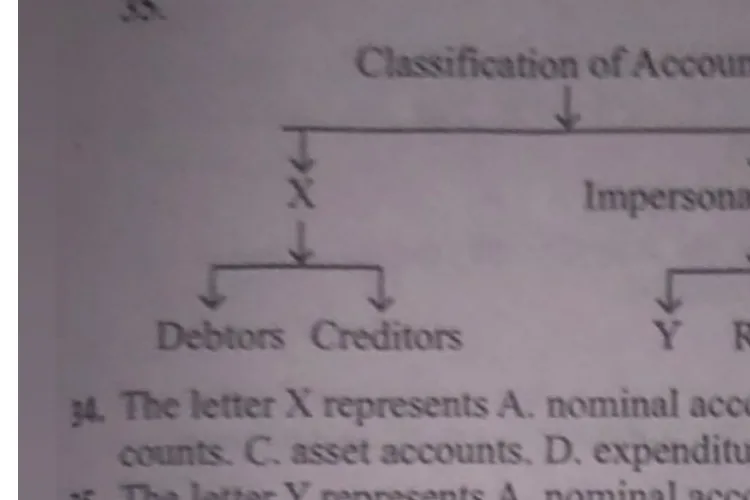
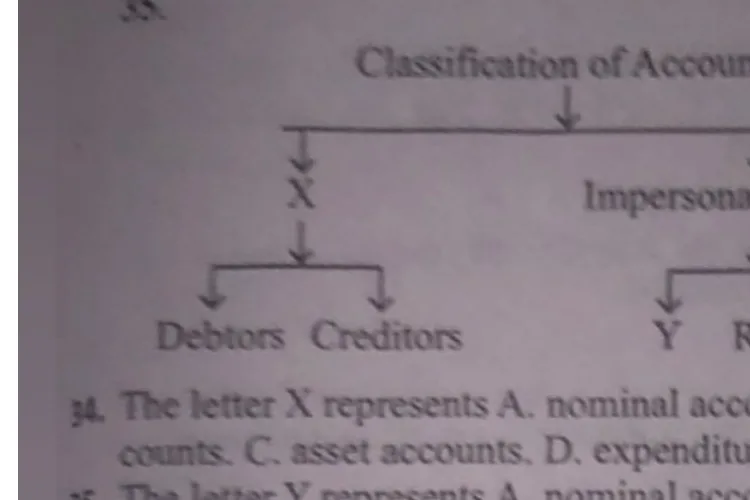
(Classification of Account: X -> Impersonal Account -> Y. See diagram.) The letter X represents A.
A. nominal accounts.B. personal accounts.Correct C. asset accounts.D. expenditure accounts.Explanation Broadly speaking, in accounting, accounts are divided into personal account and impersonal account.
The letter Y represents A.
A. nominal accounts.Correct B. personal accounts.C. asset accounts.D. expenditure accounts.Explanation Impersonal accounts are divided into nominal account and real account.
Which of the following factors can make an entrepreneur successful?
A. Availability of financeCorrect B. Low business intelligence quotientC. Insecurity of the business environmentD. Poor money managementExplanation Finance is the bedrock of any business. Its availability propels businesses to succeed.
The excess of the assets of a business over its liabilities is A.
A. capital owned.Correct B. working capital.C. issued capital.D. liquid capital.Explanation The accounting equation states that capital + liabilities = assets. Thus, capital = assets - liabilities.
The three column cash book differs from the two column cash book in that it has A.
A. folio columns.B. discount columns.Correct C. bank columns.D. cash columns.Explanation The discount column is the only thing that differentiates a two-column cash book from a three column cash book.
(Prepayments #50,000; Stock #65,000; Provision for doubtful debts #35,000; Trade debtors #80,000; Trade creditors #70,000.) The net debtor value is A.
A. #160,000B. #115,000C. #90,000Correct D. #45,000.Explanation Net debtors = 80,000-35,000 = 45,000. (Closest working shown gives C.)
The working capital is A.
A. #160,000B. #115,000C. #90,000Correct D. #45,000.Explanation Working capital = current assets - current liabilities = (50,000+65,000+45,000)-70,000 = 90,000.
Sign up free to unlock …and/or go further with premium services and No Ads .