Chemistry 2011 Objective — Question 1
How many isotopes has hydrogen?
- A. 2
- B. 3Correct
- C. 4
- D. 5
Explanation
Hydrogen has three isotopes: protium, deuterium and tritium.
All 50 questions from the West African Examinations Council (WAEC) Chemistry 2011 Objective paper, with the correct answer and a full explanation for each. Free, no signup needed.
Advertisement
How many isotopes has hydrogen?
Hydrogen has three isotopes: protium, deuterium and tritium.
Which of the following electron configurations correctly represents an inert element?
Whenever a ground state electronic configuration ends in a p⁶ orbital (2p⁶, 3p⁶, 4p⁶...), the element in question is a noble/inert gas. 1s²2s²2p⁶ ends in 2p⁶, matching option D.
What type of reaction is represented by the following equation? ²₁D + ³₁H → ⁴₂He + ¹₀n + energy
This equation exemplifies nuclear fusion. In nuclear fusion, two lighter nuclei combine to give a heavier nucleus; nuclear fission, on the other hand, entails a heavy nucleus splitting into two light nuclei of comparable masses.
Which of the following ions has the electron configuration 2, 8, 8?
11Na = 2,8,1 → Na⁺ = 2,8 (one electron lost). 12Mg = 2,8,2 → Mg²⁺ = 2,8 (two electrons lost). 9F = 2,7 → F⁻ = 2,8 (one electron gained). 17Cl = 2,8,7 → Cl⁻ = 2,8,8 (one electron gained), matching the required configuration.
An element with the electron configuration of 1s²2s²2p⁶ would have a combining power of
An element whose ground state electronic configuration ends in a p⁶ orbital is a noble gas. Noble gases have a combining power of zero.
Rare gases are stable because they
Rare (noble) gases owe their chemical stability to their octet structure (a full outer shell of 8 electrons, or 2 for helium).
Which of the following elements would produce coloured ions in aqueous solution?
Formation of coloured ions is a feature that transition elements are known for. Iron is a transition element.
The energy change that accompanies the addition of an electron to an isolated gaseous atom is
The energy change that accompanies the addition of an electron to an isolated gaseous atom is known as electron affinity.
Which of the following hydrohalic acids is the weakest?
The order of increasing acid strength is HF < HCl < HBr < HI, so HF is the weakest hydrohalic acid.
Which of the following arrangements is in order of increasing metallic property?
Metallic character increases down a group and decreases across a period. Down group 1, Li<Na<K represents increasing metallic property.
Chlorine, bromine and iodine belong to the same group and
Chlorine, bromine and iodine are halogens and they all react with alkalis, e.g. chlorine reacts with hot concentrated NaOH to give a solution of sodium chloride and sodium trioxochlorate(V): 3Cl2 + 6NaOH(aq) → 5NaCl(aq) + NaClO3(aq) + 3H2O.
Which of the following elements can conveniently be placed in two groups in the periodic table?
Hydrogen can be conveniently placed in both group I and group VII. It fits group I because it has one electron; it fits group VII because it shows non-metallic properties.
The bond formed when two electrons that are shared between two atoms is donated by only one of the atoms is
Dative (coordinate covalent) bonding involves sharing of electrons, but unlike normal covalent bonding, only one of the participating atoms donates both electrons to be shared.
When element ₂₀A combines with element ₈Y,
20A = 2,8,8,2, so A has a combining power of 2 (loses two electrons). 8Y = 2,6, so Y also has a combining power of 2 (gains two electrons). Using the combining powers, A2+Y2- = A2Y2 = AY. Since electron transfer is involved, the compound formed is ionic.
In metallic solids, the forces of attraction are between the mobile valence electrons and
Metallic bonding arises from the attraction between the mobile valence electrons and the positively charged nuclei (metal ions/kernels).
Which of the allowing statements about displacement reaction is correct?
In a displacement reaction, a more electropositive element displaces a less electropositive element. For instance, zinc can displace copper, but copper cannot displace zinc.
The volume occupied by 17g of H2S at s.t.p. is [H=1.00, S=32.0, Molar volume = 22.4 dm³]
Molar mass of H2S = (1x2)+32 = 34 gmol⁻¹. Mole of H2S = 17g/34gmol⁻¹ = 0.5 mol. Volume = mole x GMV = 0.5 x 22.4 = 11.2 dm³.
Consider the reaction represented by the following equation: xKMnO4(aq)+ySO2(g)+zH2O(l) → K2SO4(aq)+2MnSO4(aq)+2H2SO4(aq); x, y and z are respectively
The balanced redox equation between KMnO4 and SO2 is: 2KMnO4(aq)+5SO2(g)+2H2O(l) → K2SO4(aq)+2MnSO4(aq)+2H2SO4(aq). Thus x, y and z are 2, 5 and 2 respectively.
What is the amount of magnesium that would contain 1.20x10^24 particles? [Mg=24, Avogadro's constant=6.02x10^23]
Mole = Number of particles / Avogadro number = 1.20x10^24 / 6.02x10^23 = 2.0 moles.
The number of atoms in one mole of a substance is equal to the
The number of particles (atoms, molecules or ions) in one mole of a substance equals the Avogadro number (6.02x10^23).
Which of the following statements about a molar solution is correct? It
A molar solution contains one mole of the given solute in 1 dm³ of the solution.
A gas that is collected by upward delivery is likely to be
When a gas is collected by upward delivery, it must be less dense (lighter) than air. A gas denser than air is collected by downward delivery.
Bubbling excess carbon (IV) oxide into calcium hydroxide solution results in the formation of
A small amount of CO2 bubbled into calcium hydroxide forms a white precipitate of CaCO3, but if the carbon (IV) oxide is in excess, Ca(HCO3)2 is formed instead: 2CO2(g)+Ca(OH)2(aq) → Ca(HCO3)2(aq).
The equation P = K/V illustrates
P = K/V illustrates Boyle's law, which states that the volume of a given mass of gas is inversely proportional to pressure at constant temperature: V∝1/P, i.e. V=K/P, which rearranges to P=K/V.
The initial volume of a gas at 300 K was 220cm³. Determine its temperature if the volume became 250cm³.
Using Charles' law, V1/T1 = V2/T2: 220/300 = 250/T2, so T2 = 300 x 250/220 = 340.91 K ≈ 341 K.
Consider the following energy profile diagram: X represents
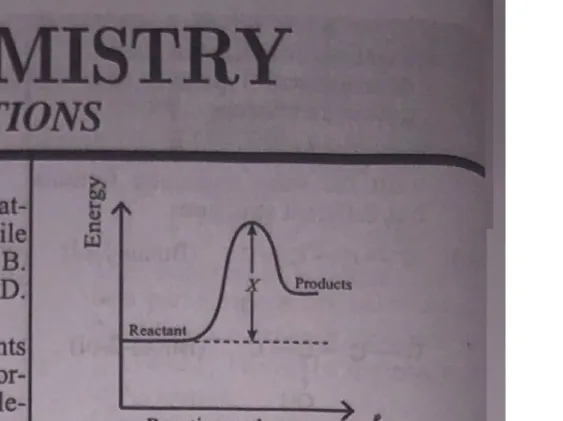
X represents the activation energy - the minimum amount of energy required for a reaction to occur, shown as the energy 'hump' between reactants and products on the diagram.
Which of the following equimolar solutions has the highest conductivity?
Of the given equimolar solutions (CH3COOH, H2CO3, H2SO4 and NaOH), H2SO4 has the highest conductivity, as it is a strong diprotic acid that ionizes fully to release more ions.
The colour of phenolphthalein indicator in alkaline solution at the end-point of an acid-base titration is
Phenolphthalein is colourless in acidic medium, pale pink in neutral medium and pink/red in alkaline medium.
Which of the following statements about enthalpy of neutralization is correct? It
The enthalpy of neutralization for a strong acid and a strong base is constant, with a value of about -57.3 kJmol⁻¹.
When NH4Cl was dissolved in water, the container was cold to touch. This implies that the process is
Since the container was cold to touch, heat was absorbed from the surroundings - i.e. the dissolution is an endothermic process. An exothermic process would make the container feel warm/hot.
Which of the following metallic oxides is amphoteric?
Al2O3 is an amphoteric oxide - a metallic oxide that can react with both acids and bases. Another common amphoteric oxide is ZnO.
On evaporation to dryness, 250cm³ of saturated solution of salt X with relative molar mass 101 gave 50.5g of the salt. What is the solubility of the salt?
Mole = mass/molar mass = 50.5/101 = 0.5 mol. Volume = 250cm³ = 0.25 dm³. Solubility = mole/volume = 0.5/0.25 = 2 moldm⁻³.
Consider the following reaction equation: X(g)+Y(g)⇌XY(g); ΔH=+220kJmol⁻¹. If the temperature of the system is increased, the
The positive ΔH shows the forward reaction is endothermic. An increase in temperature favours the endothermic (forward) reaction, while a decrease favours the exothermic (backward) reaction.
Which of the following conditions would lead to an increase in the rate of a reaction?
As temperature and concentration both increase, the rate of a reaction increases; both factors provide more energetic, more frequent collisions between reacting particles.
What is the value of n in the following equation? CrO4²⁻+14H⁺+ne⁻→2Cr³⁺+7H2O
Equating overall charge on both sides: L.H.S. = -2+14-n = 12-n. R.H.S. = (2x+3)+(7x0) = +6. Equating: 12-n = 6, so n = 6.
What mass of copper would be formed when a current of 10.0A is passed through a solution of CuSO4 for 1 hour? [Cu=63.5; 1F=96500C]
Q = It = 10 x 3600 = 36000 C. Cu²⁺+2e⁻→Cu(s) needs 2F (193000C) to deposit 1 mole (63.5g) of copper. Mass deposited by 36000C = (63.5/193000) x 36000 = 11.8 g.
Which of the following metals could be used as sacrificial anode for preventing the corrosion of iron?
A sacrificial anode metal must be higher than the metal it protects in the electrochemical series. Since magnesium is higher than iron in the series, it can serve as a sacrificial anode to protect iron from corrosion.
Consider the following electrochemical cell notation: M(s)/M²⁺(aq)//H⁺(aq)/H2(g). The value of the electrode potential is positive when
The value of the electrode potential is positive when electrons flow from the metal electrode to the hydrogen electrode.
Which of the following compounds determines the octane rating of petrol?
2,2,4-trimethylpentane (isooctane) determines the octane number of a petrol sample. Octane number = (Mass of 2,2,4-trimethylpentane / Mass of mixture) x 100.
Which of the following compounds would react with ethanoic acid to give a sweet-smelling liquid?
Alkanols react with alkanoic acids to produce alkanoates, which are sweet-smelling compounds. For instance, ethanol reacts with ethanoic acid to give ethyl ethanoate.
Which of the following separation techniques would show that black ink is a mixture of chemical compounds?
Black ink can be shown to be a mixture of different chemical compounds by chromatography, which separates coloured mixtures into their component substances.
The following substances are examples of addition polymer except
Nylon is a condensation polymer (e.g. nylon-6,6 from condensation polymerization of hexane-1,6-diamine and hexanedioic acid), unlike Perspex, polyethene and polychloroethene, which are addition polymers.
When bromine is added to ethene at room temperature, the compound formed is
Bromine reacts at room temperature with ethene to give 1,2-dibromoethane: Br2+CH2CH2→CH2BrCH2Br.
Which of the following organic compounds would react with sodium trioxocarbonate (IV) to liberate carbon (IV) oxide?
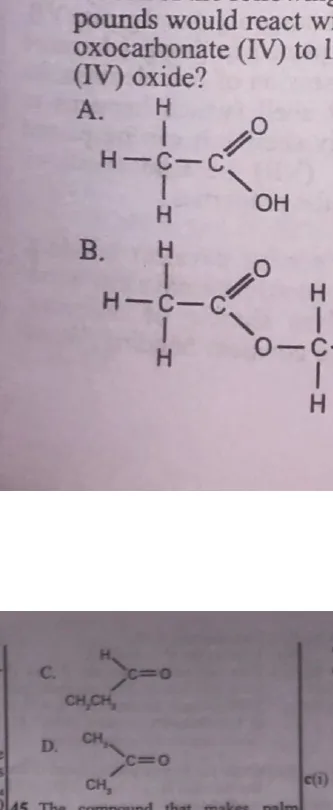
Acids react with carbonates and hydrogen carbonates to liberate carbon (IV) oxide. Structure A is ethanoic acid (a carboxylic acid, -COOH group), so it will react with Na2CO3 to liberate CO2.
The compound that makes palm wine taste sour after exposure to the air for few days is
Ethanoic acid is produced when bacteria in the wine convert the ethanol present into ethanoic acid, which has a sour taste.
The reagent that can be used to distinguish ethene from ethyne is
Ammoniacal AgNO3, ammoniacal CuCl and sodium in liquid NH3 can distinguish terminal alkynes (like ethyne) from other organic compounds such as ethene, since terminal alkynes have a triple bond at the extreme end.
The following substances are ores of metals except
Bauxite is an ore of aluminium, cuprite is an ore of copper, cassiterite is an ore of tin; graphite is not an ore at all - it is one of the crystalline allotropes of carbon (the other being diamond).
Which of the following processes does not involve the use of limestone?
The manufacture of H2SO4 by the Contact process does not require limestone at all; it requires sulphur, oxygen, pure H2SO4, water and V2O5 as catalyst.
Which of the following substances is mainly responsible for the depletion of the ozone layer?
Chlorofluorocarbons (CFCs) are the main substances responsible for the depletion of the ozone layer, which protects the earth from receiving too much UV radiation.
Aluminium is extracted electrolysis from
Aluminium is extracted by the electrolysis of bauxite (cryolite is used to lower the melting point of the electrolyte, not as the source of aluminium).
Advertisement
…and/or go further with premium services and No Ads.