All 8 questions from the West African Examinations Council (WAEC) Chemistry 2022 Theory paper, with the correct answer and a full explanation for each. Free, no signup needed.
SECTION A (Answer all questions in this section)
1(a)(i) Define an acid according to the Lewis concept.
(ii) Give one example of a Lewis acid.
(b) Explain salting out in soap preparation.
(c) State the reagent and condition necessary for the conversion: H–C≡C–H → Ag–C≡C–Ag
(d) What is the percentage abundance of an isotope?
(e)(i) Why does the element with atomic number 18 not have an oxide?
(ii) Explain why chlorine (I) oxide has a low melting point.
(f) Describe a test to distinguish between concentrated HNO3 and concentrated H2SO4.
(g) State two differences between an electrochemical cell and an electrolytic cell.
(h) How does the trend in ionization energy affect the reactivity of group 1 elements?
(i) Define the term molecular formula.
(j)(i) State which of the gases H2 and NH3 would deviate more from ideal behaviour.
(ii) Give reasons for the answer stated in 1(j)(i).
Model answer
(a)(i) According to Lewis concept, an acid is a species (atom, ion or molecule) capable of accepting a pair of electrons.
(ii) Example of a Lewis acid: AlCl3 (other examples include BF3, PCl5).
(b) Salting out in soap preparation is the addition of salt (NaCl) to the reaction mixture to enhance the separation/precipitation of soap from the mixture.
(c) Reagent: Ammoniacal silver trioxonitrate(V) [AgNO3/NH3(aq)]. Condition: heat.
(d) Percentage abundance of an isotope is the fraction of a given isotope present in a mixture of isotopes of the same element, expressed as a percentage.
(e)(i) The element with atomic number 18 (argon) has completely filled outermost electron shells, making it stable and unreactive (does not readily form an oxide).
(ii) Chlorine (I) oxide has a low melting point because of the presence of weak (van der Waals) forces between its molecules, so not much heat is required to break these forces.
(f) Test to distinguish conc. HNO3 from conc. H2SO4: Add copper turnings to each. Conc. HNO3 produces a brown fume (NO2) and a deep blue solution of copper (II) nitrate; conc. H2SO4 does not react with copper turnings at room temperature (or: reaction with sugar — H2SO4 chars/dehydrates sugar releasing heat, HNO3 does not).
(g) Differences between electrochemical cell and electrolytic cell:
- In an electrochemical cell, chemical energy is converted to electrical energy; in an electrolytic cell, electrical energy is converted to chemical energy.
- An electrochemical cell generates current spontaneously; an electrolytic cell requires an external power source (non-spontaneous reaction).
(h) Ionization energy decreases down group 1, so it becomes easier to lose an electron going down the group, hence reactivity of group 1 elements increases down the group.
(i) Molecular formula is a formula that shows the actual number of atoms of each element present in a molecule of a substance.
(j)(i) NH3 would deviate more from ideal gas behaviour than H2.
(ii) This is because NH3 has a larger molecular volume and stronger intermolecular forces (hydrogen bonding), causing it to deviate more from ideal gas behaviour.
SECTION B
2(a)(i) Define the first ionization energy of an element.
(ii) Consider the following table:
Element: Li, Be, B, C, N, O, F, Ne
Atomic No: 3,4,5,6,7,8,9,10
1st I.E./kJ/mol: 520,900,801,1086,1402,1314,1681,2081
Explain briefly why the first ionization energy of B is less than that of Be despite the fact that the atomic number of B is greater than that of Be.
Model answer
(a)(i) The first ionization energy of an element is the minimum energy required to remove one electron from the valence shell of a gaseous atom of the element.
(ii) Be has the electronic configuration 1s²2s². The electron to be removed from Be is in the 2s orbital which is closer to the nucleus and thus more strongly attracted to the nuclear (greater nuclear attraction). Hence its ionization energy is greater. B has the electronic configuration 1s²2s²2p¹, and the electron to be removed is in the 2p orbital which is farther away from the nucleus and less strongly attracted (lower nuclear attraction), hence its first ionization energy is smaller than that of Be.
2(b) When Titanium chloride was electrolysed by passing a 0.12A current through the solution for 500 seconds, 0.015g of titanium was deposited. What was the charge on the titanium ion? [IF=96500 C, Ti=48.0]
(c)(i) Aluminium can be obtained by the application of electrolysis. State the electrolyte which yields aluminium on smelting.
(ii) Name two major factors which would favour the siting of an aluminium smelter in a country.
(d)(i) Define the term paramagnetism.
(ii) Consider the following ions: 24Cr³⁺, 24Cr⁶⁺.
(I) Deduce the number of unpaired electrons in each of the ions.
(II) State which of the ions will have a greater power of paramagnetism.
(III) Give a reason for the answer stated in 2(d)(ii)(II).
Model answer
(b) Given: I = 0.12A, t = 500s, m = 0.015g, M(Ti) = 48.
Quantity of electricity, Q = It = 0.12 × 500 = 60C.
Using m/M = Q/(nF): n = MIt/(mF) = (48 × 0.12 × 500)/(0.015 × 96500) = 2880/1447.5 ≈ 1.99 ≈ 2.
Charge on the titanium ion = +2.
(c)(i) The electrolyte which yields aluminium on smelting is alumina (Al2O3) mixed with molten cryolite (Na3AlF6).
(ii) Factors favouring siting of an aluminium smelter: availability of raw material (i.e. abundant deposits of bauxite); availability and cheap source of electricity.
(d)(i) Paramagnetism refers to a phenomenon whereby some materials are weakly attracted by an externally applied magnetic field, due to the presence of one or more unpaired electrons which are attracted by the magnetic field.
(ii)(I) 24Cr³⁺ has the electronic configuration 1s²2s²2p⁶3s²3p⁶3d³ i.e. [Ar]3d³ — 3 unpaired electrons.
24Cr⁶⁺ has the electronic configuration 1s²2s²2p⁶3s²3p⁶ i.e. [Ne]... wait — 24Cr⁶⁺ = [Ar] with 3d⁰4s⁰ — 0 unpaired electrons.
(II) 24Cr³⁺ has the greater power of paramagnetism.
(III) This is because 24Cr³⁺ has a greater number of unpaired electrons (3d³) than 24Cr⁶⁺ (which has no unpaired electrons in its 3d orbital); the greater the number of unpaired electrons, the greater the paramagnetism.
3(a)(i) Define the term Avogadro's number.
(ii) If 2.30g of an oxide of nitrogen, x, contains 3.01×10²² molecules, calculate the molar mass of x.
(iii) Deduce the formula of x. [NA=6.02×10²³, N=14.0, O=16.0]
(b)(i) Describe briefly what happens when each of the following substances are added to water: (I) CCl4; (II) SiCl4
(ii) Explain briefly why the reactions in 3(b)(i)(I) and 3(b)(i)(II) are different.
Model answer
(a)(i) Avogadro's number is defined as the number of particles (atoms, molecules, ions etc.) present in one mole of a substance. It is also the number of particles present in 12.0g of carbon-12. (Avogadro's number = 6.02×10²³ mol⁻¹.)
(ii) Number of moles of x = 3.01×10²²/6.02×10²³ = 0.05 mol.
Molar mass = mass/moles = 2.30/0.05 = 46 g/mol.
(iii) Let the formula of the oxide be NxOy.
mm(NxOy) = 14x + 16y = 46.
By inspection: x=1, y=2: 14(1)+16(2)=14+32=46. ✓
So the formula of the oxide is NO2.
(b)(i)(I) CCl4 added to water: No visible reaction. Two immiscible layers of liquid are formed; CCl4 forms a layer below the water (denser, non-polar solvent, does not dissolve in the polar water).
(II) SiCl4 added to water: There is a visible reaction; hydrolysis reaction with water occurs to give a steamy fume (giving off HCl gas), and the solution becomes hot (denser due to dissolved products).
(ii) This is because the central atom in CCl4 (carbon) does not have a vacant d-orbital to accept a lone pair of electrons from water to undergo hydrolysis. CCl4 is thus non-polar and cannot be dissolved by water, a polar solvent. In SiCl4, the central atom Si has a vacant d-orbital that can accept a lone pair of electrons from water; thus, SiCl4 is said to be polar and is hydrolysed by water.
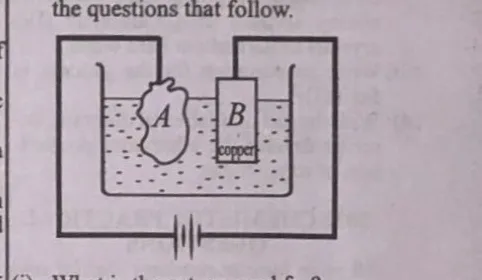
3(c) Study the diagram below and answer the questions that follow.
(i) What is the set-up used for?
(ii) Mention two compounds that could be used as electrolytes in the cell.
(iii) Write a half-cell equation for the reaction at the anode.
(iv) Calculate the electrochemical equivalent of copper if the cathode gained mass of 3.2g when 50 amperes of current was passed for 3 minutes 13 seconds.
Model answer
(i) The set-up is used for the purification of copper metal, or electroplating/extraction of copper by electrolysis.
(ii) Compounds that could be used as electrolytes in the cell: Copper (II) tetraoxosulphate (VI) [CuSO4(aq)]; Copper (II) trioxonitrate (V) [Cu(NO3)2(aq)]; Copper (II) chloride [CuCl2(aq)].
(iii) Anodic half-cell equation: Cu(s) → Cu²⁺(aq) + 2e⁻
(iv) Given: m = mass deposited = 3.2g, t = time = 3min 13sec = (3×60+13) = 193 seconds, I = current = 50A.
Electrochemical equivalent, z = m/(It) = 3.2/(50×193) = 3.2/9650 ≈ 3.32×10⁻⁴ g/C.
4(a)(i) State two conditions used in the Haber process.
(ii) Explain briefly the effect of increasing the pressure on the rate of reaction in the Haber process.
(b)(i) A mixture of nitrogen (IV) oxide and oxygen is bubbled into warm water to produce trioxonitrate (V) oxide; write a balanced chemical equation for the reaction.
(ii) Using a balanced chemical equation, explain what would happen if only nitrogen (IV) oxide is bubbled into warm water.
(iii) Compare the gases evolved when trioxonitrate (V) acid decomposes, under each of the following properties: (I) pH; (II) Solubility in water; (III) Reaction with carbon (II) oxide.
(c)(i) Name two oxides of sulphur.
(ii) Write a balanced equation for the reaction between each of the named oxides in 4(c)(i) and water.
(d) Name one calcium compound: (i) used to dry ammonia gas; (ii) used in the manufacture of cement; (iii) that causes hardness in water; (iv) referred to as plaster of paris.
Model answer
(a)(i) Conditions used in the Haber process: Temperature of 350–500°C (high temperature); Pressure of 150–1000 atm (high pressure); Catalyst — finely divided iron.
(ii) Increasing the pressure increases the rate of reaction in the Haber process because the gas molecules are brought closer together, increasing the frequency of successful collisions per second.
(b)(i) 4NO2(g) + O2(g) + 2H2O(l) → 4HNO3(aq)
(ii) If nitrogen (IV) oxide alone is bubbled into warm water: 3NO2(aq) → 2NO2(g) + NO2(g)... more precisely: 3NO2(g) + H2O(l) → 2HNO3(aq) + NO(g). A mixture of two acids (a mixture of the acid and NO gas) would be produced.
(iii) Comparing oxygen and nitrogen(IV) oxide gases evolved: (I) pH — oxygen is neutral (pH=7) while NO2 is acidic (pH<7). (II) Solubility — NO2 is soluble in water while oxygen is only sparingly soluble. (III) Reaction with CO — O2 reacts with CO to form CO2, while NO2 reacts with CO to form a mixture of N2 and CO2.
(c)(i) Two oxides of sulphur: Sulphur (IV) oxide (SO2); Sulphur (VI) oxide (SO3).
(ii) SO2(g) + H2O(l) → H2SO3(aq); SO3(g) + H2O(l) → H2SO4(aq)
(d)(i) Used to dry ammonia gas: Calcium oxide (quicklime, CaO) — note: not calcium chloride, as it reacts with NH3.
(ii) Used in manufacture of cement: Calcium trioxocarbonate (IV) (CaCO3, limestone) / Calcium oxide (quicklime).
(iii) Causes hardness in water: Calcium hydrogentrioxocarbonate (IV), Ca(HCO3)2.
(iv) Referred to as plaster of paris: Calcium tetraoxosulphate (VI) dihydrate, CaSO4·2H2O.
5(a)(i) Describe the observation that would be made when: (I) sulphur is heated from room temperature and rapidly evaporates on exposure to air till 119°C; (II) 50% trioxonitrate (V) acid acts on copper turnings.
(b)(i) State two gaseous pollutants that can be generated by burning coal.
(ii) What gas is responsible for most of the explosions in coal mines?
(iii) The mining of coal leads to environmental pollution. State two environmental effects of the mining activity.
(iv) Explain briefly why coal burns more easily when it is in pieces than in lump form.
(v) Name the non-volatile residue after the destructive distillation of coal.
(c)(i) Describe a chemical test for water.
(ii) State the effect of: (I) boiling a temporary hard water; (II) adding sodium trioxocarbonate (IV) crystals to permanent hard water.
(iii) Write an equation for the process in 5(c)(ii)(I).
(d) With the aid of a labelled diagram, describe briefly the laboratory preparation of oxygen gas.
Model answer
(a)(i)(I) When sulphur is heated: its colour darkens from pale yellow to amber, its crystals become needle-like, and at 119°C it begins to melt.
(II) When 50% trioxonitrate (V) acid acts on copper turnings: the solution turns green, bubbles of a colourless gas rise from the mixture and form brown fumes (NO2 gas) with an irritating odour; the solution later turns blue.
(b)(i) Gaseous pollutants from burning coal: SO2, NO2, CO, CO2, H2S.
(ii) Methane (CH4) is responsible for most explosions in coal mines.
(iii) Environmental effects of coal mining: contamination of soil; contamination of ground water; soil erosion; loss of biodiversity; formation of sinkholes.
(iv) Coal in pieces burns more easily than in lump form because pieces have a larger surface area; the larger the surface area, the faster the rate of reaction (combustion).
(v) The non-volatile residue after destructive distillation of coal is coke.
(c)(i) Chemical test for water: Add the sample to anhydrous copper (II) tetraoxosulphate (VI) [white powder]. If it turns from white to blue, this confirms the presence of water. (Alternative: use of anhydrous cobalt chloride paper — turns from blue to pink in the presence of water.)
(ii)(I) Effect of boiling temporary hard water: it softens/removes the temporary hardness.
(II) Effect of adding Na2CO3 to permanent hard water: it removes the permanent hardness.
(iii) Ca(HCO3)2 --heat--> CaCO3 + CO2 + H2O (or Mg(HCO3)2 --heat--> MgCO3 + CO2 + H2O)
(d) Laboratory preparation of oxygen gas: [Diagram: powdered KClO3 and MnO2 (catalyst) placed in a conical/round flask, gently heated; the gas produced is collected over water in an inverted gas jar sitting on a beehive shelf in a trough of water. Alternative setup: hydrogen peroxide poured into a flask containing manganese (IV) oxide, and the gas produced is collected in an upside-down water-filled gas jar over a trough.]
Equation: 2KClO3(s) --MnO2, heat--> 2KCl(s) + 3O2(g)
(Alternative: 2H2O2(aq) --MnO2 catalyst--> 2H2O(l) + O2(g))
2022 CHEMISTRY PRACTICAL QUESTIONS
1. A is an aqueous solution of Iodine. B is 0.100 mol dm⁻³ sodium trioxothiosulphate (VI).
(a) Put B into the burette. Pipette 20.0 cm³ or 25.0 cm³ of A into a conical flask. Add B from the burette until the reddish-brown colour fades to pale yellow, then add a few drops of starch indicator to obtain a dark blue solution. Continue adding B slowly from the burette until one drop of B causes the blue colour to disappear, leaving a colourless solution.
Repeat the titration to obtain concordant titre values. Tabulate your results and calculate the average volume of B used.
The equation for the reaction is: 2Na2S2O3(aq) + I2(aq) → Na2S4O6(aq) + 2NaI(aq)
(b)(i) From your results and the information provided, calculate the concentration in mol dm⁻³ of iodine in A;
(ii) Given a reason for each of the answers stated in 3b(i).
(c) State the method used in separating each of the following mixtures: (i) two miscible liquids; (ii) soluble salt and insoluble salt.
(d) Explain briefly why a solution of KCl does not give off a gas when mixed with NaHCO3 solution, but a solution of AlCl3 does.
Model answer
(a) Sample titration results (illustrative, as recorded):
Burette readings (cm³): 1st Titre 25.60→1.20=24.40; 2nd Titre 32.80→8.70=24.10; 3rd Titre 26.40→2.30=24.10.
Average volume of Na2S2O3 used = (24.10+24.10)/2 = 24.10 cm³ (using the two concordant titres).
(b)(i) Given: CB = 0.1 mol dm⁻³ (B), VB = 24.10 cm³, VA = 25 cm³ (volume of pipette used), CA = ?
From the equation 2Na2S2O3 + I2 → Na2S4O6 + 2NaI: nA (I2) = 1, nB (Na2S2O3) = 2.
Using CAVA/nA = CBVB/nB: CA×25/1 = 0.1×24.10/2 → CA = (0.1×24.10×1)/(25×2) = 0.0482 mol dm⁻³.
(ii) Since iodine (I2) is diatomic, this must be taken into account when calculating molar mass — the molar mass of iodine used is 2×127 = 254 g/mol, not 127 g/mol. The subscripts 'A' and 'B' refer to whichever solution is assigned as acid/base equivalent in the mole ratio calculation — any two solutions can be taken as 'A' and 'B'.
(c)(i) Method for separating two miscible liquids: Fractional distillation.
(ii) Method for separating soluble salt and insoluble salt: Dissolution followed by filtration.
(d) While a solution of NaHCO3 and KCl might swap ions, there would be no visible reaction because mixing will not visibly change state (no gas evolved) — KCl and NaHCO3 do not react to release CO2 as no insoluble product/effervescence-producing reaction occurs. The reaction with AlCl3, however, does produce effervescence due to the formation of CO2 gas: 3NaHCO3 + AlCl3 → Al(OH)3 + 3NaCl + 3CO2.
Advertisement
Sign up free to unlock
Score tracking
Practice history
Saved questions
Progress dashboard
Personalized sessions
Weak-topic breakdown
…and/or go further with premium services and No Ads.