All 50 questions from the West African Examinations Council (WAEC) Civic Education 2017 Objective paper, with the correct answer and a full explanation for each. Free, no signup needed.
The standards that are considered ethical by an individual or the society is known as
A. dignityB. rightsC. valuesCorrect D. materialismExplanation Values can be considered as the principle and standard which guide intervention of people in the society.
One significance of value in society is that it
A. brings about peaceful co-existence of peopleCorrect B. makes one to acquire more propertiesC. enhances an individual's access to educationD. promotes influx of aliens to the communityExplanation Value promotes peaceful co-existence of people.
[Use the quotation below to answer question 3: "If I should forsake you, Bamwuya motherland, Africa fatherland. Let my two hands forget their cunnings". @ Femi Ademiluyi 'The New Man' All rights reserved] The quotation shows that the speaker is
A. nationalisticCorrect B. opportunisticC. subservientD. reorientedExplanation The quotation shows the speaker's deep loyalty and devotion to his motherland/fatherland, which is a nationalistic sentiment.
The status of being a legal member of a country is referred to as
A. alienB. asylumC. citizenshipCorrect D. migrantExplanation Citizenship is the legal right or status of being a member of a country.
Rendering services to humanity across boundaries is an indication of providing solution to
A. political crisisB. social dilemmaC. natural disasterCorrect D. civic problemExplanation Rendering services to humanity across boundaries is typically an indication of providing solution to natural disasters (humanitarian relief).
Human rights can be best promoted if
A. jungle justice is discouragedCorrect B. relevant knowledge and information acquiredC. political elites exercises discretionary powersD. There is existing constitutionExplanation Jungle justice, where people take the law into their own hands and dispense punishment without due process, is a violation of human rights. Discouraging jungle justice best promotes human rights.
The rights of citizens can be guaranteed through
A. gerrymanderingB. the writ of habeas corpusCorrect C. prerogative of mercyD. political immunityExplanation The writ of habeas corpus prevents unlawful detention of citizens, thereby guaranteeing their rights.
The inalienable rights of citizens of a state can best be protected through
A. an unwritten constitutionB. parliamentary system of governmentC. unitary system of governmentD. an independent judiciaryCorrect Explanation An independent judiciary implies adequate interpretation and discharge of duties without any interference or victimization from other arms.
The society can be much more peaceful if individuals learn to
A. respect and obey the laws of the landCorrect B. gather knowledge about politicsC. understand the human rightsD. seek redress in the court of lawExplanation Respect and obey the laws of the land promotes peaceful co-existence of citizenry.
The exhibition of queuing culture in society is a good example of
A. participationB. empowermentC. nationalismD. orderlinessCorrect Explanation Queuing culture is among the typical examples of orderliness.
Constituted authority is necessary in the society because it
A. promotes international relationsB. ensures security of lives and propertiesCorrect C. serves as agent of socializationD. provides scholarship for higher educationExplanation Constituted authority is synonymous with the function of protecting lives and property of the citizens.
Responsible parenthood is important because it
A. promotes procreationB. fosters orderlinessC. grooms disciplined childrenCorrect D. provides solution to all societal problemsExplanation Responsible parenthood breeds disciplined and dependable children or youths.
Which of the following should not be encouraged by responsible parents?
A. A moral developmentB. religious fundamentalismCorrect C. spiritual developmentD. respect for eldersExplanation Responsible parents should not encourage religious fundamentalism.
Road signs primarily serve as
A. symbols to correct road usersB. signs to aid federal road safety officials to apprehend defaultersC. devices to guide traffic division of police commandD. precautionary devices to guide road usersCorrect Explanation Road signs are symbols which help road users gain full information about road, in order to avoid accidents.
In obeying traffic rules pedestrians are to walk on the left side of the road so as to
A. buy things at the road sideB. see oncoming vehiclesCorrect C. cross at any timeD. walk across junctionsExplanation Pedestrians should walk on the left side facing oncoming traffic (i.e. the side that allows them to see oncoming vehicles), for their own safety.
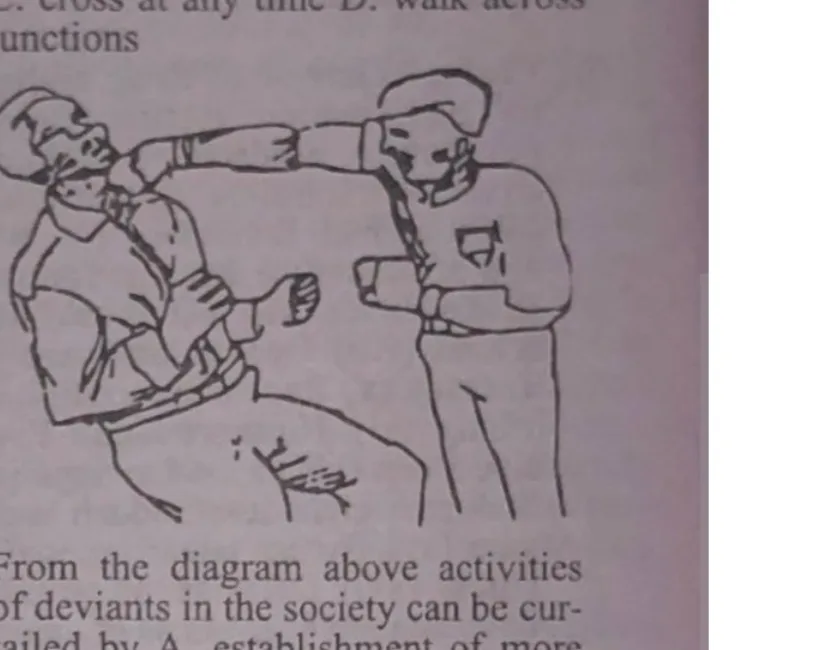
From the diagram above, activities of deviants in the society can be curtailed by
A. establishment of more prisonsB. ostracizing the deviants from the societyC. indulging the deviants with financial incentiveD. strengthening reformative institutionsCorrect Explanation Deviants in the society can be curtailed by strengthening reformative institutions that help reintegrate them into society.
The act of the deviants in the picture above contradicts the skills of
A. interpersonal relationshipCorrect B. entrepreneurshipC. inter-communal relationshipD. resolutionExplanation Fighting/assault as depicted in the diagram contradicts the skills of good interpersonal relationship.
One of the skills that can be used in resolving inter-communal conflicts is
A. coercionB. mediationCorrect C. suppressionD. harassmentExplanation Mediation is a non-judicial means/skill of resolving inter-communal conflict.
[From the dialogue: Johnson: Danladi, when are you leaving for school? Danladi: School? Johnson: Are you on break? Danladi: No, but the school has been closed down due to clash between rival cult groups. Johnson: What a terrible situation! I don't know when you are going to finish your Programme. You have already spent six years in school for a 4-year programme due to frequent closure and compulsory breaks. So what will you be doing at home while the closure lasted? Danladi: Roaming the street, visiting friends and attending social functions of course. Johnson: You better engage yourself in a productive venture such as learning a new language, entrepreneurial skills, and volunteer services and so on.] From the above dialogue, it is evident that cultism disrupts activities in the
A. familyB. schoolCorrect C. societyD. clubExplanation From the dialogue, it is evident that cultism disrupts activities in the school (leading to frequent closures).
From the above dialogue, which of the following is likely to happen if cultism is eradicated from our campuses?
A. uninterrupted school programmeCorrect B. increase in the remuneration of staff of higher institutionsC. provision of scholarships for brilliant studentsD. Amicable resolution of disputes on campusesExplanation If cultism is eradicated from campuses, there would be uninterrupted school programmes, since a major cause of disruption (like Danladi's school closure) would be removed.
Which of the following is not responsible for cult activities in schools and colleges?
A. perceived injusticeB. satisfaction of membership aspirationsC. personal protectionD. preservation of cultural heritageCorrect Explanation Preservation of cultural heritage is not a reason responsible for cult activities in schools and colleges.
Drug abuse often leads to
A. sexually transmitted diseasesB. cancerous illnessC. psychiatric disorderCorrect D. incurable ailmentExplanation Drug abuse often leads to mental disorder (psychiatric disorder).
Use of hard drugs could best be curtailed through
A. compensationB. rehabilitationCorrect C. enlightenmentD. compromiseExplanation Rehabilitation curtails the use of hard drugs.
If an individual persists in the use of hard drugs, such individual is likely to exhibit
A. hostile attitude towards religious organizationsB. unfriendly disposition towards foreignersC. oppressive behaviorD. emotional illness and aggressionCorrect Explanation Persistence use of hard drugs leads to drug addiction which causes emotional illness and aggression.
Drug abuse can best be prevented in the society by
A. arresting and persecuting drug vendorsB. engaging in public enlightenmentCorrect C. canvassing capital punishment for drug peddlersD. prohibiting the sales of drugs at the motor parksExplanation Public enlightenment (awareness) prevents drug abuse.
Which of the following people suffer most in human trafficking?
A. girlsB. boysC. childrenCorrect D. adultsExplanation Children are main targets which comprises both male and female, and suffer most in human trafficking.
Which of the following is not a symptom of HIV/AIDS?
A. loss of appetite and weightB. unexplained feverish conditionC. infections that often resist treatmentD. systematic growth of the bodyCorrect Explanation Systematic growth of the body is not a symptom of HIV/AIDS.
Which of the following cannot motivate human trafficking?
A. povertyB. greedC. low self-esteemD. educationCorrect Explanation Education brings about enlightenment and exposure, so it cannot motivate human trafficking.
One way of being infected with HIV/AIDS is through
A. the use of unsterilized sharp objectsCorrect B. sitting close to HIV/AIDS infected personC. sharing clothes with HIV/AIDS infected personD. having handshake with people living with HIV/AIDSExplanation Unsterilized objects permit transmission of HIV/AIDS.
One of the preventive measures against the infection of HIV/AIDS is
A. membership of Red cross SocietyB. faithfulness to a partnerCorrect C. becoming a medical staffD. membership of campaign against AIDSExplanation Being faithful and loyal to one's partner prevents the infection of HIV/AIDS.
Which of the following is not a skill for practical living?
A. life coping skillB. manipulative skillC. artistic skillD. cybercrime skillCorrect Explanation Cybercrime skill is not a skill for practical/legitimate living.
Which of the following is not a reason for self-reliance?
A. creation of employment opportunitiesB. innovation and creativityC. diversification of the economyD. quest for white collar jobsCorrect Explanation Quest (search) for white collar jobs does not promote self-reliance.
In the constitution, the areas where both the federal and state governments exercise joint authority are on the
A. residual listB. concurrent listCorrect C. exclusive listD. reserved listExplanation Concurrent list are powers shared between the federal and state government.
Government is saddled with all the following responsibilities except
A. prevention of internal disturbancesB. protection of lives and propertiesC. promotion of individual developmentD. provision of all the needs of the citizensCorrect Explanation Government cannot provide all the needs of the citizens.
A major feature of representative democracy is
A. free and fair electionCorrect B. absolute application of lawC. civil liberty groupsD. enlightened electoratesExplanation Election is central to representative democracy.
A feature that distinguishes the 1979 Nigerian constitution from that of 1963 was the introduction of a
A. unitary system of governmentB. republicanismC. presidential system of governmentCorrect D. Westminster systemExplanation 1979 Nigerian constitution introduced presidential system while 1963 introduced republican system.
In a democracy, official opposition is allowed to
A. bring down the governmentB. pave way for military inventionC. make government accountableCorrect D. encourage crisis in a stateExplanation Official opposition serves as watchdog which makes government accountable.
The beauty of democratic system of government is that
A. the president has supreme powerB. political power resides in the peopleCorrect C. there is absence of exploitationD. political participation is limitedExplanation Popular sovereignty resides with the people in a democratic system.
[Use the passage below to answer question 39: One morning, Mr. Ojuri was on his way to a bank in his neighborhood to make inquiries. He was arrested for wandering and subsequently detained for seven days by the police without trial or access to his relatives.] From the above passage, it could be said that in a society where this incident happened, there is absence of
A. a court of lawB. rule of lawCorrect C. lawyers and solicitorsD. the pressExplanation Refusal to give access to trial or relatives indicates absence of rule of law in that society.
The following can be classified as forms of political apathy except
A. refusal to register and voteB. lack of interest in politicsC. refusal to rig in an electionCorrect D. nonchalant attitude towards politiciansExplanation Refusal to rig in an election is a positive attitude which cannot be regarded as a form of political apathy.
The notion of perceiving the involvement of people in politics as devilish connotes political
A. demonizationCorrect B. apathyC. degenerationD. discontentExplanation Perceiving the involvement of people in politics as devilish connotes political demonization.
The active involvement of people in the decision-making process in a state indicates political
A. indoctrinationB. participationCorrect C. struggleD. apathyExplanation Political/population means involvement of people in the decision making, i.e. participation.
A non-governmental organization that allows independent initiative of citizens is known as
A. civil societyCorrect B. pressure groupC. religious groupD. professional societyExplanation Civil society is a non-governmental organization that allows independent initiative of citizens.
The effective way by which government can ascertain public support and reaction is through
A. opinion leadersB. party membersC. campaignsD. electionsCorrect Explanation Election is a means of testing the popularity, support and reaction of people towards government.
The following are effects of political apathy except that it
A. affects the quality of livesB. leads to the enthronement of irresponsible leadersC. promotes free and fair electionsCorrect D. ensures non-availability of dividends of democracyExplanation Political apathy does not promote free and fair elections; rather it undermines them.
Which of the following is the best way through which citizens can participate in the politics of their country?
A. acquisition of higher degree in political scienceB. standing for elective positionsCorrect C. learning the art and science of political sagacityD. undergoing mentorship under prominent political leadersExplanation Standing for elective positions is a form of popular participation.
The public service is important for ensuring
A. continuity in governanceCorrect B. gender equalityC. professional equalityD. superiority of the pressure groupsExplanation The permanence status of public service promotes and ensures continuity in governance.
Political neutrality of civil servants means that they
A. do not engage in partisan politicsCorrect B. should not be seen or heardC. should not work with politiciansD. do not receive praises nor blames for their actionsExplanation Neutrality means civil servants do not partake in partisan politics.
The category of public service that has the closest contact with the political class is the
A. manipulative classB. administrative classCorrect C. clerical classD. technical classExplanation Administrative class is the highest cadre in civil service, with the closest contact with the political class.
In the public service, another name for red-tapism is
A. theocracyB. bureaucracyCorrect C. autocracyD. democracyExplanation Red-tapism is otherwise known as bureaucracy.
Sign up free to unlock …and/or go further with premium services and No Ads .