Free account: track your progress — Sign up free

WAEC Commerce 2024 Theory Past Questions

All 8 questions from the West African Examinations Council (WAEC) Commerce 2024 Theory paper, with the correct answer and a full explanation for each. Free, no signup needed.

Advertisement

Commerce 2024 Theory — Question 1

1. ABC Breweries Limited started operations with production, finance, marketing and administration departments. The following personnel were in its employment: General manager; Finance manager; Personal secretary; Accounts officers; Marketing manager; Production manager; Production supervisors; Factory workers; Sales agents; Administrative manager; Administrative officers. (a) Draw an organizational chart for ABC Breweries Limited. (b) State two functions of each of the departments in the company.
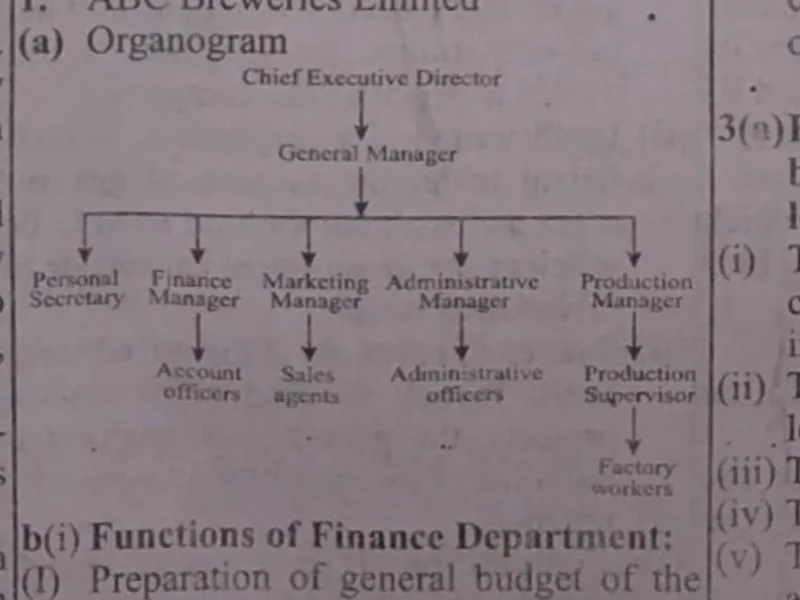
Diagram for question 1

Model answer

(a) See the organogram in the Diagrams column: Chief Executive Director -> General Manager -> Personal Secretary, Finance Manager, Marketing Manager, Administrative Manager, Production Manager -> (under Finance) Account officers; (under Marketing) Sales agents; (under Administrative) Administrative officers; (under Production) Production supervisors -> Factory workers. (b) Function of Finance Department: (i) Preparation of general budget of the company; (ii) Preparation of payrolls of employees. Function of Marketing Department: (i) Creating awareness for the product of the company; (ii) Conducting marketing research for the product of the company. Function of Administrative Department: (i) Keeping records of the company; (ii) Running day to day activities of the company. Function of Production Department: (i) Ensuring safety in the organization; (ii) Contains production of goods/products of the company.

Commerce 2024 Theory — Question 2

2(a) List five contents of a Memorandum of Association and five contents of an Articles of Association. (b) Explain five problems faced by public corporations.

Model answer

(a) Contents of Memorandum of Association: (i) Name of the company; (ii) Registered address of the company; (iii) Main objective of the company; (iv) The authorized shares of the company; (v) Names of the promoters of the company. Content of Articles of Association: (i) It states the structure of the company; (ii) The regulation of the company; (iii) Other objectives of the company; (iv) Structure of shares of the company; (v) Powers and duties of directors of the company. (b) Problems of public corporation: (i) Inadequate funding: most public corporations are not adequately funded, since it is not run for profit, thus there is a limit to the funding. (ii) Inefficiency: most public corporations are inefficient because the people that manage them are politically appointed. (iii) Political interference: most public corporations do not enjoy independence; politicians interfere which may affect efficiency. (iv) Poor attitude of staff to work: most workers in public corporations see the corporation as no man's business and thus are not effective at work. (v) Political instability: change of government too can affect effectiveness, efficiency and continuation of public corporation; all depend on the attitude of the government in power.

Commerce 2024 Theory — Question 3

3(a) State five factors a bank manager would consider before granting a loan to a young school leaver. (b) State five conditions that will make a bank to dishonour a customer's cheque.

Model answer

(a) Factors a bank manager may consider: (i) The nature of business which the receiver of the loan wants to venture into; (ii) The collateral presented by the school leaver; (iii) The brilliance of the school leaver; (iv) The guarantor of the school leaver; (v) The past experience of the banker about the school leaver in the community he is operating. (b) Conditions for dishonouring cheques: (i) Irregularities on the cheque; (ii) When the bank receives an order from the issuer to dishonour it; (iii) Suspicion feeling about the payee; (iv) When the cheque has stale; (v) Lack of reliable means of identification.

Commerce 2024 Theory — Question 4

4(a) State five features of itinerant trade. (b) State five features of a supermarket.

Model answer

(a) Features of itinerant trade: (i) It usually involves small capital to start; (ii) No shop is required; (iii) The trader may need means of transportation from place to place; (iv) Most times, all his goods are always with him; (v) It is usually a small business. (b) Features of a supermarket: (i) It is a self-service shop; (ii) It stores a wide variety of goods; (iii) It encourages impulse buying; (iv) It has trolleys for buyers; (v) It is usually a one-stop shop.

Commerce 2024 Theory — Question 5

5(a) Differentiate between the following: (i) a factor and a broker; (ii) a stock exchange and a commodity exchange. (b) Explain the following terms as used in the commodity market: (i) open outcry; (ii) futures contract; (iii) clearing system; (iv) pit outcry.

Model answer

(a)(i) A factor is an agent or an intermediary that provides finance to companies or persons who are willing to sell off their shares usually at loss than the value of the share, meanwhile a broker is a person that acts as an intermediary between an investor and a security exchange while buys, a broker only creates a link. (ii) A stock exchange is the market where shares of companies can be bought and sold at market prices while a commodity exchange is the market where commodities gotten from natural sources such as grains and gold are bought and sold. (b)(i) Open outcry: this involves indicating interest to buy or sell by communicating orders or raising hands or calling on traders in the market that you are willing to sell or buy. (ii) Futures contract: this involves a legal agreement to buy or sell a particular commodity at a predetermined price at a specified date in the future. (iii) Clearing system: this is the process of settling transactions between banks, e.g. if customer of bank A presents its cheque in bank B, the banks (A and B) have to settle one another. This settlement is referred to as clearing system. (iv) Pit outcry: this is a situation in which buyers and sellers shout out their bids in the floor of the market.

Commerce 2024 Theory — Question 6

6(a) State factors that can lead to cancellation of contracts. (b) State the essential elements of contracts.

Model answer

(a) Factors that can lead to cancellation of contracts: (i) Death of one of the parties to the contract: if one of them dies, they can cancel the contract. (ii) Frustration: if a party finds it practically impossible to supply or is faced by natural challenges such as flood, he will be frustrated and the contract can be cancelled. (iii) Failure on the part of a trading party to pay consideration or part of it as at when due. (iv) Breach of an agreement by one of the parties as related to the contract can also lead to cancellation of the contract. (b) Essential elements of contracts: (i) Offer: this involves an agreement by a party to the contract to execute or go into the contract. (ii) Acceptance: this has to do with the act of the other party (not the one that made an offer) agreeing to the terms proposed. (iii) Consideration: this is the amount or cost implication accepted by both parties to the contract. (iv) Capacity: this involves the ability of each party to carry out its own obligation of the contract.

Commerce 2024 Theory — Question 7

7(a) Differentiate between deregulation and commercialization. (b)(i) Name the policy the government of country Z wishes to adopt (to sell its transport company). (ii) Explain five reasons which could have necessitated the government's course of action.

Model answer

(a) Deregulation involves allowing the market or seller of a product to determine the price with which they will sell their product while commercialization involves converting a non-profit-making corporation to a profit-making corporation. (b)(i) Privatization. (ii) Reasons for privatization: (I) Liability of government to continue to fund the corporation: when the government becomes unable to fund the corporation, the government can decide to privatize the company. (II) Inefficiency: if a corporation is inefficient under the auspice of government and such corporation needs to be efficient, the government can decide to privatize as well. (III) Source of revenue: if the government needs money to fund some critical projects, the government can privatize some of its corporations to generate revenue. (IV) Competition: if government intends to promote competition in a sector or an industry, the government can sell its shares in the industry to private owners. (V) Corruption in a corporation can also make the government to privatize a corporation.

Commerce 2024 Theory — Question 8

8. The following information was extracted from the books of XYZ Ventures as at 31st June 2023: Opening stock Le200,000; Closing stock Le100,000; Salaries and wages Le120,000; Purchases Le900,000; Shop rent Le150,000. 30% profit was made on cost of goods sold. You are required to calculate: (a) cost of goods sold; (b) gross profit; (c) total sales; (d) net profit; (e) rate of turnover.

Model answer

(a) Cost of goods sold: Opening stock 200,000 + Purchases 900,000 = Cost of goods available for sale 1,100,000. Less closing stock 100,000 = Cost of goods sold Le1,000,000. (b) Gross profit = 30% of cost of goods sold = 30% x Le1,000,000 = Le300,000. (c) Total sales = Cost of goods sold + Gross profit = Le1,000,000 + Le300,000 = Le1,300,000. (d) Net profit: Gross profit Le300,000. Less expenses (Salaries and wages Le120,000 + Shop rent Le150,000 = Le270,000). Net Profit = Le300,000 - Le270,000 = Le30,000. (e) Rate of turnover = Cost of goods sold / Average stock. Average stock = (Opening stock + Closing stock)/2 = Le(200,000+100,000)/2 = Le150,000. Rate of turnover = Le1,000,000/Le150,000 = 6.67 times.

Advertisement

Sign up free to unlock

  • Score tracking
  • Practice history
  • Saved questions
  • Progress dashboard
  • Personalized sessions
  • Weak-topic breakdown

…and/or go further with premium services and No Ads.