All 24 questions from the West African Examinations Council (WAEC) Commerce 2025 Theory paper, with the correct answer and a full explanation for each. Free, no signup needed.
1(a) Distinguish between manufacturing and construction.
Model answer
Manufacturing involves the conversion of raw materials or semi-finished goods into semi-finished or finished goods, while construction involves adding inputs (raw or finished) together to form a bigger structure. In manufacturing, the output is usually smaller in scale compared with construction, whose output is usually much bigger.
i. It is relatively convenient for buyers as they can order items from the comfort of their homes.
ii. It is cheaper as the buyer avoids the cost of transportation to visit the seller physically.
iii. It makes feedback easy as buyers and sellers can interact through an established online platform.
iv. It reduces the cost of handling packages on the part of the seller.
i. Commerce facilitates the buying and selling of goods and services.
ii. It promotes business development as more media of buying and selling are expanded over time.
iii. It plays a vital role in economic development by promoting trade and aids to trade.
iv. It creates a wide range of jobs for the people.
2(a)(i) Differentiate between cartel and consortium.
Model answer
A cartel is a situation where two or more firms come together to regulate the output of members, while a consortium is a situation where two or more firms come together to execute a particular project, with each firm handling what it does best.
2(a)(ii) Differentiate between holding company and subsidiary company.
Model answer
A holding company is a company that owns a significant share of another company's capital — e.g. Company A is a holding company of Company B if it holds significant shares in B. A subsidiary company is a company that has a parent company; it is more or less an off-shoot of the parent — e.g. Company X is a subsidiary of Company Y if Y funds X's capital.
2(b) Abu and Saul are sole proprietors. Abu suggested to Saul that their businesses be merged into a partnership.
(i) List four sources of finance that could be available to the partnership.
Model answer
I. Loans from the partners, Abu and Saul.
II. Capital contribution of Abu and Saul.
III. Loans from commercial banks to the partnership business.
IV. Credit sales to the business.
2(b)(ii) State four reasons Saul may be reluctant to accept the merger proposal.
Model answer
i. If the capital contribution of the other partner is deemed insignificant.
ii. If the other business does not have a sufficient customer base to improve the revenue of the partnership.
iii. If Saul does not see Abu's business as a threat to his own, he may decline the proposal.
iv. If Saul has many alternative sources of capital to fund his business, he may also decline the proposal.
3. Country X established a Council tasked with increasing the sale of local products in foreign markets.
(a) Name the organization formed by Country X.
Model answer
The organization formed is the X Export Promotion Council (X-EPC).
3(b) State four functions the organization would perform.
Model answer
i. Provision of both financial and technical support for exporters.
ii. Identifying foreign market opportunities and relating them to exporters.
iii. Assisting exporters to improve the quality and standard of their products.
iv. Assisting exporters to handle administrative bottlenecks involved in exporting.
3(c) State five reasons Country X engages in foreign trade.
Model answer
i. To expand markets for its locally produced goods.
ii. Comparative cost advantage — countries trade with others that produce a commodity at a lower cost than their own.
iii. Countries are endowed with different resources, so to meet local demand they trade with countries that have what they lack.
iv. Economies of scale of production differ from country to country, prompting countries to engage in foreign trade.
v. Differences in technological know-how make a country engage in foreign trade.
4(a) State five reasons for the survival of small retail businesses.
Model answer
i. Consistent assistance from family and friends in the form of loans.
ii. Government's quick intervention in supporting small businesses with grants/tokens.
iii. A high rate of turnover keeps cash flow consistent for small businesses.
iv. High demand from the local community for retail items gives small businesses an edge to continue in existence.
v. Small businesses are easy to set up.
4(b) Outline five ways a country can correct its balance of payment deficit.
Model answer
i. By selling government investments abroad.
ii. Seeking loans from international organisations.
iii. Placing a quota on imports to reduce the quantity of items imported into the economy.
iv. Devaluing the local currency to make imports more expensive.
v. Pursuing export promotion to improve the quantity of exports.
5. Felisco Ltd, a raincoat manufacturing company, intends to gain patronage from its customers by offering a discount once a year when demand is low.
(a) Name the type of discount the company could offer.
5(b) State four reasons the company would offer such a discount.
Model answer
i. A quantity discount encourages people to buy more.
ii. It indirectly increases demand for the company's product.
iii. The cost of production may reduce due to economies of scale.
iv. It increases the revenue and total profits of the company.
i. It helps the government to generate revenue.
ii. It prevents the smuggling of goods into the country.
iii. It ensures that contraband goods and arms are not imported into the country.
iv. It helps regulate the volume of goods imported into the country.
v. It assists in protecting the border of the country.
6(b) State five measures the central bank could use to regulate the activities of other banks.
Model answer
i. Reserve requirement: the central bank sets a high or low reserve requirement for other banks to regulate their ability to give loans. A high requirement means banks can give out less credit, and vice versa.
ii. Discount ratio: the percentage the central bank charges commercial banks for money kept with it. Raising it attracts more money away from commercial banks, and vice versa.
iii. Moral suasion: the central bank persuades commercial banks on how to manage liquidity to prevent an over-liquid economy.
iv. Special deposit: the central bank can mandate commercial banks to make a special deposit with it to cater for emergencies.
v. Recapitalization: the central bank can set a high capital base for commercial banks in order to fizzle out weak banks.
Marketing can be defined as all the activities of a company aimed at promoting the buying of its products or services. It involves gathering market information, analyzing that information, and using it to make an informed decision that will promote the company's product to the public.
i. Gathering information about market needs, enabling a company to design a product that satisfies such needs.
ii. Promotion of an already existing product or service in order to maximize sales.
iii. Pricing — setting an appropriate price for the product that will attract buyers and maximize the company's returns.
Exhibition is the act of displaying a product or service for sale. It indicates that the company is ready to enter into contracts that will lead to the sale of the product or service.
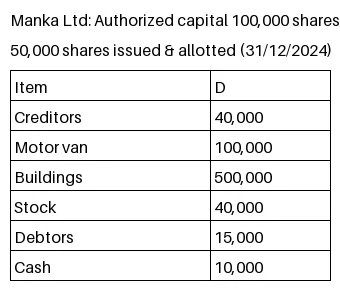
8. Manka Ltd. had an authorized capital of 100,000 shares of D40 each, out of which 50,000 shares were fully subscribed and allotted as at December 31, 2024. Other assets and liabilities were: Creditors D40,000; Motor van D100,000; Buildings D500,000; Stock D40,000; Debtors D15,000; Cash D10,000.
You are required to calculate:
(a) issued capital; (b) unissued capital; (c) total assets; (d) working capital.
Model answer
(a) Issued capital = Price per share × Number of shares issued = D40 × 50,000 = D2,000,000
(b) Unissued capital = Price per share × Number of unissued shares = D40 × 50,000 = D2,000,000
(c) Total assets = D(100,000 + 500,000 + 40,000 + 15,000 + 10,000) = D665,000
(d) Working capital = Current assets − Current liabilities = D(40,000 + 15,000 + 10,000) − D40,000 = D25,000
Advertisement
Sign up free to unlock
Score tracking
Practice history
Saved questions
Progress dashboard
Personalized sessions
Weak-topic breakdown
…and/or go further with premium services and No Ads.