All 9 questions from the West African Examinations Council (WAEC) Economics 2012 Theory paper, with the correct answer and a full explanation for each. Free, no signup needed.
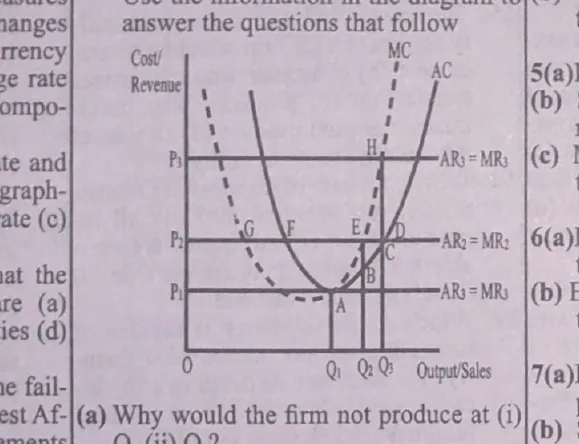
The diagram below represents the cost and revenue situation of a firm. Use the information in the diagram to answer the questions that follow.
[Diagram: Cost/Revenue axis vs Output/Sales axis, showing MC and AC curves, with three price/output levels P3 (AR3=MR3) at output Q1, P2 (AR2=MR2) at output Q2/Q3, and P1 (AR1=MR1), with points labelled G, F, E, D, H, A, B, C.]
(a) Why would the firm not produce at (i) Q1, (ii) Q3?
(b) How much profit does the firm make at P2?
(c) If price falls to P1: (i) What quantity would the firm produce? (ii) What type of profit does the firm make? (iii) Explain your answer in (c)(ii).
(d) In which type of market is the firm operating?
Model answer
(a)(i) At Q1, price P3 is above the point where MC=MR at the profit maximizing output, and the firm has not reached the output level that minimizes average cost/maximizes profit — producing at Q1 would not maximize profit since it is not where MC intersects MR at the correct level.
(ii) At Q3 (beyond the profit-maximizing point where MC=MR), marginal cost exceeds marginal revenue, so producing further reduces profit rather than increasing it.
(b) At price P2, the firm produces at output Q2 where MC=MR (point E/D). Profit = (P2 − Average Cost at Q2) × Q2, represented by the rectangle/area bounded by points G, F, E, D on the diagram — this is the abnormal/supernormal profit made at P2.
(c)(i) If price falls to P1, the firm would produce at the output level where P1=MC=AR1=MR1 (the point where the AC curve is tangent to the price line).
(ii) At P1, the firm makes normal profit only.
(iii) This is because at P1, price equals average cost exactly (AR=AC), so total revenue just covers total cost, leaving no abnormal/supernormal profit — only normal profit (which is already included within the cost curve).
(d) The firm is operating in a monopolistically competitive or perfectly competitive market structure, given the presence of a U-shaped average cost curve and price-taking behaviour typical of firms operating under such market structures in the short and long run.
3. Explain how the following factors will affect the demand for a commodity x: (a) a decrease in the price of a supply of a substitute P; (b) an increase in consumers' disposable income; (c) a decrease in the supply of a substitute P; (d) an increase in income tax.
Model answer
(a) A decrease in the price of substitute P will lead to an increase in the demand for P and a decrease in the demand for commodity x, as consumers switch to the now-cheaper substitute.
(b) An increase in consumers' disposable income will generally lead to an increase in demand for commodity x (assuming x is a normal good), since consumers have more money available to spend.
(c) A decrease in the supply of substitute P will lead to an increase in the price of P, which in turn will lead to an increase in the demand for commodity x, as consumers switch away from the now-scarcer/costlier substitute.
(d) An increase in income tax will reduce consumers' disposable income, which will therefore lead to a decrease in demand for commodity x (assuming it is a normal good).
4. (a) State and explain the law of comparative cost advantage.
(b) Give two limitations of the law as a theory of international trade.
Model answer
(a) The law of comparative cost advantage states that a country should specialize in the production of the commodity(ies) in which it has a comparative (relative) cost advantage, i.e. where it can produce at a lower opportunity cost relative to other countries, even if it does not have an absolute advantage in producing any commodity. By specializing according to comparative advantage and trading, both countries can gain more than they would through self-sufficiency.
(b) Limitations of the law: (i) The theory assumes that there are only two countries and two commodities involved in trade, which is unrealistic in the real world where many countries and commodities are involved. (ii) It assumes that there is no transportation cost between the two countries, which is unrealistic since the cost of moving goods from one country to another is significant and can offset the gains from specialization. (iii) It assumes perfect mobility of factors of production within a country and immobility between countries, which does not always hold. (iv) It ignores the possible effects of economies of scale and technological differences.
5. (a) Define money.
(b) State the three motives for holding money.
(c) Mention two determinants of each of the motives for holding money.
Model answer
(a) Money is anything generally acceptable as a medium of exchange in a society.
(b) The three motives for holding money according to John Keynes are: (i) Transactionary motive: Demand for money to be held for unforeseen contingencies and services. (ii) Precautionary motive: demand for money to cater for daily transaction in goods and services, and for unforeseen contingencies. (iii) Speculative motive: Demand for money for investment opportunities.
(c) Determinants of the motives: Transactionary: (1) Consumers' income level, (2) frequency of income/wage payments. Precautionary: (1) Level of income, (2) uncertainty of future needs. Speculative: (1) Interest rate, (2) expectations about future prices of financial assets.
6. (a) Distinguish between economic activities and an economic system.
(b) Explain the following terms: (i) production; (ii) distribution; (iii) consumption.
Model answer
(a) Economic activities are activities that lead to creation of utility. People perform economic activities and they are paid for it. They earn their living through it. While economic system refers to the arrangements that define ownership and control of means of production in a society.
(b)(i) Production is the process of creation of utility i.e. any activity which leads to creation of utility.
(ii) Distribution is the process of moving the goods to the consumer through the channel called distribution channel. It can also mean the distribution of national income among the factors of production used to produce it.
(iii) Consumption is the act of using goods and services to satisfy wants.
7. (a) Define (i) elasticity of demand; (ii) price elasticity of demand.
(b) State any four determinants of price elasticity of demand.
(c) Draw curves illustrating: (i) fairly elastic demand; (ii) perfectly inelastic demand.
Model answer
(a)(i) Elasticity of demand refers to the degree of responsiveness of quantity demanded of a commodity to a change in one of the determinants of demand.
(ii) Price elasticity of demand is the degree of responsiveness of quantity demanded of a commodity to a change in the price of the commodity.
(b) Determinants of price elasticity of demand: (i) Availability of substitutes, (ii) proportion of income spent on the commodity, (iii) necessity/luxury nature of the good, (iv) time period considered.
(c) (i) A fairly elastic demand curve is a relatively flat (gently sloping) downward curve on a price-quantity graph. (ii) A perfectly inelastic demand curve is a vertical straight line on a price-quantity graph, showing that quantity demanded does not change regardless of price.
8. (a) Define market in economics.
(b) State any three features of a monopoly.
(c) Outline any three sources of monopoly power.
Model answer
(a) A market in economics refers to any arrangement where buyers and sellers of a commodity relate/interact for the purpose of exchange, not necessarily a physical location.
(b) Features of a monopoly: (i) There is only one seller/producer of the commodity. (ii) The commodity has no close substitutes. (iii) There are barriers to entry into the industry, preventing other firms from competing.
(c) Sources of monopoly power: (i) Legal backing (patent right/licence). (ii) Control of a key/scarce resource needed for production. (iii) Large economies of scale that make it uneconomical for new firms to enter.
9. (a) With the aid of a diagram, explain a minimum price.
(b) State any five measures by which a minimum price for an agricultural produce can be made effective.
Model answer
(a) A minimum price is a price fixed by the government above the equilibrium market price, usually to protect producers (e.g. farmers) from receiving too low a price for their produce. On a demand-supply diagram, the minimum price is set above the equilibrium price, resulting in quantity supplied exceeding quantity demanded at that price — i.e. it creates a surplus (excess supply).
(b) Measures to make a minimum price effective: (i) The government must be willing to buy up the resulting surplus produce. (ii) The government can restrict supply (e.g. through quotas) to keep the price up. (iii) Provision of storage facilities to keep the surplus produce before use. (iv) Government subsidies to producers to encourage compliance. (v) Enforcement/monitoring to prevent the produce from being sold below the fixed minimum price.
10. (a) What is a supply schedule?
(b) Using an example, show how a market supply schedule is obtained from individual supply schedules.
(c) State three examples of exceptional supply.
Model answer
(a) A supply schedule is a table showing the different quantities of a commodity that producers are willing and able to supply at various prices, over a given period of time.
(b) A market supply schedule is obtained by horizontally summing (adding together) the quantities that each individual producer is willing to supply at each given price. For example, if at a price of ₦100, producer A supplies 10 units and producer B supplies 15 units, then the market supply at ₦100 is 25 units (10+15), and this is repeated at each price level to build the full market supply schedule.
(c) Examples of exceptional supply (where the supply curve does not follow the normal upward-sloping pattern): (i) Supply of perishable goods (fixed/limited supply regardless of price in the very short run). (ii) Supply of labour at very high wage rates (backward-bending supply curve). (iii) Supply of antiques or rare works of art (fixed supply, cannot be increased regardless of price).
Advertisement
Sign up free to unlock
Score tracking
Practice history
Saved questions
Progress dashboard
Personalized sessions
Weak-topic breakdown
…and/or go further with premium services and No Ads.