All 50 questions from the West African Examinations Council (WAEC) Economics 2019 Objective paper, with the correct answer and a full explanation for each. Free, no signup needed.
The fundamental economic problem in every society is
A. the large number of the unemployed
B. inadequate supply of money
C. corruption and mismanagement
D. limited supply of productive resourcesCorrect
Explanation
Scarcity is the basic economic problem faced by every society, defined as the limitation in the supply of productive resources relative to unlimited wants.
A point X inside a production possibility curve indicates that
A. resources are fully utilized
B. the country is poor
C. some resources are idleCorrect
D. resources are not available
Explanation
A point inside the PPC always indicates underutilization (idle/unemployed resources), while a point on the curve indicates optimal, fully efficient utilization of resources.
The market (capitalist) economy focuses mainly on enriching providers of capital, so profit maximization is the main driving focus of a market economy.
If the coefficient of price elasticity of demand of a product is zero, then its demand curve will be
A. parallel to the quantity axis
B. parallel to the price axisCorrect
C. negatively sloped
D. positively sloped
Explanation
A zero coefficient of price elasticity means the product is perfectly inelastic — quantity demanded does not change however price changes — giving a demand curve that runs parallel (vertical) to the price axis.
Coffee and tea are competitive (substitute) goods: if the price of one rises, the quantity purchased of that good falls while the quantity purchased of the other rises.
What effect will an increase in the supply of fish have on the meat market?
A. a fall in equilibrium price and quantityCorrect
B. An increase in equilibrium price and quantity
C. an increase in equilibrium price and quantity
D. Both equilibrium price and quantity remain unchanged
Explanation
Fish and meat are competitive (substitute) goods. If the supply of fish rises, its price falls, causing consumers to switch from meat to fish; meat sellers must then reduce their price too, resulting in a fall in the equilibrium price and quantity of meat.
Which of the following factors is not a condition for a change in supply of a commodity?
A. improved technology
B. cost of production
C. the price of the commodityCorrect
D. Government tax policies
Explanation
A change in the price of the commodity itself causes a movement along the supply curve (change in quantity supplied), not a shift of the whole supply curve (change in supply), which is instead caused by technology, cost, or government policy.
C. increase in quantity of X leads to decrease in Y
D. X and Y cannot be produced in the same process
Explanation
A joint supply is a situation where two or more products are produced together from a single process, such that one product is a by-product of the other (e.g. beef and hide from cattle).
When the price of a good is above the equilibrium, there will be
A. a shortage
B. a surplusCorrect
C. unemployment
D. inflation
Explanation
When price is above equilibrium, suppliers are willing to supply more while consumers are willing to buy less, creating excess supply (a surplus) in the market.
What happens when a minimum price is imposed in a market?
A. A shortage occurs
B. surplus occursCorrect
C. the market maintains its equilibrium
D. Many firms will close down
Explanation
A minimum price is normally set above the equilibrium price, which results in a surplus, since suppliers are willing to sell more than consumers are willing to buy at that higher price.
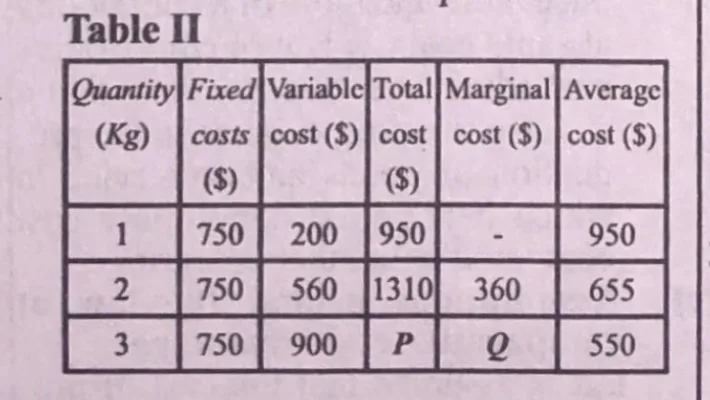
[See Table II: short-run cost of a firm — Quantity(Kg) 1,2,3; Fixed costs($) 750,750,750; Variable cost($) 200,560,900; Total cost($) 950,1310,P; Marginal cost($) –,360,Q; Average cost($) 950,655,550]
Calculate the value of Q.
A. $350
B. $340Correct
C. $360
D. $370
Explanation
Total cost at quantity 3 (P) = Fixed cost + Variable cost = 750+900 = $1650. Marginal cost (Q) = Total cost at Q3 − Total cost at Q2 = 1650 − 1310 = $340.
A cost of production that is positively related to output is the
A. total fixed cost
B. average fixed cost
C. variable costCorrect
D. social cost
Explanation
Variable cost is directly related to the level of output: the higher the output produced, the higher the variable cost (and hence total cost) of production.
In perfect competition, the average revenue curve of a firm is
A. below the marginal revenue curve
B. downward sloping
C. the marginal revenue curveCorrect
D. convex to the origin
Explanation
In perfect competition, price is fixed for the firm (a price taker), so the average revenue (AR) curve and marginal revenue (MR) curve coincide — AR is the same as the MR curve.
Government in most cases influences location of a firm to
A. discourage private investors
B. ensure equitable distributionCorrect
C. reduce cost of production
D. make the firms enjoy economies of scale
Explanation
Government often influences where firms locate in order to ensure a more equitable distribution of industry and economic activity/benefits among its citizens.
Producers and final consumers themselves are never the middlemen. Middlemen are those who join the producers and consumers in the distribution chain — wholesalers, retailers and hawkers.
The Malthusian theory of population was proved wrong because
A. the practice of subsistence farming was encouraged
B. developing countries adopted birth control method
C. new lands and new methods of production were discoveredCorrect
D. Malthus' view was seen as an exaggeration
Explanation
The Malthusian theory is considered myopic because it failed to forecast the advancement in technology and the discovery of new lands/methods of production, which have allowed food supply to keep pace with population growth.
C. general education and training is encouragedCorrect
D. it is handled by the private sector only
Explanation
Human development is fundamentally about improving people's skills and abilities. Promoting general education and training directly improves the human development index.
A. educational institutions are established in rural areas
B. commercial banks are established in rural areas
C. more infrastructural facilities are provided in rural areasCorrect
D. labour intensive method of agriculture is encouraged
Explanation
Providing more infrastructural facilities (roads, storage, irrigation, etc.) in rural areas improves agricultural productivity; it also helps check rural-urban migration by making rural facilities comparable to urban ones.
A. the contributions of industries to national income is highCorrect
B. traditional and modern sectors coexist
C. the country adopts import promotion strategy
D. primary industries dominate the economy
Explanation
A country is industrialized when its industries make a significant/high contribution to national income (GDP), reflecting a shift away from dependence on primary production alone.
Which of the following is a major advantage of establishing a tomato-processing factory in a country?
A. local consumption will decrease
B. more unskilled labour will be employed
C. foreign exchange will be conservedCorrect
D. it will attract more tourists
Explanation
When a local industry produces what would otherwise be imported/exported, foreign exchange is conserved since the country relies less on foreign sources for that product.
Which of the following items is not considered as a transfer payment?
A. pension pay
B. Government subsidy
C. students grants
D. Doctor's salaryCorrect
Explanation
A transfer payment is income received without a corresponding good or service being provided in return (e.g. pensions, subsidies, grants). A doctor's salary, by contrast, is income that is earned through work.
Which of the following factors will not underestimate the national income?
A. rapid decrease in prices
B. increased subsistence production
C. practice of specialization of labour
D. increase in value of services not paid forCorrect
Explanation
Unpaid services are not captured in national income accounting, so increases in unpaid services worsen underestimation of national income; the WAEC key associates this specifically with option D.
Which of the following is true of the value of money? It
A. is positively related to the price level
B. depends on the value people attach to it
C. is determined by the government
D. is inversely related to the price levelCorrect
Explanation
The value of money and the general price level move in opposite directions — as prices rise, the purchasing power (value) of money falls, and vice versa.
The motive for holding money to meet unforeseen events is termed
A. precautionary demandCorrect
B. transactions demand
C. liquidity demand
D. speculative demand
Explanation
The precautionary motive for holding money is the desire to keep money on hand to meet unforeseen contingencies such as sickness, accidents, or emergencies.
Insurance companies are similar to commercial banks in that they
A. compensate their customers for losses
B. act as lender of last resort
C. help in maintaining monetary stability in a nationCorrect
D. help in mobilizing savings for investment
Explanation
Both insurance companies and commercial banks are financial institutions that help mobilize and channel savings into productive investment, contributing to monetary/financial stability.
What happens when the central bank increases the bank rate?
A. Amount of borrowing increases
B. Amount of borrowing decreasesCorrect
C. supply of money increases
D. commercial banks are not affected
Explanation
The bank rate is the rate the central bank charges commercial banks for loans. When it is increased, commercial banks reduce their borrowing (and pass on higher rates to the public), decreasing the overall amount of borrowing.
Citizens are protected from government's arbitrariness in taxation by the canon of
A. elasticity
B. flexibilityCorrect
C. economy
D. certainty
Explanation
The canon of certainty ensures a taxpayer knows exactly what they are due to pay and when, protecting citizens from arbitrary/unpredictable taxation by government.
In a period of unemployment and falling prices, governments should adopt a
A. zero-based budget
B. budget deficitCorrect
C. balanced budget
D. surplus budget
Explanation
Unemployment and falling prices indicate deflation. To revive the economy, government must pump more money in by spending more than it earns — i.e. running a deficit budget.
In most underdeveloped countries, development plans do not achieve their objective due to
A. poor coordination between local and national governments
B. exportation of more primary products
C. lack of educational institutions in those countriesCorrect
D. Urban-rural migration of citizens
Explanation
Excess rural-urban migration leads to over-dependence on city infrastructure and neglect of rural development, which undermines the achievement of national development plans.
Balance of trade specifically measures the difference between a country's receipts from and payments for tangible goods (visible trade) only — not services.
An improvement in a country's term of trade means that
A. the nation can export more services
B. nation's receipts on export is equal to payments on imports
C. value of her imports is lower than her exportsCorrect
D. visible exports is less than visible imports
Explanation
Terms of trade measures the rate at which a country's exports pay for its imports. An improvement means the country's exports have become more valuable relative to its imports.
Devaluation of currency may not correct a balance of payments deficit if the demand for export is
A. perfectly inelastic
B. perfectly elasticCorrect
C. fairly elastic
D. unitary elastic
Explanation
If export demand is perfectly elastic, price is essentially fixed by the world market and a change in price (from devaluation) has no effect on quantity purchased, so devaluation cannot correct the deficit in this case.
Exploitation of forest resources becomes a major problem where
A. communities fight over ownershipCorrect
B. they are not renewed
C. they are neglected
D. the supply is fixed in the long-run
Explanation
When there is a land/forest ownership tussle among communities, it becomes difficult to exploit the forest, since the dispute creates fear/uncertainty among those willing to invest in exploiting the resource.
Natural resources that are renewable are found in the
A. mining sector
B. agricultural sector
C. traditional sectorCorrect
D. secondary sector
Explanation
Per the WAEC answer key, renewable natural resources are associated with the traditional sector (e.g. traditional/subsistence farming, forestry and fishing activities that regenerate naturally).
Advertisement
Sign up free to unlock
Score tracking
Practice history
Saved questions
Progress dashboard
Personalized sessions
Weak-topic breakdown
…and/or go further with premium services and No Ads.